
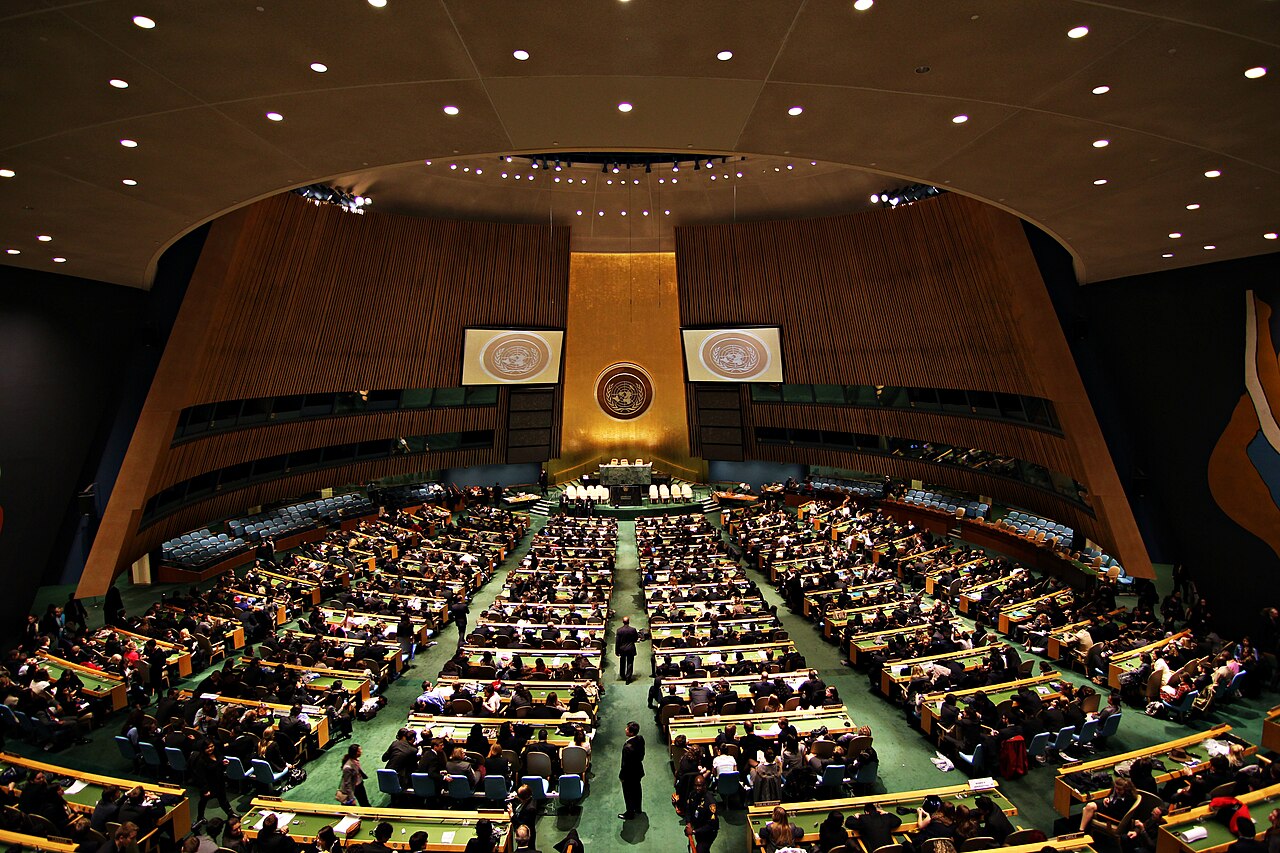
As Trump attacked the ICC and Netanyahu faced a walkout at the UN, forty states gathered to put an arms embargo, protections for the Court and a new UN mechanism modelled on the Special Committee against Apartheid.
Last week, the United Nations Conference on Trade and Development (UNCTAD) counted what remained of Gaza’s economy after almost three years of genocide and almost two decades of siege. Ninety-two per cent of its economic establishments have been damaged or destroyed. Unemployment has reached 78 per cent. GDP per person fell to $212 last year — barely 17 per cent of its pre-genocide level — while less than 1.5 per cent of Gaza’s cropland remains accessible and undamaged. Recovery and reconstruction will cost at least $71.5 billion. Pedro Manuel Moreno, acting head of UNCTAD, called it “the world’s most severe economic crisis on record”.
These were the conditions in which the governments of the world assembled in New York for the 81st United Nations General Assembly. On Monday 21 September, a thousand gathered at Riverside Church to celebrate the Charter on which the institution was founded, hosted by South Africa. Martin Luther King Jr stood in the same church in 1967 to deliver Beyond Vietnam. Nelson Mandela came there four months after his release from prison and thanked the movements that had sustained sanctions against apartheid — before urging them to keep up the pressure until victory was secured. “We acted because we know what global solidarity can do,” South African Foreign Minister Ronald Lamola told the gathering. The Hague Group, he said, embodies a “shared conviction that concrete action is needed.”
A day later, Donald Trump used the General Assembly podium to attack the International Criminal Court. He called it an “evil” and “rogue institution” and urged its 125 member states to withdraw. His administration has already imposed financial sanctions and visa restrictions on ICC officials and threatened further measures that could stifle the Court’s ability to operate. Trump has said the campaign is aimed at protecting Benjamin Netanyahu, for whom the Court issued an arrest warrant in 2024 over alleged war crimes and crimes against humanity in Gaza.
On Thursday, Netanyahu himself took the same podium. Dozens of delegates walked out as he began speaking. He held aloft a pager, invoking Israel’s 2024 terror attack in Lebanon: “Remember the beepers? Hezbollah certainly remembers them.”
Netanyahu denied that Israel had committed genocide in Gaza, denounced his critics as “moral cowards” and praised Trump as Israel’s greatest partner. Outside the UN, protesters blocked streets demanding an end to US arms supplies to Israel; at least 30 were arrested.
By Friday morning, another gathering was underway inside UN headquarters. In the Trusteeship Council Chamber, once at the centre of the UN’s work of decolonisation, forty states — represented by foreign ministers and senior diplomats — joined The Hague Group’s largest meeting yet, co-sponsored by South Africa and Malaysia in defence of international law.
Minister Lamola opened by recalling the machinery built against apartheid: the UN Special Committee established in 1962 to monitor and organise international action, followed by the campaign that turned a voluntary arms embargo into a mandatory Security Council measure in 1977. The Hague Group itself had begun with nine states in January 2025. “Our task today,” Lamola told the room, “is to turn concern into compliance, and law into protection.”
The states gathered in New York discussed a series of concrete proposals. One would create a new UN mechanism drawing on the Special Committee against Apartheid to monitor compliance with international law and coordinate action between states. Another would continue efforts for a Security Council arms embargo on Israel. For the ICC, states discussed blocking statutes against sanctions on the Court, measures to keep it operating under pressure, and coordinated action to protect judges and prosecutors from retaliation. Norway pledged to work on the Court’s “business continuity”, while other interventions stressed cooperation to ensure that its decisions can still be carried out. South Africa and Malaysia committed to continue consultations with participating governments on how to put the proposals into practice.
“The law is clear,” Indonesia’s representative told the room. “Our challenge now is to give it practical consequence.” That same week, UNCTAD had put economic figures on the destruction in Gaza.
“The authority of international law derives not merely from its proclamation, but from its enforcement,” South Africa and Malaysia concluded after Friday’s meeting. Against apartheid, declarations were followed by a UN committee, sanctions and eventually a mandatory arms embargo. In New York last week, forty states put their modern equivalents on the table.

ZNetwork is funded solely through the generosity of its readers.
Donate