
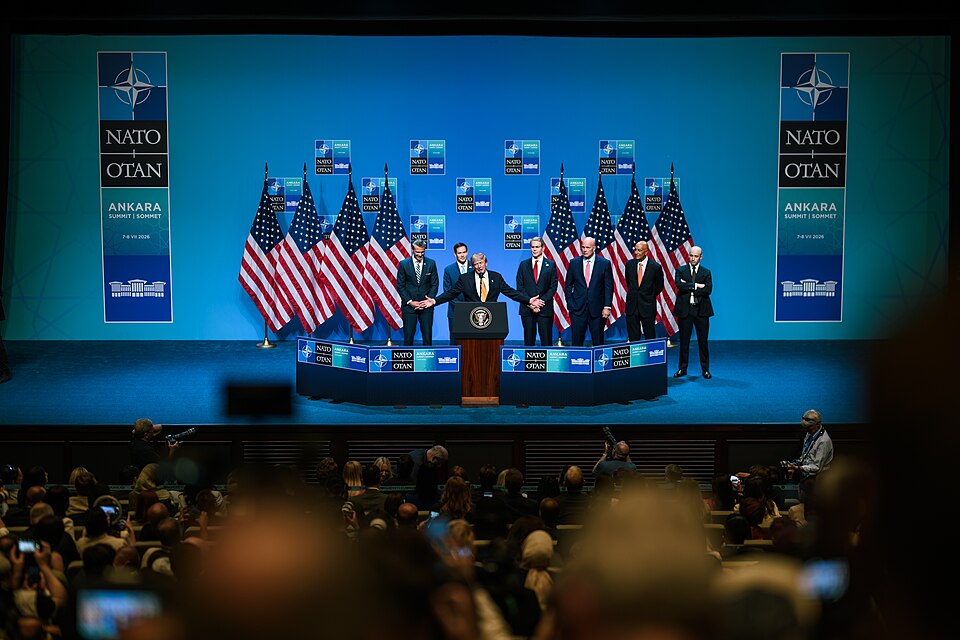
On 7-8 July, members of the North Atlantic Treaty Organization (NATO) gathered in Ankara, Turkey, for their annual Summit.
The Summit reflected two competing tendencies. On one hand, NATO member states are both dramatically increasing their military spending and acting with increasing belligerence on the global stage. On the other, they are riven by growing internal division and international resistance. Which tendency will prevail?
Last year’s NATO Summit in The Hague produced the shortest declaration in the history of NATO Summits. Its five brief paragraphs were meant to achieve consensus within an alliance increasingly unable to find agreement on its basic mission and current role.
This year, the divisions appear to have deepened. Member states struggled to agree on support for Ukraine, they could not find common ground on Iran and, notably, Spain refused to commit to the 5% spending target.
In response, US President Donald Trump lashed out. He branded Spain a “terrible partner” and a “wasted cause”, and ordered his Treasury Secretary to cut off all trade with the European country, all while reviving his claim on Greenland — effectively threatening to annex the territory of a fellow NATO member. Despite these threats, NATO Secretary-General Mark Rutte remained so servile and effusive in his praise of Trump that a journalist asked him if his attitude had “any effect on [his] self-respect”.
Where the 2025 Summit Declaration established the basis for increased military spending across the bloc — setting out the mechanism for bringing spending to 5% of GDP — this year’s declaration shifted to implementation. NATO’s European members and Canada, the Ankara Declaration read, increased their “investments in core defence requirements by more than $139 billion”.
The focus on the European members and Canada — to the exclusion of the United States — was not incidental. The administration of US President Donald Trump has pushed aggressively for what generations of US leaders have advocated: getting Europe and other members of the trans-Atlantic alliance to shoulder a greater part of the burden of maintaining the imperialist system.
To a degree, Washington’s strategy appears to have succeeded. As Rutte emphasized repeatedly in his praise of Donald Trump, spending is on the rise. Washington got Europe to love war again.
But that escalating militarism carries profound dangers and comes at a great cost.
The war against Iran has no end in sight. While NATO leaders met, Washington launched successive waves of strikes — more than eighty targets on the first night, some ninety the next — and reimposed the oil sanctions it had briefly suspended, while Trump declared the truce “over” from the summit floor and disparaged Iran’s leadership in the crudest terms.
Meanwhile, the war in Ukraine, now in its fifth year, continued to escalate. If, just a few years ago, countries like Germany were reluctant to send combat helmets to Ukraine for fear of escalation, NATO now operates as the strategic rear of the war effort. It has provided a full spectrum of advanced weaponry to Kiev. It has established drone production facilities around the bloc. And its intelligence actively engages in the targeting of Russia’s critical infrastructure.
Today, several NATO member states speak openly about the possibility of direct confrontation with Russia — and are ramping up military spending and mobilization efforts in preparation. Europe is marching towards war, and Washington helped pave the way. As Rutte himself recently admitted: “NATO is a platform for the United States to project power on the world stage.”
The cost is borne, as always, by the working people. NATO’s rearmament spree has given European ruling classes a pretext to finally dismantle the remnants of the social democratic order that prevailed since the Second World War. Militarisation and austerity are two sides of the same coin, and the effects are already being felt in budget cuts across the continent.
This is one of the terrains on which resistance to NATO’s militarist agenda is growing.
On 14 June, in the days before the European Council convened to negotiate the bloc’s next seven-year budget, thousands of people marched through Brussels under the banner “Welfare, not Warfare”. The Brussels march was the centre of a week of actions across the continent, from Spain to Finland, Greece to Britain.
Resistance greeted the Summit in Turkey itself. In the two weeks beforehand, anti-NATO demonstrations led by trade unions and anti-imperialist movements took place in Istanbul, Ankara, and Izmir against swelling military budgets and the alliance’s expansion.
The Turkish authorities responded with repression: the Ankara governorship banned all rallies, marches, and leafleting across the province for the duration of the summit, while detaining hundreds of people. The alliance that proclaims itself a community of “mature democracies” convened behind a wall of closed roads and prohibited assembly.
NATO’s march towards war is not a sign of its strength, but of its weakness. It reflects the panicked response of an imperialist system that has outlived its day, and is seeking to salvage its hegemony by brute force — killing working people abroad while impoverishing them at home.
It is the task of the international movement to connect these fronts: to link the worker in Brussels defending her pension to the people of Iran under bombardment, and the struggle against austerity to the struggle against war.
That is the message contained in the simple slogan that is now marching across Europe: “Welfare, not Warfare” — a world organised for life, not for death.

ZNetwork is funded solely through the generosity of its readers.
Donate

