
Which World Does the Woman Question Belong To?
The woman question cannot be explained within the bounds of a single nation or the gender relations of one society alone. Family structure, labor markets, wages, property, care work, migration, and the many forms of gender inequality all take shape within particular societies. But these relations do not exist in an economic or historical vacuum. They are part of a global capitalist system that positions societies unequally relative to one another, organizing the flow of capital, technology, goods, and labor through a worldwide division of labor.
Two common narratives about women are usually set against each other. The first holds that women’s experience across the globe is essentially shared, and that class or geography are secondary matters. The second — dominant within liberal feminism — reduces liberation to women’s equal entry into labor markets and institutions of power. This article rejects both, and insists on a stronger claim than simply holding gender, class, and geography together: gender is not merely shaped by the world-system. Gender relations are themselves among the mechanisms through which the world-system organizes labor, reproduces class relations, and transfers the costs of social reproduction across borders. Gender always operates within specific class relations and economic structures — but the reverse is equally true: class relations and the global division of labor are themselves organized, in part, through gender. This is not a denial of the shared experience of sexism, but a recognition that this experience is never available in some raw, unmediated form.
World-systems theory — and in particular its distinction between core, semi-periphery, and periphery — offers a useful tool for understanding these differences, provided the categories are treated as distinct structural positions within the division of labor and capital accumulation rather than a simple ranking of rich and poor countries. The central question of this article, then, is not how women are oppressed across the world in general, but rather: how does a society’s position within the global capitalist system shape the conditions under which women work, reproduce daily life, and struggle to change their circumstances?
Why Geography Matters for Feminism
Feminism has rightly shown that gender is not merely an individual or biological trait but a social and historical relation. Yet when “women’s experience” is treated as a single, undifferentiated thing, an important part of reality disappears. A female executive at a multinational corporation, a female textile worker, a migrant nurse, and a domestic worker may all face sexism, but their economic position and social power are not the same. Class alone is not sufficient either: a female worker in a core economy typically enjoys higher wages, stronger labor law, and more powerful unions, while a female worker in a peripheral economy more often works in the informal sector with far weaker legal protection.
Feminist analysis therefore needs to avoid three reductionisms: reducing the woman question to culture and patriarchy alone, reducing it to class alone, and reducing it to geopolitical position alone. Gender operates within class relations, class relations are organized within a world-system, and that world-system is in turn reproduced through these same social and gender relations.
Core, Semi-Periphery, and Periphery: Structural Position, Not a Ranking of Wealth
The global economy is not a collection of independent, equal economies. The international division of labor has produced a hierarchy of production, technology, capital, and labor. But before going further, one methodological point needs to be stated clearly: core, semi-periphery, and periphery are structural positions within the global division of labor and capital accumulation — they are not social classes, and they do not describe the condition of women in a given country as a single, uniform picture. A working-class woman in a core country can be in a far more precarious position than a wealthy, propertied professional woman in a semi-peripheral one. Without this caveat, world-systems theory unintentionally collapses back into the simple geography of “rich countries” versus “poor countries” that it was meant to move beyond.
Semi-peripheral societies occupy a structurally contradictory position within global accumulation: they may possess substantial industrial, technological, or state capacity in some sectors while remaining dependent on core capital, finance, technology, or markets in others. Iran and Turkey illustrate this contradiction in two different ways.
In Iran, the contradiction can be traced through a specific causal chain. The expansion of higher education over recent decades has brought the population of university-educated women close to parity with men, and in many fields women now outnumber them; this educational expansion has placed considerable human capital at the economy’s disposal. But the structure of Iran’s semi-peripheral economy — limited industry, a saturated state and quasi-state sector, and a small formal private sector — lacks the capacity to absorb this volume of educated female labor. The result is the transfer of a large share of this workforce into informal work, domestic labor, or jobs well below their level of education; and this transfer, in turn, reproduces rather than reduces the economic dependence of educated women. This pattern has been documented repeatedly in research on Iran’s labor market, though presenting detailed statistics is beyond the scope of this article. The chain — from educational expansion, to weak absorption, to displacement into informal work, to the reproduction of dependence — shows precisely how a structural feature of a semi-peripheral economy manifests itself in gendered experience.
In Turkey, the same contradiction takes a different form: a large share of the female workforce is absorbed directly into global production chains, particularly in export-oriented textile manufacturing, but often without the full protection of labor law. Where Iran’s semi-peripheral position produces exclusion from formal employment, Turkey’s produces inclusion on unequal and precarious terms. Both outcomes stem from the same structural position — dependent integration into the world market — expressed through different national configurations of industry, state, and labor law.
These structural positions cannot be separated from power relations among states. Control over capital, technology, production chains, and markets — what the Marxist tradition calls imperialism — is not only a relation between states; it also shapes the conditions of social reproduction within each society. When an economy is denied, or partially denied, access to technology, export markets, or capital flows because of its position in the world-system, the pressure on that economy’s capacity to absorb labor — including educated female labor — also increases. Sanctions and economic isolation, as in the case of Iran, intensify this pressure. Imperialism and global power relations, then, are not peripheral to but central to the conditions under which women work and reproduce daily life.
How Capitalism Organizes Women’s Labor
The relationship between gender, reproduction, and accumulation is not one-directional; it is dialectical. Gender relations organize how labor is reproduced; the reproduction of labor is a condition for capital accumulation; accumulation organizes the global division of labor; and the global division of labor, in turn, produces differentiated gender relations across regions, which then feed back into how labor is reproduced in each of them. Gender is not simply acted upon by the world-system — it is one of the relations through which the system continuously remakes itself.
One of Marxist feminism’s most important contributions has been to show that economic production is impossible without social reproduction. Workers must be fed, educated, cared for as children, tended to when sick or old, and the next generation of the workforce must be raised; historically, a large share of this labor has been unpaid and has fallen primarily on women.
Global capitalism does not organize this division of labor within the family alone. The global division of labor bears directly on social reproduction: capital can relocate production to low-wage regions, commodify care services, and move labor from one country to another. In many cases, gender relations allow capital to shift part of the cost of reproducing labor onto the family, and onto women themselves. Domestic labor, the care of children and the elderly, migration for care work, and the cheap employment of women are therefore not peripheral to the global economy — they are part of its mechanism of reproduction.
Women’s Migration and the Global Care Chain
One of the clearest examples of the link between gender and the global division of labor is women’s migration for care work. A woman in a core or wealthy economy cares for another family’s child or elderly relative, while her own child is left in the country of origin with a mother, sister, or another woman. Care is transferred from one family to another, but it does not disappear. This is what the feminist literature has come to call the “global care chain.”
This chain should not be understood merely as the geographic relocation of care. A migrant worker’s legal status, citizenship, visa type, and access to labor law all shape her degree of vulnerability. A worker whose residency is tied to a specific employer has limited ability to protest violence or low wages, since a complaint can threaten both her job and her immigration status.
The precise point here matters: the global contradiction this chain reveals is not a personal relationship between one privileged woman and one migrant woman. The issue is not that the professional woman “exploits” the migrant woman — such a reading reduces social responsibility to an individual relationship. The issue is that the capitalist market takes a pre-existing, global class inequality and turns it into a mechanism for privatizing and transferring the cost of reproduction. As long as care is treated as a private family responsibility, and as long as global wage inequality persists, it is this market — not the individual choice of one woman or another — that transfers care from women with more resources to women with less bargaining power.
Women Are Not a Class
Any global analysis of women risks collapsing “woman” into a single, unified subject. A wealthy woman in a peripheral economy may have far greater economic resources than a working-class woman in a core country; a female executive at a multinational corporation may profit from the labor of thousands of other women; and a female worker at an export factory may be under pressure from an employer whose own firm sits within the production chain of a core multinational. Women do not constitute a class simply by virtue of being women; but gender is materially organized through class relations, and it therefore cannot be separated from the reproduction of class society itself. A feminist analysis grounded in global political economy needs to ask at least three questions simultaneously: What gender relation is this woman positioned within? What class position does she occupy? And what place does the society in which she lives and works hold within the global division of labor? Ignoring any one of these three levels erases part of the reality.
The “Successful Woman” and the Limits of Liberal Feminism
Liberal feminism makes an important argument: for centuries women were excluded from universities, labor markets, property, and political power, and women’s entry into managerial, political, and economic positions is itself a real achievement. Defenders of this view can reasonably argue that symbolic representation is a necessary condition — not a rival — for structural change: until women hold positions at the top of institutions, even the possibility of raising more structural demands remains limited.
But this response overlooks a key distinction: equal access to power is not the same as changing the relations of power. A woman becoming CEO, minister, or board member is, in itself, a positive development, but it says nothing on its own about who power is exercised for and on what basis. A woman can become a CEO while the question of who works beneath her in the production chain remains unanswered; a woman can become a politician while the economic policies she pursues cut public services and increase pressure on families. Her gender does not, by itself, change the nature of the policy she carries out. The point is not that women should not hold power — ending the male monopoly on power is necessary. The problem is not women’s entry into power as such; it is the assumption that changing who occupies the top of a hierarchy necessarily changes the hierarchy itself.
This distinction clarifies a further contradiction: one woman’s success in the labor market is often made possible by transferring part of the care burden onto another woman. If individual competitiveness in the market is treated as the sole measure of liberation, the question of who pays the cost of that liberation remains hidden. This is not an argument against women’s economic independence — economic independence is a basic precondition for liberation — but individual independence within the market should not be confused with social liberation.
Neoliberalism, Crisis, and the Gendering of Risk
Neoliberalism is not simply a set of economic policies; it is a mechanism for shifting risk from collective institutions onto individuals and families. Temporary contracts, cuts to public services, privatization, and the erosion of social protections all transfer costs once borne by the state or collective institutions back onto the family. But the family is not a neutral, equal unit: in most societies it is women who care for children and the elderly, who leave work during illness, and who spend more time on domestic labor. Economic risk therefore does not simply become “private” — it becomes gendered. In the core, the welfare state still absorbs part of this risk; in the semi-periphery, the family and the informal market bear a larger share; and in much of the periphery, kinship networks and unpaid labor become the primary mechanism of survival.
This logic appears in a more concentrated form during economic crisis, war, and sanctions, and can be stated as an independent proposition: capitalist and geopolitical crises transfer the crisis of social reproduction down to the level of the family, and this transfer is gendered. When family income falls due to sanctions or inflation, unpaid labor increases; when public services are cut under the pressure of crisis, care returns to the home; and when war or forced migration breaks apart family structures, care responsibilities again fall more heavily on women. Global crises, then, do not simply make women “more victimized” — they reorganize the social arrangement of reproducing life itself. This is the exact point where the crisis of capital accumulation on a global scale meets the everyday experience of women at the level of the family.
Women Are Not Only Victims
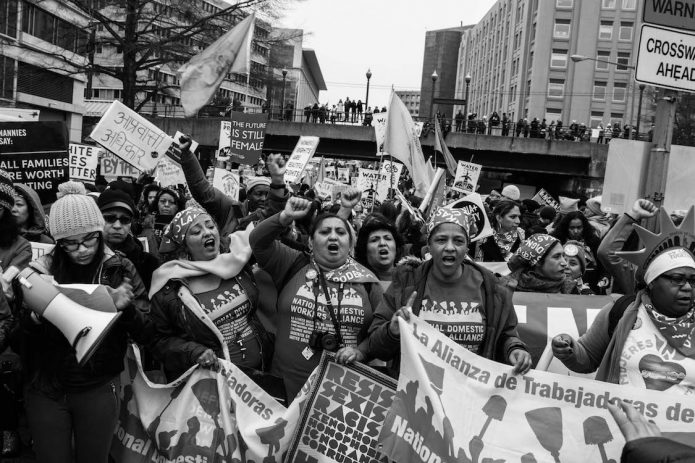
If women are seen merely as passive victims of the global division of labor, another important part of reality is lost. Women factory workers organize; domestic workers fight for the recognition of their rights; migrant women build networks of solidarity; rural women resist for land and water; and women in many countries are active in unions and social movements.
Women’s agency is real, but it does not occur in a vacuum: a corporate executive, a factory worker, and a domestic worker do not have equal power and resources with which to struggle. The question is not simply “do women have agency?” but, more precisely: which women, with what resources, against what structure, and from what position, are struggling?
A Liberation Whose Cost Is Not Passed to Someone Else
If the woman question is reduced solely to “equal rights,” class and global differences are erased. If it is reduced entirely to “class,” specific forms of gender domination disappear. And if it is reduced only to geopolitical relations, women are once again turned into passive victims of global arrangements. Gender liberation without class justice is incomplete; class justice without gender liberation is equally incomplete; and both remain limited without a change in the unequal relations of production and reproduction within the world-system.
A core economy can draw on the cheap labor of a peripheral one; a wealthy family in the core can benefit from the care labor of a migrant woman; a multinational corporation can relocate production to a semi-peripheral country; and a family within that same country can cover part of the cost of reproducing labor through women’s unpaid work. Gender relations in different parts of the world are thus connected to one another, even where women’s experiences within them differ.
Women’s liberation takes on a fuller meaning when a woman does not have to transfer the burden of her own life onto another woman in order to secure her economic independence; when one society’s independence does not rest on the exploitation of another; and when care work is no longer concealed as women’s “natural duty.” For this reason, the struggle for women’s liberation cannot be reduced to a struggle to place more women at the top of existing structures. It requires transforming the social organization of production and reproduction itself — how care is provided, how economic dependence is structured, and how the costs of reproducing life are distributed across class and national lines. The question, therefore, is not simply whether women can enter the existing structures of power, but whether the social relations that reproduce those structures can themselves be transformed.
In the end, the fundamental question for feminism is not how many women have entered the structures of power, but how many women have been freed from insecurity, dependence, and exploitation. Women’s liberation becomes a genuine social project when one woman’s freedom no longer comes at the cost of another woman’s freedom, and when the struggle for gender equality is joined to the struggle against class relations and the hierarchies of the world-system. Gender in the world-system is not a secondary matter for capitalism — it is one of the very mechanisms through which capitalism reproduces itself.
ZNetwork is funded solely through the generosity of its readers.
Donate

