
Abstract: Drawing on world-systems theory and a structural (rather than territorial) theory of empire — the “Imperial Outreach” framework developed in this author’s earlier ZNetwork essays — this piece argues that imperial decline rarely begins with a decisive military defeat. It begins when the cost of sustaining a given order outgrows the capacity of the center that built it. Reading the unfolding Strait of Hormuz war through two earlier chokepoint crises — Portugal’s loss of Hormuz in 1622 and Britain’s Suez crisis of 1956 — the essay asks whether Hormuz might mark a comparable turning point for the “empire without flags” that the United States has built since 1945: an empire that governs not through colonies and flags, but through the financial, logistical, and technological networks of global circulation.
In the history of empires, certain places carry weight far beyond their geographic size. Straits, canals, ports, and shipping lanes sometimes become nodes whose control determines who governs the circulation of trade, capital, and global power. Hormuz is one such place: a narrow passage between Iran and the Arabian Peninsula that has sat at the crossroads of empires and trading networks for centuries.
But Hormuz’s importance is not only geographic. Its history can be read as a compressed history of the transformation of imperial power itself — from sixteenth-century Portugal, which sought to monopolize Indian Ocean trade by controlling ports and sea lanes, to nineteenth- and twentieth-century Britain, and finally to the United States, which built a different kind of dominance over the global circulation of goods, energy, and capital.
Seen this way, today’s question about the Strait of Hormuz is not simply whether Iran can close the passage or whether the United States can keep it open. The deeper question is this: could the Hormuz crisis play a role for the American empire comparable to the one the 1956 Suez crisis played for the British empire?
This is not a claim that American empire has ended. US military, financial, and political power remains immense. But the history of empires suggests that decline rarely begins with a single decisive military defeat. The real turning point often arrives when the cost of maintaining an existing order exceeds the economic and political capacity of the center that sustains it.
The Hormuz crisis may be one such moment.
Hormuz and the Logic of Maritime Empire
In the early sixteenth century, Portugal was among the first European powers to grasp the importance of controlling maritime nodes on a global scale. The Portuguese goal was not simply territorial conquest; they sought to control the trade routes of the Indian Ocean. When Afonso de Albuquerque and his successors captured Hormuz in 1515, they turned it into one of the central nodes of the Portuguese network in the Persian Gulf, allowing Lisbon to oversee one of the Gulf’s most important entry points and the trade routes linking India, Iran, and the Mediterranean world.
That order collapsed in 1622, when Safavid forces, in cooperation with the English fleet, besieged and expelled the Portuguese from the island. The fall of Hormuz did not mean the immediate collapse of the Portuguese empire, but it broke one of the key pillars of Portuguese naval power in the Gulf and showed that European monopoly over Asia’s maritime networks could not be sustained indefinitely.
The historical significance of this episode is that Hormuz demonstrated, once again, that empires do not operate solely on the basis of territorial extent. They also derive power from their capacity to control “nodes of circulation.”
This concept matters a great deal for understanding modern American empire. My earlier essays on “Empire Without Flags” developed this argument at length: unlike classical colonial empires, American power does not require the direct occupation of territory. It is built from a set of interlocking networks — the dollar and the global financial system, banks and credit institutions, sanctions, military bases, naval fleets, supply chains, technology, communications infrastructure, and control over or influence on the major routes of energy and trade.¹ This is why one can speak of an “empire without flags”: an empire that operates less through flags and colonies than through networks.
But networks have their own vulnerability. The more power depends on global networks, the more disruption at their central nodes can impose enormous costs — a point developed further in the second part of that series, which distinguishes control over production from control over circulation.²
Hormuz is one of those nodes.
Suez: The Moment Britain Understood the World Had Changed
The 1956 Suez crisis is a crucial historical case for understanding this dynamic. Britain and France, together with Israel, attacked Egypt to pressure Gamal Abdel Nasser’s government and reclaim control of the Suez Canal. But London and Paris met fierce resistance from both the United States and the Soviet Union, and were ultimately forced to withdraw. Washington even used financial leverage against Britain, and the crisis showed that London could no longer pursue an independent imperial policy without accounting for American power.
Suez, then, was not simply a military defeat. The British army could still fight. The British navy had not been destroyed. The British empire did not collapse that day.
What failed at Suez was Britain’s capacity for independent power projection.
This distinction matters. An empire enters decline when its center can no longer secure, on its own, the resources needed to sustain its order. Suez showed that Britain, despite retaining military strength, could no longer unilaterally impose its preferred order on the Middle East. After Suez, the United States became the West’s principal power in the region.
Seventy years later, a related question has emerged: could Hormuz become the place that exposes the limits of American power?
Hormuz, 2026
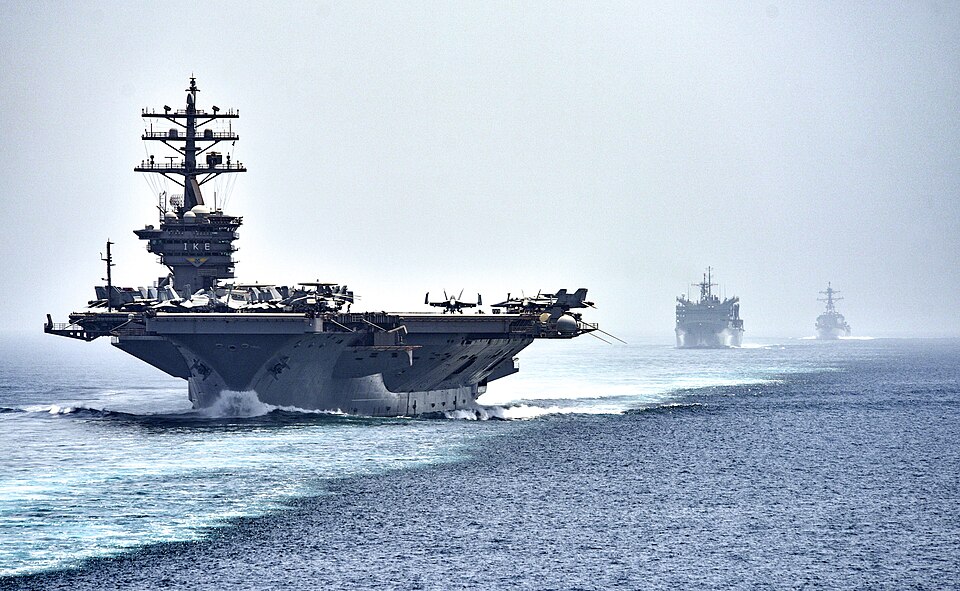
What is unfolding in the Persian Gulf today is not a theoretical threat to a shipping lane. What is often described in the press as the “Hormuz crisis” is in fact part of a war that began on February 28, 2026, with US and Israeli strikes on Iran, and that has continued since then — through a fragile summer ceasefire and repeated escalations. Beginning March 19, the US military launched a sustained air campaign aimed at “reopening” the strait; on April 13, Washington imposed a formal naval blockade on Iran; and in early September, the two sides engaged in their heaviest exchange of attacks on commercial shipping since the war began — Iran targeting tankers and US vessels with missiles and drones, the United States striking IRGC-linked tankers near Kharg Island and Jask. The fighting has cost the lives of a number of sailors and port workers on both sides.
This has occurred even as the United States has maintained an extensive military presence in the region and worked to guarantee shipping security. Yet the scale of these attacks and counterattacks has imposed costs on American empire that go well beyond a routine naval operation.
Here an important contradiction appears.
American power to secure Hormuz remains considerable. But exercising that power to keep one shipping route open has required, over the past half-year, a full air campaign, a formal naval blockade, and the sustained expenditure of missile-defense systems.
If an imperial power can sustain an existing order through a limited presence and modest cost, its power is stable. But if sustaining that same order requires months of open warfare, larger troop deployments, growing expenditure of defense systems, more ships sent to the region, alongside rising energy prices, disrupted trade, and a widening regional crisis, then the relevant question is no longer simply “power” — it is the cost of power.
This is the point at which the analysis of imperialism must move beyond counting warships.
Imperial Power Is Not Only the Capacity to Destroy — It Is the Capacity to Sustain Order
The United States can likely bomb Iranian facilities. It can likely destroy a portion of Iran’s military capacity. It may even, at times, force open limited passage for ships — as it has already done in recent months.
But this is not the central question.
The question is whether the United States can build, over the long term, an order in which the global flow of energy and trade continues at a bearable and sustainable cost. This is the difference between “military victory” and “imperial success.” An army can win a battle and still fail to sustain political order. In Afghanistan, Iraq, and elsewhere, the United States demonstrated an ability to deliver overwhelming military force — but converting that force into durable political order proved far harder.
Hormuz pushes the problem a step further. Here, the issue is no longer control of a single country; it is control of a global network.
A significant share of the world’s seaborne oil and gas trade normally passes through Hormuz. Sustained disruption of this passage is therefore not only a problem for Iran or the Gulf states — it is a problem for the global economy. In recent weeks, simultaneous disruptions at Hormuz and Bab-el-Mandeb have added further pressure to energy markets.
Faced with this, empire confronts a classic dilemma: who pays the cost of sustaining global order, and how?
A Counter-Argument: Adaptation, Not Decline
Defenders of continued US primacy would object that chokepoint disruption is nothing new. The United States managed the 1980s “Tanker War” in the same waters without any comparable erosion of its global position, and it retains tools — strategic reserves, rerouted supply, allied burden-sharing, and eventually decisive force — that earlier declining powers lacked. On this view, the current cost is a temporary spike, not a structural symptom.
This objection has real force, and history counsels against declaring imperial turning points in real time. But the comparison with the 1980s understates how much has changed since then: American power is now stretched across a far larger set of simultaneous commitments, its alliance structure is under greater strain, and — unlike in the 1980s — rival poles such as China are positioned to absorb some of the disruption’s costs rather than simply wait it out. Adaptation and structural strain are not mutually exclusive; an empire can adapt tactically to a chokepoint crisis while still paying a rising, non-recoverable price for doing so.
Could Hormuz Be America’s Suez?
The honest answer, today, is that it is not yet a clear yes or no.
There is no serious basis for claiming that American empire has already ended. The United States remains the world’s largest military power, one of its most important financial centers, and a principal exporter of technology and economic power. It retains an extensive network of allies and military bases.
But history does not show imperial decline beginning on a single day, with one final defeat. Empires typically weaken through a long process. First, the cost of sustaining order rises. Then allies begin to drift. Then regional rivals gain room to maneuver. Then alternative routes for trade and energy take shape. Eventually, other powers are no longer willing to accept the existing order on its previous terms.
Seen this way, the central question at Hormuz is not how many days or weeks Iran can disrupt the strait. The question is whether the world has entered a period in which no single power can any longer guarantee, alone, the security of global trade routes.
If the answer is yes, we are facing not merely an American crisis, but a crisis of a historical model of world order.
Hormuz and the Rise of a Multipolar World
This may be the most significant consequence of the Hormuz crisis.
The postwar order was built on a constellation of power centers, but the United States gradually acquired an unprecedented role in managing that order. Today, that position is challenged more than before by China, Russia, regional powers, and increasingly independent networks across the Global South.
Here, however, one common error on parts of the left should be avoided.
The decline of American hegemony does not automatically mean the liberation of the Global South. US unipolarity may weaken while global capitalism persists. China may grow more powerful while exploitative relations in the Global South remain intact. Russia may resist American pressure without that resistance constituting, on its own, a project of liberation.
The task for the left, then, is not to choose among existing empires. It is to understand the structure of power within which empires take shape.
This is why the Hormuz crisis carries theoretical weight for the left: it forces a renewed reckoning with the relationship between imperialism, capitalism, peripheral states, and global infrastructure.
Hormuz as a Metaphor for the End of an Order
In 1622, the fall of Hormuz did not mean the immediate end of the Portuguese empire. In 1956, the Suez crisis did not mean Britain’s immediate disappearance from the world stage. But both events revealed something previously less visible: the material limits of a power’s ability to sustain an order that had once seemed natural and permanent.
Hormuz today may play a similar role. Future years may show that the 2026 crisis was simply another Middle Eastern war. Or future historians may look back and identify this period as one of the first clear signs of the limits of American power — the moment it became evident that even the world’s most powerful military could not simply guarantee the security of global networks.
This is where the concept of “empire without flags” becomes essential. American empire does not need to plant a flag over every country on earth to sustain itself. It needs only to manage the networks of capital, energy, technology, and trade that circulate through the world. But this is precisely where its vulnerability lies. If the nodes of these networks slip, one after another, out of a single center’s control, empire may erode structurally before it is ever defeated militarily.
Perhaps, then, the right question is not “Is Hormuz the end of American empire?”
The more precise question is this: is Hormuz the moment the world sees, with new clarity, the material limits of American empire?
That question has not yet been answered by history. But the history of Portugal and Hormuz, of Britain and Suez, and now of America and Hormuz, is a reminder that empires do not always fall when they can no longer fight. Sometimes their fall begins the moment they can no longer afford the cost of their own order.
Perhaps that is the real meaning of Hormuz today: a strait too small to defeat an empire, but large enough to expose one.
ZNetwork is funded solely through the generosity of its readers.
Donate