
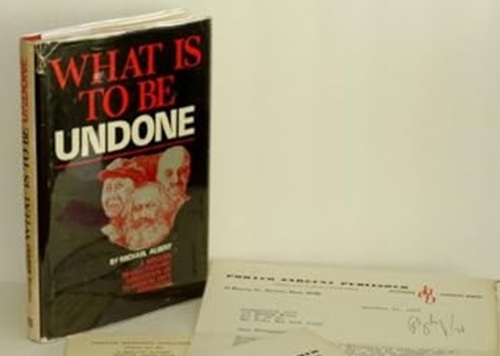
I was recently surveying my computer’s contents and I came across the text of a book I had written over a half century ago. It was published in 1974 by a small progressive publisher named for its founder, Porter Sargent, located in Boston Mass. I turned, I think, 25 when I was writing it. Its title is What Is To Be Undone, a word swipe at Lenin’s What Is To Be Done.
On the cover, it had a montage of three heads — Lenin, Marx, and Mao. Back in those days, their viewpoints and practices contended for movement influence. Indeed, they, books about them, and organizations touting them were everywhere. Trotsky too. Activists, couldn’t avoid their impact.
Even just on seeing the book cover, it was obvious I was going to address their views. If the cover graphic and the title weren’t enough to communicate that intention, there was also a subtitle: A Modern Revolutionary Discussion of Classical Left Ideologies.
Literally on the same day I newly came across What Is To Be Undone, a very close and long-time friend called my attention to a pretty current book from Monthly Review and to quite a bit of interest and turmoil around that book.
The MR book, by Gabriel Rockhill, asserts that contemporary revolutionary theory is highly problematic. Rockhill sees the problem as a deviation from earlier, better views which we might broadly call Classical Marxism Leninism. Rockhill calls the deviation “Western Marxism,” or “anti-anti imperialist Marxism.” He believes this deviation jettisoned from earlier ideology what was good and added new features that were bad—and that it did so in accord with systemic U.S. imperial and particularly CIA dictates.
In a way then, Rockhill argues that from the Sixties on, and indeed even in the Sixties, revolutionary thought and action went ideologically downhill. Rockhill’s argument seeks to document what he took to be the deviation’s nefarious origins. This revealed, he reasoned, the need to rediscover, return to, and re-elevate the materialist, dialectical approaches of the prior classical ideology.
Was Rockhill’s approach a largely wise conceptual insight, or was it mostly guilt by association? Did Rockhill dissect current concepts and visions accurately to show their intrinsic faults, or did he claim to find causes of the ideological changes and then assume that given those causes, the results were of course inevitably destructive of true revolutionary desires? I don’t know, after all, I only heard about his book yesterday. But I admit I expect the adverse latter expectation.
In either case, I was struck by a similarity between my own half century old intent with What Is To Be Undone and Rockhill’s current intent with his new book, Who Paid the Pipers of Western Marxism. Sitting down to consider and then write, both Rockhill and I, 55 years apart, were distraught about inadequacies of our times’ revolutionary ideology and practice. Rockhill now sees the inadequacies of his current epoch as being in considerable and even preponderant degree due to many people having earlier deviated from anti-capitalist thought into what Rockhill calls anti-anti imperialist thought. He feels the solution to ideological inadequacies is to reject the culprit that he calls “Western Marxism,” and decisively return to what we might call “Classical Marxism Leninism.”
So in his recent work, rather like I wanted to do in my work of 55 years ago, Rockhill wants to discern faults with current ideology and chart a path toward better ideology. For Rockhill, however, the fault to now transcend is the left having deviated from what went long before. The fault is the left having scorned what was valid and worthy Classical Marxism and Marxism Leninism.
For me, 55 years ago, which is roughly when Rockhill thinks the anti anti imperialist, capitalist accommodationist deviation gained momentum, the problem wasn’t that deviation per se, but that activists had retained too much of Classical Marxism Leninism, not too little.
So Rockhill wants to go back whereas I wanted to go forward. For Rockhill I suppose I was guilty, so to speak, of having wanted to get beyond Classical Marxism and Marxism Leninism, rather than wanting to return to it, which is Rockhill’s desire. I wonder if Rockhill would say I and people like me were deviated from truly revolutionary desires and thoughts by systemic pressures, or due to seeking personal wealth and power, or some such thing. Or perhaps he would say it was due to having read One Dimensional Man by Herbert Marcuse.
Here is a substantial excerpt from Rockhill that concluded an interview he recently did for his publisher, Monthly Review. The interviewer was Michael Yates.
Rockhill concluded the whole interview: “Here we have arrived at the most important question. Theory becomes a real force in the world when it comes to grip the masses. In many ways, my book charts the remaking of the left in the age of US imperial dominion. While the second half of the book focuses on Western Marxism, the work as a whole is concerned with the overall redefinition of the left—to use the CIA’s terminology—as a ‘respectable,’ meaning ‘non-communist,’ left that is compatible with the interests of capitalism, and even imperialism. The history of how the intelligentsia has been driven in this direction is ultimately important, not simply for its own sake, but because of what it reveals about the broader left. Today, much of the left is thoroughly compatible.
“The real task at hand, then,” continued Rockhill in the interview, “is to rejuvenate the actual left, which is anti-imperialist and anticapitalist. This is a gargantuan task, particularly given the forces arrayed against us. However, if we fail to do so, human life and many other life forms will be eradicated, either through nuclear apocalypse, intensified social murder, ecological collapse, or other capitalist-driven forces.
“In order to rise to the occasion,” Rockhill continued, “we need to be able to solve at least three important problems. To begin with, there is the issue of theory, which is the main focus of my book, [Who Paid the Piper of Western Marxism]. Contemporary theory has generally been purged of any serious engagement with dialectical and historical materialism, and the latter has been widely slandered as passé, dogmatic, reductivist, unsophisticated, totalitarian, and so forth. Even worse, Marxism itself has been hijacked by reactionary forces, working hand in glove with opportunists, and transformed into a trendy cultural commodity—“Western” or “cultural” Marxism—that is anti-communist, capitalist accommodationist, and sometimes openly imperialist and even fascist. Culturalism reigns supreme, while class analysis has been cast by the wayside. This is, moreover, by no means a problem limited to the academy, since the organizing world has been deeply penetrated by these anti communist ideologies. In this regard, my book” continues Rockhill, “seeks to serve as a corrective to such backsliding tendencies, while reconnecting the red thread to the dialectical and historical materialist tradition, developing its methodological contributions, and advancing its analysis of the imperial superstructure in the contemporary world.
“The other two problems” urges Rockhill, “are the organizational question and the issue of what Brecht calls the pedagogics of form. In much of the capitalist world, the party form, democratic centralism, and even hierarchical political organizations in general have either been abandoned or sidelined. Yet, there is no way for the left to fight and win without disciplined organizations that build collective power. These have to be able to bring people in, educate them, and empower them to take destiny into their own hands. All of this requires forms of communication, cultural expression, and organizing that really connect with people, through their form, and motivate them to engage in collective action to change the world. While my book is primarily focused on the theory problem, it does insist on the crucial importance of an organized left politics, while highlighting its important gains in the form of actually existing socialism. It is also my hope that the book provides a compelling narrative and is an enjoyable read that brings people into the collective struggle to build a better world.”
For Rockhill, then, to deviate from Classical Marxist Leninist theory, organization, and aims was to backslide. Like me he wants a framework suited to winning a new world. But to go back is Rockhill’s way forward. For me, 55 years ago, to go forward we had to examine the then preponderant revolutionary ideologies which had not given us a worthy, viable, new world. To go forward we had to find any faults that held us back.
So was I way back and for that matter am I now a part of Rockhill’s problem? We both highly criticize ideological failings. For Rockhill the target is Western Marxism, and also, I think, what we might call French Marxism, and no doubt more as well. And like him, I am also un-enamored of and often even highly critical of all that, but for me, 55 years ago, the problem I felt a need to address was Marxism Leninism itself. In the present, Rockhill and I agree on the need for change not only in society but in how we approach society to change it. But then we offer very different ways to proceed.
Returning to What Is To Be Undone, when I came across my early text while weeding my computer, I became curious about it. I had probably last set eyes on its words literally 50 years ago. I knew that if I now read its words, it would be like I was reading a new book, or an old book that I was first encountering now. It would not be like reading something I wrote. I would not remember its words. I would barely remember writing it.
So I wondered, here I was looking at a book that was written by a participant in the Sixties when it was still boiling in our blood. So would this book have current relevance? Or to read this book be kind of like digging into a time capsule of no contemporary relevance?
For myself, I admit I also wondered, would this book reveal the origins of my later efforts and views, or would it reveal early views that I later found wanting and left behind to get where I have now arrived?
Put rather differently, as I suspect Rockhill might anticipate it, would I discover the origins of a trajectory that led to my being a part of Rockhill’s problem, that is, would What Is to Be Undone reveal views that led to my becoming a capital accommodationist, anti-anti imperialist, and deluded mis-orienter of activism? Or would it reveal the origins of a trajectory that led to my becoming an ever more anti-capitalist, anti-imperialist, but also anti coordinatorist, anti racist, feminist, anti authoritarian revolutionary? Would I discover the origins of my mind becoming diversionary mud of the sort Rockhill thinks has left us with barely a left? Or would I instead discover the origins of my mind escaping obstacles in order to advance legitimate desires?
Would What Is To Be Undone’s proximity to my time of immersion in what we then saw as an urgently revolutionary epoch make it wise or make it deluded? With the passions of that time still flowing through me, did my eyes see more or see less clearly than the same eyes saw in later years?
The Sixties still matter greatly for many people, myself included. Would whatever lessons I had taken from what I had seen and done in the Sixties, appear to me 55 years later as having been naive, ignorant, and part and parcel of a deviation into accommodation? Or might I even discover I left behind some thoughts I should have retained?
Coincidentally, as I was mulling such matters, I received page proofs for a book of mine coming out imminently, an oral history not of a past tumultuous time, but of a future revolution. Its interviewees try to cull lessons from their future experiences for us to possibly adapt and use in our coming years. There is a sense, I realized, as I stared at the old and the new book, that What Is To Be Undone was me trying to do the same thing about the thoughts, feelings, and choices of what is now called the Sixties as viewed from the early seventies. I hadn’t looked at What Is To Be Undone before writing The Wind Cries Freedom. But I was too curious to not look at it now.
So, I found a copy. And on the jacket, beyond its title, its graphic, and its subtitle, i encountered three supportive quotations meant to spur anyone who picked up the book to read on. Would they spur me on, now?
Noam Chomsky wrote for the cover: “Michael Albert’s book, What Is To Be Undone is an impressive achievement. He has thought deeply about the problems of the American left and his critical view on it is, I think, extremely valuable. He writes from the point of view of a participant as well as an observer and analyst, and from both points of view, he has important things to say. He has managed to interweave his own experiences and his wide and thoughtful reading. The result is a book of considerable insight, a serious contribution to the reconstruction of an effective movement of the left in the United States.”
I have to comment because on reading this “blurb” I am pretty sure Noam read the introduction and chapter one, and then wrote the above. This would be a good guess but it is in fact more than a guess because decades later, having by then become long-time close friends, Noam told me he had gone then, lately, gone way back and finally read the book and that he thought its discussions of Marxism, Leninism, etc., were far more solid and convincing than he had earlier anticipated they would be when he at the time only reacted to my discussion of Sixties movements. After all, I felt he might reasonably have added, the words were written by a militant whippersnapper, so how wise could they be.
Howard Zinn wrote a bit differently for the book’s cover: “This book does an excellent job of showing the weakness of Classical Marxism Leninism, plus the contributions of Anarchism and Maoism. It clarifies much about the Russian and Chinese experiences and lays a sound critical foundation for Americans to create their own revolutionary strategies. It is a healthy, positive, and scholarly analysis. I agree with its political thrust.”
And Herb Gintis, who you may not know of but who was a brilliant radical economist back then, wrote for the cover: “This work goes a long ways toward critiquing old ideologies and laying the groundwork for creation of a new one. Its discussion of classical Marxism Leninism is informed, powerful, and intelligently organized around an eye-opening discussion of Bolshevik practice in Russia. The critical discussion of Classical Marxism in a praxis context is original and strong. The discussion of Anarchism and especially Maoism lead the reader from the initial primarily critical orientation toward a more balanced, positive view that posits many useful criteria for creating a new United States revolutionary ideology. The chapter on humanist and new Marxism is a good summary and continues the positive progression toward creating a new ideology. The last summary chapter and the book as a whole are thus very useful are thus very useful for revolutionary activists wanting to understand old ideologies and to work out their own new perspective, too.”
You might think that given its topic, title, timeliness, and the effusive jacket comments, What Is To Be Undone would have quickly garnered a lot of attention and moved readers as the comments suggested it would. I admit the young me optimistically anticipated exactly that. But I think instead the book’s main effect may have been to cause various Marxists, Leninists, and Maoists to develop a strong allergy, or actually more like a lasting hostility to the unknown whippersnapper author, and might indeed have deterred them from paying any attention at all to anything I ever had to say from then on. So I also thought to myself, were they right? Or was their hostile silence sectarian?
As to my writing, the truth be told, I was quite insecure then, as I am now, but when I recently started looking at the book, I was pleasantly surprised. At least as far as I have gotten so far, it was readable. That was likely due mostly to editing done by my then and ever since partner Lydia Sargent. Also, for what it is worth, this book was written partly by hand but mostly on an IBM Selectric typewriter. We are talking about way back. More in that vein, after the many paper drafts and the endless pencil refining, Lydia and I would go across town to a facility that lent us access to a then new fangled typesetter. There we prepared camera ready copy for Porter Sargent publisher well into the wee hours of each night for some weeks. We’d put the finished pages from each session into a refrigerator to preserve them as we slowly got through the whole thing. That experience led not long later to establishing he publisher, South End Press, and later Z Magazine and ZNet.
But the mechanics of it aside, the finished book had a page offering three quotes sitting just inside the cover. I think such a page, when adorned with an author’s portrait or thematic artwork is called a frontispiece. My opening page instead had no image, just three quotations. As I recently read those three quotes, I could feel that I had been nervous about how readers would react and chose the quotes partly defensively.
The first quote was from Karl Marx. It goes: “The tradition of the dead generations weighs like a nightmare on the brain of the living, and just when they seem to be revolutionizing themselves and things, in creating something entirely new, precisely in such epochs of revolutionary crisis they anxiously conjure up the spirits of the past to their service and borrow from the names, battle slogans, and costumes in order to present the new scene of world history in this time-honored disguise and borrowed language…. The social revolution of the nineteenth century cannot draw its poetry from the past but only from the future.”
The second quote is also from Marx. The book was about to criticize classical Marxism, but I had been moved by many of Marx’s own words and I was, I suspect, defensively trying to ward off rejection by people who would dismiss the book for violating any formulations of Marx by suggesting I was instead acting on some advice he rendered. As the second text, he wrote and I quoted: “The struggle against religion is therefore indirectly the struggle against the world whose spiritual aroma is religion…. Religion is the sigh of oppressed creatures, the heart of a heartless world, as it is the spirit of spiritless conditions. It is the opium of the people…. The criticism of religion is thus in embryo a criticism of the vale of tears whose halo is religion.” Substitute for the word religion ideology, or even the content of “dead men’s minds,” and you’ll see the reason for my choice of contents for my so-called frontispiece. I thought I was doing, just what Marx urged. Not because he urged it, but because it was wise advice. And to be forthright about it, I think his advice was ironically to do pretty much the opposite of what I think Rockhill is now urging activists to do.
At any rate, in case anyone didn’t then quite get why those two Marx quotes adorned the book’s frontispiece, I had a third quote as well. It was from the Guild Socialist G.D.H. Cole and was short and hard to misinterpret. It went: “woe betide those who seek to save themselves the pain of mental building by inhabiting dead men’s minds.”
The book that followed the frontispiece tried to avoid having “woe betide” me. It had an introduction and twelve chapters. How many of those will make sense to resurrect in the form of current articles. I don’t yet know, but I am curious.
At any rate, here is the Introduction to What Is To Be Undone. It is quite short, so after presenting it, I’ll comment just little about my reaction on reading it…55 years after I wrote it. So, here is the Introduction:
In this book we critically discuss Classical Marxism Leninism, Anarchism, and Maoism from the perspective of political effectiveness here and now in present United States contexts.
We demystify, criticize, and uncover the roots of old-ideology weaknesses. We seek to learn from old-ideology strengths. We try to forge guidelines for eventually creating our own newer and better revolutionary ideology. We work from activist evaluative criteria. We discuss only the core of Classical Marxism Leninism as it was really employed by the Bolsheviks and as it’s generally employed by Leninists today. Rather than struggling for ‘philosophical precision,’ we strive for practical relevant-to-use criticisms and alternative views. After emphasizing criticism in the discussion of Classical Marxism Leninism, rather than repeating that approach with Anarchism and Maoism, we turn more toward discovering positive aspects useful for us in the United States.
Chapter one gives a very brief descriptive analysis of late-sixties political movements. Its purpose is to give force to the assertion that social change requires political insight. It also provides some present movement needs to help orient our follow-up discussions.
Chapter two discusses the general nature of political consciousness in terms of the concepts of theory, strategy, and practice. It lays out an approach for studying political ideas we then use throughout the rest of the book.
Chapter three introduces Classical Marxism as a full consistent theory of social interaction, history, and revolution. It presents Classical Marxism in a positive manner but in accordance with our critical expectations.
Chapter four introduces a significant portion of Classical Leninism. The effort is to objectively set out something close to what most Classical Leninists actually use in their day-to-day efforts, but the discussion is organized and bounded in accordance with our critical desires.
Chapter five discusses Bolshevik Classical Marxist Leninist practice in young revolutionary Russia. While not explicitly discussing theory and strategy, it evaluates Bolshevik practice so as to lay a groundwork for critiquing the guiding ideology as well.
Chapter six evaluates Classical Leninism. Chapter seven evaluates Classical Marxism, completing the examination from practice to strategy to theory. Chapter eight summarizes the entire analysis.
Chapter nine discusses Anarchism, looking for new insights rather than deeply analyzing weaknesses. Chapter ten discusses the Chinese experience, again looking more to find insights than to analyze recurring Classical or other weaknesses.
Chapter eleven discusses a number of Humanist Marxist and Neo-Marxist thinkers who go beyond Classical limitations.
And chapter twelve synthesizes previous results into a number of ideas about how an improved new United States political consciousness might be developed, about what it might look like, and about what it might accomplish.
What Is To Be Undone has clearly defined and delimited purposes. If it is read with desires to find new ideas rather than to defend old sectarian ones, its worth will be greatly enhanced.
In his philosophic work titled Marx in the Mid-Twentieth Century, Gajo Petrovic included the following interchange under the subtitle “Objections and Replies”:
“The ‘strange discussions’ that have lately become frequent in Yugoslavia are free philosophical discussions about the open question of Marxist philosophy. The remnants of Stalinism in us (stronger in some, weaker in others) oppose free discussions on philosophy. An internal voice in us (or in some of us) is murmuring discontentedly: ‘Don’t we behave too freely toward our great teachers?’”
“First of all,” wrote Engels to Plekhanov, “please stop calling me teacher. My name is simply Engels.”
“However, should we not be a little more modest?”
“The truth is as little modest as the light,” says Marx, “and toward whom should it be? Toward itself? Verum index sui et falsi. Accordingly toward the untruth?”
“But by a free discussion of everything will we not confuse and disorient the masses?”
“Why should we underestimate the ‘masses’? Why could not an undogmatic Marxism be at least as conceivable to them as the dogmatic one?”
“What are the opponents of Marxism going to say? Will they not feel they have triumphed when they see we write critically of Marx?”
“They may. But let us hope that they will soon no longer be able to say: ‘Jesuits have written more studies about Marx and Marxism than Marxists themselves.’ “
“And what will our Marxist critics, for example the Chinese, say?”
“Probably the same as the Albanian.”
“But will not all these discussions weaken Marxist philosophy in its struggle against non-Marxist philosophy?”
“Why should a living Marxism be weaker than a dead one?”
I hope all this book’s readers and indeed all radicals everywhere have Petrovic’s kind of immodest and open-minded spirit, and I hope my own efforts have been true to it, and to scholarly integrity as well. We must learn from “past teachers” to transcend them, not to enshrine, worship, or exploit them.
This book reflects parts of the changing consciousnesses of a large number of activists, and we hope its presentation will help us go forward in creating new ideas, studying them, and adapting them to our own real situations. It seems that such a trend would be vastly preferable to an endless repetition of the mistakes of the past.
That was it for the introduction. So how do I react to what I set out as an important task in the early seventies, now, a half century later?
Well, I must admit that I have mixed feelings. It is clear that by Classical Marxism Leninism I at that time meant only that body of ideas that constitutes the core ideology of Bolshevik-oriented parties and/or sects. I didn’t, for example, mean the whole and most enlightened libertarian elements of Marx’s own writings or of his most competent interpreters. I was aiming at Marxism Leninism in action, not in the library.
But also, I think my stance was somewhat defensive. And that persisted in a follow-up book I wrote with Robin Hahnel, called Unorthodox Marxism somewhat later. I/we were trying to ward off dismissal that would occur on grounds that to critique Marxism, indeed any words of Marx, and Leninism, and any words of Lenin, was for some then, and now too, outrageous and could in their eyes only indicate a desire to protect existing capitalist relations against revolutionary onslaught, sort of like, dare I say, some modern day intellects urge a return to Classical ideology, even to the point of calling any other inclination anti anti imperialism.
So reading the Introduction now says to me the book will try to offer a flexible, powerful interpretation of the Classical views as good or better than any being used by active Leninist parties and will then try to find its flaws to point toward need for new ideology.
My feeling at the time was obviously that the most important point was not how ‘Marxist’ our Classical Marxism Leninism was, but how accurate a reproduction of what Marxist Leninists used in their activism it was.
Some readers of this article will be aware of later views I have persistently advocated, among them that over-elevation of economics to the detriment of attending comparably to race, gender, and power is harmful. That inattention to answering the question what do we want is harmful. That denying the existence of a class between labor and capital that can become society’s ruling class is harmful. That various Marxist methodological choices masquerading as science are harmful. And that favored Leninist organizational practices are harmful.
Rockhill in his recent Who Paid the Pipers of Western Marxism seems to think these types of criticism arise from accommodation to systemic pressures that range from CIA-financing, to cultural submersion, to trying to get ahead, or to fear of repression. Is he right? Or did these type criticisms arise instead from looking at past accomplishments and failings to try to enlarge the former and jettison the latter? It is an important question and I am inclined present more content from What Is To Be Undone in additional articles so you will be able to decide for yourself.
And even before that, how about one song. Really, just one to sign off this introductory article. The song is titled “My Back Pages.” It was Dylan in 1964, much closer to the start of the New Left than to its aftermath.
Crimson flames tied through my ears
Rollin’ high and mighty traps
Pounced with fire on flaming roads
Using ideas as my maps
“We’ll meet on edges, soon,” said I
Proud ’neath heated brow
Ah, but I was so much older then
I’m younger than that now
Half-wracked prejudice leaped forth
“Rip down all hate,” I screamed
Lies that life is black and white
Spoke from my skull. I dreamed
Romantic facts of musketeers
Foundationed deep, somehow
Ah, but I was so much older then
I’m younger than that now
Girls’ faces formed the forward path
From phony jealousy
To memorizing politics
Of ancient history
Flung down by corpse evangelists
Unthought of, though, somehow
Ah, but I was so much older then
I’m younger than that now
A self-ordained professor’s tongue
Too serious to fool
Spouted out that liberty
Is just equality in school
“Equality,” I spoke the word
As if a wedding vow
Ah, but I was so much older then
I’m younger than that now
In a soldier’s stance, I aimed my hand
At the mongrel dogs who teach
Fearing not that I’d become my enemy
In the instant that I preach
My pathway led by confusion boats
Mutiny from stern to bow
Ah, but I was so much older then
I’m younger than that now
Yes, my guard stood hard when abstract threats
Too noble to neglect
Deceived me into thinking
I had something to protect
Good and bad, I define these terms
Quite clear, no doubt, somehow
Ah, but I was so much older then
I’m younger than that now
Next installment, a New Leftist, me, criticizes the New Left back as it was ending.

Michael Albert`s radicalization occurred during the 1960s. His political involvements, starting then and continuing to the present, have ranged from local, regional, and national organizing projects and campaigns to co-founding South End Press, Z Magazine, the Z Media Institute, and ZNet, and to working on all these projects, writing for various publications and publishers, giving public talks, etc. His personal interests, outside the political realm, focus on general science reading (with an emphasis on physics, math, and matters of evolution and cognitive science), computers, mystery and thriller/adventure novels, sea kayaking, and the more sedentary but no less challenging game of GO. Albert is the author of 21 books which include: No Bosses: A New Economy for a Better World; Fanfare for the Future; Remembering Tomorrow; Realizing Hope; and Parecon: Life After Capitalism. Michael is currently host of the podcast Revolution Z and is a Friend of ZNetwork.
ZNetwork is funded solely through the generosity of its readers.
Donate


1 Comment
I was very influenced by your book. It had some of the most convincing critiques of Lenin and Trotsky, by quoting them on their views of human nature and the nature of work. To me, the core of the socialist idea is that work can be pleasurable if it is empowering and that human potential ought to be maximized by assigning everyone empowering work. Lenin and Trotsky apparently didn’t get that crucial point. It makes their whole ideology quite hollow, in my view. Your book convinced me of that.
I am not sure if you’ve read Christopher Reed’s From Tsar to Soviets. It is the first study of what was happening on the ground, as opposed to the ideological leanings of the leaders which was your focus. (Interestingly, I learnt about Reed’s book from an interview you did with Chomsky in 2020, who brought it up.) It largely confirms your critiques.