
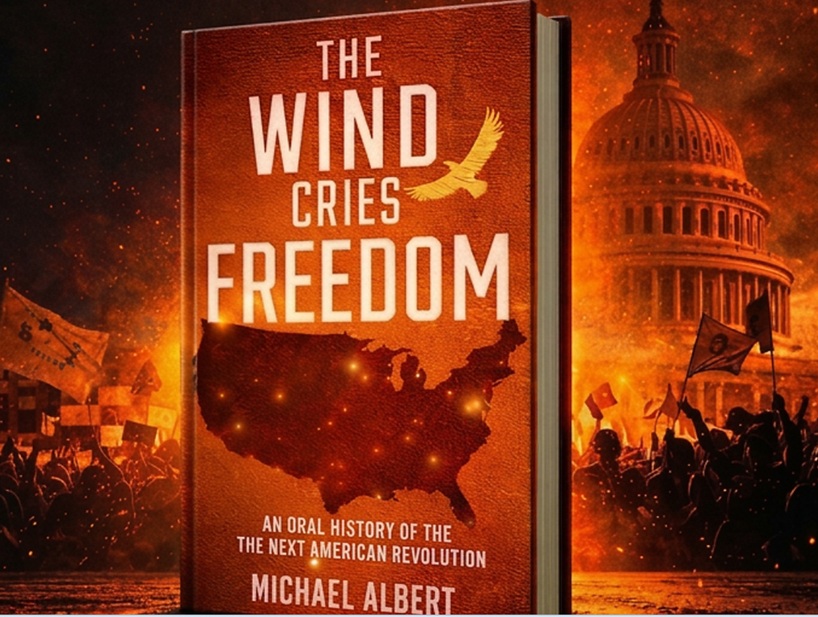
Michael Albert is interviewed here about his latest book, The Wind Cries Freedom, a fictional oral history set in the future.
Bridget: What’s in your new book?
Michael: The Wind Cries Freedom reports on a future movement that works to win a new world. The book’s imagined future interviewer, Miguel Guevara elicits tales of the interviewees’ participation in the next American Revolution. Why did they join? What did they do? What did they feel? What did they learn?
Why does the book end when the movement wins the Presidency? Is the book ultimately about electoral politics? Is that the revolution? Is that the guiding theme and goal?
No. The book’s last chapter only marked the movement having attained state power. By that point the movement had also won massive gains throughout dwellings, neighborhoods, and institutions all over the country. The book’s closing electoral victory didn’t end the revolution much less define it, it only opened a new stage of future struggle.
The future movement for a revolutionary participatory society, or RPS, first fought against old institutions. The oral history covers that. Then the project entered a new stage that would focuss overwhelmingly on building the new future, not fighting the old. Who knows, perhaps down the road some new future actors, channelled by me or whoever, will relay to us in our time the lessons of the later transitional stage of their struggle.
How tricky is keeping the timeline in mind?
For me, yes, honestly, it has been, particularly stepping back and talking about it because my mindset has been to channel Miguel and the participants the participants, not imagine them, but I hope it won’t be a problem for readers. In any case, what matters is can the lessons help us?
Alright, but why did you choose a novel, and for that matter, why now?
Unhinged, despicable fascists now seek horrific change and they must be stopped. But even when we wipe the fascists away, we will still need to replace the social structures that brought them into being. So I channeled a future oral history because we not only need to block efforts of fascists or oligarchs or whatever you wish to call them to make things horrendously worse, we also need to undertake and carry to conclusion revolutionary efforts to make things vastly better than they have ever been. Even more, the way we do the former needs to aid how we do the later.
Okay, but why an oral history? Why a novel?
I always try to convey insights and inspiration that can bear upon accomplishing immediate but also beyond that, massive fundamental change. To my way of thinking, that is the primary task of writing in our time. Aid now and aid future. But you also ask, I think, why suddenly choose fiction when you have no fiction writing experience.
It is a good question and it vexed me. Many people, including myself, write about overcoming various obstacles including not just fascism, but current perverted democracy, rapacious economy, capitalist hypocrisy, vile misogyny, hateful racism, and murderous imperialism, all topped off by suicidal ecological insanity. And many people, including myself, point to the political power of the state, the dominance of corporate centers of economic power, the pervasiveness of patriarchal norms and habits, the tenacity of racial hierarchy, as well as defenders of the existing order who repress and subvert whatever threatens their dominance.
On the other hand, not so many people write remotely as much about obstacles that we have within us that also impede our efforts. About obstacles embedded in the diverse forms of personal baggage we all carry in our personalities and habits due to living within the insane embrace of patriarchal families, schools that channel passivity, work that stifles efficacy, and a world that demands obedience, and due to the effects of all that imposed baggage on the horizons of our thoughts and aspirations.
So? Why is that relevant to the choice to employ fiction?
Well, I wanted to have people like us and like those all around us relay their experiences of becoming radical and then revolutionary. What inspired them? What did they personally feel? What did they then do? How did it unfold? And most of all what lessons did they learn that might help our own efforts in our own times? I wanted effective future revolutionaries to personally communicate with us.
But second, you asked why now? Well, why not now is one answer. Every delay in attaining a new world is more lives lost and tarnished by this world. But another answer is because, if not now, when? Each delay tends to strengthen the thought that there is no better future. Delay provokes more delay. And a third answer is, if not now, then fascist trends will likely make the task far more difficult in the future. Indeed fascism’s essential purpose all around the world is to restructure relations so that dissent and resistance much less positive fundamental change are put off forever.
Well, then, what do you think are the main obstacles to winning? You have often written about vision, what to fight for, but in this book while that is present, there is a whole lot more about what to fight against and especially how to fight effectively. So what are the main obstacles to overcome?
That is the big question. Which is why The Wind Cries Freedom is so damn long. But in a nutshell, to my eyes, what I actually think may be the biggest obstacle to our winning is not the power of the state, or the mesmerizing capacity of media, but our own doubts and harmful habits which impede hope and vision and instead impose cynicism and fear.
And that is why The Wind Cries Freedom not only addresses the technical and social possibility of a vastly better world, and not only addresses strategic and organizational ways to proceed, but also addresses interpersonal debates and differences, and personal fears, feelings, and finally personal hurdles, motivations, aspirations, and inspirations.
Guevara’s interviewees want to make real the possibility, likelihood, and even inevitability of winning if we can transcend our own histories. That is the belief that fueled the choice of an oral history, albeit fictional, instead of yet another less personal and solely analytical account.
What do you hope the book accomplishes? What do you worry might instead occur?
My hope is that The Wind Cries Freedom doesn’t become a kind of academic prop much less some kind of operating manual, but, instead that it becomes a positive pole, a sort of chime of freedom that helps open options and inspire choices, and that if it doesn’t itself do all that, then that it at least provokes discovery by others of critical insights that can do all that.
My fear for it, instead, is that it is effectively born dead, not because its substance or the sentiments of its actors are shown insufficient or misleading, but because it doesn’t reach its audience. It simply isn’t read and assessed. Many friends have told me that the idea of future revolutionaries telling their experiences is great. How can people now, they reason, who face Trump, who see the urgent need for fundamental change away from what gave us Trump, but who doubt that such change is even possible, or can be win, not hope that such a book will ease or even erase those doubts? So they tell me that the time is right for the book, the style is right for the task, and so surely people will give it a try. It will resonate and generate discussion, debate, and desire.
I hope the people telling me that are right. But the power of long-nurtured cynicism can’t be ignored. The power of hopelessness. The power of a sentiment like “been there, done that, so no thanks,” is real. Indeed, I think cynicism, hopelessness, and impatience are examples of the baggage-based obstacles I mentioned earlier. This book is meant to address how to overcome those factors that exist in our own activism. But that suggests a weird kind of complication. Does one have to have read the book, or something similar, to want to read the book? I hope not. I hope instead that it will be enough to have witnessed Trump and actors like him elsewhere and to have endured what led to him; that it will be enough to have witnessed or been part of MAGA or MAGA’s international variants and felt their impact and shortcomings as a response to the horrors of business as usual; that it will be enough to have fought against ICE and other anti immigrant projects around the world and against war; and to have known injustice in its many various forms to motivate enough desire for shared vision, shared strategy, shared methods, and shared mutual respect for people to give this oral history a chance. I guess we will see.
And for those not yet ready to give it a look, there is a book page with description, early testimonials, the table of contents, even a playlist to go with the book, and more, to consult before deciding to read it or not.
You can see Michael’s book page and buy The Wind Cries Freedom from here.

Michael Albert`s radicalization occurred during the 1960s. His political involvements, starting then and continuing to the present, have ranged from local, regional, and national organizing projects and campaigns to co-founding South End Press, Z Magazine, the Z Media Institute, and ZNet, and to working on all these projects, writing for various publications and publishers, giving public talks, etc. His personal interests, outside the political realm, focus on general science reading (with an emphasis on physics, math, and matters of evolution and cognitive science), computers, mystery and thriller/adventure novels, sea kayaking, and the more sedentary but no less challenging game of GO. Albert is the author of 21 books which include: No Bosses: A New Economy for a Better World; Fanfare for the Future; Remembering Tomorrow; Realizing Hope; and Parecon: Life After Capitalism. Michael is currently host of the podcast Revolution Z and is a Friend of ZNetwork.
ZNetwork is funded solely through the generosity of its readers.
Donate
2 Comments
Nekto, remarkable. I read your comment and wondered what I could have said in this short interview that would cause someone to write as you have not to mention to feel such confidence in your highly dismissive judgements. And I am unsure, but it seems that because along with my mentioning our nightmare problems and their institutional roots, I also mentioned the importance of the feelings, views, desires, fears, etc. of people who would or would not work to win fundamental change, you deduced that the book is “‘idealist,” whatever that might mean to you.
Then, having determined the book is “idealist”—I suspect without reading a word of it—you In turn concluded that it it must be not only useless but also harmful. That it must not be concerned with developing “well-organized, militant, massive support” for fundamental change in a context like ours. And yet, how to do that is exactly the book’s main focus.
Yes, the interviewees reject the idea that the unfolding of material relations—prices going up or down, jobs being gained or lost, temperatures rising to kill, racist and misogynist violence, vicious war, and so on—will by themselves rally the numbers we need and provide the understanding, desires, vision, strategy, and confident aspirations we need, not to mention the organizational methods we need if we are to win fundamental change. Instead the interviewees discern that activism and also organizing and organization are needed, so they describe what moved them and their movements, in their time, to reach ever more and still more new people and to attain the growth, clarity, wherewithal, and organization to win.
By the by, it has been my experience that to organize to win anything, anyone with eyes open quickly sees that success requires addressing how to organize enough “well-organized, militant, massive support” to move toward and finally attain your aims. In practice, having eyes open and being involved also reveals that to do that in turn requires addressing peoples thoughts, feelings, doubts, hopes, etc.
I should perhaps say, the book also very closely considers another line of demarcation that may—I hope not—separate you and I. That is, the widespread inclination to come to disparaging conclusions based not on the actual characteristics of what we are assessing, but on some misattributed characteristics that we impose on what we are assessing, due to our false expectations that those characteristics must be there.
I look forward to your actual reactions to the book once you have time to read it. Perhaps write a review?
One fundamental problem of the author’s approach to social (revolutionary or not) transformation is that it is philosophically idealistic, which makes it truly fictional. The major obstacles of social transformation and, most probably, its justification are found not in the objective, first of all economic, conditions of life, but in mental conditions (“doubts and harmful habits”, “cynicism and fear”, etc.), which, apparently, should be overcome by mental efforts of the “revolutionaries”. Revolution becomes a matter of “motivations, aspirations, and inspirations” of the revolutionaries, not the life conditions of the majority of the population. This is very similar to The New Left movement driven by the sentiment and irrational ideas. These “revolutionaries” can succeed only in fictional stories. It’s absolutely clear from the author’s recent articles that he firmly believes in this “mental” concept of the revolutionary development. This totally idealistic premise of the socialist revolution is not only useless, but harmful and leads exactly to the current conditions of the American pro-socialist Left that cannot get organized and united over a common, realistic and practical agenda. As a result, DSA is the only practical Left opposition, and ‘democratic capitalism’ promoted by Sanders is the only popular variety of socialism. This kind of “socialism”, which is symbolized by the New Deal, has no chance of being adopted again by the elites in the current economic, social, and political conditions without well-organized, militant, massive support, which is nowhere on the horizon. “Trumpism” is a relatively benign symptom of the aggravated chronic social disease – capitalist social-economic system, which specific conditions along with the symptoms they cause must be explored by the visions and strategies of the socialists. We should be prepared for much worse, especially if we reach +2°C within a decade.