
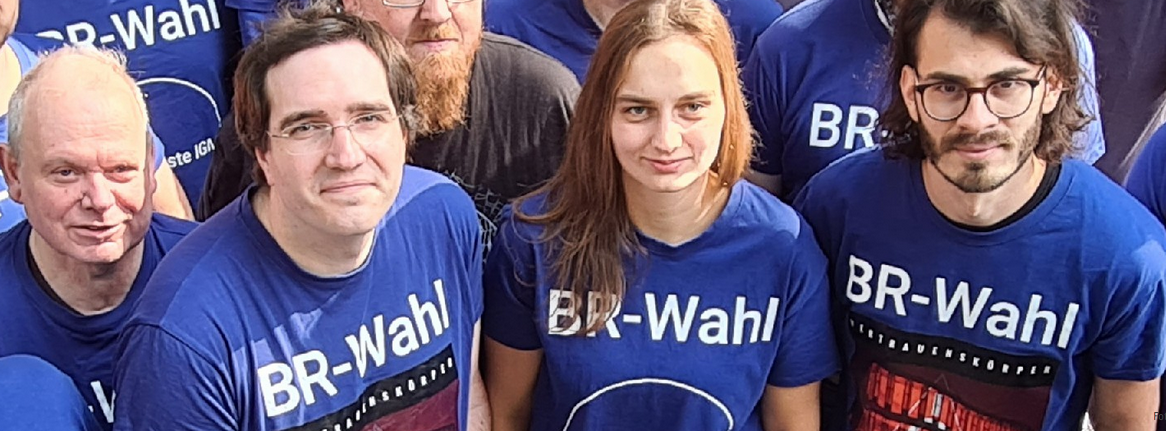
In spring 2026, elections to German works councils took place in which workers voted as workers and not as trade union members – paradoxically. Even though, at least in Germany’s all-important car industry, the vast majority of workers are union members.
Cunningly, Germany’s post-war labour relations system separates workplaces from industry-level labour relations. At the workplace level, works councils run the show, with lots of power over small issues and not much power over issues that could – even potentially – impact corporations like Mercedes-Benz, Volkswagen, BMW, Porsche and the like.
Even worse, collective bargaining has been taken out of workers’ hands and placed – safely for capitalism – in the hands of complying trade unions, which reach collective agreements at the industry level. Most German trade unions see themselves as social partners – meaning: we support capitalism.
Yet, the recent works council elections showed no shift to the right in Saxony’s car factories – a state know of far-right politics where 1/3 of all support the neo-fascist AfD. Works councils at Volkswagen, Porsche and BMW remained stable, even where the neo-fascist AfD commands around 40% voter support.
Even in far-right Saxony – also known as Dunkeldeutschland, or “dark Germany” because of its perceived remoteness – works councils continue to be dominated by the IG Metall union. The right-wing – better: neo-Nazi – lists linked to the AfD in Zwickau missed their electoral targets.
All in all, the much-trumpeted claim that German workers disproportionately vote for the AfD did not translate into votes at the workplace level. At VW in Saxony, the vast majority of the workforce continues to support IG Metall.
In other words, in both the VW plant in Zwickau and at Porsche and BMW in Leipzig, IG Metall lists remain the dominant force in worker representation for the next four years. The ambitious goals of initiatives supported by the far-right (Neo-Nazi) Zentrum Automobil (ZA) – a camouflaging name for the neo-fascist AfD – which sought a majority on the works council in Zwickau, failed significantly.
Especially the election result in the West Saxon VW plant had been eagerly awaited. The plant was once considered a pioneer stronghold for neo-Nazi organising. After all, it was this factory that was the first to be completely converted to the production of electric vehicles.
However, recently the VW corporation has slipped into crisis. Management plans to close the factory had circulated – though these are off the table for now. It is not uncommon for corporate management to operate with threats in order to domesticate workers.
Discontent within Volkswagen’s workforce – especially after many temporary workers were recently laid off – remained significant. The struggle for the future of the plant appears to have been partially successful, however, as the majority of the 8,200 workers remain employed. As for IG Metall – even if its popularity has dipped slightly – the union remains strong.
In the works council election, the union received a solid 81% and secured 29 of the 35 seats. In the previous regular vote, the union had achieved 93%, holding all 35 seats out of 37. The number of works council members is regulated by Germany’s Works Constitution Act and reflects the size of the workforce.
At that time, VW employed more workers. When the workforce shrinks, so too does the number of council members. Capitalism does not want too much democracy inside its factories – not that workers get funny ideas about living in a democracy. Certainly not in the place where you spend eight hours a day.
A 2025 election had become necessary following a successful lawsuit against the previous vote, brought by two works council members from the neo-Nazi Zentrum Automobil. This right-wing yellow union has long been represented at VW Zwickau.
In the recent election, the neo-Nazis ran under a concealing umbrella organisation called the Association of Free Works Councils. Just like the AfD itself, its operatives no longer wear uniforms but business suits. AfD apparatchiks at work do not openly proclaim their neo-fascism. Disguised as free works councillors, they aimed to secure a majority. Just like in Orwellian Doublespeak, free in the context of the AfD means the exact opposite. The term free means being beholden to far-right ideology and corporate management.
Plans to convert the region’s works councils into instruments of AfD-aligned neo-fascist networks had been outlined in advance by leading candidate Lars Bochmann – a VW worker and AfD operative who openly embraces his politics. Bochmann also sits on the city council of the 20,000-strong town of Aue-Bad Schlema. Yet the neo-Nazis’ high-flying ambitions clearly failed.
As in a similar election last year, the AfD-linked list secured only around eleven percent. Another two mandates went to a list called “The Other List,” which received a meagre seven percent.
Meanwhile, IG Metall struck a combative tone following its electoral success. This is a clear signal from a workforce that remains largely united behind its union, despite massive challenges, uncertainties, and attempts to divide workers between supporters of democracy and authoritarianism.
This result strengthens trade unions ahead of upcoming disputes over the future of automotive production sites. IG Metall has declared its intention to do everything possible to secure these locations beyond 2030.
At the same time, IG Metall’s works council at VW Zwickau faces difficult conditions amid declining profits – profits, not workers’ livelihoods, being the central concern. In Volkswagen’s Leipzig plant, IG Metall received 66% of the vote, securing 21 of 31 seats. At BMW Leipzig, 19 of 31 works council members come from IG Metall.
The works council chair noted that an absolute majority of workers voted for IG Metall – despite an unprecedented number of competing lists. The AfD-linked Zentrum Automobil gained one additional seat. But with only two representatives, its influence remains marginal.
In the 2018 election, the right-wing grouping had already secured four seats at BMW and two at Porsche. Still, it remains far from its stated goal of breaking IG Metall’s dominance. That did not happen in Leipzig – much to the frustration of ZA figure Oliver Hilburger. Before all that, Hilburger was part of a Neo-Nazi band Noie Werte, spoke at a Neo-Nazi Compact rally and fancies to show up with Austrian top-neo-fascist Martin Sellner of the Wannsee 2.0 meeting.
Having successfully defended against far-right advances, IG Metall expressed relief in Leipzig. The results show that even in difficult times, the vast majority of workers rely on unity, cohesion, and collective strength – against both corporate management and the far right.
Across Germany’s car sector, works council elections delivered around 80% support for IG Metall, despite what are widely described as “difficult times” – or, more plainly, the recurring crises of capitalism. Roughly 2,300 out of 2,900 works council seats went to IG Metall.
While elections continue until May 30, the overall trend is clear: at the workplace level, German workers prefer representatives linked to trade unions. Crucially, they rejected the neo-fascist AfD. The far right failed to make meaningful inroads into workplace representation. Nazism did not win.
While Germany’s petty-bourgeois press – sometimes not without reason – asks why more workers are voting for the AfD, this trend did not carry over into works council elections. By mid-April, the 2026 works council elections in the automotive industry were largely complete. The AfD’s hoped-for rightward shift failed to materialise.
A similar pattern emerged at Porsche, where the union list Team IG Metall won 66.3% of valid votes on March 11, securing 21 of 31 seats. Voter turnout rose significantly to 64%. At BMW Leipzig, IG Metall also achieved a majority, winning 19 of 35 seats with a turnout of 69%.
However, what appears to be a strong victory is, in historical perspective, more mixed. In many West German car plants, IG Metall once represented close to 100% of workers. While union-backed lists still dominate, the presence of far-right lists introduces division and offers management potential leverage.
In West Germany, preliminary results from the Mercedes plant in Untertürkheim show IG Metall winning 31 of 43 seats (72%). The AfD-linked ZA list secured nine seats. Pro-business “yellow” lists gained a smaller presence.
The AfD’s list gained two additional seats compared to 2022. Operating under the name Zentrum Automobil, this far-right anti-union grouping traces its origins back to 2009 at the Mercedes plant in Untertürkheim.
At the Mercedes plant in Sindelfingen, 61.4% of workers participated in the election. IG Metall secured 48 of 57 seats with over 80% of the vote. The AfD-linked list gained a small foothold with three seats.
Meanwhile, at Volkswagen’s Osnabrück plant, IG Metall won over 92% of the vote. In Emden, it secured 85.1% and 31 seats. Smaller anti-union and conservative groupings gained only marginal representation.
Overall, these results show that IG Metall-backed works councillors have largely fended off the far-right challenge in Germany’s car industry. In no major plant did AfD-linked lists come close to securing a majority or transforming works councils into instruments of management or far-right influence.
However, there is a downside. In many plants, discussions among unionised workers will increasingly move out of official works council offices, as AfD-aligned representatives gain seats. Strategic conversations may shift to informal spaces – lunchrooms, locker rooms, and quiet corners. This complicates organising, but it will not stop union representatives from continuing their work.
Thomas Klikauer has over 1200 publications (including 16 books) and writes regularly for Cross Border Talks ( Europe), Countercurrents (India), and ZNet (USA) on global warming, labor relations, and Germany’s far right.
ZNetwork is funded solely through the generosity of its readers.
Donate