
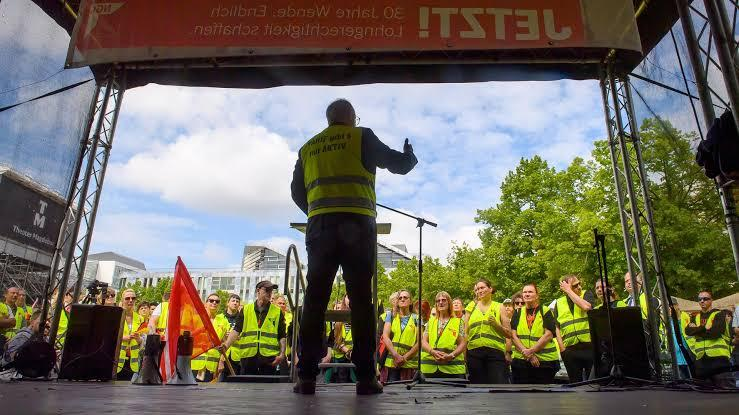
In times of crisis – which is pretty much all the time under capitalism – workers and trade unions are placed under additional pressure by corporate bosses, business-supportive media, and conservative governments. Deliberately, this creates fear in workplaces and across industries. Fearful people are easier to manipulate.
All of this is good news for corporate lobbyists and conservative government representatives hooked on the expansion of Germany’s arms industry. While the general public is fed the ideology of “empty coffers” and hospitals are told to save money, no longer putting patients at the center but instead focusing on profitability and the bottom line, German schools aren’t renovated and, worse, the infamous “debt brake” is presented as an absolute necessity.
Now – suddenly – billions of euros are promised for war-making material. German industry and German politicians know: “If you want to kill people, you need stuff.” Germany’s armaments industry is here to supply this – as always.
Meanwhile, corporate-military shareholders are cheering as they see the rising share prices of so-called “defense companies”. Evil heretics might ask: didn’t Germany invade neutral Belgium, thereby helping to start the First World War? And didn’t Germany invade Poland to start the Second World War? Never mind.
Then, as today, there is always more profits to be made for German arms makers. Recently, corporate bosses declared their intention for up to 100 workers at the automotive supplier Continental in the northern town of Gifhorn to move to the newly established Rheinmetall munitions factory.
Meanwhile, the German-French tank maker KNDS has taken over a railway factory in eastern Germany’s Görlitz from the French locomotive manufacturer Alstom. These are just two of the many examples showing the profound change emerging in Germany’s industrial landscape. In short: more arms and less civilian manufacturing.
Many workers are clear on this: such “upgrades” do not provide peace. Worse, increasing expenditure on the military tends to lead to cuts in the social, cultural, health, and education sectors.
In present-day Germany, a lot of the funding for war-making equipment comes from what politicians have euphemistically labelled a “special fund”. It is political trickery to bypass a self-imposed brake on state debt. Eventually, the money borrowed for arms must be paid back.
For staunchly conservative Chancellor Merz, it is not to be financed by a wealth tax or higher inheritance taxes for the rich. In the logistics of war, many workers see war not only from a distance. Being employed in the freight traffic of Germany’s railway – Deutsche Bahn, for example – workers are directly involved in the transportation of military machinery. Every day, German railway workers make decisions about whether or not to transport military equipment.
At times, this is framed as the protection of their “own” country – even though workers own very little of “their” country. At other times, these transports are conducted for wars in other countries. Yet some works council members – for example, at the railway’s cargo division, DB Cargo – are here to give a helping hand, saying: “We can already say that armaments and weapons deliveries do not concern us.” For some of these works council members, it is simply the execution of a job.
Still, for many workers, the transport and production of arms is not desirable. Instead, they favour the redistribution of wealth, the expansion of public infrastructure, and the reconstruction of industry towards a foreign policy geared towards peace.
Correctly, IG Metall argues that every single euro put into armaments disappears and is therefore unavailable to be spent on good education, good pensions, and financing public services in Germany. Simultaneously, workers have been convinced by Germany’s commercial media that there is no alternative. This fits Germany’s political shift to the right and strengthens Germany’s military – and, worse, militarism.
Meanwhile, Germany’s industrial landscape is being changed by corporations and Germany’s conservative government. There are acquisitions of formerly civilian establishments and plants by arms corporations. Examples include:
The acquisition of Wismar’s MV Shipyard by arms maker ThyssenKrupp Marine Systems (TKMS).
FSG was taken over by the Heinrich Rönner Group.
Nobiskrug was taken over by the Lürssen shipyard.
Prime armament maker Rheinmetall is interested in one or two VW plants.
In Görlitz, the railway carriage manufacturer owned by Alstom went to the tank maker KNDS.
There is the “cooperation” between the tyre manufacturer Continental and Hensoldt and Rheinmetall.
Worse, formerly entirely or largely civilian companies are now involved in armaments production.
Virtually the same has happened to the Vileda manufacturer, Freudenberg, which, after its use of forced labour for production in Hitler’s war machine, was prohibited from making arms again – at least until now.
Simultaneously, the Ditzingen-based Trumpf Group, which in its 102-year history had nothing to do with armaments, has now entered the arms field.
In addition, Heidelberger Druckmaschinen has also set its sights on making military equipment.
The same goes for automotive supplier Schaeffler and carmaker Porsche.
Despite this grim picture, there are options for conversion towards alternative products. Making machines for warfare is not inevitable. If trade union representatives and works councils seek to act against the prevailing drive towards war-making, they are facing a difficult task. Options for this are offered in Germany’s Works Constitution Act (BetrVG).
These legal options are a policy instrument that can be linked to production geared towards peace, not war. This, in turn, can be developed into convincing arguments for the workforce. For example, a works council has the legal right to take the initiative to secure and create employment in accordance with §92 of the BetrVG.
A proposal — according to §92 BetrVG — can include an alternative to a production and investment program designed to manufacture arms. Such a union-based proposal can then be used as an alternative to management proposals for the planned conversion of production to armaments. It can provide a platform for works council negotiations with management.
A works council can propose that the conversion to arms production is not inevitable. German unionists understand “conversion” as the conversion of production from military to civilian use. This means, for example, converting the production of military tanks into the production of locomotives.
Under German labor law, management is obliged to discuss such suggestions with the works council. If management considers the proposals of a works council inappropriate, it must justify this.
Works councils can use this to make clear that alternatives are possible, showing that other goods — rather than military goods — can be produced. The British example of Lucas Aerospace remains useful in this regard. In Germany, the Works Constitution Act provides rights and obligations for works councils and management that can, for example, support a Lucas Aerospace-style non-military conversion.
Accordingly, German works councils — according to §2 BetrVG — are to engage with management on the basis of “trust and cooperation”. Worse, it stipulates that “party politics” are not permitted. In other words, the self-invented “right to manage” triumphs over democracy.
It gets worse: works councils have no co-determination rights over business decisions. This extends to management’s decision to convert an automotive supplier to military production. In short, German works councils have the full right to decide which tea towels are used in the canteen, but no rights over business decisions. The entire charade is then framed as workplace democracy, co-determination and social partnership.
Yet it still gets worse. Military production is not only framed as critical infrastructure but is also covered by secrecy — military secrets or even “strictly secret” information. To ensure this and to eliminate union involvement, Germany’s conservative government — historically always supportive of war — has issued a “Merkblatt zum Geheimschutz in der Wirtschaft”, a guide for management to use “military secrecy” as the ultimate justification.
Despite the seemingly overwhelming power of Germany’s conservative government, supportive media and profit-driven companies, unions and works councils can fight the militarization of companies.
For this, they can start a process that might be called “ideas management” to develop alternatives to arms production and ideas for new products. These ideas can be developed within a company, for example by involving shop-floor workers. They can also be developed in works council meetings.
The workforce should not be forgotten in this process. Workers should be encouraged to submit proposals.
Calls for such input can be made via a company meeting, personal contact in affected departments, and an intranet, as well as on commercial — albeit union-run — online platforms such as Facebook, Instagram, etc.
Works councils can work on innovations together with workers, who can be consulted as advisers according to §80(2) of the Works Constitution Act.
At plant-wide company meetings, information can be provided about plans to develop alternatives to arms production.
The workforce should also be encouraged to consider these ideas and submit proposals to works council members.
On the bright side, works councils have extensive rights to obtain information from management. This is of great importance to works councils. For example, the interests of workers can only be effectively represented if the works council has an overview of management’s “military conversion” plans. Simultaneously, the mobilization of workers can only succeed with a corresponding level of knowledge about company developments.
The quest for information is not automatic. Rather, works councils often have to request documents. However, if an employer is planning to switch to military production, the effects on the workforce must be presented. Inevitably, this will have an impact on the workforce.
Such information includes personnel planning under §92(1) of the Works Constitution Act. Since the core of personnel planning can only be derived from the company’s objectives, it is therefore closely linked to production, sales and investment planning. This information is important for a works council.
Equally, the level of planned production can have a significant impact on the number of employees required. If new manufacturing processes or working methods are introduced, employees may require additional qualifications. All of this involves the works council.
Meanwhile, workers should also be aware of which works council member is available on-site to answer questions. Works council proposals to move from military to civilian production can demonstrate to a company that the ideas presented by the works council align with those of the workforce.
According to §112(1), employers must consult with works councils regarding a planned operational change and seek a reconciliation of interests. The negotiations primarily concern three questions:
Whether: whether the actual implementation of a measure goes ahead.
When: when such an implementation takes place.
How: how the implementation affects the operational change and the workforce.
In the end, Germany’s works councils have ample opportunities to prevent management from moving towards the production of killing machines for war. Yet works councils can also offer alternatives to military production. German labor law provides the necessary framework. All it needs is a willing works council and supportive workers, and a move towards military production can be prevented.

Thomas Klikauer has over 1200 publications (including 16 books) and writes regularly for Cross Border Talks ( Europe), Countercurrents (India), and ZNet (USA) on global warming, labor relations, and Germany’s far right.
ZNetwork is funded solely through the generosity of its readers.
Donate