
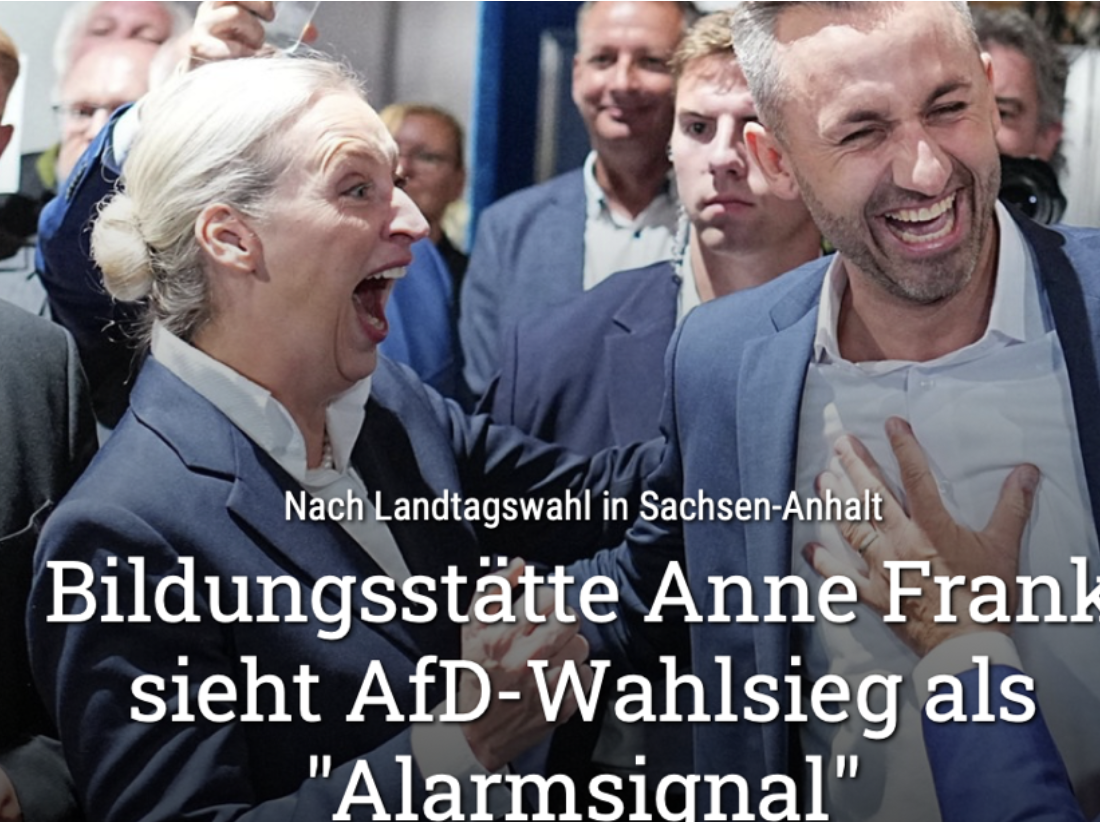
In the 2026 September election in the small East German state of Saxony-Anhalt, the former Neo-Nazi Ulrich Siegmund and his AfD party won a whopping 44%. It is very likely that, behind closed doors, Ulrich Siegmund is greeted by his adoring worshippers with “Sieg, Sieg, Sieg” — a reminiscence of Hitler’s “Sieg Heil.”
Meanwhile HJ-Siggi was not only an active member of a Neo-Nazi organization called “Heimattreue Deutsche Jugend” (HDJ) but also took part in Neo-Nazi training camps in his youth. Germany’s more recent HDJ was ideologically close to Hitler’s HJ (Hitler Youth). For Germany’s otherwise rather inactive secret police (the Verfassungsschutz, VS) when it comes to Neo-Nazism, the “HDJ-equals-HJ” conclusion was a bit too much — even for the Verfassungsschutz.
Siegmund’s beloved HDJ was made illegal in 2009. This did not mean that the HDJ-Neo-Nazis suddenly vanished. They continued to exist and they continued to be Neo-Nazis,
While missing the infamous baseball-bat years when East German Neo-Nazis ran the streets with brutality during the 1990s, HJ-Siggi was born in 1990. Yet he still had ample time to train with the HDJ before his 19th birthday and the time when the HDJ ceased to exist.
HJ-Siggi was forced to start looking for a new Neo-Nazi organization. Neo-Nazis always long for Mussolini’s “fasci” binding likeminded thugs together in the Fasci italiani di combattimento. HJ-Siggi found his fasci di combattimento in the 2013-founded Neo-Nazi party, the AfD. His new outfit was no longer marked by camps and violence. Instead, HJ-Siggi started to dress smart and adjusted his language.
In 2026, HJ-Siggi’s ideological and strategic HDJ training and his rise to Gruppenführer in Saxony-Anhalt’s AfD eventually bore fruit. He almost matched his idol.
In July 1932, Hitler’s Nazi party received 45% in the little Anhalt that had just 230,000 voters, of whom a staggering 92% turned out, about half voting for Adolf Hitler.
Ninety-four years later, in Saxony-Anhalt only 78% of the 1.8 million voters went to the polls in a 2.1-million-strong East German state. In other words, HJ-Siggi’s 44% was just 1% less than the 45% Adolf Hitler received 94 years earlier.
Perhaps Hamilton‘s “Who Voted for Hitler?” was not wrong. Nazism was also a völkische movement housed in the north and east of Germany rather than in Adolf Hitler’s southern homeland of Bavaria.
In Saxony-Anhalt, the virus of Nazism seems to have been dormant during decades of state socialism (1949–1990) as well as for 36 years (1990–2026) of “democracy” delivered to East Germans after Germany’s reunification in 1990. In short, voting for an anti-democratic political party like the AfD comes easier to East Germans than to West Germans.
Unlike West Germans, who received democracy during a time of tremendous economic prosperity, East Germans got democracy from the West in 1990 and, worse, it came with the ravages of neoliberalism, widespread poverty, mass unemployment, and declining infrastructure. On top of that, East Germans were not exposed to democracy between 1949 and 1990 — more than four decades.
Meanwhile, Germans like to pretend that not all of the 44% who voted for HJ-Siggi in 2026 were Neo-Nazis, just as Germans like to pretend that not all of the 45% who voted for Adolf Hitler in 1932 were Nazis. But what if they were? What if many of Hitler’s 45% knew what they were voting for? And what if many of HJ-Siggi’s 44% knew what they were voting for?
In both cases, the state election was (1932) and is (2026) an expression of a profound polarization between Neo-Nazism and democracy. While German officialdom likes to call them “the extreme right,” one might also call a spade a spade. These were Nazis and are Neo-Nazis. Yet in both cases, they fell short of an absolute majority — Hitler by 5% and HJ-Siggi by 6%.
Today, more than in 1932, the election is being described as “triggering a political earthquake.” Oh gosh! Suddenly, Germany discovers that it has Neo-Nazis! Neither Adolf Hitler in 1932 nor HJ-Siggi in 2026 was or is able to form a government outright.
The state election in Saxony-Anhalt on 6 September 2026, as in Adolf Hitler’s election in 1932, indicates a desire for fundamental change — not for the better. Perhaps almost half of all Germans hold Neo-Nazi attitudes – one way or the other. Dealing with its Nazi past failed in both cases.
In West Germany, a handful of show trials like the Auschwitz Trial camouflaged what Nazi hunter Fritz Bauer called “one dead Jew equals ten minutes prison.” Worse, by mid-to-late 1944, Hitler’s Schutzstaffel (SS) had somewhere between 800,000 and 910,000 members. Most were not even asked what they did in German concentration camps. Instead, thousands of Nazis re-entered Germany’s economic, political, cultural, and state institutions during the 1950s in a process known as “Re-Nazification.”
Meanwhile in East Germany, things were not much better. Founded by the survivors of Nazism, the people of East Germany became — automatically — antifascists. As a consequence, no dealing with the past was deemed necessary, other than to say that Germany’s Nazis were now in West Germany — a not totally wrong assumption. Today, when AfD voters are told to have voted for a Neo-Nazi party, the response is “there are no Neo-Nazis here”.
Given all this, Germans today talk of a “political earthquake” — suddenly Neo-Nazis win big. In a country that denied its own Nazi past, this created “shock waves.” The official version is that 43.8% (the exact number is presented just as Auschwitz recorded exact numbers, something that Germans are good at) of these voters decided for the “right-wing extremist” (avoiding the word “Neo-Nazi”) AfD, which gained an additional 23 points.
Of course, the ruling CDU’s punishing drop to 17.2% had nothing to do with Kohl’s lie that blooming industrial landscapes would arrive with western capitalism. It got him elected. Distrust in democracy rose while East Germans experienced the cold intimacies of capitalism, and what Case and Deaton diagnosed as the despair of capitalism.
Perhaps fittingly, the political party most representative of neoliberal capitalism, the FDP, was eliminated in Saxony-Anhalt from the state’s parliament. The once-mighty social-democratic SPD working-class party is floating at a measly 9%. Rather unexpectedly, the environmentalist Greens won a clear 9%.
Meanwhile, the more socialist Die Linke lost again, hovering around 8.6%. Most interestingly, the extremely unpredictable BSW cleared the 5% hurdle and is represented in Saxony-Anhalt’s parliament. The BSW might be a mixture of national Bolshevism and Otto Strasser’s socialist Nazism, or something like that.
All in all, this translates into the following distribution of Saxony-Anhalt’s 83 parliamentary seats: CDU: 15; AfD: 39; Die Linke: 8; SPD: 8; The Greens: 8; and BSW: 5. Tellingly, a recent photo of the AfD’s 39 delegates showed 37 (mostly) old men and just two women. In other words, AfD delegates mirror its voters: old men. Apart from the AfD’s pretty face of neofascism, the Swiss lesbian Alice Weidel and figurehead Beatrix von Storch – after all, her grand-daddy was Hitler’s finance minister von Krosigk – the AfD is a party of old men.
Meanwhile back in Saxony-Anhalt, the fact remains that only if all democratic parties work together (with 44 seats) can the Neo-Nazi AfD (39 seats) be prevented from taking power — or what HJ-Siggi might call “the Machtergreifung.” HJ-Siggi’s Machtergreifung would camouflage what occurred in 1933. The way Adolf Hitler got into power — as his Nazi party failed to reach a majority — was with the help of Germany’s conservatives.
Then as today, Germany’s conservatives avoid being reminded of their historical failure. The Nazi ideology of a Machtergreifung became a handy tool to smokescreen reality. Then as today, Adolf Hitler (then) and HJ-Siggi (today) needed another political party to get into power.
Beyond all that, many surveys in Saxony-Anhalt throughout 2026 recognized that the AfD would be by far the strongest power in the state elections in Saxony-Anhalt.
This is the AfD that the Verfassungsschutz classified as radical-right extremist — not Neo-Nazi. Publicly, the AfD is called a far-right extremist party, as if this would have an impact. It did indeed have an impact: East Germans voted strongly for the AfD.
While Adolf Hitler had a compliant press and a propaganda minister, both Adolf Hitler and HJ-Siggi operate with targeted misinformation and what we today call fake news. In 1932, there was no Jewish World Conspiracy holding Germany in its grip. Today, there are no migrants overrunning HJ-Siggi’s beloved Volksgemeinschaft.
HJ-Siggi was a zealous participant in what was officially called the “Potsdam Treffen” (2023), a meeting that planned the “remigration” of all those not belonging to the Volksgemeinschaft. Located close to the Wannsee — as deliberately planned by Germany’s AfD Neo-Nazis — the meeting is, in German officialdom, not called the “Wannsee Conference” but the “Potsdam Treffen.” It should not allude to Heydrich’s Wannsee Conference (1942), which planned the deportation and murder of six million Jewish people. In short, Wannsee became Potsdam and Conference became Treffen. Germany’s Nazi past vanishes into thin air — once again.
During the election campaign in Saxony-Anhalt, and lacking Hitler-style street thugs like the SA, the AfD was forced to resort to “hybrid attacks” to delegitimize Germany’s democracy. The process was spiced up by AfD politicians and Neo-Nazi influencers flooding online platforms. As Donald Trump’s strategist Steve Bannon once put it, flood the zone with shit.
Beyond that, the AfD has managed to channel dissatisfaction with capitalism and Germany’s state government against Germany’s democratic political parties. What assisted Adolf Hitler just as it assisted HJ-Siggi is that Saxony-Anhalt has structurally weak rural areas with a struggling and ageing male population left behind by those who have moved to West Germany. The AfD is a party of old men. Tellingly, a reporter on election night made the comment that he was surrounded by 80% men.
Meanwhile, not only supporters of the AfD see, more often than not, that “the way of life” — meaning the Volksgemeinschaft — is threatened, as nostalgia is mixed with the memory of a mostly white East Germany that existed between 1949 and 1990. Today’s foreigners in Germany, who exist elsewhere but not in Saxony-Anhalt – with just 1.6%) – are constructed as a threat by the AfD.
This is the problem of perception: the German Neo-Nazi does not need a migrant next door to hate all non-Germans. The opposite is the case — the less engagement with non-Germans, the easier it is for Neo-Nazis and the AfD to construct them as “the enemy.”
Yet those Germans call “AfD followers” (and not Neo-Nazis) are fundamentally different from supporters of Germany’s democratic parties. It is AfD vs. the CDU, the SPD, Die Linke, and the Greens — democratic parties vs. a Neo-Nazi party.
In other words, the AfD in Saxony-Anhalt is, in almost all regions, social strata, and groups of the population, the dominant force. The AfD won 38 of the 41 constituencies. Only in three urban constituencies did Die Linke win a mandate.
Important in all this was the AfD’s local Führer, Ulrich Siegmund. Four out of ten AfD voters decided to vote Neo-Nazi because of him — the eternally grinning Neo-Nazi.
The Führer was more important than the horror of the AfD’s party program. HJ-Siggi’s AfD positioned itself once more as a radical counterproposal to what it contemptuously calls the “old parties” — meaning Germany’s democratic parties. The pro-HJ-Siggi excitement was further cranked up through the AfD’s ability to be the central agenda-setter. All of Germany’s democratic parties were forced to react to the AfD’s racism. The AfD clearly dominated the media landscape in Saxony-Anhalt.
After a radical drumbeat kicked off the campaign, top candidate Ulrich Siegmund and the AfD in Saxony-Anhalt strategically — and to nobody’s surprise — ran a content-poor campaign strong on promises, catchy slogans, and sensationalism.
Family-style festivals and “Simson trips” (the nostalgic symbol of East Germany) with like-minded Neo-Nazis (no longer dressed in black), along with rafts of positive messages, advanced the nationalist-xenophobic program of the AfD. The AfD created the impression of supporting ordinary people, or, as the AfD says, “people nearby.”
In this way, the radical far-right reconstruction of the AfD translated into emotions, and therefore its Neo-Nazism became less visible than what was announced in the AfD’s election program.
HJ-Siggi’s campaign strategy was based on the slogan “Anything Is Possible.” It stood in contrast to the usual AfD rhetoric of how bad things are and that Germany is looking into the abyss. The underlying motto of the AfD in the past was “the worse things are in Germany, the better for the AfD.” Not so with HJ-Siggi. He represented a Hitler-like optimism that Germany can be fixed, or, as Donald Trump once said, “I alone can fix it.”
This updated communication strategy of the Neo-Nazi AfD can be described as feel-good Neo-Nazism. HJ-Siggi has applied this in Saxony-Anhalt consistently. This is further enhanced by the Siggi factor.
With Ulrich Siegmund, the AfD had a top candidate whom Germany’s media talked about more than the party itself. In the election campaign, that was a clear advantage. HJ-Siggi might well be the Führer the AfD never had — so far. That is especially the case compared with Björn Höcke in Thuringia, who used to feature under his Neo-Nazi code name, Landolf Ladig. Rather than the highly ideologically motivated and awkward Höcke, HJ-Siggi is a consensus candidate. Siegmund is presented by the media as everybody’s darling and as moderate.
The selfie candidate dominates well-attended campaign events, selling himself as a down-to-earth candidate in his performance. HJ-Siggi does this very successfully.
With this domineering presence during the AfD’s election “events” and his smooth-talking communication strategy, Siegmund makes people feel that they are part of a political awakening — an updated “Deutschland Erwache!” of Adolf Hitler.
HJ-Siggi has greatly contributed to a right-extreme movement based on his key message that “we are making history!” — empty but effective. Add to this HJ-Siggi’s skillful use of social media, and the AfD’s new Führer comes alive.
At the center of HJ-Siggi’s election campaign was the fabrication of a sense of community — a community that existed between 1949 and 1990 but was destroyed by western capitalism. In 2026, HJ-Siggi presented himself as the leader of a newly awakened people’s community — the Volksgemeinschaft. This is no longer the imagined socialist community of Erich Honecker, but the Neo-Nazi’s imagined community of an Aryan Volksgemeinschaft.
HJ-Siggi spiced this up with a spirit of optimism and the promise of salvation under his slogan “anything is possible.” HJ-Siggi’s campaign framed the choice as a “Vision 2026,” focused on mobilizing supporters and voters.
The propaganda of “everything is possible” provides for a homogeneous people’s community, putting its interest — as represented by HJ-Siggi — first. There would no longer be a need for refugee support programs, for minorities and queer people, for civil society, or for instruments to deal with global warming. All of these can be cut. Then, so the propaganda of HJ-Siggi goes, Germany would again be enough for itself. HJ-Siggi’s call for a community — the Volksgemeinschaft — is always and exclusively the exclusion of “the other”, the stranger, the enemy.
The others to be excluded, of course, means Jewish people. One of the most respected voices of Jewish people is the Charlotte Knobloch, the former president of the Central Council of Jews in Germany. In August 2026, the 93-year-old Holocaust survivor warned that the AfD is increasingly resembling the Nazi Party before its rise to power.
She noted that that Hitler’s NSDAP and HJ-Siggi’s AfD cannot be equated, but they should be compared. Charlotte Knobloch argued that the AfD, like the NSDAP in its early years, has been testing the boundaries of what is politically acceptable while gaining support as its positions become increasingly radical.
Despite the staging of a feel-good election campaign that was extreme right-wing in character, the Neo-Nazis of the “baseball bat generation” feature disproportionately in HJ-Siggi’s entourage.
Yet there are no longer openly displayed Nazi tattoos. Still, HJ-Siggi is proud to have a network of Neo-Nazis and the fascistic-racist Identitarian Movement behind him. One of the key strongmen in this network is HJ-Siggi’s close associate Hans-Thomas Tillschneider — the strategic brain behind the grinning HJ-Siggi.
Many of these Nazi-boys go back a long time. AfD top candidate Siegmund used to sell perfume before he mutated into a far-right Neo-Nazi politician in Saxony-Anhalt, where he learned to fight for victory by any means necessary — fair or not.
HJ-Siggi is the soul-catcher who goes way beyond the AfD’s recently renamed youth organization, now called “Generation Deutschland.” At HJ-Siggi’s events, of course, there are selfies with him. There are plenty of promises from the always-beaming, smirking HJ-Siggi. Usually, these processions are followed by the obligatory autograph session. The charismatic top candidate dominates the crowd.
At the time, Siegmund’s top right-wing influencer was the self-appointed “action man” Matthäus Westphal, who streams hours of live YouTube video of HJ-Siggi. Westphal, who has been convicted of incitement, rallies enthusiastic AfD supporters. He claims that German values are being stabbed in the back by foreigners. At these AfD events, T-shirts bearing the imprint “I love Rechtsruck” (“I love the far-right shift,” with the shape of a heart) are sold.
Westphal’s Neo-Nazi language is nothing like Siegmund’s. HJ-Siggi prefers the smooth talk of a modern politician. It worked. HJ-Siggi got close to Adolf Hitler’s 45% in Saxony-Anhalt. If HJ-Siggi gets into government, Saxony-Anhalt might well become known as Nazi-Anhalt.
Thomas Klikauer has over 1200 publications (including 16 books) and writes regularly for Cross Border Talks ( Europe), Countercurrents (India), and ZNet (USA) on global warming, labor relations, and Germany’s far right.
ZNetwork is funded solely through the generosity of its readers.
Donate

