
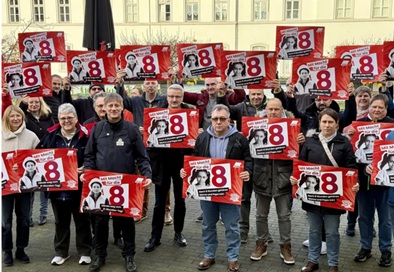
In recent weeks, Germany has experienced a targeted attack by Germany’s powerful employers and the ultra-conservative and super-neoliberal government on one of the key achievements of not only the German working class: the eight-hour day.
This struggle dates back well over 100 years. Before 1900, the battle for the eight-hour day received great momentum at the Geneva Congress of the International Workers Association (IAA) in 1866. It involved well-known figures such as two of Germany’s finest: Karl Marx and Friedrich Engels.
The goal was the creation of an internationally recognized legal introduction of an eight-hour working day. In 1869, this demand was introduced into the Eisenach Program of the Social Democratic Workers’ Party. In 1885, it appeared in a draft law on labour protection pushed by social-democratic parliamentarians in the Reichstag, Germany’s parliament.
The Degussa company, a gold and silver refinery in Frankfurt am Main, Germany, introduced the eight-hour day in 1884. Degussa was ahead of the game. Meanwhile, in the UK, the eight-hour day was introduced in 1889 at the Beckton Gas Works in the East End of London.
Back in Germany, the eight-hour day became law in 1918. After four years of senseless bloodshed for the Kaiser during World War I, revolutionary workers forced capital to make several concessions in order to prevent a workers’ revolution.
After Germany had started and lost the First World War (1914–1918), and with the beginning of the November Revolution, the capitalism-appeasing social democrat Friedrich Ebert, backed by his bloodhound Gustav Noske, the so-called Majority Social Democrats, the capital-accommodating sections of Germany’s trade unions, and, of course, Germany’s deeply reactionary employers worked in cahoots.
Together, they drew up – especially Germany’s massive arms industry – an agreement to prevent the formation of a democratic workers’ republic that would have ended capitalism. It became known as the Stinnes–Legien Agreement of 15 November 1918. With that agreement, the eight-hour day came into effect across Germany’s steel and armaments industries.
While workers got the eight-hour day, capitalism got something more important. It secured its existence. The revolution was averted—capitalism had won. In his 1973 book, Sebastian Haffner would call it The Betrayed Revolution: Germany 1918/19, while workers started singing: Wer hat uns verraten? Sozialdemokraten! Who has betrayed us? Social Democrats!
With capitalism secured, the minor concession granted by capital was that what workers and trade unions had fought for over so many years became reality: the eight-hour day with full pay for all workers, without distinction of age or gender.
However, it did not take capital long to take revenge on German workers. Already in 1923, German capital achieved a major success. The now-legal eight-hour day was undermined again. Germany’s Working Time Regulation of 21 December 1923 permitted, in addition to the eight-hour day, a ten-hour day.
Besides the struggle over collective bargaining rights, working time in Germany continued to be a field of political and union struggle throughout the years from 1923 to capitalism’s so-called world economic crisis of 1929 and beyond. Much of this forced Germany’s trade unions into accepting a “significant modification” (read: workers lost) of Germany’s 1923 working-time scheme.
With the Nazis came worse. They introduced a new working-time regulation in July 1934. The Betriebsführer – the fascist leader of a company – could, and of course did, extend working hours far beyond eight hours. These corporate mini-Führers made such extensive use of this power that the eight-hour day was practically abolished.
Cunningly, Adolf Hitler’s Nazi Party even featured the words “socialist” and “workers” in its name: the National Socialist German Workers’ Party. The trickery worked. Rafts of German workers voted for the pro-business, anti-Semitic, and war-making Nazis and paid a bitter price.
Worse was to come. The Nazis’ working-time decree of April 1938 considerably expanded exemptions from the eight-hour day. During the Nazis’ war against Germany’s neighbours and beyond (1939–1945), most protections on working hours were removed. In other words: vote Nazi and you will work long hours.
Once liberated from Nazism by the Allies (mostly the Red Army – Stalingrad is not in New Hampshire), Germany’s working-time regulation changed dramatically. With Directive No. 26 on the Regulation of Working Hours (26 January 1946) issued by the Allied Control Council, the eight-hour day was officially reintroduced. But not all was good. By that time, Saturday was still a working day of another eight hours, making for a 48-hour work week.
By 1956, Germany’s peak union body, the DGB, had started a massive campaign for the introduction of the five-day week and the 40-hour week under a slogan that is still remembered by many: “On Saturdays, Daddy Belongs to Me!” – a simple, powerful, and winning ticket.
Yet the struggle continued until 1965 in West Germany. From 1980 onwards, Germany’s most powerful trade union, IG Metall, began fighting for a 35-hour week. The union won, albeit only through a very slow process. Since 1990, the 35-hour week has been in place in Germany’s metal industry – at the speed of a snail. By the mid-1990s, many companies in the metal industry had moved beyond the 40-hour working week.
Germany’s Working Hours Act (Arbeitszeitgesetz, ArbZG) of 6 June 1994 enshrined the eight-hour day – with exceptions – into law. Germany’s labour-relations system allows unions to negotiate collective bargaining agreements that improve working conditions. It allows, for example, union agreements providing for a seven-hour working day.
Meanwhile, the Act states that an employee’s daily working time must not exceed eight hours. And there is always a “but”. But: It can be extended to up to ten hours, provided that, within six calendar months or 24 weeks, an average eight-hour working day is not exceeded.
In other words, the eight-hour day of 1918 gave way to making working time more “flexible”—the magic word of German capital. Flexibility means KAPOVAZ (Kapazitätsorientierte variable Arbeitszeit). This sheer, unpronounceable German-language monstrosity simply means capacity-oriented flexible working time.
It opened the door wide to workplace despotism, with the evil boss claiming that productivity demands force workers to work longer. In companies with a works council and a strong trade union, these corporate macho managers can be held at bay.
From 2000 onwards, various corporate lobbying groups began advocating working weeks exceeding eight hours per day. This started a trend that continues to rise. According to one study, the actual working time in German companies in 2004 averaged 42 hours per week for full-time employees (2024: 40.2 hours). This is significantly longer than many collective bargaining agreements allow.
Meanwhile, at the European level, EU Directive 2003/88/EC of the European Parliament and the Council of the European Union concerning certain aspects of the organisation of working time stipulates that average working time, including overtime, over a seven-day period and a four-month reference period may not exceed 48 hours per week.
Against this background, Germany’s conservative government, employers, capital, and associated corporate lobbying organisations have begun seeking longer working days for German workers.
Germany’s ultra-conservative and staunchly pro-business government wants work to be “flexible”—a code word for working longer hours. It wants the eight-hour day to be “softened” – the deceptive language of neoliberalism. German workers, trade unions, and the DGB reject this.
This is also a debate about “reform”– another deceptive code word that hardly ever means something good for workers. Trade unions warn that extending working hours will damage workers’ health. It would represent a departure from the eight-hour day introduced in 1918 – over 100 years ago.
For a very long time, it has been proven that long working days can lead to sickness and disease. Long hours will not only damage employees but also the economy and Germany’s health system, as sick leave will almost inevitably increase.
Any weakening of Germany’s working-time rules would be biased against workers while creating an increasing burden on workers’ lives. The current law protects workers’ health and prevents people from being treated like machines.
Undeterred, Germany’s government – a coalition of the conservative CDU and the social-democratic SPD, with private-jet-flying multimillionaire Friedrich Merz as chancellor – is planning to proceed with the so-called “reform”: the weakening of Germany’s working-hours law.
Instead of the traditional eight-hour day, there would only be a maximum weekly working time in order to ensure greater flexibility – meaning KAPOVAZ, or flexible despotism. It might well mean a return to a time when a Nazi Betriebsführer could set working time at will.
Being in cahoots with Germany’s capital, employers, and conservative government, Germany’s labour minister, Bärbel Bas (SPD), wants to submit a draft law that would weaken existing protections and might well end the eight-hour day.
Once, she had distanced herself from proposals to relax the eight-hour day, but because it is included in the coalition agreement, she will submit a draft revision. German social democrats have almost never failed to accommodate the wishes of capital.
Meanwhile, Germany’s NGG union, which represents many workers in the hospitality industry, has criticised the proposed measure. According to the NGG, this is a step backwards into a past that German workers do not want to revisit. The union pointed to medical studies showing that long working hours make workers sick.
Since the beginning of Germany’s working-time legislation, protecting workers against management’s capricious claims and the arbitrariness of managerial prerogative has been a key concern. The aim of Germany’s employers in the current debate is that working time should be arranged in such a way that “employees can be used at his [the boss’s] discretion.”

Thomas Klikauer has over 1200 publications (including 16 books) and writes regularly for Cross Border Talks ( Europe), Countercurrents (India), and ZNet (USA) on global warming, labor relations, and Germany’s far right.
ZNetwork is funded solely through the generosity of its readers.
Donate