
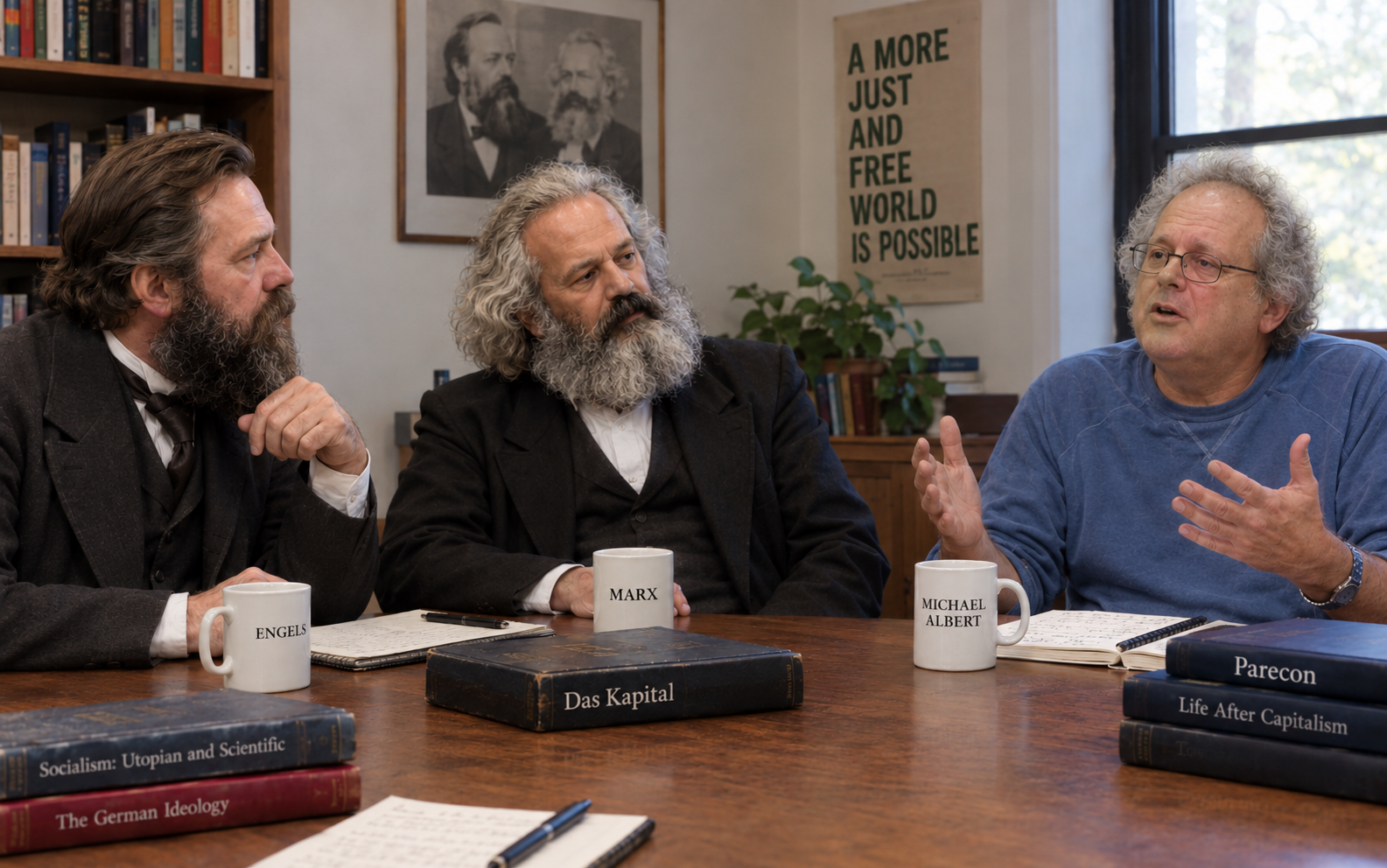
[This article continues the sequence that excerpts from the seven author book Liberating Theory. This time the collective work addresses concepts for understanding history with the aim to next and finally address vision and strategy. This excerpt begins:]
Can we ever understand history? Can we explain this long running drama, with its countless plots and subplots—past, present and future? Or can we only provide narrow post-mortems of brief interludes? Can we conceptualize social change in ways which enhance strategy and program?
Frederick Engels, one of science’s great popularizers, described history’s imponderability this way: “When we consider and reflect upon Nature at large or the history of humankind or our own intellectual activity, at first we see the picture of an endless entanglement of relations and reactions, permutations and combinations, in which nothing remains what, where, and as it was, but everything moves, changes, comes into being and passes away. We see therefore at first the picture as a whole with its individual parts still more or less kept in the background, we observe the movements, transitions, connections, rather than the things that move, combine, and are connected. This primitive, naive, but intrinsically correct conception of the world is that of ancient Greek philosophy, and was first clearly formulated by Heraclitus; everything is and is not, for everything is fluid, is constantly changing, constantly coming into being and passing away.”
The Greek (and Zen) conceptions that Engels admires, while essentially correct, encompass too much and pinpoint too little to be analytically useful. At a point in time, a society is certainly a single network, as these viewpoints emphasize, but in order to understand any society we must conceptually divide it into finer “parts” we have called the human center, institutional boundary, and four spheres of social activity. Not surprisingly, the same need arises when we view any society’s historical development. While we should begin by recognizing the integrity of the historical process, we must also define more focused concepts. To begin this process we adopt a familiar distinction between two different types of social change, each of which we need to theorize: Reproduction versus Transformation, Social Stability versus Social Change.
People constantly “make” their own history, including themselves and their social institutions. We act, form expectations, and find those expectations fulfilled or disappointed. Beginning with the obvious, we can usefully conceptually divide people’s “history-creating activities” into two types.
The first type generates human and institutional characteristics fundamentally similar to those of preceding periods. Even when it changes second-order features, this type of activity also re-creates defining characteristics and patterns of the past. We call this type of change reproduction because even as it alters some attributes, it reproduces core human and institutional structures.
The “structural continuity” of society’s defining features results not from dormancy but from human activity. Technology develops in ways such that the social relations of production reproduce. Fashions and modes of child rearing alter in ways such that defining kinship relations remain.
The other possibility for social change is that our activity creates human and/or institutional characteristics fundamentally different from the characteristics of preceding time periods. Instead of recreating main defining structures while changing only peripheral characteristics, this type of transformation alters defining structures and creates new core characteristics fundamentally different from those of the past. Political relations move from authoritarian to formally democratic. Defining community structures are replaced.
It follows that both “social reproduction” and “social transformation” result from human activity. In either case—reproduction or transformation—outcomes must be explained and not taken for granted since even social stability is produced by a particular kind of social motion. But, having understood this much, we encounter more subtle gradations of understanding where conceptual differences start to distinguish historical analysts: how much change makes any characteristic “fundamentally different” versus “fundamentally similar”? And how much of the human center and/or institutional boundary must change “fundamentally” before we conclude that we have experienced a “social revolution”?
Besides observing that these questions, like all others related to concept-defining, can only be mediated by practical considerations, we agree with adherents of every other social theory we know of that it is useful to categorize many kinds of changes as consistent with overall social stability.
Things have certainly in some sense changed when a woman is selected as a candidate for vice president by the Republican or Democratic parties; when a progressive Black presidential candidate wins a substantial share of the primary vote; when a wave of mergers increases monopolization of the economy; when the steel industry declines; when a right wing Republican defeats a liberal Democrat for the presidency; when abortion is legalized; when Rock ‘n Roll arrives on the scene; when a voters’ registration drive adds millions of low income voters to the rolls; when a mass campaign of civil disobedience forces a shift in U.S. policy toward South Africa. Things have certainly changed, indeed, but only within the confines of overall social stability. Such changes may occur in both center and boundary, but society’s defining contours remain in place.
I interject from 2026: Changes that involve qualitative transformation occur less frequently than system-preserving changes, but have more importance from the perspective of social activists: a change in the kinship sphere replacing one form of patriarchy with another or eliminating patriarchy altogether; a change in the community sphere drastically altering relations between the races, such as the abolition of slavery or the dismantling of apartheid; a change in the economic sphere in which the coordinator or working class replaces capitalists as the ruling class; a change in political relations in which representative democracy replaces monarchy or participatory democracy replaces one-party bureaucracy.
The Liberating Theorychapter continues: What distinguishes these and other fundamental changes from social stability is that characteristics of both the human center and institutional boundary change sufficiently so that the way that activity is carried out in at least one spherefundamentally alters. The social organization for carrying out the activity is changed and the definitions of social groups and/or social relations between groups that carry out that activity are transformed. The change is experienced as a change in society’s core characteristics and thus in the “meaning and quality of life”—for better or worse.
But, in addition to distinguishing between fundamental social change and social stability, we must also decide how much social change must occur before we say there has been a “social revolution.” For traditional Marxists, only a fundamental transformation in the economic sphere constitutes a social revolution. A change in ruling class and in the “mode of production” is a social revolution, whereas equally drastic changes in state, cultural, or kinship relations are not. For these Marxists, drastic changes in the “superstructure” may contribute to a social revolution, to be sure, but only if they culminate in a change of the mode of production itself. And while feminists, anarchists, and nationalists are slightly less insistent on making analogous claims, in practice they too tend to view “social revolution” as a semantic term to be applied only when there is a fundamental social change in their favored sphere. Of course, the assumption behind the claim of each of these schools is that the dynamics of their favored sphere are at the root of all society’s most important characteristics and tendencies. Therefore, unless these change, things pretty much “stay the same.”
While recognizing that definitions themselves can be neither “wrong” nor “right,” only more or less applicable and useful, we remain critical of these conceptual choices because they promote all the errors we warned of in our earlier discussions of monism. Instead of defining “social revolution” as a fundamental social change in only oneparticular sphere of social life, we think it is more useful to define the term to refer to fundamental change in any of the four defining spheres of social life. We must then investigate the prospects for changes in each sphere in any society and whether spheres are likely to change alone, in tandem, or only collectively as a whole.
Marx himself gave us the most succinct formulation of the more monist “historical materialist” view: “At a certain stage of their development the material forces of production in a society come into conflict with the existing relations of production, or what is but a legal expression for the same thing, with the property relations within which they have been at work before. From forms of development of the forces of production those relations turn into their fetters. Thus begins an epoch of social revolution. With the change of the economic foundations, the entire immense superstructure is more or less rapidly transformed.”
The problem with this “historical materialist” definition of social revolution is not that the economy is less influential than Marx thought, but that there are (at least) four influential spheres—not one—which define and texture society and one another. The quotation would be just as compelling if we substituted any of the other three spheres of social activity for the economy while changing the appropriate references. Recognizing this, we can further see that during periods of social stability the four spheres can change at different paces and be more or less in or out of “sync” in their motion (though they will all move only within limits set by society’s core characteristics). Insofar as spheres accommodate or co-define, reproductive changes in any one can easily percolate into others.
A changing pattern of inter-community relations may affect norms within factories or alter political alignments. A change in industrial structure may provoke changes in school curricula and the family, or vice versa. But as long as none of the core characteristics of a particular society change—as long as there is no fundamental social change in any of the spheres of its social life—it has only on-going social stability.
On the other hand, the kind of revolutionary transformation described by Marx above can evolve for any of the four spheres from either what Marxists call “Internal contradictions” within any one of the four spheres or from disruptive dynamics between them. The economy can rupture due to its own motions and internally developing contradictions or due to changes in another sphere which disrupt its functioning and cause its classes to intensify their struggles. And vice versa.
To the extent that spheres accommodate and co-define, fundamental changes in one can provoke fundamental changes in others. A revolution in political forms can (but won’t necessarily) engender a subsequent revolution in culture, or vice versa.
The point is that historical materialism and all other monist orientations must be replaced by a view of historical change that: 1) sees (at least) four essential spheres of social life instead of one; 2) sees fundamental change in each sphere as equally deserving of being considered “revolutionary”; 3) sees “accommodation” and “co-definition” as two way streets between all spheres (sub-spheres) of society so that to the extent that inter-relations between spheres are strong, both non-fundamental and fundamental changes will “percolate” from one to others.
Achieving this much yields a theoretical framework able to help us organize our thoughts about history in ways that provide us with explanations of contemporary and past events and hypotheses about future possibilities. But, if one believes the inter-connections between spheres in societies are often very strong, it is tempting to generalize further. Thus, if a society’s spheres are strongly co-defining, a revolutionary change in one will generally have to produce revolutionary transformations in all others or, eventually experience a kind of counter-revolution itself as the co-reproductive forces from other spheres re-establish old core characteristics in the sphere that had changed.
I interject from 2026: Given this sort of interaction, which may or may not operate in any particular society in any chosen epoch, for a revolution to be successful in any one sphere, it would have to be accompanied by, or somehow unleash, a still more cataclysmic change throughout all of society—a change fundamentally altering all spheres and all core characteristics, not only one. Or, a more optimistic way of saying the same thing would be to note that if in some society the co-reproducing interconnections between spheres were strong enough, revolutionary change in any one of them might generate strong pressure for compatible revolutionary transformations in others.
The excerpted chapter continues: Sometimes old largely unchanging kinship forms can come into conformity with a newly revolutionized economy through only modest alterations. Other times economic revolution may spur a subsequent revolution in kinship relations as well. But, what if new economic forms are incompatible with old but intractable kinship forms? Then, if social stability is to be re-established and if kinship forms won’t alter to conform with the newly altered economic forms, the economic forms will have to alter again or even revert to their old shapes. This is one among many possibilities of the same sort that Marxists and all other monist theorists refuse to recognize, not only for economics and kinship but for all spheres in all directions.
Since such relationships vary from society to society in tune with social conditions in each, we can’t sensibly generalize about the likely strength of such mutual interconnections nor about the likelihood that old spheres interconnected to the one that undergoes a revolutionary change will always drag it back or, vice versa, that a transformed sphere will always drag old ones forward. What happens will vary from situation to situation.
There are many paths other than our’s that go beyond historical materialism and while these approaches are often motivated by desires to overcome many of the same monist weaknesses we have discussed, this does not immunize them against new mistakes or the familiar problem of “throwing out the baby along with the bath water.” Here, before further elaborating our own conceptual alternative, by way of motivation we mention a few examples of flawed attempts to go beyond the failures of historical materialism.
One response to the economism of historical materialism has been to deny the existence of critical contradictions in modern capitalist economies. Such approaches might argue that post Keynesian economic reforms such as fiscal and monetary policy, incomes policies, profit sharing, labor participation at some levels of corporate decision making, and indicative planning or “industrial policy” can smooth out capitalism’s main problems. The implication is that if these methods could be “scientifically” applied by knowledgeable technocrats insulated from politicians subject to partisan pressures, they would render the economic “contradictions” of capitalism obsolete. While there is much to be learned from these arguments, (particularly by Marxists who continue to pursue the chimera of the failing rate of profit or an inevitable crisis of under consumption), the struggle over control of the work process and distribution of its fruits will continue at least as long as capitalism does. Claiming to master the economic sphere of modern capitalism—heralding “an end to ideology”—or minimizing the economy’s importance by adopting a non-economic form of monism such as radical feminism are both mistaken correctives to historical materialism. It does no good to “transcend” Marxist analyses by denying the importance of economics instead of recognizing the importance of other spheres as well; or by denying the importance of classes instead of recognizing the existence of other agents of history as well; or by denying the progressive role of workers instead of seeing that their role is complex.
Another attempt to transcend Marxism is represented by Andre Gorz, who holds that the economic sphere is centrally important, but argues that the industrial working class can no longer act as a progressive agent of history. If the future requires so much technological innovation and social restructuring that industrial jobs and the relative status of industrial workers must be undermined by any desirable form of progress, then along with Gorz one might reason that industrial workers will be initially inclined to protest such transformations, not propel them. And though there is certainly considerable insight in this analysis, regrettably Gorz accompanies it with a thesis that the workplace itself must always be marred by a lack of self management. Gorz can only see the dawn of a new day in society’s other spheres of life, not at work. But this is tantamount to unnecessarily tying one’s hands before undertaking battle. An alienated economy means an alienated society.
Still another possibility, propounded by many social democrats, for example, is what we might call neo-populism. Advocates rightly criticize Marxists and other monists for being too narrow and intellectually elitist in imposing a single focus on all analyses. But, neo-populism’s critique of Marxism does not extend to Marxism’s failure to identify the existence of empowered employees who can seek to become a ruling class by monopolizing knowledge and skills, and, indeed, this is because neo-populism actually serves coordinator interests. In order to remain invisible while coopting traditional workers and other social agents to programs elevating coordinators, coordinator intellectuals must elaborate conceptual frameworks which literally deny the importance of class differentiations of any kind by highlighting the idea of a populist community of anti-capitalist actors. Since the aim is to have a coordinator run economy with workers confined to disempowering roles on the one hand, or unemployed on the other, there will be considerable attention given to enlarging welfare rights to avoid great poverty and attract allies. But worker power over the economy won’t be on the agenda. And, at the same time, parallel attitudes regarding racism, democracy, and sexism will also be watered down versions of genuinely liberatory views.
For example, we can anticipate that progressives identified with the coordinator class will extol the importance of democracy, but ignore or down play the development of genuinely participatory alternatives compared to unaccountable electoral models that elites can control and benefit from; will decry sexism, but see the need for childcare or “maternity” leave primarily as relating to women; will decry racism, but construct their economic alternatives in settings dominated by white men. Of course advocates of this approach will claim they are seeking change to enhance the interests of all of society’s poorest and most oppressed peoples—as reformists generally do—and, indeed, if enacted, many of their programs will have some of this sort of impact. But first and foremost, this orientation will foster economic advance for coordinators.
Those of us engaged in social theory building should take a cue from other scientists who regularly replace outmoded theories with superior alternatives. Any new theory must explain the successes of its predecessors. We cannot sensibly deny the importance of the economic, kinship, community, or political sphere and drop any of these from our conceptual framework, or deny the importance of oppression based on race, class, gender, or authority and drop any of those issues from our activist programs. Theories should not extrapolate from a particular situation to all situations without being sure the leap is warranted. Social theorists who see that under certain circumstancespressures on industrial workers, for example, tend to inhibit the likelihood of their grasping progressive options should not then jump to the conclusion that henceforth industrial workers will play a secondary role in social change. The fact that some set of circumstances makes a particular social group unlikely to take progressive action today, doesn’t mean that group will not play a progressive role in other circumstances tomorrow and in no way justifies a leap to the claim that the group is no longer an important historical agent. What more does our own conceptual choice, complementary holism, say about these matters?
We know that history is a single flowing pattern of interconnected changes, yet to think about it in manageable chunks, we need to abstract component parts. Many of the stabilizing and destabilizing forces of history operate on a constant and more or less unconscious basis. The dynamic that induces individuals to choose to behave and develop in ways sanctioned by existing social roles in order to benefit from the fruits of social discourse, operates constantly, though this is seldom focused on by those under its influence. Similarly, the disruptive forces of strong human needs that cannot be adequately met by people consigned to oppressed roles in domination relationships continuously foment daily acts of individual rebelliousness the causes of which are frequently lost sight of by the perpetrators of oppression. Some of the stabilizing and destabilizing forces, on the other hand, emerge from the conscious behavior of social groups organized as agents of history and working for the maintenance of existing social relations or for their transformation. In assessing the possibilities of historical change in any society, complementary holism looks at all these factors and tries to assess their relative strengths.
In our conception, a society will tend to remain stable whenever a rough conformity exists between center and boundary and between the four defining social spheres. The state produces personality traits that help reproduce core economic relations, and vice versa. The economy runs with only minor contradiction and accommodates hierarchies born of kinship and community relations. Community reproduces itself and class hierarchies, and so on. Under these conditions changes will occur along a stable trajectory. Within limits, people will expect and be capable of what social institutions require of them. Each defining sphere’s field of force will be in rough conformity with the character of consciousness and institutions in all other spheres and all changes will be constrained to preserve these harmonious relations between spheres. Under these conditions the dissipative systems within society and the dissipative system that is society itself will certainly undergo continual alterations, but their main contours will reproduce without major change.
Revolution, on the other hand, becomes possible when destabilizing forces within or between spheres cannot be resolved without altering at least one of society’s core characteristics. Kinship generates adults ill-suited to economic roles. The economy’s contradictions cause people to challenge not only work but also political forms. Community conflicts spread as cultural relations demand and provide people with personalities contrary to what other spheres require in order to stably reproduce. Basic institutions are changed. Core characteristics alter.
In sum, society has four spheres that share time and space with each other and minimally accommodate or maximally co-define one another when society is not in a state of crisis. Of course, sometimes crises do occur and also initiate revolutionary transformations. Yet, our point is that in the absence of revolutionary change, the failure to minimally accommodate for an extended period implies that a society would remain in a state of crisis for that whole period. We make no claim that crises can’t happen, nor that they must always end quickly or always provoke revolutions which lead inexorably to new periods of a changed stability. Revolutionary struggles, conscious and unconscious, can last decades and, moreover, sometimes societies can enter a period of great upheaval which doesn’t induce a revolutionary period at all, only a period of great disturbance and contradiction. Regrettably, in this as in other matters, history offers no answers to the question, “what’s inevitable?” It does, however, allow some interesting answers to the more tractable questions of “what’s possible?” and even “what’s likely?”
In the last chapter, when we were analyzing societies as interconnected social networks, we introduced the concept of “co-definition.” Now we introduce the parallel idea of “co-reproduction” to help understand one possible kind of causal force at work in historical development. Spheres co-reproduce when the dynamics of one reproduce the defining relations of others. For example, in a racist society, economic relations will co-reproduce community relations if daily economic activity reproduces racist relations just as it reproduces class relations. Of course co-reproduction is but one theoretical possibility concerning the relationship between social spheres and only empirical investigation—and activist practice—can reveal whether or not this relation pertains in any particular place and time. But we should also note that since spheres must all occupy the same social space and since human consciousness tends to repel cognitive dissonance, co-reproduction is a likely possibility.
It follows that trying to overcome racism without addressing the economic sphere in a society in which economic relations co-reproduce community relations, would be an incomplete and probably fruitless strategy. Likewise, trying to overcome authoritarianism without addressing sexism in a society where gender relations co-reproduce political relations would be similarly short-sighted. In either case—and these are but two examples—co-reproductive influences would make it practically impossible to transform one sphere without simultaneous compatible changes in the other. Thus strong co-reproduction makes a shambles of the idea that movements can overcome racism while down-playing sexism; overcome classism while fostering authoritarianism; and so on. Co-reproductive connections of oppressions are “deadly” indeed.
One way to think about these intricate patterns is to realize that rates of change within and between spheres may differ. As events transpire spheres may get out of sync with one another. Interactive forces among the spheres then tend to pull them back toward stable conformity, usually by evolutionary transformations of each. Different spheres never stop moving in and out of synchronization nor do they ever attain a perfectly harmonious conflict-free form. Just as Prigogine’s dissipative systems move on an evolutionary trajectory as a result of complex flows of energy, materials, and information, so spheres in a society continually alter in a reproductive way due to internal contradictions and contradictions with other spheres in both the center and boundary.
Societies are always changing. During periods of social stability, fluctuations “level out.” In revolutionary periods, however, certain fluctuations (which may have their basis in many different aspects of social life) are magnified until the whole character of a society leaps from one stable path to another. There is no single cell of society from which all change emanates. Instead, each cell interacts with and exists as part of all the others. To say this is not to embrace ignorance but to recognize how complex history is and how multifaceted our conceptualization must be.
In our theoretical framework, a society could undergo a number of different types of revolution. Hypothetically (if co-reproduction were weak), a society could have an economic revolution with no other fundamental changes; or a kinship revolution with no other fundamental changes; or a kinship and political revolution with the economy and community largely unaltered; or maybe a community and economic revolution with kinship and politics largely unchanged. And so on. Moreover, there could be different types of revolution within each sphere. A revolution might lead from a capitalist economy to a coordinator economy or from a capitalist economy to a true workers’ self-managed classless economy. Or a revolution could replace procedural democracy with a single-party, bureaucratic state, but it might also transform the polity from a procedural to a participatory democracy. In the abstract, our theory of history allows many logical possibilities.
In reality, we know, things often become less flexible. Certain theoretical possibilities may be ruled out in particular societies in which the strength of co-reproduction between spheres delimits the types of revolutionary processes that can reach a new stability. And if we seek revolutions that eliminate core forms of domination instead of reformulating them by exchanging one dominating group for another, the possibilities open to us may be highly constrained indeed.
In our own study of the United States we have come to believe that here, although many types of non-liberatory revolutionary change can conceivably occur, intricate co-reproducing relations constrain liberatory options so severely that relatively few are feasible. We believe the oppressive core characteristics of the United States—racism, sexism, classism, and authoritarianism—are now so mutually reproductive of one another that, to fully eliminate any one, all will have to be overcome. Institutional and consciousness relations have become so entwined that each of our society’s four core characteristics now reproduce within every sphere instead of only within the sphere of their origin.
The American family reproduces class domination, authoritarianism, and racism—as well as sexism and heterosexism. The U.S. economy reproduces authoritarianism, sexism, and racism—as well as class division. The dynamics between races in the U.S. reproduce authoritarianism, class, and gender oppression—as well as racism. And political activity in the U.S. reproduces sexism, racism, and class domination as well as authoritarianism. Each sphere reproduces the defining forms of all four.
We can conceive of an economic revolution—creating technocratic, coordinator economic relations in the U.S.—which would change the nature of class oppression but not eliminate it and, in doing so, remain compatible with only moderately reformed relations in the community, kinship, and political spheres. And, as a matter of fact, in our opinion this is the most probable result of many variants of social-democratic (and what we have called neo-populist) efforts in the U.S., should they ever prove successful.
To take another example, if liberatory child rearing, socialization, and sexual practices began to be carried out in the kinship sphere, but community, economic, and political life continued to be organized as it is at present, there would be a profound social contradiction. Young adults would be unprepared to submit to and engage in racist, capitalist, or authoritarian forms of domination. And the sexist dynamics pervasive in other spheres in the U.S. would constantly threaten new kinship practices. In other words, there would be intense pressure for the kinship revolution to revert, or for other spheres to begin transforming. Indeed, we see this happening today, with the so-called “post-feminist” generation’s reassertion of the primacy of motherhood over career, among other things.
I Interject, please keep in mind this was written forty years ago, so comments about then current trends are, here, about trends four decades ago.
The chapter continues: One way to think about all this is to say, “all right, if changing one sphere requires changes in all of them, let’s determine which we can change most easily, change it, and then worry about pulling along the others.” This, in essence, is what monists do, choosing the economy, for example, or the state, family, or culture, and then, depending upon how mechanical they are, either asserting that the rest of the spheres of social life will automatically fall into line on their own, or that this may take some time and struggle but will nonetheless be a lot easier than if any attempt had been made to address all issues in the first place since such attempts would have been divisive and diverted energies from their most efficient allocation.
This is the “weak link” approach to social change, and in some situations it can make perfectly good sense. It does not ask which sphere’s current relations are most oppressive, or which dominated groups have the most righteous moral claims, or even which have the greatest anger. It asks, how can we win fastest. However, if a society isn’t a mesh chain in which there is one most important link which, if we pull it hard enough, will ultimately necessarily cause the whole thing to come undone, then this approach becomes suspect. Indeed, if, as we think, our society is a kind of fabric with four complex, interwoven patterns, each of which has the capacity to redesign or regenerate any of the others—each of which can act as a source of incidents able to initiate major change, mold the texture of changes, and modulate the size to which changes grow or are limited in their influence—then the weak link approach becomes suicidal. If we attack “weak links” we may alter one pattern only to find that having ignored the others they have successfully undone all our work. Perhaps they will not exactly reproduce the old pattern we altered, but they will mold it to fit within the oppressive norms they still prescribe. The societal fabric will settle down to a new form with the four patterns compatibly entwined, and if three remain oppressive, the fourth will too. Our economic revolution against capitalism might not be rejuvenated to the old form of capitalism, for example, but instead channeled into a new class-stratified form we have elsewhere labeled a coordinator society. But it will not become socialist. And similarly, our feminist revolution may create new kinship forms, our community revolution may transform cultures, or our political revolution may create new governing methods, but none of these revolutions will lead to optimal liberatory results without changes in other spheres as well.
I interject from 2026: It’s a little worse. Or a lot, depending how you look at it. Because there is also the issue of building a movement able to win fundamental changes in even one sphere. Strategically to focus on only one as paramount, can even before winning anything much subvert efforts to do so, by reducing the support for change and the degree of commitment of actors to the singular change given that they endure much broader kinds of relations.
The chapter continued: When you shine a laser through a “hologram,” a three dimensional image which has been stored in the hologram earlier is projected. Remarkably, if you break the hologram into small pieces and shine a laser through any one of them you get the same complete image (only a bit less sharp) as when you earlier used the whole hologram. U.S. society behaves like a hologram in exactly those areas most critical to problems of social revolution. Each sphere—like the hologram’s pieces—contains the totality of defining core characteristics and can potentially project them into any new reorganization of society in which that sphere remains largely unaltered.
There is a tendency among activists to sometimes exaggerate what their theories can hope to accomplish so that people come to believe that they have discovered The Truth about this or that. Often sectarianism follows. In order to get a better grasp on what a historical theory can and cannot hope to achieve, and on some attributes it needs to have, to consider similarities and differences with Darwin’s theory of natural selection might help.
In natural selection, evolutionary change derives from the cumulative effects of chance accidents in an ecological environment which “selects” for fitness. Biological mutations within an organism’s genetic structure propel anatomical changes that in turn reduce or improve the organism’s capacity to give birth to new offspring of its own type. As surprising as it seems, the initiating accidents occur randomly, in no particular pattern at all. What gives species evolution the appearance of following a master plan is not an interrelatedness of causes among the triggering accidents, which does not exist, but the after-the-fact channeling effects of the process of natural selection within a complex environment.
In societies, we know that changes arise everywhere from countless causes. Most often, whether any particular change takes root depends on whether it conforms to its social environment. In this analogy, society as a whole provides an over arching social niche. Be they relatively small, like the invention of a minor new technology, or large, like the restructuring of gender relations owing to a revolution in kinship forms, to persist changes must fit (or redesign and then fit) their surrounding social niche.
Of course, this analogy is inexact. In natural evolution true laws of motion operate which allow us to make mathematically precise statements about the frequency of mutations, the likelihood of any mutation taking hold, the time for the spread of changes throughout a species, etc. Yet, because the initiating mutations of natural evolution are purely random, despite these understood laws of motion, few before-the-fact testable predictions prove possible—only explanations after the fact. According to some schools of philosophy this characteristic relegates Darwin’s theory to a sub-scientific shelf in the panoply of intellectual disciplines. Natural selection is a theory which, like complementary holism, is incapable of alone making many testable predictions. Elaborated further, to create a derivative
theory like population genetics, natural selection can lead us to predictions, of course, but then elaborated into a specific theory of capitalist economic forms, complementary holism will also lead us to predictions. Even without refinement both approaches can explain events after the fact; make revealing claims about intellectually conceivable occurrences which are not, in fact, immediately practically conceivable; and make informative claims about the probability of certain possible future occurrences coming about. Referring to skeptics who are uncomfortable using the word “theory” when referring to social history, we would reply that we use it in roughly the same way a 19th century Darwinian would have used it when referring to natural history. But, beyond this, the similarities in these two frameworks are minimal and it is actually the differences that can help us understand historical theory’s potentials better.
In social history fewer if any fixed laws of motion operate. One can’t make general statements about the frequency of changes or their rates of taking root since the consciousness of human actors makes most uniformities in the way history unfolds temporary. Further, in societies the link between “social mutations” and lasting changes in the social niche are more bi-directional than the link between biological mutations and changes in the ecological niche. And, what’s worse, recognizing both that social conditions can create social mutations, and that consciousness plays a role in defining social conditions, in societies it follows that the initiation of “mutations” is not totally random. Chance is one factor in the motion of social relations, but in history there is no impermeable barrier between the organism/environment complex on the one hand, and the incidence of social evolution/revolution engendering “mutations” on the other. The former can cause, mold, and even consciously contour the latter, which in turn needn’t be random, therefore, but can be aimed to particular ends. We can consciously cause social “mutations,” which in turn either fit or fail to fit our social environment. Indeed, this is the aim of social activists.
Ironically, with less in the way of scientific laws of motion, social history permits more than biological history in the way of predictions about possible future events. The initial context only channels biological evolution, but it can provide a predetermined goal for social changes—a goal whose influence we can perceive and at least partially understand, allowing us, therefore, to sometimes predict with some measure of confidence the likelihood of specific future outcomes coming to pass.
There is, however, an additional rough similarity between natural evolution and historical evolution which makes precise predictions nearly impossible in both. It is a characteristic also common to the weather, to the flow of waterfalls, the shape of clouds and snow-flakes, and, perhaps, even to the cosmology of our universe and the dynamics of most real phenomena. That is, in these realms very small changes in initial circumstances can lead to very large changes in outcome in relatively proximate futures. A difference of a half degree in temperature over New York on Thursday can mean the difference between sunshine and rain over Toronto on Friday. A fragment of a twig wedged between two rocks at the top of a waterfall can cause the molecules flowing over the falls to wind up in completely different positions with respect to one another than they would have were the twig fragment not there. The smallest variations in atmospheric conditions can lead to huge variations in the shapes of clouds and winds. And, likewise, the tiniest variations in a mutation in one generation can lead to the difference between a species existing and not existing just a few generations later, and then, in the event the species has a marked affect on the social ecology, to dramatic differences in the whole of nature still a few generations further on. And, similarly, tiny changes in where, how, and when individuals and institutions act, can sometimes trigger huge alterations in the pace and shape of historical patterns. Such volatility renders precise prediction impossible in all these fields of study precisely because we cannot know the position of every twig or inclination of every actor at the outset. But that does not mean that useful predictions and analyses are ruled out. Indeed, this “chaos factor” causes us to have to understand “prediction” in the case of weather, history, and other such phenomena in a cautious way. Moreover, we choose the word “chaos” with care. Recently physicists have begun studying this type of phenomena to discern what kinds of patterns exist in the development of “chaotic” systems, and perhaps these studies will provide further analogies and insights that can help others enlarge and refine the perspectives set forth here. In any case, since we cannot know all the fine details of historical (or atmospheric) “initial conditions” as they might exist at any moment, we cannot possibly perfectly predict all outcomes at some later moment. Moreover, since the variations that can result from small changes in “initial conditions” are great for most historical processes—history’s “chaos factor”—sometimes our errors will be great despite the most intelligent analyses. What a theory can do, however, is help us chart rough potential trajectories of overall developments (whether of weather or of history) and
discern their relative probabilities and, to some extent, illuminate how our own activities (seeding clouds, waging social struggles, developing new institutional forms) might affect those probabilities. The task of a theoretical framework oriented to help us understand history, then, is to assist in the limited but crucial undertaking of pinpointing as precisely as possible those kinds of dynamics and relationships that will most often be most critical to:
a. Initiate macro changes in society of a type important to our lives.
b. Channel and texture such changes so they persist or fade away, become localized or spread.
C. Modulate such changes so they refine outcomes only minimally, as in historical evolution, or transform them dramatically, as in historical revolution.
The point is to use theory to create visions and strategy we can implement. That we must be cautious and never presume to think that we have all the answers in no way means we cannot take informed initiative to improve our society.
When trying to determine whether a society is likely to undergo a revolutionary change any analyst develops a set of guiding questions. One way to appreciate the difference between theoretical perspectives is to compare the guiding questions or “research programs” they imply.
A complementary holist approach poses the following kinds of questions: What is the character of the four defining spheres of social life and how does it affect people’s ability to fulfill their various potentials? What distinctive social groups are defined by the organization of social activity in each sphere and how do these groups interact? What contradictions exist within and between each sphere and how do these contradictions affect class, community, gender, and political struggles? What factors influence the power of competing groups as they pursue their interests, and how do the dynamics between spheres affect the self-consciousness of these groups? How do events and struggles tend to reproduce or undermine core characteristics? How does the undermining of core characteristics in one sphere affect society’s other spheres? And finally, what reproductive and destabilizing dynamics are at work between the human center and institutional boundary?
The complementary holist agenda requires an analysis stressing the interactive effects of four fields of influence without assuming a priori the influence of any one of these fields, some priority ordering of their importance, or some fixed form for their interaction. However, this does not imply our concepts are amorphous since they direct us to examine dynamics within and between particular spheres in very specific ways.
Does our approach increase the probability of a more comprehensive understanding? Does it avoid subordinating the concerns of one group to those of another? Will it facilitate a fuller solidarity among those with a common interest in social change? Or does it merely add steps to historical analyses for little additional insight, confusing a muddled picture with a fuller one? While it isn’t a virtue to present a motion picture of reality with no central concepts or organizing principles to guide analysis and prediction, it is also no virtue to claim to have uncovered the essential tension while ignoring or misunderstanding other critical relations. Complementary holism can yield concrete results only when applied to particular societies, historical problems, visions, and issues of strategy. We believe our concepts of center and boundary, core characteristics, accommodation and co-reproduction, stabilizing and destabilizing dynamics, and our newly refined conceptualization of four critical spheres of social activity provide a set of conceptual tools that can help activists with a wide range of priorities tackle the difficult problem of building increasingly powerful social movements in the years ahead. It is not the only set of concepts one can usefully use to try to create social change, but we think it is one set of concepts particularly suited to the purpose. Only time will tell.
I interject from 2026: That ended the chapter proper. The “We,” remember, is the group of seven authors: Myself, Leslie Cagan, Noam Chomsky, Robin Hahnel, Mel King, Holly Sklar, and Lydia Sargent. As I read the material I was impressed and I hope you, reading it now, are as well. To me, this little book delivered what it claimed. A conceptual tool box designed to help activists avoid mistakes of the past while effectively handling conditions of the present. Next step is vision and strategy.
Having not read this seven-authored material in almost forty years, I have encountered it roughly as you have. I wonder what effect it has on you. And I apologize for the fact that I and the six other authors didn’t push harder for it forty years ago. I am honestly not sure why we didn’t scream out, this needs attention. Pre-writing, I am sure the motive for doing it together was a belief not only that the result would be much better due to the collective input, but also that the fact of the seven authors would propel attention. But that didn’t widely happen and, I now think wrongly, we too modestly said okay, that’s the verdict, no use pursuing it more. I think we should have. Hell, I think some publisher should re-release it now. Anyone?
At any rate, here is the dialogue that followed the history chapter.
Coho, our Complimentary Holist participant started it off by saying: The point is that historical materialism and all other monist orientations must be replaced by a view of historical change that sees at least four essential spheres of social life instead of one; sees fundamental change in each sphere as equally deserving of being considered revolutionary; and sees accommodation and co-definition as two way streets between spheres so that fundamental and non-fundamental changes will percolate from one to others.
Marlen, our Marxist Leninist participant, comfortable on his turf, reacts first, as usual: I think you have really lost it this time, Coho. You cannot point to any inexorable processes regarding kinship, authority, and community that lead inevitably to revolutionary contradictions. Why don’t you finally admit that economics directs historical developments? Accumulation causes contradictions that rupture old forms and augur new ones. Other social dynamics, as I have stated, are important primarily in terms of their effects on economic occurrences.
Nat, our Nationalist participant, interrupts: Stop right there. I admit I can’t point to a single process that recurs repeatedly in all community spheres in the way that you pinpoint the accumulation process. But I can point to many social struggles where nationalist aspirations played primary roles. Or a combination of religion and nationalism. What about South Africa, Iran, China, India?
Marlen: Just a minute here. Racial and national dynamics operate to texture economic dynamics which alone set the stage for change…
Ana, our Anarchist participant interrupts: Wait a second, Marlen. Even in the Soviet Union it was Lenin’s party that played a central role in determining that change would be bureaucratic and statist, not socialist…
Marlen interrupts: But the state was not the basic motor for change….
Sofie, our Socialist Feminist participant interrupts: Hold the phone, Marlen. Your evidence only proves that economics is causally relevant, not that other spheres are irrelevant. I think we should look more closely at relations between gender and class. We could certainly find some laws of motion in that relationship which would help us understand historical change better than the continued assertion of economics alone as the basic motor for change.
Radfem, our Radical Feminist participant adds: There’s no question in my mind that the motor force in history is the striving of men for power over women.
Marlen responds: That kind of blindness simply proves my point. What evidence can you possibly have for that statement? The Russian Revolution? What kinship laws of motion occurred there? Don’t make me laugh.
Coho reacts: You each make the other laugh at your respective monist claims. I think, Marlen, that your point can never be proven. What evidence do you have of a revolution brought about by the forces of production bursting social relations of production? Your formula hasn’t been verified anywhere any time. Where is your evidence that in China or Cuba, for example, growing forces of production running up against constraining social relations caused their revolutions?
Marlen replies: I might say the same to you, Coho. Where are the laws of motion in Cohoism?
Coho: I repeat, Marlen, in what revolution have fettering forces brought about revolutionary change? (pause) All right, you don’t or can’t answer that one, let me try another. Let’s suppose that growing forces encountering frozen relations could become important. What if what you say were true for developed capitalism: that there exist intrinsic economic dynamics which push developed capitalist economies inexorably toward revolutionary upheaval. Why are we then to deduce that only economics can move societies with capitalist economies? Or that only changes in economics could bring about other liberatory social structures?
Marlen: I repeat, Coho, you take your holism so far that nothing precise remains.
Coho: But I don’t claim to know precise laws of history. Indeed, there are no precise, always operative laws in the sense you mean. We can say interesting things about how the four spheres will interact no matter what specific contours they may have. We can know what general kinds of conditions are impossible between spheres or inside spheres. We can discover that all societies of a particular type will always embody certain traits. But we can’t say, for example, that every society will inevitably undergo such and such a pattern of development, or even that every capitalist economy or patriarchal kinship sphere will always follow such and such a trajectory. Other spheres may interfere…
Marlen interrupts: Like I said, no laws of motion.
Coho: You may not like it that we can’t enunciate universal laws, but postulating violated laws doesn’t improve the situation.
Sofie: I can agree with that. Why enshrine inaccurate laws? Even if we analyze certain intrinsic characteristics of a particular type of economy or state, we can’t say with certainty that those characteristics will always operate in real societies.
Marlen: But why must we believe that the best we can come up with is general assertions about accommodation and co-reproduction and nothing more?
C.C., our Council Communist participant answers: Because while we can analyze specific societies to determine what historical pressures and trajectories operate in them, we can’t do it for all time and for all societies.
Coho: I would go even further. I would say that any theory that treats history as if there is a built in, unchanging economic script is a theory that ignores that the rules of historical development are themselves historical.
Marlen: (in disbelief) Are you calling me a-historical?
I have to interject, I am currently laughing while I read this…
C.C. continues: I think she is.
Nat: I like the way this discussion is going.
Sofie: Me too..
Ana: I wonder why.
Radfem: I’m not sure I do.
Plury, our Pluralist participant adds: Fits in with my thinking.
Coho, insisting on this point: In every field of study, scholars develop theories that operate on many different levels. They make general theories about the behavior of solids, liquids, and gasses. They make more specific theories about compounds in general. Or about particular compounds. Or about molecules in general, or specific molecules, or elements in general, or specific elements, or atoms in general, or specific atoms.
Radfem: Science again.
I interject, laughing again…
Coho responds: We can theorize about qualities of all languages, or of all languages of a specific type, or of a particular language, or about all structures of a particular type within a particular language.
C.C.: But history is at a higher level of complexity than chemistry, biology, or even linguistics. History involves all those things as well as living organs, thinking beings, and elaborate networks of institutions and ideologies.
Coho: Still, the analogy can help. When we theorize general classes of things like all compounds or all languages we only discover broad possibilities and make predictions about ranges of possible outcomes. When we need more detail, for more precise results, we lower the level of abstraction and discuss particular compounds or languages. Then we discover more exacting relations which allow us to predict with greater precision and detail. And the same is true for societies and history.
Sofie: I see what you mean. We can theorize about societies and history in general or we can look at specific societies like the U.S. We would name the basic spheres in and society economic, kinship, community, and political and we could use those spheres to theorize about society in general and about specific events that happen in a particular society—about evolutionary and revolutionary patterns as they emerge in both particular societies and whole epochs.
Nat adds: For example, looking at the community sphere, we can talk about religion in general, catholicism in general, the catholic church, the church in Nicaragua, a particular parish, and so on.
Marlen, unimpressed, replies: You want me to believe that in the U.S., the Soviet Union, China, Cuba, or any other country, there are noneconomic dynamics that significantly affect evolution and even the prospects for revolution? Where is your evidence?
Coho: There is probably no evidence that will convince you. If I state that the formation of the working class in England was differentiated along gender lines because sexism produced in the kinship sphere caused both male workers and male capitalists to struggle to embody the same relations in the economy, partly to defend gender privilege as well as partly to use gender hierarchies to support class hierarchies, you would probably reply that no, gender divisions were produced only to divide the working class and had purely economic roots. If I describe the Soviet Union as a society that from birth was a social formation with a dictatorial bureaucratic state, a technocratic economic structure, an initially fragmented community sphere fraught with racism and pushed toward homogenization, and a kinship sphere with the nature of sexism altered but patriarchy intact, you would disagree. You see the Soviet Union as a society that had a socialist revolution in the economy, that was subverted by capitalist encirclement, illiteracy, and poverty, where I would say it is neither capitalist nor socialist, but coordinator, and I would highlight the other spheres as well.
We have such different pictures of things, Marlen, that I think you will never accept my evidence. But for all your “weight of history” and the past predominance of your well-developed economic theory, can you even explain struggles among coordinators, coordinators and workers, coordinators and central party bureaucrats over planning and markets in the Soviet system?
Nat adds: When, Marlen, have you ever adequately explained religious and cultural persecution or the positive dimensions of spirituality and power of cultural identifications?
Sofie: The limited access of women to positions of political influence?
Radfem: The distortion of sexual potentials?
Ana: Stalinism?
Coho: The question of what constitutes sufficient evidence to justify giving up an established widely-held perspective is difficult. Is the experience of the Soviet Union evidence enough? What if that experience combined with our theory of the coordinator class can counter any Marxist claim that Leninism serves the working class?
I think we have a plausible workable conceptual alternative. I think complementary holism gives us concepts that help understand things that marxism ignores. But not only that. Its concepts help us know that these are important areas of consideration in the first place. Complementary holism aims to give a generalized theory of the operations of history that will help us delimit the ranges of historical outcomes. It makes it possible to theorize certain types of institutions—economies or markets; communities, colonialism or specific cultures; dictatorial states or parliaments; communes or nuclear families—to then make predictions about general and more specific social dynamics. And it can help us theorize about trajectories of development, how spheres interact and change, and how force fields radiate throughout society. Isn’t that enough to warrant giving it a practical chance?
Marlen, adamant: I’m not giving up. Your methods give no priorities, no guidelines of focus. Going back to our early and ever-popular stew analogy, you’ve got a lot of vegetables, meat and potatoes floating around in a gravy with no way to decide which gives the stew its main flavor, which to eat first, what to add later. My concepts allow me to enjoy the stew even though clearly the dominant flavor comes from beef if it is a beef stew, lamb if it is a lamb stew, etc.
Sofie: I will never understand, Marlen why you cannot criticize your own theory. You argue for a set of laws of motion of some abstracted part of society which you then say will tell us all the important things we need to know about all of society.
Plury: I think, Marlen, you have made a strong case for the rest of us to simply get rid of the Marxist framework.
Radfem: I agree. Talk about fetters.
Neopop: No problem for me. I left Marxism behind some time ago. Marxist class analysis has become a handicap to a movement for social change. Class analysis, any kind of group analysis, promotes dissension and tension.
Coho: Now hold on. It is one thing to note that some of Marxism’s central concepts are flawed. But why overreact and reject all the insights Marxism provides? That is going much too far. We need to improve Marxism and incorporate its positive lessons, not reject it whole hog.
Neopop, our neo-populist participant differs: No. I think we need to reject it because we need to unite people, not fragment them. We need to respect differences and value all sides of polarities. There are many different kinds of work, so why not value them all? The same for cultures and kinship roles. All you’re doing, Coho, is expanding the number of correct political lines people must argue over. While Marlen would only criticize us for having the wrong line on the economy, you would criticize us for having the wrong line on just about everything. Why not simply propose a liberatory program that opposes all important oppressions and invite everyone to support it?
Coho: The danger of Complementary Holism becoming just another batch of lines, as you point out is real—although I have never claimed that people should think, act, or look alike. Quite the opposite. Perhaps you were dozing but, in any event, your solution to the dangers of sectarianism has tremendous problems which I think cannot be corrected.
Neopop: I might have known.
Coho: Let me put this to you as a hypothesis. One approach to the fourfold core characteristics in our society is to analyze them from the perspective of those who are oppressed along each axis and then propose alternative visions which are fully liberatory for all.
Another approach, however, starts with the supposition that what is needed is to eliminate certain specific ills so that a particular group, rather than all groups, might benefit. My claim is that whenever the group in this second approach is one of those at the bottom of the hierarchy of the oppressed, liberation will be impossible without pervasive liberatory changes in all spheres of social life. But if the group is not one of those at the bottom, but rather the coordinator class, then activists engaged in elevating this class to economic supremacy could choose a politically effective program conducive to that more limited end. And I claim that decades ago, the best choice for a champion of coordinator interests was marxism Leninism since marxism could deflect attention from coordinator aims even while it helped coordinators organize other sectors to join the coordinator defined project. But nowadays almost any sustained thinking about classes reveals coordinators as important historical participants, and so marxism, which highlights class analysis, no longer serves coordinator needs well as it once did.
It leaves too much possibility of people noticing the role of coordinators—even as it tries to prevent this. A better ideological choice, in the eyes of some coordinators, is to adopt some kind of populism rejecting all class analysis in favor of “unity.” Of course, the marxist infatuation with markets and central planning for allocation can be retained, though coordinators will also want to emphasize the value of parliamentary democracy—which, of course, benefits them most of all.
C.C.: It sounds to me like in current situations you put the economy first.
Radfem: I knew it.
Nat: I suspected it.
Coho: In analyzing the program of a specific class, yes. But only because I see an emerging political program serving the economic interests of coordinators, under the guise of a popular front.
Neopop: Who said anything about the economic interests of coordinators? I offer constructive criticism and you label me an obscurantist enemy.
Marlen: Join the club.
Coho: If what I said applies to you, then I plead guilty of labeling. Changing society is not the same as having a friendly chat. A great deal is at stake. But I think I was only suggesting the dangers of an approach which, for whatever reason, says that classes are no longer relevant historical actors. There are even some who now argue that because work is inevitably boring and regimented, we should give up revolutionizing it and simply diminish the number of hours we spend working while increasing the amount of leisure time. Oppressions in the economic sphere remain as they were—we just suffer them for a shorter period of time. This not only risks losing any chance of attaining liberation in the other co-defined and co-reproduced spheres, it ignores that work, freely undertaken, is a critical element of a fulfilling life.
Marlen, sensing affirmation: So, you admit the need for working class leadership in struggles to change history.
Coho: Of course. because I see that history has a critical economic component. But our movements must also be led by those whose interests lie in the elimination of all forms of domination.
Sofie: You know, while I don’t agree with Neopop’s approach, I must say that I am getting nervous again. I can easily see where your concepts, Coho, can sound very plausible, flexible, and inclusive. Everyone understands and is sensitive to everyone else. But what if the person or group of people using the theory are black people whose experiences differ from each other but who locate themselves in the community sphere. What makes them sensitive to the other spheres? Because they’ve studied and understood the theory? Maybe. But they haven’t understood the experience of white women or women in the garment industry.
Nat: And the same would hold true for white women in the kinship sphere. What increases their sensitivity to community? They don’t live where I do or suffer in the same way. Why would they incorporate the principles of co-definition and co-reproduction in a way I would applaud?
Radfem: What would make those concerned with sexual preference issues incorporate experiences of black auto workers, and vice versa?
Ana: What would make those addressing state power feel that any changes in that sphere were co-dependent on other spheres…
Plury: It just seems so impossibly complicated.
Coho: It’s true that it requires a great deal. But we are talking about changing society. We can spend our energy branding people with simplistic labels and manipulating people’s words and programs in sectarian ways or we can listen critically to familiar approaches, decide that they are less desirable than they might be, and openly and carefully develop new and better beliefs and goals.
Ana: Back off. You’ve already convinced me.
Nat: I don’t know.
Radfem: If I thought men would actually…
Sofie: I’m getting there.
Coho: Shall I tell you about my thoughts on vision and strategy for a liberatory society?
Nat: Why not.
Cyn: (smugly) A liberatory society? That ought to be good.
Coho rustles through her papers as the others wait eagerly…
And so ended the dialogue and chapter-length look at concepts for understanding history. Do they match up not only with past history but also with current activist needs? If not, well, why not? What faults do you see? But if so, then what is to be done about this approach to history? Should it get support? For one thing, it certainly diverges from what is called Historical Materialism. Will advocates of Historical Materialism’s concepts reject or support Liberating Theory’s alternatives? Maybe they will correct them somewhat. Or maybe they will entirely reject them. Might they even support them? However harsh or hospitable your reactions to these comments may be, I hope I will hear them.

Michael Albert`s radicalization occurred during the 1960s. His political involvements, starting then and continuing to the present, have ranged from local, regional, and national organizing projects and campaigns to co-founding South End Press, Z Magazine, the Z Media Institute, and ZNet, and to working on all these projects, writing for various publications and publishers, giving public talks, etc. His personal interests, outside the political realm, focus on general science reading (with an emphasis on physics, math, and matters of evolution and cognitive science), computers, mystery and thriller/adventure novels, sea kayaking, and the more sedentary but no less challenging game of GO. Albert is the author of 21 books which include: No Bosses: A New Economy for a Better World; Fanfare for the Future; Remembering Tomorrow; Realizing Hope; and Parecon: Life After Capitalism. Michael is currently host of the podcast Revolution Z and is a Friend of ZNetwork.
ZNetwork is funded solely through the generosity of its readers.
Donate