
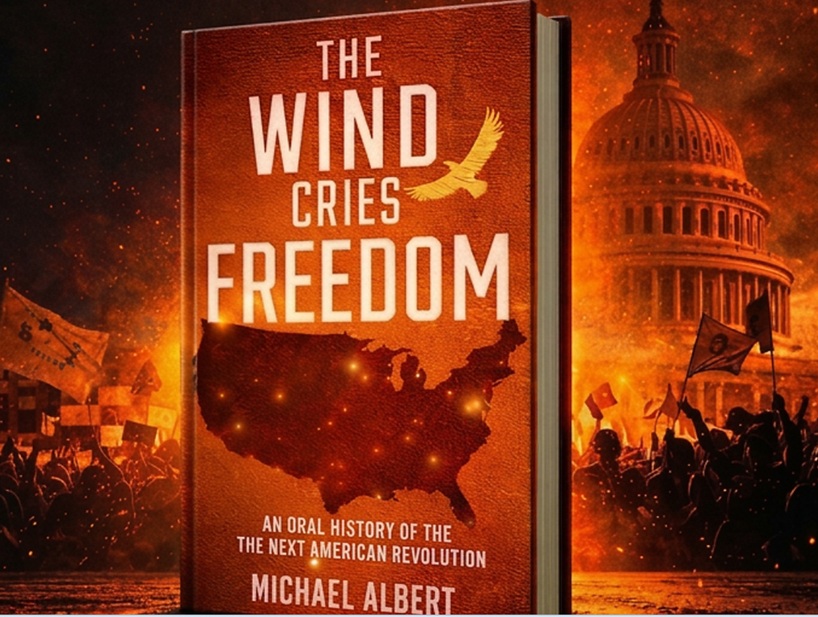
Is revolution a single event? Or is it a process? Perhaps a process made possible by the many gaining certain invaluable insights into their own conditions in relation to society’s reigning institutions, acting together on them, and staying collectively and strategically committed to positive transformation for the many.
But does it stop there? Does revolution have a final climax and termination where all is won? Should it always be, on the contrary, continuous renewal?
But is that even it? If revolution is not a quick, bloody power grab at the top of society, what does it mean for not only individuals but for core societal institutions at every level, from families, workplaces, communities, schools and universities, and the economy and governments?
How do we come to certain insights in the first place that allow us to carry out transformational progression? And how do groups of ordinary people make it happen?
Lastly, if substantial portions of populations find revolution is urgently needed at certain times, does this mean it is only appropriate at those times?
If past is a prologue of lessons, we should not at the same time allow ourselves to be bogged down by it. Past peoples’ lessons merit attention to the degree that they enable us to forge our own insights, individually and collectively. And to the extent that they appeal to a sense of our own capacity to act and our own recognition that we can radically alter not only ourselves and our communities, but also our societal institutions for the better.
Past or present lessons should be recognized as valuable when they reveal that doctrine and orthodoxy do not simply come from above but are all around us, indeed how we ourselves can become producers of it when we are not careful. And they are valuable when they evoke understanding as to why doctrine in itself is a roadblock to awareness and change.
Current writing should allow others to come to realize the need for serious change and how intrinsic features of current institutions stand in the way of that. It should also reveal that this is the case today as it was long before what we see in the news and in our own lives everyday – genocide, climate and ecological collapse, aggressive war, the threat of nuclear war, classism, fascism, authoritarianism, racism, sexism, exploitation, homophobia, transphobia, pandemics, unemployment, healthcare crisis, housing crisis, out of control cost of living, unseen levels of anxiety, crisis of time to think, pervasive absence of dignity and ubiquitous cynicism.
Michael Albert, along with Robin Hahnel, is the conceiver of participatory economics (Parecon), part of a broader participatory society vision,
and has been writing, acting and organizing on the basis of similar insights since the 1960s. With others he has developed a publishing house, alternative media networks and written over 20 books and countless articles evoking insight into vision, strategy, agency and much else. While he has previously written a screenplay and a memoir, this may be perhaps his most unique literary offering to date. A fictional oral history of the ways in which many near-future members of society see the need to come together over a period of decades in order to create revolutionary transformation. They reveal what equity, solidarity, dignity, diversity, justice and potential, among much else, could actually look like. And how difficult in the first place it would be to reveal what this looks like without certain insights making up a guiding vision, one put to practice through strategy.
As with the characters interviewed in the novel’s oral history, it is up to us to arrive at our own insights in our own way to see the need for a dramatic re-envisioning and reconfiguring of society’s institutions.
To that end, is it really fiction if insights apply not only to an imaginary future but to our own lives, potentials and visions? I interviewed Michael Albert with questions that arose for me while reading his recent book.
PROGRESS / REVOLUTION / TRANSITION TO A TRANSITION
Luke Alden: “The Wind Cries Freedom – An Oral History of the Next American Revolution” describes a near future of a vast and profound improvement in quality of life and reports its revolutionary process as it is taking place over the next few decades, subsequent to groundwork being laid today and over previous decades as well. Might we generally characterize some of the reasons to write this book now as a reaction to an analysis of our times or as an expression of the writer’s own values? Is it of any use to distinguish between the two? Or can the reasons be better characterized another way?
Michael Albert: I wrote it to try to provide reasoned hope in the possibility of movements winning massive, fundamental change starting now and extending into the future. So the book certainly reacts to our times, and indeed it begins with them. But mostly it proposes how these particular activists moved forward in their world. The distinction between their history and my own values is a little complicated. As I wrote the book, I understood myself to be conveying the views, feelings, actions, and life circumstances of the future interviewees. I was a conduit.
When a novelist writes about a character’s views, where the character might even be a serial killer, the novelist is certainly not solely presenting herself. The same holds here. The interviewer and interviewees have their own back stories and priorities sometimes different than mine. After all, there are nineteen of them, who I dreamed up while trying to simultaneously channel them. I like to think of the book as relaying a message from a possible future.
Why might a discussion around “revolution” be warranted, especially in our time? And if warranted, what does a revolution mean to you as the writer, or better, to those in the story who bring revolution into being in the future? How is revolution defined in the book that might distinguish it from conventional associations of the term?
The discussion is warranted because in our time we suffer not just some bad people or cruel choices, but horrible institutions that corrupt people and pervert choices. The word revolution doesn’t mean a big conflict, a dramatic quick transformation whether chaotic, tumultuous or whatever. The term “revolution” names any process that successfully replaces some or even all defining institutions in a society with new and fundamentally different defining institutions. And that is how the participants saw what they contributed to. The key thing wasn’t some particular tactic or clash, or even how many people participated, or how long they all struggled, or how fierce or difficult it got, but whether they did or did not successfully replace the institutions that defined one or more spheres of their social lives.
In what sense or context might “revolution” mean perpetual rebirth in the book – one “who isn’t busy being born is being dying” as Bob Dylan sang – and in what other sense or context might that definition not aptly apply?
I think the idea of being open to, welcoming, and intent on change in one’s personal beliefs as well as in society’s defining relations is perhaps the most succinct characterization of what it means to be personally revolutionary. To just do what one does, uncritically, to “let it be,” passively, and “to go along to get along,” is in some sense a kind of opposite approach. The extreme opposite is arguably to try to ward off everything that differs from past belief and practice. It is to try to reflexively defend rather than question not just society but oneself. Defensive, sectarian, are the watchword of “not busy being born.”
A revolutionary participant and economist, Andre Goldman, talked to journalist interviewer Miguel Guevara in a session with two other revolutionary activists Alexandra Hanslet and Malcom Mays, about what made him feel that change had actually occurred while considering cross-movement organizing among the myriad of ongoing campaigns, in particular a societal arms boycott, from his perspective inside universities. This took place in the context of a broader discussion on fighting to win and the collective realization that strategic and tactical choices had to focus not just on immediate gains but how these choices and gains could provide a basis for further gains. Goldman says in the book that seeing the need for and looking to attain a profoundly better world—aka “being a revolutionary”—was about “having a new attitude” beyond simply “supporting particular ideas or even having a transformative vision,” or “courage,” or even “organizational ties.” Can you talk about this?
As I channeled that sentiment it meant to me that as compared to someone going through the motions of parroting some ideology just to be loyal to his team, someone who is truly revolutionary does not just pronounce some important truths (or lies) to be loyal to some organization, or even to be courageous. There is a personality or attitude facet to it. A revolutionary sees the glass half full. A revolutionary is not a cynic. A revolutionary is critically discerning. A revolutionary communicates reasoned hope and desire. A revolutionary seeks to make revolution. That is the heart of it. Part of the reason for doing a novel with lots of different characters was that I felt the human dimensions of revolution are very difficult to believably convey other than by displaying characters that embody them.
Another future participant in transforming society says, “we weren’t only laying out a vision for some future society. We were also planting seeds in our present. We said this was about the kind of world we hoped to build, yes, but also about the way we wanted to organize ourselves right now.”
It is desirable and even necessary to be able to describe one’s goals. After all, how can you advocate a revolutionized future much less win it if you don’t know what its main features are and so can’t convey them? But while it is necessary to have an image of worthy institutional features, it isn’t sufficient. The proof isn’t in the picture but in the actual pudding. The idea that movements need to win changes in society now, and in their own dynamics now, and to plant the seeds of the future now, conveys that the future picture matters not least for enabling us to head toward it. We need to plant seeds that can grow into it.
Throughout the oral history, the importance of vision is front and center. If we want to attain a vastly better world, how will it benefit us to come up with shared vision now? Can a better world even be attained without vision? How is working up shared vision not just about the future but very much about the present?
Yes, the interviewees urge that to have a shared institutional vision of what we want including guiding values and desired outcomes, but also describing the key institutions that will manifest those values and engender those outcomes is essential. To achieve that helped the movement wind up where its participants wanted to arrive and not somewhere imposed by a domineering few—as has so often occurred in past revolutions. So their vision was not only about their future. It informed what they did to get to their future.
The interviewees describe, for example, how their vision affected their approaches to violence and non-violence, elections, mass consumer campaigns, strikes, occupations, movement organization and decision making, alliances and what they called their revolutionary bloc, and other strategic choices.
CYNICISM and HOPE
What’s hope to you? What might we say is a meaningful view of hope as expressed throughout the book? In the same stated context of discussion with Goldman above, Alexandra Hanslet, in talking about ways of meeting people where they are emotionally in order to combat cynicism, as well as how to extricate ourselves from being perpetually on the defensive as movements, says, “Cynicism smells fear. Hope is contagious, but only if it’s true.” Tell me about this.
Hope can be sort of religious. I hope something is, and so I say of course it is. That to me is not what we need. Rather, we need informed hope. Hope that can justify itself to usefully inspire others. Hope that can admit losses and recognize the need for refinements. Hope that can refine itself. I think that is the preponderant view of desirable hope throughout the book, but the interviewees also describe their moments of doubt, the pressures and events that caused them to doubt, how they searched for words and actions able to inspire hope in others, and how they dealt with and avoided both debilitating cynicism and soul-emptying sectarianism.
My memory is seriously poor, and I do not even remember one of the characters using the words you quoted, but I think he or she meant more or less that cynicism often becomes an identity, and that when that happens, cynicism defends itself and tries to get others to be cynical too. The cynic detects people who can be manipulated or scared sufficiently to become cynical. Hope, by contrast can feed on hope, but only on reasoned hope, convincing hope, honest hope.
Your interviewees report that perhaps the harshest obstacle to winning a better world, particularly in the embryonic stages of seeking revolution, is cynicism, hopelessness, and defeatism. This may come as a surprise to many who talk strictly about how what’s out there impedes progress, rather than what’s in us doing so. The “out there” that is often rightfully talked about includes material conditions and seemingly immovable institutions such as multi-national corporations, banks, media, schools, states and militaries.
Yes, and those things are undeniably real. And they often obstruct reaching our aims. To win we must find ways to dodge around them or to march right through them. To see much that is pretty straightforward. The internal baggage part, the personal views, habits, doubts and fears part, the part that is inside us due to our being brought up in, schooled in, and having worked in our incredibly corrupt self-reproducing societies, that is another matter. That obstacle is baggage that we carry.
I don’t think all the interviewees saw it as starkly as that, but some did, and I admit that I do. I actually think society’s imprint within us, the ways that society’s oppressive pliers have bent us, is arguably the hardest obstacle to transcend. One of the perhaps surprising things some readers will perceive in the interviewees’ reports is the degree of attention they give to overcoming internal obstacles, as well as to overcoming the socially coercive law, police, military, media, capitalists, and so on. To be able to communicate that aspect of struggle was another reason I chose to do a novel.
Included among the vast amount of insight offered in the book about vision and especially about strategy and practice for everything from education to adjudication, and from work and consumption to family and friendship is that, among all of us in the general population, defeatism is learned, and therefore cynicism is learned. Can you talk about that and about how central it is to the lurking belief that “there is no (better) alternative,” and to an overall lack of vision?
Since we are not born cynical, lazy, and lacking curiosity and desire, what stamps us down? What makes us feel small and batted about, until we do show those traits, if it isn’t our genes? I think schools do that, families do that, and trying to function in our economy’s alienated jobs does that. Our efforts to navigate bureaucracies to get what is available do it. Mass media does it. Endless stories of violence, corruption, greed, and more greed does it. The world around us, in which we seek to fit in order to survive and perhaps prosper is currently constructed so that garbage rises. So, the advisory is, to rise become garbage. Literally. Look at Trump.
To benefit in our institutions requires that we abide their rules. AS a result our psyches carry baggage from our histories and all manner of our past involvements. What emerges from all that is very often various degrees of greed, mistrust, and fatalism. Solidarity, compassion, empathy, and concern become anchors that impede success. To ignore the pain of others fosters personal gain. The culture says so. Schools say so. Markets say so. Experience says so. Cynicism about collectively achieving better social relations is not all powerful. But the idea that “whatever will be will be” and that “there is no alternative” have long been very effective bulwarks against revolutionary attitudes, desires, and actions. The Wind Cries Freedom’s testifiers tell how they worked to overcome all that. They had doubts and fears. Life wounds. But they got beyond complaints and pain. They described rising above conditions in one pursuit after another. They described how their words and actions changed peoples’ choices. In contrast, many artists explain the rejected cynical circumstances. In fact one of the interviewees describes having a kind of epiphany listening to John Lennon’s song, “Working Class Hero.”
As soon as you’re born, they make you feel small
By giving you no time instead of it all
Till the pain is so big you feel nothing at all
They hurt you at home, and they hit you at school
They hate you if you’re clever, and they despise a fool
Till you’re so fucking crazy, you can’t follow their rules
When they’ve tortured and scared you for twenty-odd years
Then they expect you to pick a career
When you can’t really function, you’re so full of fear
Keep you doped with religion and sex and TV
And you think you’re so clever and classless and free
But you’re still fucking peasants as far as I can see
There’s room at the top they are telling you still
But first you must learn how to smile as you kill
If you want to be like the folks on the hill
A working class hero is something to be
A working class hero is something to be
Goldman talks about how, indeed, defeatism “wasn’t merely a passive response” to society’s ills. It instead “was the product of an active process.” He further says, “a system (our current one) that depended on inequality and domination could not afford for people to believe in their capacity to act. So instead, the system cultivates a belief that change is impossible because of human nature itself.” Can you talk a bit more about this active process of how cynicism is inbred into and perpetuated by current societal institutions, including but not only education? How are today’s institutions by and large cynicism-creating machines and who are they run by?
Media, school, adults who exist all around us, petty and big bosses, preachers and professors, most often describe evil, greed, and passivity as just the way things are, or sometimes even as virtue. “Nice guys finish last.” “You can’t fight City Hall.” The persistent message is: Compete to win. Ignore others. Do the assignment, but don’t ask questions outside the box. Lone superhuman heroes may temporarily stop some injustice, but they never overturn a whole system. And those heroes are never people like you and me. I think John Lennon, quoted above, explained it better than I can. Some of the interviewees explained it by conveying their own back stories of impoverished childhoods, rapes and beatings, dead friends, and blinders all around. I guess people have to read the book to get those in-context human accounts, but here is a related excerpt from Dylan’s Subterranean Homesick Blues which was in many respects my own epiphany first encounter with poetry in my senior year of high school.
Ah get born, keep warm
Short pants, romance, learn to dance
Get dressed, get blessed
Try to be a success
Please her, please him, buy gifts
Don’t steal, don’t lift
Twenty years of schoolin’
And they put you on the day shift
Look out kid
They keep it all hid
Better jump down a manhole
Light yourself a candle
Don’t wear sandals
Try to avoid the scandals
Don’t wanna be a bum
You better chew gum
The pump don’t work
’Cause the vandals took the handles
But how is cynicism a “precondition for passivity” as your character Goldman asserts?
Why is a person passive in the face of injustice? Fear. Doubt. Feeling like, what can I do that would matter? Feeling like, I can’t win better so I ought not waste my time trying. The book has discussions in which cynical passivity, which is not at all crazy but is deadly, is addressed. What do most of us learn in school? We learn how to take orders. We learn how to endure boredom. We learn how to fit in. We learn to not rock the boat. Well The Wind Cries Freedom is about people who didn’t didn’t fit in and did rock the boat. And it is about how that happened next.
Goldman, an insightful character as all are in the book, talks about how cynicism, in the form of pessimism, is very often “cloaked in the garb of analysis.” Talk about this please.
First, not everyone in the book is insightful. Trump is in it. Gun lovers are in it. A sheriff who does get smart is in it. Corporate owners are in it. A rapist and some racists are in it. But, to your question, one kind of cynicism is just outright defeatism. “It’s obviously impossible to win anything, but you want me to make a difference? Get out of my face.” But there are other types. Threats may stifle inclinations to struggle for fear of dangerous repercussions. Or sometimes what keeps us tethered is fear of going against the grain and losing friends or disrupting family. Or sometimes lack of confidence that was pounded out of us is what holds us back. And then there is also sometimes what I think Goldman was trying to communicate—academics dream up polysyllabic justifications for themselves to not join activist students as well as to look wiser than them. Academics or academic wannabes often speak in incomprehensible ways to make other people feel small while they try to appear wise.
Yes. But what about the tendency on the part of movements and media to offer almost entirely analysis of what is wrong to the near total exclusion of vision? Is this also what Goldman is referring to as pessimism or cynicism “cloaked in the garb of analysis?”
Perhaps, in the sense that one can pretty safely wax long and eloquent about what’s wrong without fear of refutation. More often though, I suspect it is an effect of cynicism. If you think things are going nowhere you don’t spend time trying to describe where they ought to go.
To follow that up, what do future participants tell us about what the prioritizing of “style over substance” may reveal about movement communication in general?
To try to fundamentally change a society is in one respect like entering a winner-take-all sports event. So much is at stake. To win requires so much focus and commitment. But what if, deep down, you have become convinced you cannot win. That changes the picture. If you have no chance to win, why bother to strategize? Why get in shape and develop relevant skills? If you are going to lose no matter what you do, why push rocks up hills only to have them crush you as they roll back down? Why not instead at least look stylish as you lose? Why not establish by your dress or your words that you are on the side of the angels and are politically correct? Instead of working really hard to try to win what you consider unwinnable? Why not work just enough to look good. This thinking can cause strange choices in media efforts, but really in all kinds of activity. You ask yourself, how will I look to others, not what can we accomplish, for whom, with what follow-up? You conclude, maybe consciously, but maybe not, you ought to do what won’t be controversial. You ought to do what won’t risk upsetting anyone who’s on “your side.” This is just the “go along to get along” pattern in another form.
The interviewees offer analysis and vision but mostly strategy. They describe rallies and marches. Speeches and boycotts. Conventions and confrontations. Elections and strikes. Struggle and celebration. Deeply involved people with familiar personalities and sometimes troubled psyches describe defeating passivity.
What are some of the rationalizations that future participants in transforming society found regarding why some people, students for example in the context of nationwide university arms boycotts and strikes in early revolutionary phases, still justified not participating in movements even in the face of overwhelming evidence of their institution’s complicity in the downward trajectory of society, or even in its high crimes?
Okay, says a student. I get that my school is culpable. I get that it is criminal in the broad sense. I hear that you want me to protest it. To fight it. To demand and not relent until we win. But you are so naive. You want me to risk my grades, my connections to parents and friends, my chance at a successful future, to make my school stop investing in and providing a home for military work? Even if you succeed, the work will just go elsewhere. In the book organizers run into that kind of reaction and many other rationales as well. They listen. They talk to their mates. They argue the issues, and they describe how the proposed efforts can succeed and yield more and more success. But they do not demean or judge.
Okay, but how specifically can cynicism be defeated, or at least begin to be eroded, as reported by the participants?
We seem to be focusing just a tad bit much on this topic among so many others the book’s participants address. Alright, one way to erode or defeat cynicism is straight forward. Refute the rationalizations. Another way is to provide a kind of model, an attractive rather than constantly bickering alternative, a positive rather than constantly judgmental and negative option. The exchanges and calculations the interviewees relate often got down to variants of reticent students believing people are innately greedy. “People are innately shitty. So of course we have shitty outcomes. What’s the point of my whining about it? I get that you are right about the injustices” the student concedes. “But that’s just the way it is. That’s human nature.” So the interviewees would discuss that view. And in the book some of the interviewees relay how they did just that in sanctuary organizing, boycott organizing, prison strikes, a church confessional, a massive sit down strike at Amazon, and even while addressing military and police about refusing orders, and how they sometimes made rapid headway and other times, not so much—at least until they worked still harder at it. Revolution involves careful and persistent communication and struggle. Revolution is not a cakewalk.
Goldman also seems to be stating that when one believes nothing can change, in particular that institutions can’t be changed, and so one believes that society can’t exist without violence and with solidarity, it becomes logical to agree with someone or something morally repugnant, nonsensical or self-harming. Can you talk about this in our current context? Here, among many examples, authoritarians and fascists in power, voting habits, vaccine beliefs, gun beliefs come to mind.
Yes they all do, and I am glad I didn’t have to have the interviewees describe each one in detail to surface all the associations. After all, the book is already far more than a Tweet, and it didn’t need to be even fatter. But to evidence this logical but harmful kind of thinking, if the world really is populated by countless thugs, as one pro-gun student maintained arguing with an interviewee, and each thug has a big gun, it starts to seem like to also have a big gun establishes a kind of self defense. If guns are everywhere, mutually assured destruction may prevent thugs from firing theirs. If you can’t win fundamentally better institutions, and if everyone is out for themselves, you may think you ought to find the best villain and join his team. If trust and truth disappear, you may think you should latch onto the best liar and spout whatever beliefs will catch his fancy. Organizers had to deal with such obstacles in people’s minds as well as with bosses calling on phalanxes of cops to enforce obedience. The oral history conveys the lessons they took from types of problem.
THE USE of FICTION
Some may be skeptical or confused about your use of fiction, particularly by employing the scenario of a near future being transformed by many, as being especially useful for the purposes of overcoming current societal ills. So how is envisioning also very much about the present?
Again, thinking long and hard to get outside the box and arrive at vision of institutions that can deliver what we desire is certainly about the future in which those institutions would operate, but it is also about the present in which vision can help orient movements. Vision can help us better understand what is wrong now by contrasting our present to what we want in the future. For example, what is exploitation? It is whatever doesn’t deliver what we ought to receive. But to know what we ought to receive, we need to figure what we would receive in a new worthy economy.
Vision can also provide reasoned hope now. It can orient us toward what we want rather than our flailing about without clear destination and winding up somewhere we don’t want to go. It can help us determine what attributes we need to have in our organizations, what features our demands and actions should address, and what our words should aim to achieve. Could it be any simpler? Which way should we go? Lewis Carrol’s cat rightly tells us that that depends a great deal on where we want to wind up.
What is amazing is that in our restrictive current contexts this obvious truism becomes muddied until we start to think that vision and desire are just naïveté unfurled. What is hard about conceiving aims and methods to attain them, the interviewees demonstrate, is not due to some incredible intrinsic complexity aims and methods have, but due to worthy revolutionary aims and methods diverging so sharply from our biases, our past learning, our expectations, and what the world around us calls intelligence and wisdom.
If lack of familiarity is a bigger obstacle than so-called intellectual ability to understanding the world, and to our being able to work in solidarity with others to make changes, how might fiction be at times a better option than non-fiction for the purposes of creating a more compelling way of gaining insight? Does the kind of distance fiction allows the writer have something to do with it? Does fiction more than non-fiction allow us to build a bridge to the kinds of thoughts and ideas which are blocked by lack of familiarity and practice in society? Is poetry and song an example of this too?
I guess I would say yes, certainly, to all of that. But one aspect is a little tricky. Fiction can be dismissed as imaginary. That is just a novel, just a song. More, fiction that necessarily works to maintain pace and dramatic interest often leaves out too much detail, too much substance. Fiction also often features a lone super leader, not collective action.
The Wind Cries Freedom is fiction, yes, but as an oral history it means to read like non-fiction. It could retain needed substance via the participants’ reports, yet it could also go beyond what’s familiar by way of imagined situations. I thought fiction could hopefully get into the human, personal dimensions of revolution in a way that my non-fiction writing can’t. That it is oral history let it simultaneously get into the ideas, issues, and proposed solutions in enough detail so the future’s lessons might emerge to emerge sufficiently to be refined and revised to inform present choices. My oral history novel isn’t remotely Steinbeck or LeGuin, but I think someone may come away from it with more coherent, robust, and lasting activist lessons—or that is my hope, in any case.
I don’t think nor did the interviewees think that what made it difficult to arrive at and implement shared vision and strategy was conceptual complexity. To think usefully about revolution isn’t trivial but it also isn’t rocket science. What makes parts of revolutionary thinking hard is how far it diverges from and even contradicts what people have thought in the past.
How might the use of fiction—in this case the oral history of participants in a near future transitional revolutionary period to another further and deeper transition, the latter which the book doesn’t cover—reflect or even embody the necessity of vision in popular movements?
To use fiction lets the participants describe, each in their own way, each coming at it from their own unique personal background and experiences, how they each became revolutionary, and, in particular, what experiences and lessons changed their own thinking and might, therefore, also be useful to others. And it lets the interviewees also describe how they in turn tried to and often did successfully reach out to other people to form an encompassing organization and how they built it, and how it used diverse tactics to steadily win more adherents and more influence and power to unite more people and together bring power to all people.
In terms of the need for vision to inspire and guide versus the risk of overextending our reach into the future, do you see it as worthy in the present to continue this story into the following revolutionary phase, as you end this book, a “transition to a fully-fledged participatory society, which now continues.”?
The book addresses the early and middle phases of revolution that first mainly raise consciousness and then mainly contest old institutions and their defenders. It addresses garnering support and contesting for power by winning a sequence of what the participants describe and conceive of as non-reformist reform struggles in society’s many institutions. It displays the struggles as they extend from homes to workplaces, from schools to courts to jails, and from sports fields to auditoriums to places of worship. But that struggle phase isn’t the whole of revolution. Upon attaining power, while resistance from the past persists and still requires attention, the bulk of focus shifts to constructing the new institutions of a new society. And at the start of that construction process is where this book ends.
Will I or someone else try to extend the story further to display future people building the full breadth of their future society? I don’t know. I don’t even know if this book will have its desired effects, much less whether a second one would. But I do think that to treat constructing the new society this way would involve a danger you allude to. Such a book could start to look like it was saying here is the plan, the blueprint. Now implement it. We don’t know enough for that, but even if someone could make a credible claim to offer such a broad blueprint, I think to do so would prove counter productive. Worthy revolution is not people following a blueprint someone else lays on them. It is people learning and implementing together as they go. Yes, I do think some aspects of a worthy future can be broadly known in advance to become a rough vision that we share and refine as needed, while we work to implement it. The book has that much. But that provides a kind of scaffold. Most of the detail, which is most of what constructing the new society works out and implements in each country’s different detailed conditions—is contextual and contingent. There is no one right way. Could a book very like The Wind Cries Freedom, offer imagined future characters who recount the steps of their constructing a new society avoid getting too specific? Could the participants avoid seeming to say, “here is the one true path, our path, now follow it”? I don’t know. I had the same problem but I think far more tractable, with talking about the consciousness raising and struggle aspects of revolution, and I decided to try. Those lessons are mostly general, not specific. Is it clear that the lessons conveyed in The Wind Cries Freedom about our world, vision, and strategy are proposals to refine, augment, and perhaps transcend in light of our own future steps and considerations? I hope so.
EDUCATION / DIALOGUE / IS IT AN INTELLECTUAL PROBLEM?
What do our friends from the future in the book reveal to us, in brief, about the massive deficits in the way education is largely carried out today, thanks to their insights gained through persistent organizing and practice of their visionary strategies in early stages?
Regarding education and so many other spheres of human involvement that they treat, the book’s practitioners describe their experiences enduring what we live with today, thinking through what they would like instead for tomorrow, and how they worked to win it. I am inclined to say the way to encounter and assess their claims and choices is to listen to their reports in the pages of the book. But, as you ask, I will summarize, quite drastically, how they reveal that contemporary education is actually not about helping people discern the world’s true features and expand their own capacities. It is instead about preparing people to fill societal roles. It is, for example, about preparing most people to take orders and endure boredom. To go along to get along. And at the other extreme, it is about teaching people how to give orders, how to properly fit in with and flaunt wealth and power, and how to be masters. To communicate such awarenesses of current education, as well as its brighter aspects, the interviewees talk about getting through public school and about teaching in it, and also about being trained in college and even grad school to become economists unable to even perceive exploitation and doctors taught to heal but not to prevent illness and taught to order from but not question pharmaceutical companies. And of course the interviewees also talk about how they organized in such realms, garnered support, made demands, and carried out campaigns.
How is intellectual jargon a “defense mechanism” for many intellectuals in academia, media and movements, according to your book’s future activists?
Suppose you have various advantages—a quite high income, better work conditions, a lot of influence, and so on—due to some role you fill in society. One way to defend such advantages can be to simply enforce them with laws and put up obstacles to entry that keep others out. Another way would be to make it appear that only you and a few others like you can handle the position’s demands. You are smart enough. Others are not. You are clever and driven enough, others are not. You deserve the benefits. Others do not.
On the one hand, the interviewees address such horribly wrong ideas about deserving more income, influence, etc. On the other hand, they dissect claims to be superior that are often made by way of utilizing unnecessary jargon and obfuscation. You are here asking, honestly, like many other questions you pose, big questions and I hesitate to offer brief and necessarily very partial responses (or to write another book here) not least because I hope the oral history does much better than that. But suppose you have an ideology that conveys to you authority, or you are a professor of some topic, or a practitioner of some profession, and suppose your status is supposed to be a reward for the complexity of your knowledge and its accuracy and depth. But suppose also that your knowledge really isn’t all that accurate, isn’t, at bottom, intrinsically all that difficult, and perhaps that you aren’t even all that good at it. In that case, to maintain your status and income, it might be wise to spruce up with impenetrable language that which could otherwise be easily understood rather than it being intimidating.
Further, one of the interviewees’ recurring themes is that class division is not only about ownership relations. It can also be about some actors monopolizing empowering circumstances while others are left with rote and disempowering circumstances. To hold onto the empowering circumstances and also feel positive about yourself, it is serviceable for the first group to maintain that they have their many benefits not by virtue of others being excluded and exploited—which is the actual case—but by virtue that they alone are capable. And to make that case even individually, and certainly socially, requires a high degree of obscurantism regarding the quite different true reality. Intellectual jargon is one means.
Are insight, intuition and introspection prioritized today as much as information and knowledge in education? What do your books’ activists’ and organizers’ collective efforts and gains reveal about the value of insight and how we arrive at it? What do they say regarding why it is “difficult” to “name the ghost in the machine”—as revolutionary participant Bertrand Jagger says about how internal class divisions in workplaces and in movements too recreate these same divisions that interfere with envisioning a new economy and a new society in all its features. Is it an intellectual problem or something else?
I think, short of now going on at very great length, that this was asked and briefly answered earlier. But I will add this much. A friend, Robin Hahnel, and I, many years back developed a vision for “life after capitalism,” a vision, that is, for a post capitalist economy. I have run into many people who have thought that was quite something. Really difficult. But the truth was I could sit with random people, barely schooled, not leftist, and work through it with them understanding and asking and also answering questions much more easily and better than I could do that with more “advanced” folks. Less education tends to often mean fewer hurdles to overcome. Fewer self identifications to overturn or at least end run. I had a friend years back who wrote a book titled The More You Watch, The Less You Know. It was about mainstream media news reporting. In some respects it is also true, I would suggest, that the more you are taught, within and about our society, the less you know.
What may be the relationship between lack of vision today and education as currently constructed and carried out in schools and universitites?
If schooling to be a doctor ignored the fact that people have lungs and thus ignored the attributes of lungs and also looked askance at challenges to its claims, and if as a result doctors couldn’t see lung cancer—what would the connection be? Well, education, at the top, at least, isn’t often that bad but the interviewees describe less extreme but still very real characteristics of just that sort. So the problem with current schooling is partly that nearly all education is about being told information to then regurgitate it on command and is not about discovering information, challenging it, and conceiving new information. Most of education is learning, honestly, to be a kind of parrot. And then sometimes education is, as the economist interviewee in The Wind Cries Freedom describes, instruction to receive and pass tests on a body of knowledge, which knowledge, however, excludes a great deal that is of importance—even comparably to how leaving out lungs would be deficient medical training. Thus in economics departments we encounter leaving out economic classes and their structural roots and social effects, or leaving out the non material effects of work on those who do the work and on the environment.
One of your chapters is titled “Academia or Activism.” Why the “or”?
Well, it isn’t a totally rigid “or.” There are academics, professors, researchers and so on, who are also activists—and not just on behalf of preserving society as it is but even to revolutionize society. As the saying goes, I have friends like that and I have been greatly impacted by some who engage like that. But to be an activist academic is, at least most of the time, quite rare. How often have you heard about lots of academics in some discipline which you are studying being, also, socially critical political activists? To become politically involved and even just emotionally involved, much less to become a serious activist dissident is sometimes explicitly and almost always implicitly taboo. And then there are the disciplines themselves and the training they impart about the need to abide rules and to not challenge and break them. Partly pressure to focus narrowly, partly the narrowness of the subject matter itself, and partly the nature of the roles and their requirements tends to diminish the likelihood of encountering activist academics.
What does it mean to the activists in the book to pay attention to what a theory, ideology or critique leaves out, as opposed to what it says?
Please don’t take offense if I note that I think you are asking me to repeat what some of the activists interviewed said which particularly caught your attention and, okay, I get that but I feel like for this and some other questions what I say will lack the human texture, depth, and breadth of what they say. But, okay, briefly, suppose in my country Trump or whoever else with great power, says, I care about everyone. I am acting on behalf of everyone. I do all I do for the good of everyone. I act to enhance everyone’s well being. Do we simply believe a powerful figure who says that? Or do we look at the person’s choices to see if his claims are true, a lie, or delusional?
By the same reasoning, suppose some ideology or intellectual framework. or even an academic discipline says it exists to pursue benefits for everyone, to free everyone, to end domination, to liberate all people, and so on. Do we just believe the proud pronouncements? No. Like for the individual, we should look at the ideology’s associated practice to see if the claim is true. Part of doing that is to look at the intellectual framework to see if it harbors roots of problems. For example, did things the discipline or ideology left out cause its practitioners to ignore things in their practice and thus ride roughshod over those things?
We shouldn’t just ask a person or a some viewpoint what the person or framework seeks. We should look to see what the person or the framework in fact delivers. We should look at what its components get wrong or leave out to see if that causes problems. In the book, that kind of lesson emerges from personal descriptions of activist steps taken and results that emerged. Here, the presentation is less engaging.
How do our roles in institutions of all kinds end up defining our behaviour, how we see ourselves, and how others see us? What implications do our roles in institutions have on our sense of agency, equity, self-management and much else?
The interviewees answer this question by their descriptions of their back stories in families, schools, religions, work and movements too. But in sum, the idea is simple enough. We enter some institution. To get what it offers—be it security, education, awe, income, or whatever—we have to abide its role structures. For example, we have to fulfill the role requirements of being a mother, father, sister, or brother, or being a student or teacher, or being a priest or parishioner, or being a cop or government bureaucrat, or being an assembly worker, manager, or owner, and so on. And while we are only very tangentially what we eat—we are actually, much more so, what we do. If we mainly have to nurture or to punish, to think critically or to parrot without questioning, to obey or to rule, to kill and celebrate our having done so or be killed, we tend to adopt views and habits that facilitate and sustain what we do and that repeatedly justify and duplicate it. If we have to care or not care, notice or ignore, the same applies.
We enter roles because they are the available paths to whatever society will let us have. We are molded and even mold ourselves to fit and endure, in our roles. That is how societies work especially when they aren’t literally police states that coerce outcomes. In contrast, we revolt to escape imposed roles. We develop and share vision to guide us in creating new roles that facilitate rather than crush our becoming the best we can be.
Kareem Ali emphasizes a certain question when speaking with those new to activism. He asks, “what in your life do you think is responsible for your being here to learn about revolutionizing society?” Essentially, “why are you here?” Why is this question crucial and doesn’t it apply to anyone just desiring change?
It does, yes. But in some situations that question provides a path to further discussion, which, when talking with someone who is investigating activism or who is perhaps considering joining a revolutionary organization, can elicit important and sometimes otherwise unspoken truths. Why are you here? What do you see in your life, or in other peoples’ lives, that makes you feel this step beyond society’s normal offerings is needed? Do you know what you are getting into by becoming activist, becoming revolutionary?
INSTITUTIONAL STRUCTURES – TODAY and TOMORROW
As much as The Wind Cries Freedom maintains that cynicism is a key obstacle to successful movement building and winning change, and though that cannot at all be separated from the following, what about the arena outside our own consciousness as obstacle too? That is, what insights does the book have on how the internal composition of today’s institutions actually stand opposed to equity? Opposed to justice? To democracy? To self-management? To dignity? To peace? To education? To a sense of agency? To ecological sanity?
Jeez, pardon me this, but when I was, I don’t know, maybe ten, my older brother offered to tell me a joke. He said I should ask him to explain the meaning of life and how the world works in thirty seconds. So I said “what is the meaning of life and how does the world work?” He let some silent seconds pass and when I looked puzzled, he said “what’s the matter, do you want to see me do it again?” Another time he said “tell me to make you a soda.” So I said “make me a soda.” He flapped his hand blew at me and said, “you are a soda.” I couldn’t stop laughing. Well, what you have asked for is a good part of what the book addresses in many places and ways. You read it, so I assume you are asking so readers of this interview will hear it too. I hope you won’t feel cheated if I reply that for all that, they need to get the book.
Okay, what is the coordinator class, and why do committed and open activists of the future continue to make it a central focus of theirs in vision and in practice?
Is it me being snotty? Okay, no, not that. It is instead the set of employees in the economy whose economic roles convey to them skills, information, access, connections, and activities that together tend to empower them—as compared to the working class who are the set of employees in the economy whose economic roles fragment, exhaust, and deny them skills, information, access, connections, and activities that might empower them. In capitalism this coordinator class exists between labor and capital and has an interface with each, has attitudes toward each, and has interests contending with each. It is a class that can become the economy’s ruling class by eliminating the ownership relations that create and elevate capitalists, so that it becomes a new boss in place of the old boss. Short of that, it sits between labor and capital, and largely commands the former while largely obeying the later. So what? Well, at times that class contributes to very important outcomes, for example, its attitudes and attitudes to it explain much about the rise of Trump and MAGA. That class’s dynamics, like the dynamics of race, gender, and authority, play a major role in the interpersonal aims and choices of the oral history’s Revolution for a Participatory Society organization’s definition and in its many struggles.
On that note of juxtaposition, what insights does the book offer about the centrality of organization? That is, what do our future friends tell us about why individual liberation is indispensable, but at the same time completely insufficient if we want a better world?
Your question has two parts. First, the interviewees explicitly describe building their organization from scratch. How they got started, created chapters, settled on procedures, agreed on and implemented campaigns, and so on. Second, they show how collective action was essential by describing its impact on society and its institutions, and on organizing to change them. They describe displaying and utilizing power, implementing boycotts, wage strikes, organizing take-overs, enacting disruptions and undertaking electoral campaigns.
Tell me about what the book says about meritocracy, in terms of today’s conventional notions of it in contrast to the insights that the characters in the book have garnered. What would a structural reimagining and revision of the distribution of tasks in workplaces but also in movement organizations and many other arenas tell us about meritocracy? What does “expertise” turn out to be upon examination?
This is another question that could and has provoked large sections of The Wind Cries Freedom, and also whole other essays and even books. But, in pursuit of extreme brevity, I am myself often a bit blunt about this. To me, we live in a society where the quality of one’s endeavors and choices sometimes garners respect and even influence, but for the most part, on balance and often even overwhelmingly, garbage rises. Meaning, advancing up society’s various ladders of income, status, and influence nearly always depends on jettisoning one’s empathy, ignoring and even trouncing the well being of others, and also pursuing advantage only in ways that society ratifies. There is so much that is relevant to this question, and that the book’s characters display and address, for example, that while people do have different talents and capacities (a) those should be celebrated but should not be rewarded, and (b) in any event seeming differences are often due to some people essentially monopolizing training and access that others are denied. What a redefining of the sort you intimate would mostly do is allow people to fully participate in decision-making by their having the confidence, information, and skills needed to arrive at their desires and opinions and to then effectively express and act on them.
But regarding garbage rising, there are people who see the reality, though more people who simply don’t wish to see it and won’t acknowledge it until movements arise to change it. Consider, as an example, the famous American criminal/murderer Al Capone. He used to say, “I love America. In America you get whatever you can take.” Al knew that in America garbage rises and he embraced that fact. I suppose there is a sense in which Trump has been Capone on a grand scale.
How do paternalistic patterns in workplaces and movements of “ to protect us from responsibility,” as coordinators see it, mirror that same mentality in racist and sexist attitudes? What does this paternalism do even beyond “preserving injustice” and why can’t this mentality be transcended solely through education or “in principle?” Rather, what has to be done, structurally, in practice too?
Jeez, Louise—that used to be a saying, many decades back—people above other people typically need a reason why they are so they can live with themselves. Also, if they amass wealth and power, the need a reason to so justify it. The typical approach is to denigrate those below, the extreme version of which would be to view them as subhuman, and to elevate oneself, depending on where in the hierarchy, even to super human status. When one high up acts, and someone will below hurts, the one above, or the constituency or class above, if it hasn’t gone so far as to be claiming those below are subhuman, will typically assert that the action is actually taken to benefit those below, not at their expense. For example, in the case of class, those above first claim they know better and make better decisions, than those below so for them to decide everything helps those below. But even more, as they enjoy great wealth and all sorts of “stuff,” those above will say they pay so little to those below because the downtrodden don’t have the taste and inclination to actually enjoy the better things in life. If they received too much income they would just squander it and get in trouble. It is better for those above to make good use of the wealth. Similarly, says those above, if those below have to make too many decisions, they will suffer anxiety and guilt due to their inability to make good ones. If you look closely, this sort of rationalization of unjust conditions is typical of coordinator class attitudes toward workers, and also for white attitudes toward subordinated races, and for male attitudes toward women, and so on. It is all only coincidentally self serving, those up top would argue.
What insights do our future friends have on tendencies to elevate one societal ill or crisis or movement over another? What do they have to say about the instrinsic interconnectedness of the totality of racism, classism, coordinatorism, sexism, capitalism, militarism, authoritarianism, climate catastrophe, ecocide and much else?
How can I answer? The interviewees’ actions, choices, and words have a lot to say about all of that. Best for people to consult them, but for me it is interesting you use the word “totality.” All the way back in the late Sixties, at least in the Boston area, we leftists used to call what we were fighting against the “totality of oppressions.” Perhaps one or more of the characters in The Wind Cries Freedom got their notions about connections and totality starting with that slogan. Who knows?
The book details a transition to a transition yet to come. How might it be determined where that next transition is heading? By who?
Well, the book describes key defining aspects of a process to raise consciousness, organize support, form organization, and finally contest power and institutions all to win gains that build a movement that had sufficient reach, power, clarity, and commitment to continue on to construct a whole new way of being and the institutions to facilitate it. What will determine where that period of building the new society is heading will be partially the seeds of new relations that were already planted in workplaces, communities, and throughout society, plus wherever the participants want to arrive, which they will determine by their choices and the lessons of those choices.

Michael Albert`s radicalization occurred during the 1960s. His political involvements, starting then and continuing to the present, have ranged from local, regional, and national organizing projects and campaigns to co-founding South End Press, Z Magazine, the Z Media Institute, and ZNet, and to working on all these projects, writing for various publications and publishers, giving public talks, etc. His personal interests, outside the political realm, focus on general science reading (with an emphasis on physics, math, and matters of evolution and cognitive science), computers, mystery and thriller/adventure novels, sea kayaking, and the more sedentary but no less challenging game of GO. Albert is the author of 21 books which include: No Bosses: A New Economy for a Better World; Fanfare for the Future; Remembering Tomorrow; Realizing Hope; and Parecon: Life After Capitalism. Michael is currently host of the podcast Revolution Z and is a Friend of ZNetwork.
ZNetwork is funded solely through the generosity of its readers.
Donate