
As one of the most time-honored truths goes: wherever there is capitalism, there is labor, and wherever there is labor, there is organized labor. Yet not all organized labor is on our side. There are yellow unions – even in Germany.
A yellow union is a fake or “pretend-to-be” worker organization. It is dominated, unduly influenced, or outright represents the interests of management, companies, and capitalism as a whole. Yellow unions are not independent trade unions.
Yellow unions are contrary to international labor law – ILO Convention 98, Article 2. In the USA, for example, they were outlawed under the 1935 National Labor Relations Act §8(a)(2). They are seen as agents that interfere with independent unions. However, yellow unions persist in many countries – Germany is one of them.
Historically, yellow unions operated in France around the beginning of the 20th century. To distinguish themselves from real trade unions – seen as red organizations – yellow unions defined themselves as yellow. The Fédération nationale des Jaunes de France (National Federation of the Yellows of France), for example, was formed in 1902, explicitly in opposition to the color red associated with socialism.
Yellow (non-)unionism is rooted in fierce, often violent conflict between real labor movements and ineffective, impotent, pro-company organizations. In many cases, yellow unions are established, influenced, or directly controlled by employers or management. They are rarely, if ever, controlled by workers themselves.
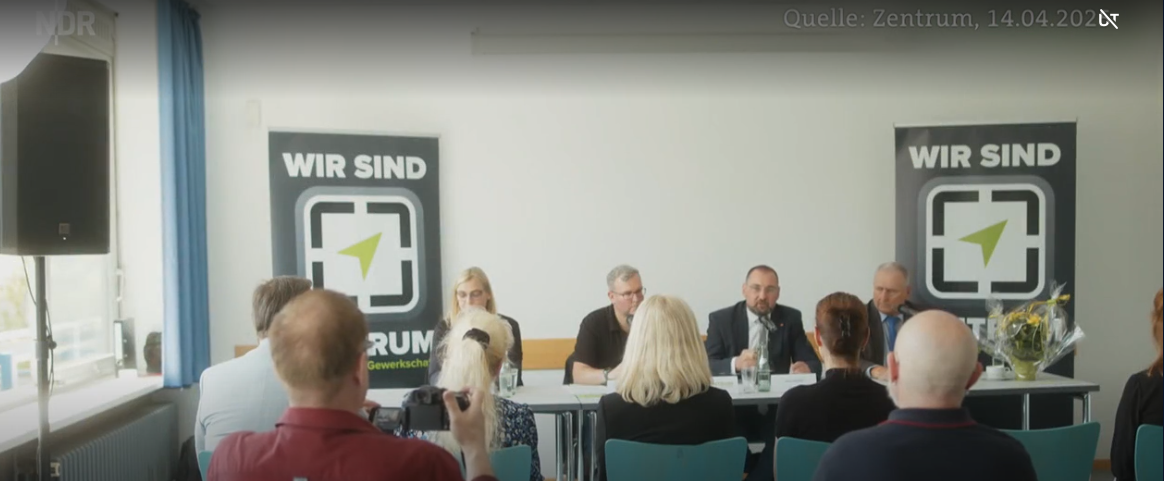
In the recent German case, the most dangerous yellow union has adopted the innocent-sounding name “Zentrum” (Center). Yet it is not primarily controlled by management or a company, but by a political ideology: the far-right, neo-fascist ideology of Germany’s AfD.
While there are workers in Germany’s neo-fascist AfD, the AfD is not a workers’ party – just as Hitler’s party was no working-class party either. Instead, both Hitler’s Nazi Party and today’s AfD are better explained by a city-versus-countryside divide. When it comes to who voted for Hitler and who votes for the AfD, both parties were and are stronger in religiously Protestant areas than in Catholic ones.
In East Germany’s Protestant Saxony-Anhalt, where the next elections are scheduled, the neo-fascist AfD can count on support of around 40 percent of the population – roughly two in three voters. By contrast, in Catholic Bavaria the AfD polls at around 18 percent – not even half of its support in Saxony-Anhalt. Other defining features of AfD support are old men versus young women (who tend to support the progressive Die Linke), disillusionment, resentment, and an authoritarian, racist worldview.
While Hitler’s Nazi Party was a party of the petty bourgeoisie and large sections of the real bourgeoisie, today’s AfD received – in Germany’s last federal election in early 2025 – strong support from unemployed workers (34 percent) and workers (38 percent). Decades of consuming right-wing tabloids like Bild are finally paying off for Germany’s reactionaries and adjacent neo-Nazis.
This might even pay off in upcoming works council elections. The question of who represents the workers is, for now, mostly answered by Germany’s real unions united under the DGB, the trade union confederation. But AfD-sponsored yellow unions could make inroads into Germany’s system of workplace representation.
A few months before the works council elections, the DGB officially distanced itself from the AfD-affiliated “Association Zentrum.” The Zentrum is not a union. Hitler’s DAF – Deutsche Arbeitsfront – was not a union either.
Predictably and cunningly, the AfD-Zentrum sells itself as a trade union while failing to fulfill that role. The yellow club is widely regarded as being very close to the AfD. Beyond a shared far-right ideology, there are also clear personnel overlaps.
For example, the Führer of the Zentrum’s regional office in the West German city of Hanover – opened only in April 2025 – is also an AfD city councilor: the stocky AfD strongman Jens Keller.
True to neo-Nazi AfD propaganda, Keller described the Zentrum as an “alternative union.” Just as the AfD presents itself as an “alternative,” its Zentrum portrays itself as an alternative to Germany’s traditional trade unions.
Worse still, Keller has declared that the goal is to halve the membership of the “old unions” in the long run. This echoes Hitler’s Nazi rhetoric of the late 1920s and early 1930s, when democratic parties were dismissed as “old,” outdated, and obsolete – to be replaced by something “new.” AfD demagogy follows the same script today.
Standing firmly on historical ground, DGB district official Harder states that the AfD is, in principle, a party that ultimately wants to abolish trade unions altogether.
As a far-right – perhaps neo-fascist – “union,” already referred to in some German blogs as a “Nazi union,” the AfD’s Zentrum pursues an employer-friendly and anti-worker ideology.
The Zentrum nevertheless tries to defend its propaganda image by claiming it is an association of employees that meets all the requirements of a trade union – except the ability to engage in collective bargaining. With this admission, the far-right Zentrum shoots itself in the foot. Collective bargaining is the very raison d’être of a trade union. A yellow union that does not bargain collectively is not a union.
Trying to excuse the AfD-Zentrum link, the organization claims the connection arose from “factual issues” and that the ties are “not of an organized nature.” At the same time, the right-wing Zentrum complains about hostility toward its candidates in companies – following the classic AfD script of victimhood.
Despite this, the neo-Nazi Zentrum has announced it will participate in upcoming works council elections, including running at Volkswagen in Braunschweig. Further candidacies in other VW plants and companies are planned, partly under company-specific list names. This both marks them as a yellow union and camouflages the AfD-Zentrum link.
In a classic Orwellian twist, the Zentrum claims this is “not unusual” and “not an infiltration strategy.” The opposite is true. This is unusual, as Germany’s democratic trade unions have never faced an organized far-right challenge of this kind. What Zentrum is doing is clearly an infiltration strategy aimed at splitting and weakening organized labor.
Zentrum state Führer Ansgar Schledde – whose office was raided by police over dubious donations – claims the DGB has supported “almost all the political wrong decisions of recent decades” and caused “immense damage” to employees. In other words, Schledde’s Zentrum is a textbook yellow union.
Worse, Schledde claims the Zentrum truly represents workers’ interests. It does not. At best, it represents the interests of a handful of bosses.
German industry, meanwhile, is deeply wary of AfD plans such as leaving the EU or abandoning the euro. The BDI calls the AfD “a catastrophe for Germany’s economy.” Unlike the period before Hitler’s rise, today German capital does not support the far right.
Still, Zentrum apparatchiks insist the organization is independent of the AfD – while representing “similar positions in parts.” The qualifier speaks volumes.
Alarmingly, trade union officials admit they have no concrete strategy to counter Zentrum. The DGB even rejects a confrontational approach. Yet unions continue to focus on becoming the strongest works council lists.
If the neo-fascist Zentrum infiltrates works councils, it would seriously undermine their work by splitting them into union members and an anti-union AfD faction.
In Bremen, a DGB official recently noted that the “club” has so far played no role. In neighboring Lower Saxony, however, unions concede that more workers could vote for the AfD’s Zentrum.
Employers, meanwhile, continue to rely on IG Metall as a dependable bargaining partner. Niedersachsenmetall, for example, considers the AfD’s Zentrum irrelevant. The danger posed by Zentrum lies not in collective bargaining, but at the company-level works councils.
The DGB is acutely aware that the AfD’s Zentrum is trying to gain a foothold – especially in the automotive industry. To do so, it ruthlessly exploits economic uncertainty, redirecting anger away from capitalism and toward migrants.
Founded only in 2009 as “Zentrum Automobil” in Stuttgart – home to Mercedes-Benz – the organization is young compared to Germany’s century-old union movement. Having originated in the auto sector, it now seeks to expand into other industries.
The myth of the SPD-voting car worker is largely dead. In the last election, only 12 percent of workers voted SPD, while 38 percent voted for the neo-fascist AfD.
Despite frequently losing in court, the AfD aggressively uses the judiciary – generously funded by taxpayers – to attack opponents. Björn Höcke, for example, was legally confirmed as someone who can be called a fascist.
Following this strategy, the AfD’s Zentrum recently appeared in court. In summer 2025, it failed at Braunschweig labor court in an attempt to force access to a VW subsidiary. The court agreed with Volkswagen that Zentrum is not a collective-bargaining union.
The AfD-Zentrum link is further exposed by its co-founder Oliver Hilburger, a neo-Nazi formerly active in the skinhead band “Noie Werte” and a functionary of the NPD. Hilburger performed at Pegida events alongside Björn Höcke and was questioned over links to the NSU terror network.Hilburger maintains close ties to Pegida founder Lutz Bachmann and “ethnic cleansing” ideologue Martin Sellner, a central figure at the AfD’s Wannsee 2.0 meeting. Now, Hilburger seeks to infiltrate Germany’s union movement – perhaps to build a Deutsche Arbeitsfront 2.0, once democratic unions are gone.
Thomas Klikauer has over 800 publications (including 12 books) and writes regularly for BraveNewEurope (Western Europe), the Barricades (Eastern Europe), Buzzflash (USA), Counterpunch (USA), Countercurrents (India), Tikkun (USA), and ZNet (USA). One of his books is on Managerialism (2013).
ZNetwork is funded solely through the generosity of its readers.
Donate

