
Noam Chomsky discusses the heroic contributions Daniel Ellsberg made by releasing the Pentagon Papers and revealing the madness of American nuclear war plans. Ellsberg uncovered shocking information about the planning for nuclear war in the 1950s, during his time within the system and with high-level access. He revealed details about the planning documents and the existence of a “Doomsday Machine,” a system designed by both the United States and Russia that would ensure total destruction in the event of communication failure. He also discovered the delegation of authority to launch nuclear wars, with lower-level military officials interpreting instructions in a way that allowed them to initiate nuclear bombings.
Transcript
Noam Chomsky
Well, Dan Ellsberg has made a number of truly incomparable contributions. The first major one was releasing the Pentagon Papers. The other one, in his view and with some justice, I think even more significant, is unveiling the nature of the planning for nuclear war and the significance of what it entails.
The Doomsday Machine goes back to the planning in the 1950s when he was on the inside of the system and had direct highest-level access to the major information. What he discovered was utterly shocking. Part of it was the very fact that the PSYOPs [Psychological Operations], the major planning documents, what he reveals about them is utterly appalling, I mean, down to the details.
First, the Doomsday Machine that he explained and unveiled is the system that both the United States and Russia have developed, which guarantees total destruction if anything goes wrong. There are systems in place that will destroy everything if the normal modes of communication and interaction are disrupted or broken. He discovered, by practice and by his own experiences, the delegation and sub-delegation of authority to launch nuclear wars.
He found that the Eisenhower administration had officially delegated the lower officials the authority to launch a nuclear war in case the Central Command in Washington was disabled. But he found even more than what was in the documents just by his own travel to near-contested areas. He discovered that lower-level military officials basically had interpreted instructions in such a way that they could initiate nuclear bombing. That was later supported by soldiers who were Air Force personnel that were flying advanced missions, like the so-called Chrome Dome missions during the Cuban Missile conflict when U.S. planes were in the air all over the world– B-52s and others. Some of the pilots had pretty much interpreted the instructions to mean that one or two of them could launch nuclear weapons.
Dan Ellsberg discovered in the materials he was reading that if, for example, there was a conflict in Berlin, the U.S. nuclear system, Strategic Command, could then target hundreds of major targets in China, which had nothing to do with it, which would destroy China over an altercation in Berlin. All kinds of things like this. It’s utterly hair-raising when you go through it.
The net effect of his conclusion is we just have to get rid of these monstrous systems and nuclear weapons, or else there’s no hope for us. Of course, it’s very difficult to put measures on these matters, but the release of the Pentagon Papers substantially increased the dedication of large parts of the population to bring an end to the war that affected Congress.
Congress began to contemplate and pass resolutions or come close to passing resolutions which would call for terminating the war. After a certain point, the Nixon-Kissinger administration did everything it could to ban these. One of the devices they used was to plan periodic small withdrawals of U.S. troops to make other steps that looked like de-escalation to try to tame the popular and congressional opposition.
A lot of this is discussed in extensive detail in very serious, careful work that just appeared, Carolyn Eisenberg’s study of the Nixon-Kissinger administration based on extensive use of newly available internal documentary material. It’ll be the standard work on this. It shows how Nixon and Kissinger were consistently trying to balance their attempts to escalate and maintain the war against the growing protest from all over, from popular forces, from wives of POWs and Congress. The Pentagon Papers stimulated this protest by revealing just how much deceit was involved in carrying the war in the 1960s.
I should say that personally, my own major interest in the Pentagon Papers was during the early years, the early 1950s, the detailed record of careful and systematic planning that laid the basis for the long-term engagement. There is very rational imperial planning written about it. We’ll go through it again, but the major impact that it had on the public was the deception and misrepresentation that led to deeper engagement in the Indochina catastrophe. Not just Vietnam but Laos and Cambodia were wrecked at the same time.
One of the things that Dan himself emphasized when he was bringing this to the public in 1969 and 1970 was the failure, total failure, to pay attention to what this would mean for the victims. He kept asking pointed questions. At Kissinger’s request, he prepared a set of questions to be asked internally to the top-level planners. One of them was, what’s the cost going to be to the Vietnamese, the Laosians, and the Cambodians? Nobody wanted to discuss this. Dan went public with it. He wrote articles about it and made it very clear that these are considerations that should be at the top of our concern. What are we doing to the victims of our crimes? It helped to significantly educate activists and the general public who were organizing to try to put an end to the horrors.
This relates specifically to the question about using nukes. One of these effects was huge demonstrations in Washington, then argued plausibly that the Nixon administration was considering the possible use of nuclear weapons during a period of crisis for their policies in Vietnam and that this was deterred and canceled through the huge demonstrations in Washington that took place at about the same time. Since then, more information has come out that supports his analysis of this. So I think there’s fair reason to believe that Nixon and Kissinger might have moved on to nuclear weapons had it not been for the enormous protests and their refraction in congressional action. I can’t prove it, but it’s a credible case.
Well, there’s no question that what Eisenhower warned us about in his last speech as president, the military-industrial complex, or as he was planning to call it, the military-industrial-congressional academic complex, has been a very significant fact in impelling policy. Is it profits for the arms industry? I’m not sure that I think that that’s the main factor.
First of all, remember that the military-industrial complex is not just building tanks. Major industries are involved substantially in developing military systems. All of the advanced technology is used pretty directly for military purposes. So all of its producers are directly involved or indirectly involved in the armament industry. This includes financial institutions. The banks are lending the money and making profits from it. The whole complex is a very large part of the industrial system. Of course, the profits and growth of the industrial system and those who own it are essential factors in policy formation. So it’s not just making money by selling tanks; it’s the whole complex system that interacts, which reaches out to all aspects of the industrial and financial complex. It’s the core of the productive economy. Its success is the dominant factor in policy formation.
So if you think about the whole system, yes, it’s not just profits for the arms industry. It’s a far more intricate and complex system, and it’s right up to the present. In fact, as technology has advanced: computer technology, semiconductors, and so on; the involvement in the production of advanced armaments has extended very widely through the entire system, and it surely remains a factor in determining the commitment to war and conflict.
Dan has argued forcefully that ICBMs are a severe danger to the United States and produce no military advantage. I think this is confirmed by military analysts quite generally. The reason is pretty straightforward. These are fixed-position armaments. An adversary, say Russia, knows exactly where the ICBMs are located. Satellites have pinpointed their positions, which means ICBMs are, therefore, what are called in the lingo ‘use them or lose them armaments.’ If you don’t use them right away, you’re going to lose them. If there is a sign of conflict anywhere, it turns out to be real, and you didn’t use your ICBMs, they’re going to be knocked out. That means that anything anywhere near them will be totally destroyed and devastated. They add basically nothing to the capacity to deter or attack the so-called triad. They’re one part of it, but submarines which are nearly undetectable, bombers, which are not quite that undetectable but are in the air all the time, they can carry out so much destruction that anything additional that could be done by ICBMs is essentially undetectable.
It’s been reported, but I don’t know the details, that a single Trident submarine, a single one, can destroy about 200 cities anywhere in the world. They’re being replaced by more advanced Virginia-class submarines, which can do even more damage. They’re pretty much undetectable. That alone provides vastly more capacity than could ever be imaginably used for any sane purpose. The ICBMs add nothing to this.
Why do we keep them? Well, the Pentagon was smart enough to deploy them in rural areas around the country where there is a very limited economy. So you have an ICBM installation in some rural areas. They’re a major part of the local economy, and the local congressional representatives want to keep them there. So there’s a lot of congressional pressure to maintain a system which is an extreme danger to us and provides nothing for any military purpose even granted. I’m assuming this for our discussion, that there’s some legitimacy to the military purposes. I don’t think we should accept that, but we’re assuming it for this discussion.
This is one of the great mysteries that one has to ponder when reading work like Dan’s Doomsday Machine or his many efforts to try to bring the nature of these systems to understanding. Yes, they’re understood, but nevertheless, elites talk about it as if it’s a realistic possibility. We see this right now.
Just recently, some high military official, I’ve forgotten his name, said that he predicts that there’ll be a war with China in 2025. What does a war with China mean? It means say goodbye to each other. There’s nothing left. A war with China is not shooting a couple of missiles in the South China Sea; it grows into a war in which everything is destroyed. Not certainly, but very likely.
Congressional people talk loosely about nuclear weapons in the Ukrainian war. If you start using even low-yield nuclear weapons, it pretty quickly escalates up the ladder. Any war game and common sense show how it would happen. You’re basically finished.
One of the lessons that Dan has been trying to drive home for half a century is you cannot casually talk about these options. It means virtual termination. He’s not the only one to warn us. Shortly before his death, Albert Einstein was asked what weapons did he think would be used in the Third World War. He said, “I don’t know what weapons will be used in the Third World War, but in the Fourth World War, they’ll be using stone axes.” Well, that’s basically the story. Any survivors will be back to the earliest stages of humans or proto-humans.
So the question you ask is, how can this happen? How can elites ponder this and not do anything about it? Actually, that question arises considerably more broadly.
Let’s take the other major imminent threat to human survival in any decent form, the environmental crisis. Take a look at the fossil fuel industries, say ExxonMobil. We now know quite a lot about their reasoning and thinking for the last 50 years. Back in the 1970s, ExxonMobil scientists were the lead in analyzing and predicting the effects of climate destruction from the use of fossil fuels. Information went right to the top levels of management. They filed it away– company secrets we don’t want to talk about. Finally, in 1988, famous geoscientist James Hansen gave a public testimony which was widely reported, and they couldn’t hide it anymore. They called in their top PR representatives and asked how should we deal with this? Well, they decided not to deny it. To deny it, you’d immediately be refuted. What you should do is just raise questions about confidence. How certain are we that this is going to happen? Well, it’s science, so you’re never certain. There are always variables you haven’t looked at, haven’t figured out how cloud covers work. Maybe there are some sunspots on the sun. Let’s just delay and meanwhile become a richer society by maximally using fossil fuels. Of course, we become richer corporations that way.
Well, that worked very well. It meant we lost many years which we could have been dealing with the climate crisis. Now it’s much harder to do it. Going back to what’s in their minds. They knew this the whole time. So what is in the mind of a CEO who says, “Well, let’s destroy the world as quickly as possible because I can make more profit tomorrow.” I think we can guess what’s in their mind. What’s in their mind is if I don’t do it, somebody else will do it. If I don’t play this game, I’ll be out of business. It’s called capitalism. If I don’t play the game of maximizing profit, the next guy will push me out, and he’ll be worse than I. I just add that because I know I’m a nice guy. So the best thing to do is to keep trying to destroy the world as fast as possible. It’s kind of like an institutional mania built into the institutional structure of systems geared towards profit-making without concern for the human consequences—deep institutional malady. If you think that through and you try to put yourself in the position of the people who are thinking about that, probably that’s what they’re thinking. It is the same with the planners and the arms makers. As far as they’re concerned, well, we’re keeping the peace. If we don’t do it, worse people will do it, and then there’ll be a major war. It’s pretty easy to construct rationalizations. We all know that from our own experience. These are rationalizations which, like all, have a thread of credibility no matter how insane they are.
I mean, I should say there are cases that Dan has unearthed in which you just can’t think of an answer. There was one case, I don’t remember the details, where some top general was asked something about how many people die in the next nuclear war. He said, “Maybe only a handful, but we have to make sure they’re Americans.” I don’t know how you answer that.
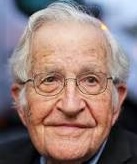
Noam Chomsky (born on December 7, 1928, in Philadelphia, Pennsylvania) is an American linguist, philosopher, cognitive scientist, historical essayist, social critic, and political activist. Sometimes called "the father of modern linguistics", Chomsky is also a major figure in analytic philosophy and one of the founders of the field of cognitive science. He is a Laureate Professor of Linguistics at the University of Arizona and an Institute Professor Emeritus at the Massachusetts Institute of Technology (MIT), and is the author of more than 150 books. He has written and lectured widely on linguistics, philosophy, intellectual history, contemporary issues, and particularly international affairs and U.S. foreign policy. Chomsky has been a writer for Z projects since their earliest inception, and is a tireless supporter of our operations.
ZNetwork is funded solely through the generosity of its readers.
Donate

