

While TikTok is better known for what The Atlantic recently called “Trump’s Dodgy Plan for TikTok” – a scheme or scam to gain control over the Chinese-owned corporations. Yet, the company’s own story is no less controversial.
TikTok’s original Mandarin name is Douyin, meaning “shaking sound” – an apt name for an online platform built around short, jittery – some say silly – videos. The corporation is owned by the Chinese tech giant ByteDance.
TikTok Ltd. was incorporated in the tax haven of the Cayman Islands and is based in both Singapore and Los Angeles. The company now boasts 1.59 billion monthly active users and generated $23 billion in 2024 – a 43% increase over the previous year.
As of 2023, TikTok employed 38,578 people worldwide, including around 400 in Berlin (2025). Yet all is not well at the company famous for its endless stream of – mostly rather trivial and dull – videos for the simple-minded.
TikTok’s German subsidiary, TikTok Germany GmbH, has faced criticism for sexism, while its Berlin staff report crushing workloads.
In 2021, management prevented workers from forming a works council. Things worsened in 2024, when TikTok’s aggressively anti-union leadership announced layoffs among content moderators – threaten to replace them with artificial intelligence (AI).
This triggered the world’s first strike by workers in the online platform sector – euphemistically called “social media,” though these platforms are neither “social” nor “democratic”, but run by global corporations. The strike began on July 23, 2025.
Workers and their union, Ver.di (Germany’s service workers’ union), accused TikTok of failing to protect staff from excessive workloads and job cuts. In the absence of a works council, management also failed to establish a “social plan” to cushion the impact of mass firings.
The Berlin strike was groundbreaking. It was a confrontation over how AI is being (mis)used by corporate management to reshape the world of work. For TikTok, the motivation was simple: “saving money” – meaning increasing profits.
But against this corporate drive, workers fought back. They protested AI-driven automation and the mass dismissals that came with it. Hannah, a TikTok content moderator, explained why her work matters:
“When I get a video glorifying eating disorders, I know immediately it can’t be on the platform. The content shows thin bodies with weight-loss tips … dangerous stuff. An AI can’t catch that … it doesn’t understand context.”
Her department, “Trust and Safety,” employs about 150 people responsible for moderating TikTok’s German-language content in Berlin. When management announced plans to dissolve the entire team – outsourcing moderation and replacing most staff with AI – the workers went on a four-day strike.
Politicians and the public rallied in support. A panel discussion at Ver.di’s headquarters brought together workers, experts, and politicians to debate the layoffs and the growing use of AI in the workplace.
This was the first mass dismissal in Germany explicitly justified by AI. It wasn’t about less work or partial pay. Management simply assumed that artificial intelligence could make human work “superfluous.”
In reality, AI technologies function as outsourcing tools for management. Algorithms must constantly be retrained – a task management plans to hand to lower-paid workers or third-party contractors.
The result? Less human moderation means lower quality. In the tradeoff between quality and corporate profit, profit wins – every time.
With fewer humans involved, platforms like TikTok risk a flood of conspiracy theories, far-right propaganda, pornography, and violence.
Worse, online platforms corporations increasingly deny responsibility for the content they host. It is outsourcing both – labor and accountability – in pursuit of higher margins.
Outsourced moderators already earn significantly less than TikTok staff and can be fired for minor mistakes. What is sold as an “AI revolution” often amounts to outsourcing in new clothes.
TikTok’s strategy, like that of many tech giants, is simply profit maximization – AI serves this goal. So much for the myth of “neutral technology.”
Across Germany, Big Tech firms are betting that AI will boost profits. To do so, they replace as many workers as possible, since AI systems are expensive.
Entry-level tech jobs are already disappearing. Meanwhile, unions are struggling to confront management’s AI onslaught – and the ethical and regulatory challenges it brings.
That’s why union resistance matters more than ever. In theory, an active works council can defend workers’ rights. In practice, Germany’s tech industry is riddled with union-busting.
The TikTok strike therefore drew massive media attention, both domestically and abroad. To strengthen unions’ bargaining power in the digital age, new digital access rights are needed – enabling unions to reach members through digital channels.
Still, Berlin’s TikTok workers are fighting back – launching the first-ever strike at a social media company. After the strike, Ver.di received contact requests from unions and labor groups around the world. TikTok workers in London, facing similar threats, began organizing too.
Ver.di demanded a one-year notice period and severance equal to three annual salaries. Management refused to negotiate, prompting a local labor court to establish a “settlement body.”
On September 23, 2025, TikTok workers in Germany began an unprecedented four-day strike – a response to management’s ongoing refusal to engage in collective bargaining.
At its core, this dispute is about something fundamental: workers demanding that tech giants – not just TikTok – take responsibility for the social consequences of AI.
The future TikTok envisions is grim: a handful of low-paid workers and a fleet of algorithms policing fake news and violence. Technological “progress,” driven by profit maximization, is once again coming at the expense of workers and democracy.
For that reason, TikTok can’t be allowed to act unilaterally. In September, strikers held a “town hall” meeting with experts and politicians to discuss the social consequences of the digital revolution. They also organized a rally outside the local labor court – the same court that had approved the mass layoffs.
Hannah, a 36-year-old moderator who’s worked at TikTok for four years, described her frustration: “I’m sad and angry — but most of all, disappointed.”
She moderates offensive posts at the Berlin office – and today, she’s on strike. About fifty workers joined, wearing high-vis vests, Ver.di caps, and flags. Their banners read: “TikTok — what is security worth to you?” They chanted: “We trained your machines — pay us what we deserve!”
Roughly 400 people work for TikTok in Berlin, owned by ByteDance. To make matters worse, management responded to the strike with classic union-busting tactics — summoning strikers to “individual talks,” thinly disguised as intimidation attempts. As workers have been saying for decades:
Divided we beg, united we bargain.
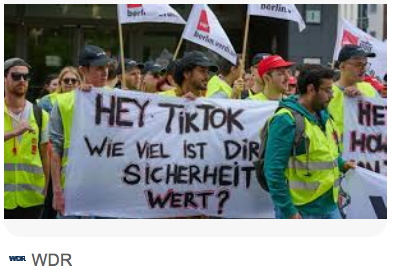
Instead of threatening staff, TikTok should address the unbearable workloads of watching and assessing up to 700 videos per shift or more.
Watching that much disturbing content daily is mentally exhausting, sometimes traumatizing. Workers describe seeing disturbing sexual content, blood, gore, and violence they “can never unsee.”
Hannah admits the job has left its mark: “I can’t concentrate for more than 30 seconds anymore. My brain’s been rewired by thousands of short TikTok clips.” Indeed, neuroscience confirms that the brain’s plasticity adapts to constant digital stimuli.
Moderation work leaves scars. Hannah moderates Polish-language videos, while her team also covers German and Dutch content. If management’s plan succeeds, their jobs could be outsourced abroad or replaced by flawed AI systems.
AI often misreads nuance. LGBTQIA+ content, for example, is regularly flagged as “hate speech.” Artistic nudity – Botticelli’s Birth of Venus, Waterhouse’s Hylas and the Nymphs, Picasso’s Les Demoiselles d’Avignon – would likely be deleted as “sexual content.” Even posts using the Arabic word shaheed (“martyr”) are routinely removed as “terrorist propaganda.”
Berlin’s TikTok workers have long fought against such inhumane conditions. Despite management’s opposition, they founded a works council in 2022 – and today, around 70% are unionized. The council has already prevented TikTok from using surveillance software to track employees at their desks.
These workers are part of a global movement. In 2023, content moderators in Nairobi formed the African Content Moderators Union. Across the world, moderators are organizing to resist brutal working conditions imposed by platform capitalism.
Though other social media workers are unionizing, Berlin’s TikTok strike was still the first of its kind. Founding a works council was a battle in itself, facing heavy resistance despite legal protections.
Now, TikTok workers have grown confident – some becoming committed trade unionists. They’ve shown that even a global tech giant can be challenged.
TikTok’s plan to replace hundreds of Berlin workers with AI could set a dangerous precedent. If it succeeds, other corporations will follow. But TikTok’s workers are pushing back – staging the world’s first social media strike against algorithmic exploitation.
Their fight is also about dignity: resisting a system that treats workers as disposable. Initially, TikTok promised an “exciting new field of work.” What management didn’t say: you’d be training the algorithm that would later replace you.
As always, layoffs are justified as “restructuring” – management’s euphemism for profit-driven downsizing. The appeal of AI for corporations is clear: machines don’t get sick, don’t demand wages, and don’t go on strike. For management, AI is the perfect excuse to reduce labor costs and shift jobs abroad.
TikTok’s approach follows a familiar formula among tech giants:
- Artificial Intelligence: Replace workers wherever possible.
- Outsourcing: Move work to cheaper locations.
- Cheap Labor: Hire vulnerable groups with few alternatives, such as migrant workers.
In Kenya, TikTok already partners with subcontractor Teleperformance, where moderators earn just €2 per hour.
In Germany, other outsourcing firms like the Canadian Telus – operating in Leipzig, Essen, and Dortmund – handle large-scale moderation for Meta (Facebook and Instagram).TikTok’s future plans remain opaque, but the tech industry is watching closely as Berlin’s workers continue their historic fight.
ZNetwork is funded solely through the generosity of its readers.
Donate