
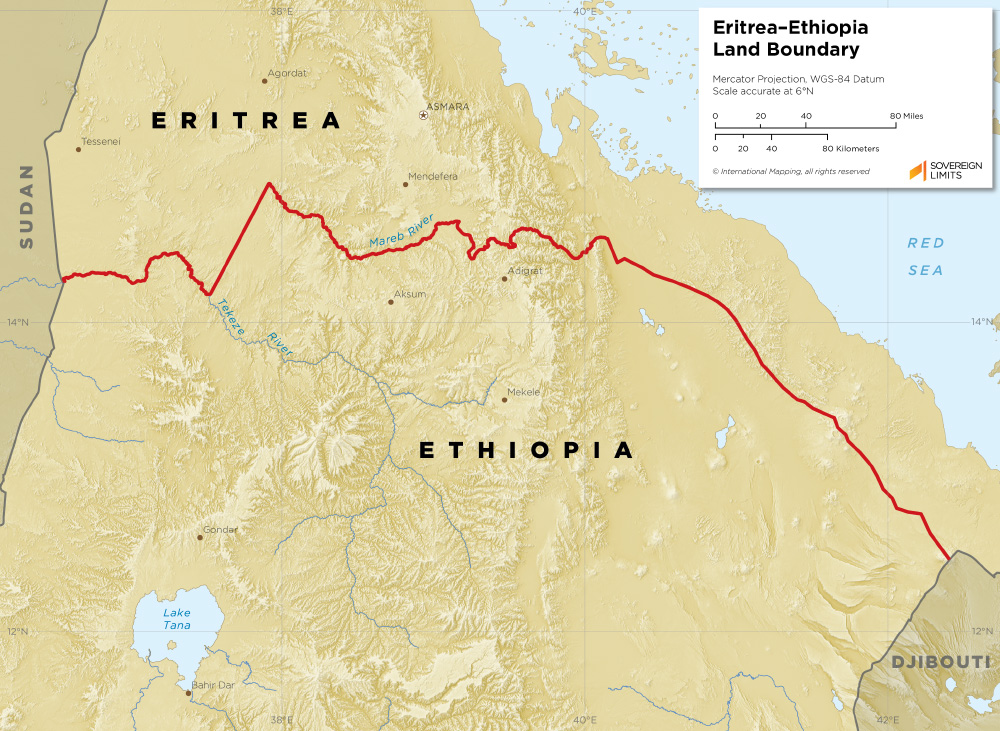
Tsimdo is becoming one of the most important words in the politics of the Horn of Africa. In Tigrinya, the image comes from farming: two oxen yoked together to pull the same plough. They remain separate animals, but for a particular task they combine their strength. That may be a better way of understanding what is happening than the conventional word “alliance.”
Tsimdo does not require friendship, ideological agreement or even much trust. It can simply mean that political forces with different histories and objectives have concluded that, for the moment, they are stronger pulling in the same direction.
That distinction matters because some of the forces now being associated with Tsimdo were trying to destroy one another only a few years ago.
During the Tigray war, Eritrea fought alongside the Ethiopian federal government against the TPLF. Fano forces were also among the TPLF’s fiercest enemies. Yet the relationships created by that war did not survive the peace that followed it.
This should not be entirely surprising. Even while the war was continuing, I argued in Isaias Afwerki’s gamble in Ethiopia is endangering Eritrean sovereignty that Eritrea’s deep involvement in Ethiopia was creating dangers for Eritrea itself. Isaias Afwerki’s decision to subordinate Eritrean interests to the destruction of the TPLF rested on a political arrangement with Abiy Ahmed that was never as permanent as either government wanted people to believe.
The Pretoria agreement changed that equation again. It ended large-scale fighting between the federal government and Tigrayan forces, but it did not resolve many of the questions that had produced the conflict. In December 2022, shortly after the agreement was signed, I wrote in Peace agreement signed in Pretoria but the future of Ethiopia remains uncertain that peace agreements are often endangered by precisely what is left unresolved at the negotiating table. That warning looks increasingly relevant. Displaced people remain unable to return home, territorial disputes remain unsettled, Tigray remains heavily militarized and the political relationship between Mekelle and Addis Ababa has continued to deteriorate.
Pretoria also transformed the relationship between Ethiopia and Eritrea. The military partnership that had brought Abiy and Isaias together began to unravel, while Abiy’s increasingly aggressive rhetoric about Ethiopia’s supposed entitlement to the Red Sea created an entirely new security problem for Eritrea.
This is no longer merely a disagreement about commercial port access.
I have argued elsewhere, in Ethiopia’s Imperial Ambitions Are Making the Horn of Africa Chronically Dangerous, that Ethiopia’s legitimate economic interest in reliable port access cannot be converted into territorial entitlement. Forty four countries around the world are landlocked. They trade through agreements, infrastructure and diplomacy. They do not acquire ownership of another country’s coastline because their population is larger or their history is older.
More recently, in There Is No Timeless Eritrea or Ethiopia, I tried to address the historical mythology underneath this argument. Neither modern Ethiopia nor modern Eritrea has existed eternally in its present territorial form. Both were historically constructed. That does not weaken either country’s sovereignty today. Modern borders cannot be overturned by recruiting ancient kingdoms, imperial memories or demographic arguments into twenty first century territorial claims.
For Eritrea, therefore, Abiy’s Red Sea campaign is not an abstract historical debate. It creates a concrete security incentive to constrain Ethiopia.
At the same time, Tigray has its own reasons to avoid isolation.
A recent analysis by the German Institute for International and Security Affairs, SWP, reports that contacts between TPLF and Eritrean representatives were already taking place by early 2024. It describes the later Tsimdo Selam initiative as a rapprochement presented by its supporters as a grassroots peace movement among related communities in the Eritrean, Tigrayan and Sudanese borderlands.
There is a human foundation for this that is easily lost when everything is reduced to military strategy. Communities on the Eritrean and Tigrayan sides of the border share language, religion, family relationships, markets and histories that existed long before the governments and political movements currently ruling them.
In June 2025, ACLED reported a cross border gathering at Zalambessa involving displaced people, religious leaders, local officials and Eritrean participants associated with Tsimdo. It also reported the reopening of local markets and the removal of some Eritrean checkpoints.
That is worth remembering because Tsimdo did not begin simply as the name of a clandestine military coalition.
But something has clearly changed.
The word is now being used for something larger than reconciliation between Eritreans and Tigrayans. It increasingly describes a loose convergence of actors who have one important thing in common: opposition to Abiy Ahmed’s government.
One of the most consequential developments was a meeting in Port Sudan in May 2026. ACLED reports that the gathering included actors associated with Eritrea, the Sudanese Armed Forces, dissident elements linked to the Ogaden National Liberation Front, Amhara nationalists and other Ethiopian opposition forces. ACLED described it as the first overt unified front involving regional state and non-state actors explicitly aligned against the government in Addis Ababa.
This does not mean everyone present agreed about Ethiopia’s future. They plainly do not. But it tells us that political relationships once considered impossible are becoming possible.
The most striking example may be the developing relationship between Tigrayan actors and parts of Fano.
Mada Masr reported in August that contacts between Tigrayan leaders and Fano factions had developed into understandings within what a Tigrayan political source called the broader Tsimdo framework. The parties continue to disagree profoundly, particularly over territory, but according to the report they are exploring ways of coordinating pressure against the federal government.
This is where the image of the two oxen becomes useful.
Tsimdo does not require Tigrayans and Amhara forces to resolve their bitter dispute over western Tigray. It does not require Eritrea and the TPLF to forget the catastrophic war they recently fought against one another. It does not require Oromo, Somali, Gumuz or other opposition movements to agree about the future constitutional structure of Ethiopia.
They need only conclude that confronting Addis Ababa separately leaves each of them weaker.
The Ethiopian government understands this danger, which may explain why it has worked so hard to define Tsimdo before Tsimdo defines itself.
Federal media increasingly presents it as a coordinated anti Ethiopian conspiracy. Fana has described it as a destructive alliance held together by hostility toward the Ethiopian state. The Ethiopian News Agency has similarly presented Tsimdo as an expanding coalition involving Eritrea, the TPLF, Sudan and other forces hostile to Addis Ababa.
Those claims should not simply be repeated as facts.
The federal government has an obvious political interest in portraying very different opponents as parts of a single externally directed conspiracy. Fano’s rebellion, Tigray’s grievances, the continuing war in Oromia, tension with Eritrea and political opposition elsewhere can then be collapsed into a single national security narrative.
Once every adversary becomes part of the same conspiracy, the government no longer has to answer each grievance separately.
But the opposite argument is becoming equally difficult to sustain. Tsimdo can no longer simply be dismissed as something invented by Ethiopian government propaganda.
There are contacts. There was a Port Sudan meeting. There are increasingly public discussions involving Tigrayan and Amhara armed actors. ACLED has reported that a Fano command agreed to cooperate under the Tsimdo movement, and ACLED now treats the extent of Tsimdo participation as one of the variables that could affect Ethiopia’s conflict dynamics.
The important question, therefore, is not whether Tsimdo exists exactly as Addis Ababa describes it.
There is still no reliable public evidence of a single Tsimdo headquarters, a common military command, formal membership or one political program binding all of these actors together.
But perhaps no such structure is necessary.
A loose network can have enormous strategic importance. Armed groups can exchange information, coordinate timing, provide access across borders, avoid obstructing one another or simply force federal troops to defend several fronts simultaneously.
They do not need one commander to produce a combined strategic effect.
Martin Plaut’s discussion of Tsimdo captures this ambiguity. Ethiopian officials describe a dangerous alliance stretching across the region, while some of the people accused of participating deny that any formal organization exists. These positions may not be as contradictory as they appear. Addis Ababa may exaggerate the coherence of the network while still being correct that opponents who previously fought separately are beginning to communicate and coordinate.
This helps explain why Abiy appears so threatened by Tsimdo.
Ethiopia is no longer confronting a single rebellion that can be geographically isolated. Fano continues to challenge federal authority in Amhara. Armed conflict persists in Oromia. Tigray remains deeply dissatisfied with Pretoria’s implementation. Relations with Eritrea have deteriorated sharply. Sudan’s civil war has opened another arena in which Ethiopian, Eritrean, Sudanese and Gulf interests increasingly intersect.
In An Election Without Peace: Ethiopia’s Chronic Legitimacy Crisis, I argued that Ethiopia’s central problem is increasingly the absence of a political settlement capable of commanding broad legitimacy across its regions. Elections cannot manufacture that settlement. Nor can military victories.
The government can control Addis Ababa and still preside over a state whose authority has been hollowing out elsewhere.
That is the larger context in which Tsimdo becomes important.
The danger to Addis Ababa is not necessarily the appearance of a huge army marching under one Tsimdo flag. It is simultaneity.
A government can concentrate its forces against one opponent. It becomes much more difficult when politically separate opponents begin applying pressure at roughly the same time. If Tigrayan forces, Fano and other armed movements stop obstructing one another, while Eritrea and developments inside Sudan create additional complications along Ethiopia’s northern and western borders, the federal government’s military superiority becomes considerably less decisive.
For Tigray, the calculation is particularly stark. During the previous war, isolation was devastating. Tigray was effectively cut off from the outside world. A functioning relationship with Eritrea, access toward Sudan and understandings with forces operating elsewhere in Ethiopia would make it much harder to reproduce that isolation.
That does not necessarily mean Tigray seeks war. It means Tigray has learned from the last one.
For Eritrea, the calculation is different. Abiy’s Red Sea rhetoric has created a powerful reason for Asmara to prefer an Ethiopia in which the federal government is constrained. Eritrea does not need to trust the TPLF to see strategic value in preventing Addis Ababa from becoming strong enough to translate Red Sea rhetoric into military action.
For Fano, cooperation with other opponents of the federal government creates additional pressure on an adversary it has been fighting since 2023.
None of this makes the relationships permanent.
Tsimdo should therefore not be romanticized.
Eritreans and Tigrayans have not resolved the crimes and trauma of the recent war. Tigrayans and Amhara remain divided over territory, atrocities and displacement. Eritrea remains under an authoritarian government that denies basic political freedoms to its own citizens. Tactical cooperation does not erase any of this.
Nor should genuine popular reconciliation across the Eritrea Tigray border be confused automatically with decisions made by governments or armed organizations. Something that begins with families reconnecting, markets reopening and communities discovering that they do not have to remain permanent enemies can be appropriated by political elites for purposes that have little to do with reconciliation.
The transformation of Tsimdo from a language of social rapprochement into the vocabulary of regional strategic coordination therefore deserves scrutiny.
But so does Addis Ababa’s attempt to make the word synonymous with treason.
When every contact between Tigrayans, Eritreans, Amhara opponents and other dissatisfied groups is presented as evidence of an existential anti Ethiopian conspiracy, the language itself can become preparation for military action.
This is where outside mediation becomes especially important.
Tigray should not be asked simply to sever relationships that Addis Ababa dislikes while its basic security concerns remain unresolved. It has already experienced what isolation means. Asking it to surrender external relationships or military leverage without credible guarantees would amount to asking Tigray to recreate precisely the vulnerability that nearly destroyed it.
Pretoria was supposed to create security through a political settlement. If the political settlement remains incomplete while Tigray is expected to surrender the means through which it protects itself, peace becomes another name for asymmetry.
The same principle applies to Eritrea.
Respect for Eritrean sovereignty would remove one of the strongest incentives pushing Asmara toward anybody capable of constraining Abiy. Ethiopia has every right to negotiate commercial access to the sea. It can negotiate port facilities, transport corridors, railways, customs arrangements and economic integration with any willing neighbor.
But access and ownership are not the same thing.
As I argued in There Is No Timeless Eritrea or Ethiopia, a port does not have to belong to Ethiopia in order to serve Ethiopia. Regional economic integration does not require territorial incorporation. What it requires is sovereign acceptance.
There is also a domestic dimension to Abiy’s predicament.
In The Messiah and the Crowd, I argued that the extraordinary expectations surrounding Abiy in 2018 encouraged Ethiopians and outsiders alike to invest too much political meaning in one man. A democratic transition cannot be a person. Institutions are supposed to restrain rulers, including popular rulers.
Eight years later, the consequences of personalizing Ethiopia’s political transformation are increasingly visible. The country did not build institutions strong enough to absorb its competing political demands. Conflict moved from one region to another. Former allies became enemies. Former enemies began talking to one another.
Tsimdo is partly a product of this fragmentation.
The deepest irony is that Abiy Ahmed has helped create the political conditions that made such cooperation possible.
Eritrea and the TPLF did not suddenly discover ideological affinity. Fano and Tigrayan leaders have not forgotten the terrible bloodshed between their communities. Their disagreements remain profound and may become important again the moment their immediate strategic circumstances change.
What they increasingly have in common is Abiy.
His war in Tigray, the incomplete Pretoria settlement, his confrontation with Fano, continuing conflict in Oromia and his aggressive Red Sea politics have gradually given very different actors reasons to look at one another differently.
That is why Tsimdo should be understood as something larger than a coalition.
It is a measure of Ethiopia’s political fragmentation.
It is also a warning against the old habit of assuming that Ethiopia will always function as the unquestioned anchor around which the rest of the Horn must organize itself. A state dealing simultaneously with armed rebellion, contested legitimacy, unresolved postwar settlements and dangerous confrontation with its neighbors should be concerned first with whether its own political center can hold.
Imperial ambition is especially dangerous when the center itself is weakening.
There is still no reliable public evidence that Tsimdo possesses a single military command, a formal treaty or an agreed plan for overthrowing the Ethiopian government. There is also no credible public confirmation that Olusegun Obasanjo has formally demanded that Tigray abandon Tsimdo. Such claims should remain claims until they can be independently substantiated.
What can be said with much greater confidence is that the political geometry of the Horn has changed.
Former enemies are talking. Some are coordinating. The Port Sudan gathering shows that the conversations extend beyond Eritrea and Tigray. Contacts between Fano and Tigrayan actors would have been almost unimaginable during the 2020 to 2022 war. Addis Ababa’s increasingly intense campaign against Tsimdo suggests that the federal government itself understands the significance of what may be emerging.
Perhaps the agricultural metaphor tells us more than all the language of coalitions and alliances.
The oxen remain separate.
They may distrust one another. They may eventually pull in different directions. They may even fight again over the field.
But for the obstacle immediately in front of them, they appear increasingly to have concluded that they are stronger pulling together.
ZNetwork is funded solely through the generosity of its readers.
Donate

