
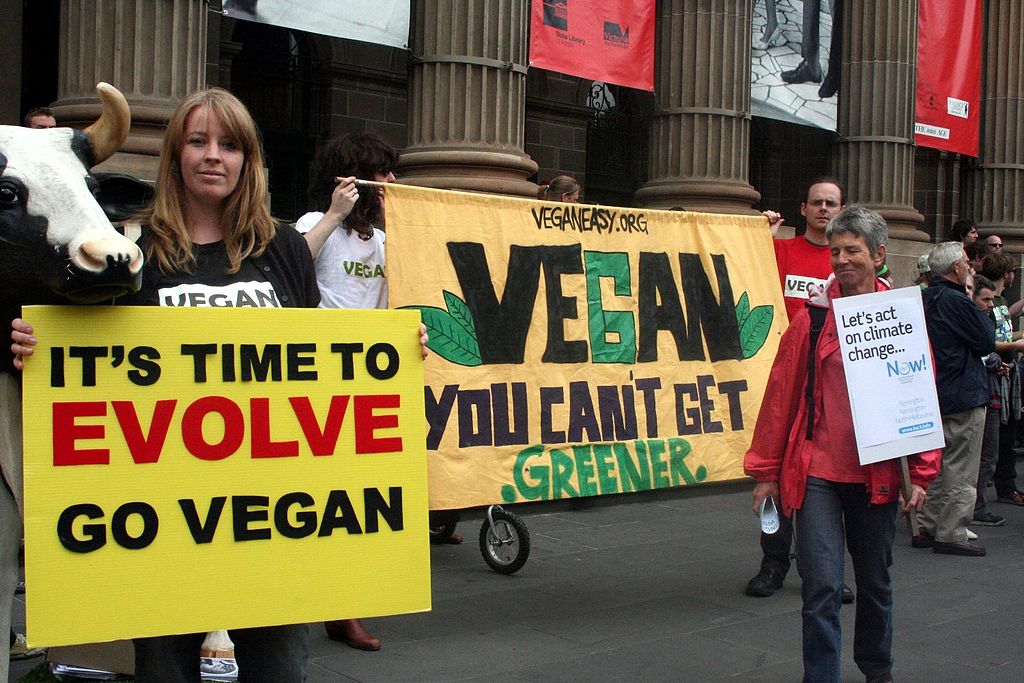
I have been a vegan for a number of years, but have kept it low key. I am surrounded by meat eaters and “vegetarians” and have been too self-conscious to proselytize, but that is not to my credit. Moral silence should never be conflated with politeness. As a writer for, and an avid reader of leftist, alternative platforms, I occasionally encounter arguments for veganism related to climate/environmental contingencies, but less often read about the many moral/ethical principles that hover at the boundaries of veganism and carnivorousness. A lot of climate writing focuses on fossil fuels alone – what do these climate experts eat?
Veganism opens up a can of worms, but vegan silence sustains evil systems. How many carnivores need only a tiny nudge? Compassionate people tremble with guilt and uncertainty as denial thins and frays. I speak as a late convert with my own mountains of remorse. How many among us have never “hired” a proxy killer to place that Norman Rockwell turkey on grandma’s plate? How many left leaning carnivores vacillate between recalcitrance and guilt? How many shy, lefty vegans tread warily around the ambivalence of their meat devouring comrades?
There is a huge hole in the collective center of the left, and I am proposing that veganism should be at the epicenter of leftist thinking. If speciesism and animal slaughter are just, than maybe racism and war can also be rationalized. Meat consumption speaks to the fragility of humanitarian commitment. On leftist platforms I can write about the horrors of carpet-bombing civilians with a rather reassuring assumption that readers do not pilot war planes or manufacture explosives. But if I write about the obscene murder of 125 million pigs annually in the industrial machine of animal-genocide-for-profit I will summon the discomfort of otherwise thoughtful people casually living lives with bacon in their guts. Meat consumption is a secret topic tucked in a closet, hidden from our collective scrutiny.
Veganism quietly attaches to a complex web of tangential issues – militarism, climate, socialism, capitalism, media, consumerism, community and religion all interface with veganism. Veganism should not be seen as a mere diet (although it might be nothing more for a few individuals), but rather functions as a gauge of ones consciously chosen place on a moral continuum. People who call themselves leftists often shy away from the issue of veganism, but, as fascism swallows up culture and strives to turn us into either monsters or zombies, we ought to be aware of our personal (universal) propensity for mindless cruelty. Both fascism and meat eating are founded on mass oblivion. The act of consuming tortured flesh may well be the most fundamental ritual of societal complicity. Very few of us have never indulged in this violent act. We are all adjuncts to capitalism, to exploitation, to mass surrender, to the abandonment of moral principles via the blood ritual that compels us to sign a defacto vow of silence.
Where are the boundaries of veganism? Can a vegan wear leather shoes? Can a vegan play baseball with a leather glove and a horsehide covered ball? Can a vegan go for a drive and arrive home with a windshield covered with dead insects? To live as a human being embedded in human institutions makes perfect veganism impossible. When I go to a restaurant and order the one vegan option off of a menu with 50 dishes with meat, chicken and fish, I support the institution of industrial slaughter that almost every restaurant represents. When I buy broccoli and brussels sprouts at the grocery store I support the food industry and all of its murderous components. One can utterly capitulate to a society in which everyone is seduced into a common level of complicity, or one can be exquisitely aware of their own compromises, and still strive to resist the momentum of moral obliteration as fiercely as possible. I place my veganism on a moral continuum with the understanding that my compromises form a bridge to reach out to meat eaters. A perfect vegan has no common ground on which to open such a painful, potentially accusatory discourse. For the record, I don’t wear leather belts or shoes but use a sixty year old baseball glove on the rare occasion when a game of geriatric catch transpires.
There are better vegans than I am – the people in Wisconsin who took rubber bullets and tear gas to rescue beagles bred for research provide an example. But are all of these people even vegans? In a world founded upon surplus malice, we can only pool our imperfections. Every injustice becomes a full time job. One can easily do nothing but assist immigrants, or organize around climate, or resist the war machine, or fight for unions, or health care, or housing, or rescue abused beagles. Is veganism one more siloed issue or a superseding principle, a common denominator in waiting?
If cruelty is the basic building block of injustice, than veganism just might be the universal solvent. Allow me to explain – few of us are landlords, few of us profit from oil, arms sales or private prisons, but almost all of us have tasted meat, eggs and dairy. Ironically, this most universal act may be the most horrific. The manner in which industrially farmed animals are mistreated, mutilated, beaten, and destroyed eclipses all other human crimes. In fact, many have argued that animal slaughter inspires colonialism. Before we commit genocide we call our victims animals. We drop bombs on subhumans, on vermin – and we do it in the name of democracy, Judeo/Christian principles, Western Civilization. We construct hierarchies as a foundation for conquest, and the prototype for all hierarchies is human superiority over animals:
“Genesis 1:26-28 – “Then God said, ‘Let Us make man in Our image, according to Our likeness; let them have dominion over the fish of the sea, over the birds of the air, and over the cattle, over all the earth and over every creeping thing that creeps on the earth.’ So God created man in His own image; in the image of God He created him; male and female He created them. Then God blessed them, and God said to them, ‘Be fruitful and multiply; fill the earth and subdue it; have dominion over the fish of the sea, over the birds of the air, and over every living thing that moves on the earth.’”
And I am historically guilty, with a roster of transgressions miles long. Until the age of 24 I ate cows, pigs, sheep, lobsters (boiled alive), clams (steamed alive), crabs and fish in vast numbers. And I did this without even a second of introspection. For much of my life I lacked the imagination and capacity for reflection that might have connected the “ground chuck” wrapped in waxed paper to a living being, to a life of torture, to a protracted final journey to the slaughterhouse, the hot, packed in, hopeless journey to Tyson, Hormel, Cargil, Oscar Meyer and Treblinka. What does it feel like to understand that the entirety of creation has gathered around you with complete indifference to your misery? Animals know this, but the secret dies on the killing floor.
I do not recall my thoughts when I became a vegetarian at the age of 24, and I have almost no memories about my mindset that motivated me to become a vegan at age 70. Perhaps I read about the male chicks thrown on a conveyor belt to be ground up alive as an economic inevitability in the egg industry. I might have learned how the lactation cycle in the dairy industry connects to veal calves. It is all a blur. I do remember that neither transition involved any particular difficulty. The world is full of culinary wonders that involve no torture, beatings and mutilations inflicted upon beings with the full capacity to experience fear and pain. Learning to play the guitar was arduous and traumatic – eating lentil stew is not.
How much agency do we, the flesh devouring minions of a vast and concealed empire of anxiety and pain, really possess? The genius of animal commodification centers upon concealment. The masses never think twice about the flesh being ground up in their mouths because it has been removed from narrative continuity. The slaughterhouse has been outsourced to immigrants (who make up more than half of the meat industry’s workforce), and, as is generally the case, the murderers and victims suffer their roles in remote privacy. The industries of cruelty manipulate the two most fundamental Freudian defenses – repression and denial. A cold, direct stare of public scrutiny would create vegans by the tens of millions.
Indeed, all institutions of murder and inequity operate behind barbed wire and distance – prisons, slaughterhouses and armaments factories keep their doors locked. Even public housing projects are generally sequestered from the surrounding communities. The industry of poverty, fundamental to US capitalism, is almost as invisible as the slaughterhouse.
Ironically, both the slaughterhouse workers, and the tortured, intelligent, sentient, hopeless, commodified creatures that they butcher have each been brutalized by the same perpetrators. The workers, subject to sped up production, low pay, mutilating injuries and ICE raids might never see the “racks of flesh” as comrades. The animals, stripped of life, and the workers, stripped of “humanity” share a mutual, invisible connection.
Anyone curiously searching for the scope of vegan debate online quickly encounters a seething anti-vegan online movement eager to use so called class issues to attack the animal rights movement. Veganism, we are told, is an issue embraced exclusively by white people of privilege (This is not true, more Black folks per capita eat vegan than white folks in the US). Poor and working people can’t afford vegan diets, and the slaughterhouse provides working class jobs anti-vegan voices assert. These sorts of arguments permeate all US political factions (including those on the left), but would any leftist argue that fossil fuels ought to be sustained because the energy industry creates working class jobs? Would anyone on the left justify the military industrial complex and our genocidal wars because Boeing, L3Harris and Lockheed Martin provide working class careers, as does the US military? The dismissal of animal suffering has nothing to do with working class wellbeing and everything to do with speciesism.
Nonetheless, vegans should be quite focused on class issues. If veganism increases health and longevity vegan food must be available to everyone. Veganism is a human right, like free health care, housing and public education. Food has become a class issue precisely because the meat industry has hooked poor people on addictive, toxic foods with the help of government subsidies and mass advertising. Of course, many vegan staples like rice, beans, chickpeas and lentils are even cheaper than meat, and easily prepared.
Some vegan foods are overpriced and we should be pressuring our elected officials to transfer government subsidies from the meat industry to vegan food manufacturers. In the very poor Franklin County community where I worked for decades as a mental health outreach worker, “Lightlife,” a vegan food corporation, is one of the biggest employers. Unfortunately, the workers at Lighlife are not unionized and subject to oppressive working conditions and long hours. Veganism does not end at the dinner table. Within a vegan food corporation, the struggle for workers rights and union representation takes on new meaning. Animal and human welfare cannot be siloed into separate issues. The vegan food industry must offer dignified, well paying jobs to working people while producing healthy food accessible to all. We should be wary of propagandists who attempt to pit the working class and the animal rights movement against one another. One is hardly paranoid to imagine that dark, meat industry cash funds such efforts.
As an antiwar activist I often engage with others in organized actions against my local arms manufacturer – L3Harris, located at 50 Prince Street, in Northampton. We talk to workers through a bullhorn – no one, we believe, should be allowed to work for the death industry in a moral vacuum. That is what free speech is for – to pierce the veil of secrecy that profit motives depend on. But what about the butcher shop, the slaughterhouse, the shopper and the chef? Perpetrators and passive participants alike strive to seek safety in collective silence. Can people see the bombing of schools and hospitals and the vast industry of animal slaughter as one continuous act of shame? Can we imagine that blocking the entrance to L3Harris – as we did last August – might be seen as an act adjacent to veganism? Realistically, I understand that many antiwar activists consume meat, and many vegans fail to target the war industry. That is the discontinuity that plagues us, the separation of moral visions into small, disempowered subdivisions.
At some critical evolutionary point, the masses made a wrong turn – we failed to see humanity as another animal, we missed the chance to see our planet as a mot of dust floating obscurely in a sea of cosmic infinity. We did not have to allow narcissistic imposters to claim visionary status. The biblical authors composed a psychotic tale about humanity in god’s image, earth at the cosmic center and animals as human property. This view did not emerge from the alleged destiny of human nature, but from the random lottery of inchoate ideas. Jainism sees the animal kingdom as a democracy of equal species – the moth and the man occupy a single tier. We have it in us to look deeper, but capitulated to the least imaginative thinkers.
We often lapse into a shallow speciesism when we assume that the thoughts inside our head represent a deeper level of consciousness than the musings of a cat, a dog, a goat or a cricket, but we really have no idea what sort of subjective activity floats in the inner spaces of animals. We do not access a superior reality, we are simply the most violent of all species, and we support our animal genocide with the requisite rationalizations. Jainism teaches us that it is possible to compose a worldview free of speciesism:
“There are on earth approximately 8.4 million species. This defies credibility and it is difficult to envision so many beings . Humans are only one species amongst many and according to Jain belief humans have no more rights than any of the myriad creatures with whom we share this world. All beings both human and non human have an equal right to life, there is no discrimination. Humans have no right to subdue other beings, and do not have dominion over any creature. However unlike other beings Jains believe that human beings have an obligation to practice non violence and to care for other creatures.”
In a recent Jubilee debate, vegan activist, Jack Symes was asked how many cows it would take to equal one human life, and Symes unwisely took the bait, and produced a figure (maybe a thousand or three thousand…it doesn’t matter and I don’t recall). Symes did not have Jainism as a reference for that moment. I would have answered with another question – how many cows have dropped atomic weapons on other cows, how many cows have poisoned the skies with atmospheric lead, how many cows have spent a trillion dollars annually for armies and weapons? With the planet reeling from human ecological crimes, one can easily justify putting humanity at the bottom rung of all hierarchies. If one enters a burning building, do you save a butterfly or a child? The Butterfly of course – they pollinate plants and aerate soil. The child grows up to drive a Hummer.
Jainism guards against the trap of biological hierarchies. The worm and the congressperson each have one soul. As an atheist I can also justify equality as a default. If neither the worm nor the congressperson has a soul they are, thus, equal. Perhaps the equality of species creates a foundation for human equality. People who imagines themselves to be mere equals to beetles and mice will be unlikely to champion war.
The moral arguments for veganism are unassailable, but nearly beside the point. Animal agriculture contributes approximately one seventh of all greenhouse emissions, and with the sixth extinction thundering upon us at speeds that mock geological time, veganism is not an abstract moral argument, it is an urgent mandate for survival. For that reason vegans like me can’t afford to hide behind a veneer of civility. Like with rampant fossil fuel extraction, oil wars and runaway consumerism, the agenda can no longer be set by profit motives and alleged consumer choice (always controlled by commercial media). Your steak no longer merely murders a cow, it slays the biosphere as well.
For the sake of clarity, here are some annual body counts for the US:
125 million pigs. 34 million cows, bulls and calves. 250 million turkeys. 9 billion chickens. 300 million lobsters. 25 trillion shrimp. 7.5 million sheep and lambs. 23 million ducks. 4 billion fish. 600 thousand goats. Let us add in that up to 100 million creatures die annually in research experiments. These gargantuan figures are staggeringly meaningless. No words can begin to move us once the billions of tortured souls turn into statistics, into an abstraction that flies past our conceptual limits.
Ironically, the more human meat consumption grows, the more people go hungry. Meat production uses exponentially more water and land to feed people than would be required to sustain the public on vegan fare. Deforestation for meat drives our mass extinction. The Amazon rain forest occupies MacDonald’s grazing lands.
Writing this represents a transition for me – I can no longer be an outspoken leftist and a silent vegan. Veganism must be a critical topic on every leftist platform, and if some people have to confront their personal contradictions, that can only be a good thing. Ultimately it will take more than the sum total of individual choices to create a vegan world. It will take government policies to subsidize and incentivize vegan agriculture, and responsible media to illuminate environmental and ethical issues. The massive, hidden crimes of industrial slaughter will have to be solemnly revealed to the public gaze. This all begins with incremental commitments.
I will end with a link to The Vegan’s Voice, my go to platform for vegan education.
ZNetwork is funded solely through the generosity of its readers.
Donate


4 Comments
I disagree of course that any of “my” conclusions are false. And that much of the case presented here for veganism is based on scientific evidence. No. People opt for it for moral reasons. Fine. But doing violence to science & evidence by trying to align this moral cause with concerns for climate, environment and human health is not fine.
“Yes, humans evolved as flexible omnivores. That does not mean humans require animal products today.”
Yes, it pretty much does. Evolution doesn’t work that fast. And as I said, technology is not yet advanced enough to safely replace them. Wishing that it were, that the universal veganism promoted in this article is even safe for humans – doesn’t make it so. It is also probably unsafe for the planet.
“Major nutrition authorities state that well-planned vegan diets can be nutritionally adequate, including for pregnancy, childhood, older adults, and athletes, with attention to nutrients like B12, vitamin D, iodine, iron, calcium, omega-3s, and protein.”
No they don’t, not really. While they tend to say nice things about veganism, they generally say that such diets can be nutritionally adequate – IF they are supplemented with B12 etc. It is quite difficult for an unsupplemented vegan diet to be nutritionally adequate. Even impossible for some people.
In the real world, nutrition authorities and national guidelines have been slavish copies of the US guidelines. The US guidelines have been formulated by a tiny self-perpetuating coterie – against scientific evidence, promoting plant foods over animal based foods, perpetuating antiquated, scientifically refuted myths like the dangers of cholesterol, (saturated) fat, salt, (red) meat etc. And downplaying real dangers, like sugar, refined carbohydrates and probably vegetable oils. And have rather clearly led to catastrophic consequences for human health. Cynics might note, also big profits for junk food interests that support the coterie and institutions like the Harvard Public Health, the American Heart Association, American Diabetes Association etc.
The big money is behind plant-based processed food, not beef and dairy. Simply because Big Plant is a far bigger business than Big Beef, Big Egg, Big Dairy etc. Impugning the motives of people presenting the science objectively, like me – is like the alcohol industry complaining about lemonade stands.
The US Congress commissioned the National Academy of Sciences to report on them, and the NAS has repeatedly said they are “unscientific” and “the outcome of an unscientific process”. Until recently the reports have been ignored – and even called “misinformation”. So the one good thing the Trump administration did was its new dietary guidelines that eliminate the non-science based fearmongering.
And IIRC (see Zoe Harcombe’s work & site) German & Swiss authorities do point out the dangers of the vegan diet, particularly for the categories I listed.
There is no vegan infant formula for sale in the USA, and vegan mothers have been known to be unable to produce nutritionally adequate breast milk for their children. A rigorous vegan diet is not consistent with human reproduction, which is why there have been no self-reproducing vegan communities in history ever. Sure, that could change, with Star Trek technology. But we don’t have that tech yet.
“Cows were always here” is not a climate argument
It most certainly is. It shows cows, their methane production, manure etc are not a climate / environmental problem. More the reverse. That the case for cowphobia is a joke, an insult. So cows are part of an industrial food system. Big deal. They are an innocuous part that does not cause the problems. The FAO estimates are absurd, relying on repetition of refuted science. The US EPA is more careful and assesses the impact of livestock on greenhouse emissions as negligible. Diana Rodgers, Robb Wolf- Sacred Cow: The Case for (Better) Meat: Why Well-Raised Meat Is Good for You & Good for the Planet- BenBella (2020) is a good source for most of these statements.
“The land-use claim also collapses under evidence. Most agricultural land is used for livestock, yet meat, dairy, and farmed fish provide only a minority of global calories and protein. A global shift toward plant-based eating would sharply reduce agricultural land demand because it removes both grazing land and feed-crop inefficiency.”
I refuted this above already. The world already eats a plant-based diet. Insufficient animal product consumption is a major problem for the world’s poor. Removing grazing land would make the human dietary and planetary environmental situation much worse. Animals are grazed on land that cannot safely be used for crops. We agree on the inefficiency of feed crops. But that land should mostly be kept wild or used for animal grazing – not destroyed by planting crops on it. As again, in the US Dustbowl. Again, most agricultural land is used for livestock because it is marginal land and that is the best use. Again, using it for crops would destroy it. Sure, I would be happier if we could get all our food from Star Trek food replicators. But wishing that they existed – which is about what vegan ideology does – does not mean they exist.
Calgacus, you state:
“The big money is behind plant-based processed food, not beef and dairy. Simply because Big Plant is a far bigger business than Big Beef, Big Egg, Big Dairy etc. Impugning the motives of people presenting the science objectively, like me – is like the alcohol industry complaining about lemonade stands.”
Total meat sales annually in the US are in the range of 900 billion. Vegan food sales are about 8 billion. BTW, a Brazilian meat producer was the largest donor to Trump’s inauguration, shelling out 5 million, and that is why you have the fraud RFK Jr. hyping meat. It has to do with $ not with science. Furthermore, there are a myriad vegan baby formula choices. You can say random stuff off the top of your head and pretend it’s discourse, but you won’t be taken seriously.
The fact is that human beings evolved to eat meat and animal products, that increased consumption was part of the evolution of big brained primates. There is no scientific dispute or doubt about that. So vegetarianism (eggs and dairy are allowed) is one thing, a possible choice for human beings en masse, but veganism – no animal products allowed?
The number of human communities in human history and prehistory that have been entirely vegan is zero. Overwhelming majorities of people who try veganism or even vegetarianism – give up and go back to omnivorism. Children, the elderly, (pregnant & nursing) women and the sick often need to ingest animal products.
So one reason that: “Meat production uses exponentially more water and land to feed people than would be required to sustain the public on vegan fare.” is false – is because the public cannot be sustained on vegan fare. Some fraction of healthy adults may be able to maintain passable physical and mental health on such a diet, but probably not most.
The main reason is of course that the first clause, that meat production is inefficient, is just plain false. Yes, using cropland to grow crops to feed to animals is inefficient. But only a small fraction of agricultural land is suitable to grow crops. Far more is marginal, suitable for pastures, where grazing cattle is the most efficient use. Some land can only be used to grow crops for a generation – and then the crops, without restorative, regenerative animals there, will destroy the land and make it useless for decades if not centuries – the US Dustbowl was a land where the buffalo roamed, then the land for the biggest cattle ranch of all time. But even later, farming crops there for a few decades destroyed it, turned it into dust. Also as in the Dustbowl, the stuff about water is quite false too, as the UN report author mentioned below eventually agreed. Animals poop and pee. The water is not lost, used, but not used up. (In visionary pioneer environmentalist / economist Kenneth Boulding’s distinction.)
This may change in the future, with the progress of science, that one can make an approximately optimal diet for most humans based only on vegetable ( or fungal or bacterial) products, But that is beyond human technology now. The history of the last centuries does not augur well for such a happy development: recklessly modified vegetable products – refined carbohydrates and vegetable oils – are sure A or more likely THE causes of chronic disease epidemics due to the metabolic disruption of such new “foods”.
The linkage between animal agriculture per se and global warming is basically nonsense. Yes, there are insane practices in modern animal husbandry – antibiotics, feeding grains and other unnatural diets to these animals. But the ideas that cows cause global warming is insane. They were around, in approximately the same number or more, for millions of years and did not. The current US total cattle herd are half the size of the 19th century’s, for a much bigger population now. So this part of it deserves to be called a Big Lie, a naked emperor – that people only believe because they have not reflected on how absurd it is.
This scare and the scare over animal husbandry and the climate originally stemmed from a UN report of 20 years ago. The lead author did the right thing – retracted when critics convinced him it had fatal mistakes and illogical methodology. But it has had a propaganda afterlife that never mentions that its author said it was wrong!
Who might be behind this pseudoscience? Cui bono? Who benefits from taking the spotlight for the culprit of global warming off the fossil fuel industry and on to the beef industry etc?
Well, one major figure is Johan Rockstrom of the Potsdam Institute. Leader of the EAT-Lancet / Planetary Health Diet initiative. Although it is nutritionally deficient, would lead to several types of anemia and other deficiency diseases, it is proposed for all humans on earth. Rockstrom piously writes prefaces for Greta Thunberg’s books and vice versa. Quoted and cited by other well meaning enviromental pieces here.
On the other hand – do a little digging and go a couple levels down – who funds the organizations that fund Rockstrom & Potsdam? Uhh, the fossil fuel industry. Nice gig, nice work Johan – but most of us, vegans, vegetarians, omnivores, carnivores and fungivores – can’t stomach that level of hypocrisy and corruption.
Calgacus, your argument mixes one true point with several false conclusions. Yes, humans evolved as flexible omnivores. That does not mean humans require animal products today. Major nutrition authorities state that well-planned vegan diets can be nutritionally adequate, including for pregnancy, childhood, older adults, and athletes, with attention to nutrients like B12, vitamin D, iodine, iron, calcium, omega-3s, and protein.
The land-use claim also collapses under evidence. Most agricultural land is used for livestock, yet meat, dairy, and farmed fish provide only a minority of global calories and protein. A global shift toward plant-based eating would sharply reduce agricultural land demand because it removes both grazing land and feed-crop inefficiency.
“Cows were always here” is not a climate argument. Today’s animal agriculture is part of an industrial food system, producing methane, nitrous oxide, manure emissions, deforestation pressure, and feed production impacts. FAO estimates livestock at about 14.5% of human-caused greenhouse emissions.
Veganism is not prehistoric nostalgia. It is an ethical, evidence-based response to modern capacity and modern harm.