
“The Second World War is here, and it is only a matter of time before the United States is an open belligerent in words as well as in deeds. Of all the havoc caused by the war, none is so tragic as that produced in the working-class movement. Suppressed, atomized, corrupted, demoralized or misled, labor has missed its second great opportunity in the twentieth century to lift society out of the dreadful morass in which it is floundering and to reorganize it socialistically, on the foundations of orderliness, brotherhood, abundance, security and peace for the peoples.
Max Schachtman – The New International, 1941
I sense it from private conversations and from a gathering number of posts on well-travelled political platforms. The urgency of our moment and the resolve of the US left are grotesquely out of whack. I have spoken to determined activists who blame themselves for not doing enough and others who rail at the media, the public, and of course, the fractured, squabbling, uncertain, opaque, ill-defined leftist movement itself, with its habitual delight for indulging in internecine bile. There are, I note, a number of newly inspired optimists among the disparate throngs on the left who see in the recent rise of Zohran Mamdani a new potential for a long awaited leftist populism – nascent and spontaneous, a moral flavor to sweep away the rancid taste of MAGA decay. But an old accusation continues to resurface, a meta-political whisper that will almost certainly grow louder – the left has abandoned class consciousness and that has fractured any nexus between academic theorists and the popular will.
Factional attacks have always been a feature of leftist politics as this 1920 CPUSA critique of presidential candidate, Eugene Debs, illustrates:
“The name of Debs cannot in least alter the fact that the Socialist Party of the United States is an organization inherently anti-revolutionary, in that it fosters the illusion that capitalism can be destroyed through the legislative and constitutional methods of capitalist “democracy.” The Socialist Party has the ambition to make itself part of this capitalist government, thereby to reform it. The Communists stand for the destruction of this form of government and constitutionalism, since these are in their very nature the mainstay of capitalist exploitation.”
At the root of the frustrated quest for a vibrant left, true to the aspirations of common people, is a longing for a mass movement superior in force to the populist groundswell that has produced MAGA Fascism. Thus, many voices on the left lament a retreat from class based perspectives. The universal and inclusive working class has been replaced, some critics complain, by culture wars and identity politics. Even going back three decades ago, Todd Gitlin warned:
“Unless it learns to speak its own language of commonality, the shards of the left will be condemned to their separate sectors, sometimes glittering, sometimes smashed, and mostly marginal.”
The conceptual power of the term “working class” relates to the aspiration of the left to reclaim a compelling story. Marx placed the working class at the center of a narrative about injustice and redemption – the exploited factory laborers, abused, overworked and suffering in the sweatshops and mills of industrial capitalism were preordained to rise up and take control of the “means of production.” The working class transcended the crass lust for profits, the Darwinian struggle for individual supremacy, and even the petty nationalism of separate countries. The working class could leap across borders to represent a moral force bigger than territorial constraints. “Workers of the world unite. You have nothing to lose but your chains,” so concluded The Communist Manifesto.
In the meta-political analysis of those writers criticizing the left from within, there is an overwhelming sense of loss, a resentment toward elitism, and trivialized distraction that has castrated the left and made it virtually irrelevant in the face of an emergent, seemingly indestructible fascism. The UK environmental activist, Roger Hallam, recently called for a political movement willing to cede power to the masses. In a piece entitled, “Who is in Control” he wrote:
“Many thousands of words have been written about how to empower and involve marginalized and alienated communities in the political process, and no doubt many important points have been made. But there is a towering fundamental question: who is in control? You or them?”
While, perhaps subconsciously replacing working class with “marginalized and alienated communities” the appeal to a universal, class based mindset is unmistakable. Hallam goes on to elaborate:
“In the same week as the Green Party meeting, I was involved in the launch meeting for a community independent candidate for the local elections in one of the wards of that borough. A similar number of people came along but there were several key differences. The event was for people in only one of 25 wards in the borough – hyper local. The organizing group had been going not fifty but just a few weeks. And most significantly, the majority of people in the room were people of colour and/or from migrant communities; over half were working class, and many had not been to a political meeting before.”
This passage elucidates Hallam’s call for a synthesis of identity and class politics, a unified movement of local people – “people of colour,” “migrant communities,” and “working class.”
It is not difficult to imagine that renewed calls for a working class coalition, reflect a long and disappointing history of tepid opposition to neoliberal trends within the Democratic Party, which has all too often become almost a shadow of Republican values, supporting military expansion, capitulating to AIPAC and failing to stand up for the rights of immigrants. The Democratic Party pulled together with rarely seen unity to sabotage and destroy the Bernie Sanders campaign in 2020. Sanders had adopted working class unity as his core message, and his early primary victories had corporatists in an unprecedented panic. The immediate period following the successful Trump 2024 election saw the Democratic Party approval ratings fall to unprecedented lows. The failure of the left to gain a toehold within the Democratic apparatus has been an ongoing source of cynicism and political despair.
Vincent Emanuele, writing at ZNetwork, recently attacked the online leftist sphere – describing them as a self-indulgent, isolated and elitist community of political dropouts:
“For the most part, these individuals rant and rave about political issues, cultural topics, and national figures, but they also spend a significant amount of time talking about one another. An online commentator makes a statement, and other online pundits respond. And their followers do the same. It’s a never-ending cycle of banter, unproductive debate, and navel-gazing.”
While not directly pleading for class based unity, Emanuele’s allegation of online factions abandoning organization and resistance for a quest to monetize leftist politics as a mere entertainment commodity, speaks to the sense of a leftwing drifting with utter lack of intention, listless, aimless, detached from its historical purpose of mobilizing the powerless.
David Schultz, who has, as of this writing, posted three parts of a five part critique of the US left at Counterpunch, observes that identity has usurped class in leftwing rhetoric:
“The trouble is that an agenda built on identity and status does not gather people; it divides them, and it alienates many whose support a majority would require. The worker who is told that his position in the hierarchy of privilege disqualifies his complaint, rather than that he shares an interest with workers unlike him, will not be recruited to the cause. He will be repelled by it, and he will remember the insult at the ballot box. Solidarity invites; status excludes.”
The dichotomy pitting racial identity and class affiliation has been a longstanding point of debate on the left and an area of particular focus for Adolf Reed Jr. who has argued that we should understand both as, “the fluid, evolving, reciprocal relation between race and class as nodes in a unitary system of civic hierarchy rooted in the capitalist labor relation.”
Reed notes that the mobilization of racism largely originated as a tool to parry episodes of Black/White labor solidarity:
“planter elites had been able, through officially sanctioned terror, blatant and systematic election fraud, and similar means, to impose white supremacist politics on the region by eliminating blacks from public life.”
Unfortunately, the leftist proclivity to recapture the narrative force of class as a unifying concept, a basis for organization and redistribution of wealth and power, now faces a new and ominous context. We no longer have the luxury of unimaginative clichés regarding a working class comprised exclusively of truck drivers, plumbers and steam fitters. Nor do the elite capitalist rulers wish to merely exploit workers for labor. With the advent of Artificial Intelligence, many workers are on the cusp of elimination, and many of this extraneous labor inhabits the “information sector” – among the most educated and upwardly mobile members of the workforce.
Nor should we think of the “ruling class” as being rationally governed by the mere lust for profits. We have a new, previously unimagined category of apocalyptic capitalists, eager to provoke the doomsday clock with climate denialism or expansive war machines. These hyper-capitalists indulge in fantasies about evangelical end times, escapes via interplanetary travel and huge expenditures in the underground bunker industry. While we have traditionally thought of workers and capitalists as engaging in an eternal struggle to balance wages and profits, we had never envisioned capitalism as embodying “Thanatos,” the death drive associated with Freudian Psychoanalysis.
If the working class is to regain its status as the animating force in leftist political thought, it must be updated – reimagined to encompass the enormous number of victims of an emerging capitalist death cult. Are lower tier real estate agents, who represent buyers of luxury properties, members of the working class? Such agents may be personally struggling to hold eviction at arm’s length, mimicking the image of affluence with designer suits and high heels, while confronting poverty and loss of medical coverage? My daughter who worked in this thankless industry described an epidemic of Stockholm syndrome among aspiring real estate agents who are psychically immobilized by the mirage of wealth.
As the economy has shifted from manufacturing to human services, we have failed to modernize our internal schema of the working class. As a community mental health outreach worker with a master’s degree, and an arduously obtained “professional” credential, I never had a moment’s hesitation in labeling myself and my $40K annual salary as “working class.” Many of my agency peers survived with the same “SNAP” benefits and housing subsidies as their impoverished clients. The idea of the working class as being comprised solely of blue collar workers is an anvil around the throat of unified opposition to capitalism.
The distorted view of an exclusively blue collar working class creates the myth of a natural affinity between workers and fascist movements. But if UAW membership significantly voted for Trump, we should take satisfaction to know that nurse’s union members, and teacher’s union members did not. Teachers, on average, earn less than auto workers, while nurses earn a comparable salary, on average, to auto assembly line laborers. Should salary be the primary gauge of working class belonging, or should we see such categorization as a reflection of the venom that capitalist strategies injects into each profession? Are millions of handicapped workers, receiving both disability benefits and sub-minimum wage stipends as laborers, members of the working class? What about handicapped people who work, by the millions, under the table – are they members of the working class? Do we include “undocumented” workers who receive sub-minimum, under-the-table stipends to avoid ICE detection, as members of the working class?
What about doctors? We reflexively imagine doctors to inhabit the social status stratigraphy somewhere between the upper middle class and that of wealthy elites. But doctors seldom own their own practices these days, and often work for private equity firms, private hospitals, or large governmental agencies like the VA. Most are forced to exist within the bureaucratic strictures demanded by insurance corporations. They are the ones often forced to helplessly watch their patients perish when UnitedHealthcare functionaries veto requests for costly medicines and procedures. As such, doctors spend valuable, life-saving, uncompensated time scribbling out tedious forms. Doctors are leaving the profession in droves, and female physicians have a suicide rate four times higher than their female peers in the general population. With catastrophic doctor shortages impacting much of the US, some 60% of physicians support universal healthcare, a gauge of “working class” consciousness seldom, if ever observed in more “blue collar” endeavors. When did you ever hear of UAW members arguing to nationalize auto manufacturers?
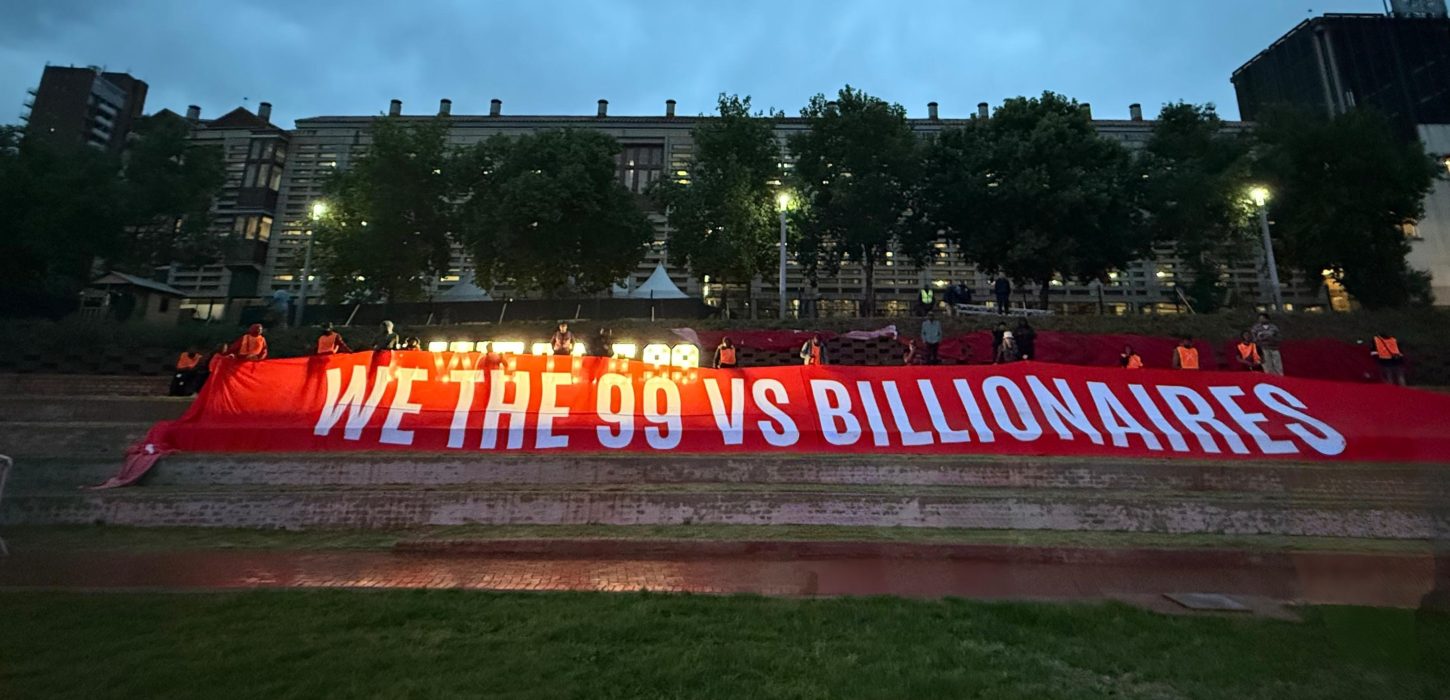
George Monbiot has described politics as story-telling and has labeled political evolution as being products of “restoration stories.” The Marxist theory of a preordained political struggle between the owners of the means of production and the proletariat may be the greatest restoration story ever told, but in the current struggle between death cult, Evangelical capitalism, and the besieged masses, the narrative has shifted. The owners of the means of production have shrunken into a handful of multi-billionaires, mad with wealth and narcissistic delusions. The working class has inevitably expanded, encompassing the very poor who work under the table for less than a minimum wage, and the formerly secure professional class who are now threatened with job loss, or mounting bureaucratic paperwork that makes working life almost unbearable.
Writers like Roger Hallam, Vincent Emanuele, David Schultz and Adolf Reed Jr. have correctly and admirably redirected the left toward the narrative life-blood of class, but class must be retrofitted and expanded for our apocalyptic times. A new, inclusive coalition has only a limited time to act against environmental implosion, war and fascism. That coalition must be founded on an expanded definition of the working class. George Orwell recognized that language formed the basis for political oppression. Likewise, language is a tool of liberation. Therefore, it is imperative that the left not only embrace the working class as its constituency, but define it with precise accuracy.
Phil Wilson also writes at Nobody’s Voice.
ZNetwork is funded solely through the generosity of its readers.
Donate


1 Comment
Excellent essay, Phil. I made a similar appeal in a keynote I gave on the Care Economy (as a unity point in the struggles for equality, the eco-system and peace). https://masspeaceaction.org/news/fund-people-not-pentagon/an-intrinsic-convergence-of-justice-peace-and-the-environment/2025/05/14/. Keep up the great work, Brother!
Harris (Executive Director of the SEIU MA State Council)