
John Nichols: When you were ten years old, you wrote a short essay on your concerns about the rise of fascism. You were writing after the fall of Barcelona to Francisco Franco’s fascist forces in the closing days of the Spanish Civil War. The Americans who fought in that war, as members of the Abraham Lincoln Brigade, were disparaged as “premature anti-fascists,” as they dared to raise arms against the allies of Hitler and Mussolini before the US entered World War II on December 8, 1941. At ten, you aligned yourself with the antifascists. Do you recall the article?
I was writing after the fall of Barcelona, February 1939. And it just seemed at the time that the spread of fascism was inexorable. Nothing was going to stop it. The article was concerned with what was going on in the world, which was frightening. I was old enough to listen to Hitler’s speeches at the Nuremberg Rallies — not understanding the words, but it was easy enough to pick up the tone. You could just see what was happening as this plague spread all over Europe and seemed to have no end.
When Barcelona fell that was not only pretty much the end of the Spanish liberal democratic state but, for me, more importantly it was the end of the social revolution. [The Spanish Civil War] wasn’t just a simple war between fascism and liberal democracy; there was an amazing social revolution going on in a large part of Spain and it was crushed by … the joint efforts of the Communists, the fascists, and the liberal democracies. They didn’t agree on much, but they agreed that the social revolution had to be crushed. Barcelona was just the last symbol at that point. People just kind of fled to France if they could get away.
NC: Well this, as I say, seemed like it was unstoppable. This was going to spread over all of Europe, over the world. I learned much later that US planners, at the same time, were already meeting — the State Department, the Council on Foreign Relations — and had study groups working on what the war would be like and what the postwar period would be like.
And by this period, 1939, they were already anticipating that the war would end with a split between two worlds, a US-dominated world and a German-dominated world. That was the picture. So my childish perception was not entirely unrealistic.
NC: It was connected with local experiences. We happened to be the only Jewish family in a mostly German and Irish neighborhood. And the Irish hated the British and the Germans liked the Germans … and I can remember beer parties when Paris fell. The kids in the street went to a local Jesuit school and I hate to think what they were being taught there, but they came out raving antisemites. It took a couple of hours before they’d calm down and you could play ball in the streets and that sort of thing.
So it did combine personal experiences, which incidentally I never mentioned to my parents. They had no idea about it to the day of their death; it’s just that, in those days, you just didn’t talk to your parents about things like that. That’s personal. But it was a combination of these things that led to this [article].
NC: Well, I’m a little reluctant to use the word “fascism.” It’s used quite loosely now. It’s used to refer to anything hideous. But fascism really meant something back in the thirties. In fact, it’s worth remembering that even liberal opinion had a kind of a moderate appreciation of fascism. So, for example, Roosevelt described Mussolini, the original Fascist, as “that admirable Italian gentleman.”
The fascists had succeeded in crushing the labor movement and the social-democratic and the Communist left, and that was something that Western opinion was pretty much in favor of. Western business and the State Department in 1937 was describing Hitler as a moderate and George Kennan, our consulate in Berlin at the time and later one of the most respected statesmen of the post-period, was writing back from Berlin that we shouldn’t be too tough on these guys. There are things wrong with them, but they’re doing some things that are pretty good, so we can probably get along with them.
Fascism was understood as something different back then. It wasn’t just anything horrible, it had a particular social and economic policy. It was to be a powerful state which would coordinate all sectors of society. It would dominate; business would flourish but under the control of a powerful state. Labor would be accommodated as a subsidiary of this overall system. It’s not what we refer to as fascism today.
NC: What’s called fascism today is anything rotten.
JN: That’s a broad definition.
NC: Broad definition.
JN: Is there any place, when you look around the world today, and I know you do, where you see threats emerging in stark terms?
NC: Well I think Brazil maybe is the most extreme case right now. Brazil is in the hands of the new president [Jair Messias Bolsonaro]. Bolsonaro has taken over. Brazil, as you know, had a horrendous military dictatorship: torture, murder. Bolsonaro praises the military dictatorship. To the extent that he does criticize it, he says the military dictatorship in Brazil didn’t kill enough people. They should have been like the Argentines, who had the worst of these kind of neo-Nazi national security states. They killed 30,000 people.
There’s been a coup going on, a right-wing coup going on in Brazil for several years. The first state of it was a totally fraudulent impeachment of the president, Dilma Rousseff [a longtime leader of the Partido dos Trabalhadores, or Workers’ Party]. When Bolsonaro voted for the impeachment, he dedicated his vote to the chief torturer of the military regime, who had been personally responsible for the torture of Rousseff. That’s the kind of guy who’s there.
Bolsonaro’s policies are essentially to wipe out the indigenous population, to totally sell off the country. His economics minister, Paulo Guedes, is kind of an ultra-University of Chicago neoliberal, who worked in Chile under the Pinochet regime. And his goal, as he put it, is: privatize everything, sell off the whole country to foreign investors. He wants to open up the Amazon to exploitation for mining and agribusiness, which is a kind of death knell for the world, as the Amazon is one of the main lungs of the world.
NC: The way he got elected is pretty remarkable. We should pay attention to it. We’ll see more like this in our next election. It’s kind of an experiment. The first thing they did was to go after the person who was going to win the election. Judging by polls, that was Lula da Silva, the former president who presided over a period that the World Bank called the Golden Decade of Brazil, with substantial poverty reduction, opening up of educational opportunities for minorities, for other people — quite effective policies. Plenty of mistakes too, but he was in fact probably the most respected political figure in the world. He was also supporting the role of the Global South and its effort to escape from the legacy of colonialism, which was still very severe.
So, what they did with Lula da Silva, who was ahead in the polls, [was to put him] in jail for twenty-five years, in solitary confinement. Not permitted to read anything and not permitted to make a statement. My wife, Valeria, and I visited him in jail. Twenty-five years of solitary, that’s a death sentence essentially. But, crucially, he was not permitted to make a statement — unlike murderers on death row, who are allowed to talk. His favorite grandson just died and after a lot of negotiations they permitted him to leave to attend the funeral for one hour, but not to say anything …. If he survives, it’ll be amazing. He’s easily the most important political prisoner in the world.
NC: This guy is about as close to something like fascism — not in the technical sense, but in the sense of bitter, vicious, deeply authoritarian, and brutal — as I can see.
JN: How he came to power is not just troubling in and of itself. It’s an indication of how politics is changing around the world.
NC: The way the election was won — and this is what I had in mind by saying we might think about it — is by an incredible campaign on social media, which is the only thing that most Brazilians have as a source of so-called “information.” You know, WhatsApp? It was just flooded with the most unbelievable lies, distortions, fabrications about the supposedly hideous things that the PT [Workers’ Party], the opposition, was going to do … I suspect that in our next election, say if Bernie Sanders runs [against Trump in the November election], that’s what you’re going to see. These are the kinds of accusations you can’t answer. You know, it’s just gross, ugly, vilification. It’s already beginning, you know, with the charges of socialism.
I noticed that in President Trump’s State of the Union address, there was a rather lengthy soliloquy on socialism and clearly that has become a big touchstone for many of the criticisms of folks within the Democratic Party. There are a handful of democratic socialists who have risen in the Democratic Party: Bernie Sanders, Alexandria Ocasio-Cortez, Rashida Tlaib, and others. And so there is a reality there that we have for the first time in a very long time, a rise of a democratic-socialist presence in our discourse.
NC: Well we should bear in mind that the United States is a very isolated country, culturally and intellectually. I mean, in the rest of the world, socialist is a normal term. Communist is a normal term. People can be communists, the Communist Party can participate in elections. To be a socialist is just to be a kind of a modern person. Here in the United States, socialism is a curse word — so to call someone a socialist is to say they must be some total monster, like a Nazi, maybe like Stalin. But that’s unique to the United States.
Take Bernie Sanders. His positions would not have surprised [former President Dwight] Eisenhower. You go back and you read Eisenhower’s statements, when he suggested that anybody who questions the New Deal just doesn’t belong in our political system. Or that anyone who thinks that laborers should be denied the opportunity to form unions freely — and should be returned to being the huddled, pathetic masses of the past — simply just is not part of the civilized world.
NC: The country has moved very far to the right during the neoliberal period, since the Reagan years — the Carter-Reagan years. So when these people who call themselves “democratic socialists” come along, they’re essentially going back to a tradition which is pretty much like the New Deal. It’s very healthy, I think, but it has really nothing to do with socialism or anything like the traditional sense of the word. Remember what socialism meant once. Socialism meant, at the very minimum, control over production by the workforce, control over other institutions by participants, democratic control over the whole social and economic system.
[Most of the prominent democratic socialists in contemporary US politics] are not calling for that. They’re calling for what in Europe would be called moderate social-democratic measures — which for the United States is very important. So, I think it’s a very good thing. But it will be tarred with tirades of vilification and demonization and denunciation. You can be pretty sure of that. And what happened in Brazil, I think, is worth looking at as a kind of experimental model of what may be coming.
NC: I think he’s going to be subjected — and this is true if he runs or if almost anyone else like him runs — to a very vicious, vulgar campaign over social media, over cable news, over radio. Remember all of these instruments have been taken over by the very far right. I don’t know if you listen to talk radio? I do every once in a while. It’s really shocking. I mean, it makes Fox News look liberal, you know? And this reaches lots of people. Rush Limbaugh reaches 20 or 30 million people, telling them for example that there are — what is his famous phrase? — four corners of deceit, institutions that exist on the basis of deceit: government, media, academia, and science. He’s telling people: don’t believe a word that comes out of that. Things like this are reaching a huge part of the population.
JN: You have always reminded us that the elites put great energy into constraining and narrowing the political discourse.
NC: Social activism is considered by the political class and the business classes kind of like a cancer. If it gets too malignant, they think, you have to stop it by force. But it’s much more cost effective in the case of a cancer to prevent it. And [there are] all these means to prevent the rise of organized social movements which will challenge the developments that are taking place.
Diverting people’s attention to other directions is another way this is done. So, you know, there’s [messaging from Trump and his allies] about the hordes of rapists, murderers, terrorists just about to pour over the border and invade us and destroy us. Okay, so they want us to pay attention to that and not to the fact that our real wages haven’t increased in thirty years, that we’re losing benefits, that the political system is collapsing — that every act taken by the administration is an attack on the workforce and the poor. The message is “Don’t look at that. Look at these guys coming across the border. Worry about your guys or something else.”
There are very extensive means for distracting people. They’ve been developed for many years. They’re a big part of the advertising industry — one of the biggest industries in the country — and they’re being applied now to prevent people like you, especially young people, from getting the “wrong idea,” getting organized, getting active, and doing the kinds of things that Ocasio-Cortez is doing. Trying to stop it, nip it in the bud, don’t let it get started.
NC: Well, I’d put it the other way. It’s because of the effects of the neoliberal era that you’re getting this reaction. There’s a reaction worldwide, and it’s in two directions. Sometimes it’s the kind of thing that you’re describing. Sometimes it’s neofascist.
There’s a real question now as to which way it’s going to go. In Europe and in the United States, and other places, there’s a tremendous rise of anger, bitterness, resentment about something. And the question is, what is that something going to be?
From the point of view of the political elites in the business world, they want that something to be “rapists coming across the border.” From the point of view of Ocasio-Cortez, or Bernie Sanders, they want it to be the social and economic policies that have been instituted and that are marginalizing people, casting them aside, undermining the political system.
So that’s a struggle in the United States and all over Europe, as well. But the anger and bitterness are there and the different [political players] want it to be focused in different ways. Some want you to divert attention from the causes, so they can control you better. Others want you to pay attention to the causes, so you can do something about them. This is a major struggle that’s building up in much of the world. I mean, the capitalist system took up kind of a savage form in the last thirty or forty years. People are suffering from it and they’re angered, and they’re reacting.
The question is: How will they respond? In this respect, it’s a little bit like the 1930s. It could have gone in other directions. So for example, in the 1920s and the 1930s, there were very lively, activist labor and social-democratic movements, communists and other left movements. There were also rising fascist movements. And there was a question: Who’s going to win? Unfortunately, we know how that turned out. I don’t think it’s quite that dramatic today, but it’s similar structurally.
Now, we find ourselves in a different era, but certainly a very turbulent time. We’re thirty years into globalization, which is changing everything about how we relate to the world, we’re twenty years into a digital revolution that is changing everything about how we communicate, we’re eight to ten years into an automation revolution that is beginning to change everything about how we work. People are clearly jarred by all of this. My sense is that the Democratic Party in the United States has failed to provide many answers for how to deal with these changes. Is that a fair assessment?
That all kind of stopped in the early 1970s. And there’s a regression, what’s called the neoliberal period, which went in very different directions and the parties changed. The Democratic Party had maintained a kind of an uneasy coalition between racist Southern Democrats and Northern workers and liberals. That fell apart at the time of the Civil Rights Movement.
The next strategy [advanced by President Richard Nixon and his political aides] was to try to pick up the racist elements of the South and bring them to the Republican Party. Meanwhile, the Democrats shifted. They had been a party based at least in part on the working class and maintaining some commitment to working-class interests and values. By the 1970s, that changed. The Democrats simply abandoned the working class, essentially handed them over to their class enemy. That’s essentially what happened. The last gasp of the Democratic Party, of its kind of moderate liberalism, was the Humphrey-Hawkins Full Employment bill, which passed Congress in 1978 but which Carter actually watered down. After that, there isn’t even a gesture to the working class. So, they’re essentially abandoned.
NC: The Republicans were able to pick them up and mainly by this technique of diversion. And it’s still working. But it hasn’t always worked. It’s interesting when Obama came along, he did get working-class votes. A lot of the working-class people who voted for Trump actually also voted for Obama. They believed the talk about hope and change. But they very quickly found out it’s not going to be change and there’s no hope.
Remember the bailout after the 2008 crash. The congressional legislation for the bailout had two parts. One was bailing out the criminals who created it, the financial institutions. And the other was help for the victims, the people who lost their homes — their homes were foreclosed as wealth disappeared and so on. Well, you could have guessed which part was going to be implemented. In fact, the inspector general of the Treasury Department, Neil Barofsky, was so outraged by this that he wrote an interesting book about it [Bailout: An Inside Account of How Washington Abandoned Main Street While Rescuing Wall Street]. But working people could see what was happening. Their reaction was: “We’re being thrown to the wolves. They don’t care about us. It’s just nice talk.” So the next thing you do is vote for your class enemy, Trump, who’s doing everything he can to shaft them but manages to keep some kind of a base by, you know, bringing up the “rapists” and the “murderers” or whatever will be next.
But this is a very uneasy situation. And people like Bernie Sanders, Ocasio-Cortez, and others are trying to bring the Democratic Party back to, in fact, what it once sort of was — but without the millstone of the Southern Democrats, which was a very serious problem for Roosevelt and the New Deal and up until the Civil Rights Movement.
NC: In fact, we’re going to face a constitutional crisis. If you look at what’s happening now. Just look at the numbers. By now, states with about 25 percent of the population run the Senate — the most important of the institutions …. [The Senate is dominated by members representing] mainly a rural, traditional, older, often white supremacist, very religious sector that’s diminishing demographically. But they are going to maintain their power. Now that’s almost certain to lead to a constitutional crisis. And notice that it can’t be changed by any constitutional means. It can’t be changed by amendment because they have enough power to block any amendment.
JN: They have the power to block democratizing amendments. But you worry about amendments favored by the elites.
NC: You should watch very carefully about amendments. The most vicious of the business lobbies, and in my opinion the strongest of them, ALEC, the American Legislative Exchange Council, is [working] to get state legislatures to agree to a constitutional amendment which will establish a balanced budget limit on the federal government. What does a balanced budget limit mean? It means you end all welfare programs. You end anything that’s of any benefit to ordinary people. Of course, you keep the Pentagon budget up in the stratosphere — and no doubt you keep big subsidies to agribusiness, energy, and financial institutions. But forget Social Security or Medicare or education. Now that’s what a balanced budget is. You can see it working in the states that have balanced budgets.
There’s a real, major class war going on, right below the surface. Bits and pieces of it are visible, but it’s going to lead to, I think, major crisis in the near future.
NC: You can read the articles in the business press saying that the big banks, JPMorgan Chase, the biggest banks are increasing their investment in fossil fuels. Now that’s very interesting. When you read these things you start, you can begin to think. Suppose, put yourself in the position of Jamie Dimon, CEO of JPMorgan Chase. He knows everything we know about global warming and its extremely hazardous, imminent effects. But he’s still putting money not only into fossil fuel extraction, but the most dangerous of the fossil fuels, Canadian tar sands.
So what’s going on in his head? Well if you think about it, it’s not very complicated. He has two choices. One choice is to do exactly what he’s doing, try to increase profit for JPMorgan. The other choice he has is to resign and be replaced by somebody else who will do exactly the same thing. This is a deep institutional problem.
There’s no point just talking about these bad guys who do this and that. In the institutional structure, they just don’t have choice, which tells us what we ought to be looking at: the institutional structure. It’s one of those things you don’t want to be diverted away from. So, you read the New York Times, you learn a lot. You read the business press, the Wall Street Journal.
In that essay, you wrote: “With respect to the responsibilities of intellectuals, there are still other, equally disturbing questions. Intellectuals are in a position to expose the lies of governments, to analyze actions according to their causes and motives and often hidden intentions. In the Western world, at least, they have the power that comes from political liberty, from access to information and freedom of expression. For a privileged minority, Western democracy provides the leisure, the facilities and the training to seek the truth lying hidden behind the veil of distortion and misrepresentation, ideology and class interests, through which the events of current history are presented to us. The responsibilities of intellectuals then are much deeper than what has been suggested and what they call the responsibility of people given the unique privileges that intellectuals enjoy.”
It strikes me that throughout your life you have tried very hard to live up to that duty. And I think there has to be an element of optimism in that.
What was this place like in 1966? Just think back to what it was. First of all, one of the worst wars in history was going on. At this point, the United States had practically wiped out South Vietnam. The leading historian of Vietnam, Bernard Fall, highly respected by the government and everyone else, wrote at that time that he didn’t know whether he was a Vietnamese scholar. He didn’t know whether Vietnam would survive as a cultural and historic entity under the assault of the worst, most vicious attack that had ever been launched against an area that size.
There was almost no protest in the United States. I was living in Boston. It’s a liberal city. October 1965 was the first international day of protest. So we tried to have a march in Boston, go to the Cambridge Common, the place where you give talks. I was supposed to be one of the speakers. It was broken up by counter-demonstrators, mostly students who didn’t want to hear this kind of commie rat talk about Vietnam.
The next international day of protest was March 1966, right before this was written, incidentally, right before the talk was given. We knew we couldn’t have it on the Boston Common. We wanted to have the meeting in a church, okay? We met in the Arlington Street church. The church was attacked. Tomatoes, cans, counter-demonstrators, police outside to keep it from blowing up. This is what was going on in 1966.
And what else was going on in the country? Well, we still had federal housing laws which required segregation, required pure white federal housing. And we had miscegenation laws, anti-miscegenation laws that were so severe that the Nazis refused to accept them. When the Nazis were looking for models for the Nuremberg Laws, the racist laws, they looked around the world. About the only ones they could find where the American laws. But the US laws were too severe for the Nazis. The US laws were based on what was called “One Drop of Blood.” So if your great, great, great-grandmother was black, you’re black, you know? That was too much for the Nazis. [Those laws] were still in place in the late 1960s. Anti-sodomy laws, of course.
There was no women’s movement to speak of. Women had not yet been recognized by the Supreme Court as legal peers, as persons. That didn’t happen until 1975, when [the court] granted the right to serve on federal juries as a peer. We can go on. I mean, the country was much worse than it is now.
What changed? There were no gifts from the heavens. What changed is a lot of people, mostly young people, began to get organized, began to get active, struggled, made it a much better country.
NC: Take Ocasio-Cortez’s Green New Deal, which is now a very serious proposal. It’s now right in the middle of the agenda. A year ago, maybe, it was ridiculed. How did it happen? How did that change take place? Well a bunch of young people from the Sunrise Movement sat in at [House Speaker] Nancy Pelosi’s office, [and their issue was] picked up by a couple of legislators. Pretty soon it became a major issue. [Washington Governor] Jay Inslee just announced his candidacy for the Democratic presidential nomination, with his top priority being the danger of climate change. This is now an issue you can talk about, you can do something about. We don’t have a lot of time. Well, all of these are reasons for optimism. A lot of things have improved and they’ve improved by active, organized, committed people who went to work on it and changed the world. That’s a reason to be optimistic.
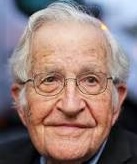
Noam Chomsky (born on December 7, 1928, in Philadelphia, Pennsylvania) is an American linguist, philosopher, cognitive scientist, historical essayist, social critic, and political activist. Sometimes called "the father of modern linguistics", Chomsky is also a major figure in analytic philosophy and one of the founders of the field of cognitive science. He is a Laureate Professor of Linguistics at the University of Arizona and an Institute Professor Emeritus at the Massachusetts Institute of Technology (MIT), and is the author of more than 150 books. He has written and lectured widely on linguistics, philosophy, intellectual history, contemporary issues, and particularly international affairs and U.S. foreign policy. Chomsky has been a writer for Z projects since their earliest inception, and is a tireless supporter of our operations.

ZNetwork is funded solely through the generosity of its readers.
Donate
1 Comment
So, this is where we are. “Climate crisis” is not only the physical state of planet Earth, it is the volatile, violent, and right shift of the social planet. “We don’t have a lot of time,” Noam says. I hope he is right that there’s “reason to be optimistic.” Besides, what choice do we have? We must all find a way to act, in the simplest terms, in the right way which means with intelligence, decency, and (forgive the created word) constructivity.