
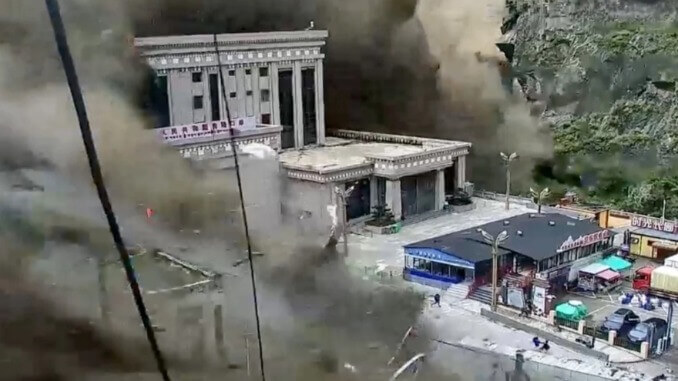
A stark warning was issued to humanity via CCTV on 26 August when a tsunami-like torrent of floodwater rising as high as 130 metres destroyed Gyirong Port, one of the main border crossings between Nepal and Tibet.
The deeply shocking video footage shows the massive main building surrounded by a complex of other buildings and car parks. Some of the 560 staff and visitors can be seen running for their lives. At 25 seconds, what looks like a puff of white cloud emerges top left, behind the main building. Seconds later, the entire complex is hit by 2.2 million metric tons of sediment, rocks and water, a mixture that has been likened to ‘liquid concrete’. It is clear that everyone seen running will have been killed by the wave travelling at 60 mph. Before and after images show that the complex was not just destroyed but erased down to the bedrock. As the first journalists at the scene reported, it looks as though no-one had ever built there. In all, the flood left at least 1,380 dead and some 5,500 people missing.
The US Geological Survey reports that since 2000, glaciers ‘have lost between 2% and 39% of their ice regionally and about 5% globally’, changes which are ‘indicators of ongoing anthropogenic climate change’.
Bill McGuire, Emeritus Professor of Geophysical & Climate Hazards at University College London, explained the connection in the Guardian last week:
‘As glaciers retreat, they expose unstable terrain that is often ripe for landslides. The swift thawing of permafrost as global heating causes freezing levels to progressively rise also means that mountain faces become unstable rock masses looking for any excuse to collapse. At the same time, wherever there is an available dip or hollow, glacial meltwater is accumulating, forming expanding lakes that are increasingly prone to overtopping or breaching, dumping prodigious volumes of water into inhabited valleys downslope.
‘In such circumstances, there are manifold ways in which climate-driven responses from the earth under our feet can drive dangerous and deadly hazards. As in Nepal and Tibet, the collapse of a weakened glacier can promote a flood, either directly, or by throwing a dam across a river valley that is eventually breached. Permafrost thawing, heavy rains or an earthquake can lead to the formation of landslides that can also block rivers, or obliterate communities completely.’
The increased threats McGuire describes include earthquakes and volcanoes, and are biblical in scale:
‘Add in the fact that environmental parameters such as temperature, precipitation and sea levels are all on the rise, and you have that extra nudge that can goad an inactive volcano into erupting, cause a long-dormant fault to rupture, or coax the snout of an unstable glacier to collapse. The end product can be a devastating geological event that is out of all proportion to the size of the initial trigger.’
In August 2025, a landslide in Alaska’s Tracy Arm fjord generated a 500-metre-high wave. By sheer luck, the landslide occurred early in the morning, before the arrival of large cruise ships, which during the summer can involve six vessels and thousands of passengers per day. A few months earlier, the collapse of part of a glacier in Switzerland caused a torrent that destroyed most of the village of Blatten, which had been evacuated.
In the Daily Mail, commentator Richard Littlejohn defied both the scientific evidence and common sense when he declared that the disaster in Nepal and Tibet ‘had nothing to do with drilling (or not) in the North Sea’. (Littlejohn, ‘The climate emergency is over – here comes the rain,’ Daily Mail, 28 August 2026)
In The Spectator, Matt Ridley agreed:
‘This catastrophe was far more likely to have had an entirely natural cause.’
‘UK Air Passenger Numbers Hit Record High’
Back in the real world, after this latest calamity, the term ‘climate change’ seems almost quaint. In reality, we are facing climate breakdown that is bringing not just human disaster but human erasure.
The glacier collapse follows the warmest UK summer on record. Over an eight-day period, the UK experienced sustained temperatures above 34°C for the first time, causing grass to turn brown nationally as a severe drought took hold, while 54 Met Office stations set all-time daily high records. Globally, the daily average sea surface temperature hit 21.1°C – the hottest ocean temperature ever recorded by satellites. Multiple European countries also set all-time or monthly maximum records, including Germany (41.7°C), France (43.8°C), Spain, Austria, Poland, and the Netherlands. Tragically, the heatwave resulted in 2,877 deaths in the UK in May and June (figures for July and August are not yet available), and 35,000 deaths elsewhere across Europe from May to early August.
After watching the obliteration of Gyirong Port, it was sobering to look up and know that airliners were flying thicker and faster than ever with not even a glimmer of hope of change on the horizon. A Jet2 advert announced the good news last week:
‘Over 15,000 seats at £39 or less on selected September 2026 flights. When they’re gone, they’re gone.’
Under the headline, ‘UK air passenger numbers hit record high despite Middle East disruption’, the Travel Tomorrow website reported on 28 August:
‘UK air passenger numbers broke a record in the second quarter of 2026, with more than 81 million passengers travelling through British airports despite disruption caused by the conflict in the Middle East… The figure was more than 120,000 higher than the 81,035,648 recorded during the same period in 2025, making it the busiest second quarter on record.’
The increase was mostly driven by low-cost airlines like Ryanair and Jet2, which both recorded 9% year-on-year growth in passenger numbers during the quarter.
If this was madness, what to say of the two stories that broke on the same day last week? On 4 September, an astonishing piece on the BBC website reported:
‘Households should stock up on food to prepare for extreme weather as the strongest El Niño event in a generation develops over the Pacific Ocean, a government minister has said.’
Environment Secretary Angela Eagle warned:
‘We’re about to experience probably the largest El Niño that has ever been seen, and that will lead to drier summers, wetter winters, with more extreme storms in this country…
‘If you’ve got a store of a bit of food that can keep you going for a while before the emergency services can get to you, you’re going to be a lot better off than if you haven’t.’
Even the fanatically climate-denying Telegraph reported:
‘Britain braces for crippling food crisis as “Godzilla” El Niño stirs’
About as many people died from the heat in the UK in May and June as died in the terror attacks of 11 September 2001. While those attacks triggered a vast propaganda blitz launching ‘the war on terror’, the heat deaths of 2026 are being met, not with positive political action, nor even with indifference, but with action to make the problem worse. Thus, also on 4 September, the BBC reported:
‘The UK government is set to give the go-ahead for a controversial new gas field off the coast of Aberdeen, the BBC understands.
‘Approval for the Jackdaw project could come in mid-September, just before Parliament breaks for party conference season, according to government and industry sources.’
It has been estimated that Jackdaw could produce 35.8m tonnes of carbon over its 11-year lifetime, the equivalent of 90% of Scotland’s emissions for 2023.
Tessa Khan, executive director of environmental group Uplift, said more North Sea drilling would not cut energy bills and would ‘make no meaningful difference’ to UK energy supply.
‘The science is clear that the world already has far more oil and gas than can ever be safely burned if we are to limit warming.
‘When it comes to these decisions, the prime minister needs to listen to scientists’ warnings and think back to those families who lost their homes to this summer’s wildfires, the UK farmers struggling to grow our food in the drought, and the lives lost in the floods in Nepal – and not the self-interested demands of the oil companies.’
In a long piece for the BBC, international business correspondent Theo Leggett noted that flights are being increasingly impacted by the flooding of airports, intensifying storms causing diversions and worsening turbulence. Leggett quoted the no-doubt scrupulously impartial Andrew Charlton who manages the Swiss-based consultancy Aviation Advocacy:
‘I think the best we can do is mitigate.’
Charlton offered some detail:
‘We need to make sure we have enough space at air terminals for people whose flights are being disrupted and delayed, that we have enough hotel rooms and parking space and so on.
‘But ultimately, disagreeable moments are going to happen more.’
The BBC’s sage conclusion:
‘Passengers, he thinks, will have to accept it as a fact of flying life.’
Just two sentences were devoted to the role of aviation in driving climate breakdown:
‘The aviation industry is often criticised for its own contribution to climate change emissions. It faces a forbidding challenge in attempting to meet a target of being carbon neutral by 2050, while also accommodating growth that is expected to see the global aircraft fleet double in size over the next two decades.’
The ‘forbidding challenge’ involves the notion that Sustainable Aviation Fuel (SAF), fuels made from waste oils or synthetic power-to-liquid processes, will cut emissions by 50% – 65% . Unfortunately, SAF currently accounts for less than 1% of total global jet fuel demand. Increasing that figure to meet 2050 needs would mean 5,000-7,000 new biorefineries and over $4-5 trillion in capital investment: a highly improbable scenario, to say the least.
Nowhere does Leggett raise the exotic possibility that solutions might lie in people choosing to take fewer flights to hen parties in Prague, stag parties in Berlin and weekend shopping trips to New York. With clear signs of social collapse looming, stopping is not on the agenda.
Instead, the Ostrich-like delusion that climate breakdown is something we can ride out is everywhere. Stuart Rust of the BBC asked:
‘What will you tell your grandchildren about the summer of ‘26?…
‘As it draws to a close, we look back on some of the moments that will be talked about for years to come.’
The question is completely divorced from reality. If we are even around in ‘years to come’, we won’t be talking about the summer of ‘26; we will be talking about the cataclysmic summers to come that will do to us, our food supply and social cohesion what 2.2 million metric tons of ‘liquid concrete’ did to Gyirong Port.
Even if such an outcome was a mere possibility rather than a certainty, we would be right to place society on an emergency war footing, exactly as has happened in the face of far lesser threats from war and terrorism.
Alas, while war is decidedly good for business, action to limit fossil fuel use is anything but. Our key, related problem being that, as John Dewey observed, ‘politics is the shadow cast on society by big business’. (Quoted, Robert Westbrook, ‘John Dewey and American Democracy’, Cornell University Press, 1991, p.440)

David Edwards (born 1962) is a British media campaigner who is co-editor of the Media Lens website. Edwards specialises in the analysis of mainstream, or corporate, mass media, which are normally considered impartial or liberal, an interpretation he believes is disputable. He authored articles published in The Independent, The Times, Red Pepper, New Internationalist, Z Magazine, The Ecologist, Resurgence, The Big Issue; monthly ZNet commentator; author of Free To Be Human – Intellectual Self-Defence in an Age of Illusions (Green Books, 1995) published in the United States as Burning All Illusions (South End Press, 1996: www.southendpress.org), and The Compassionate Revolution – Radical Politics and Buddhism (1998, Green Books).
ZNetwork is funded solely through the generosity of its readers.
Donate

