
We, of course, post on all kinds of emotive and controversial issues on social media: genocide in Gaza, the war of aggression on Iran, the weaponisation of anti-semitism to undermine democratic choice and defend Israel, and so on. Perhaps because we don’t post out of anger and hate, we don’t generally receive a lot of hostility in response.
Remarkably, the one issue that is all but guaranteed to generate snarling dismissals and abuse is climate change. Discussion of highly sophisticated and complex climate science has become a ‘populist’ cause among people raised on a diet of trashy tabloids and hard-right politics (Reform, Restore, MAGA). Their passionate conviction: climate scientists and ‘alarmist’ politicians are faking data to secure research grants and tyrannical control of society. With great, mocking confidence, scientists are accused of the most childish errors – like all ‘Bad Guys’ they are as stupid as they are corrupt.
On 26 May, the Met Office posted on X:
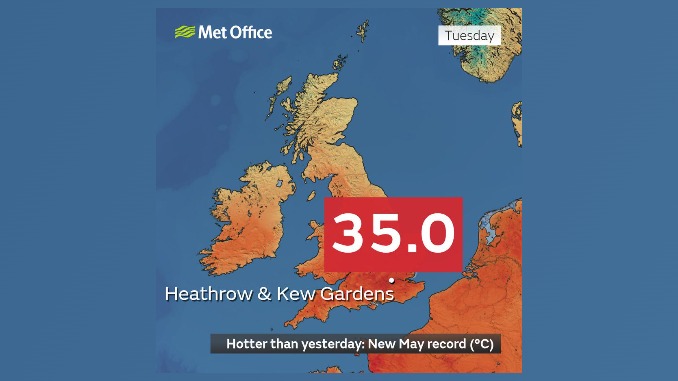
‘Today is now the hottest day in May on record with Heathrow and Kew Gardens provisionally reaching 35.0°C.
‘Until yesterday the highest temperature in May was 32.8°C, but we’ve now exceeded that record on consecutive days by a full two degrees Celsius.’
The Met Office emphasised the ‘full two degrees’ because in the last century records have usually been broken by tenths or hundredths of a degree. Despite what many people appear to believe, this spring was actually the warmest on record for England and Wales. The last three years are the top three warmest on record. Nine of the top ten warmest springs have been since 2007.
Paul Hudson, a BBC meteorologist and climate correspondent, posted:
‘EVERY weather station, both rural & urban, in Yorkshire & Lincolnshire, set a new May temperature record yesterday.
‘Unprecedented.
‘For the climate sceptics out there, the game is up. Go and bore someone else with your nonsense.’
Nahel Belgherze, who focuses on extreme weather events worldwide, commented over a graph:
‘Hard to believe I’m even writing this.
‘Meteorological summer hasn’t even begun, yet Paris, France has already logged more days above 32°C (89.6°F) than its annual average.’
Jeff Berardelli, chief meteorologist and climate specialist at WFLA-TV (Tampa Bay), posted a map of shattered temperature records in France that also contained this comment:
‘A totally HISTORICAL day.
‘334 monthly records were SIMULTANEOUSLY broken this afternoon in France. Never in the history of climatology have so many records fallen all at once.’
Nevertheless, in response to the latest heatwaves, the BBC featured the following responses from two male beachgoers:
‘I just love it, just bring it on! More, more…! If this is what global warming means, don’t want the other stuff, but lovely temperatures like this is good.’
The second interviewee agreed:
‘Gotta make the most of the sunshine. You can’t complain about it; it’s not here for long enough, is it? So, yeah, make the most of the sunshine; come down by the sea and enjoy it.’
In 2022, Saffron O’Neill, Professor in Geography at the University of Exeter, led a study which investigated the visual reporting of heatwaves over the summer of 2019 in the UK, the Netherlands, Germany and France. The conclusion:
‘Many visuals were positively valenced (in contrast to article texts), framing heatwaves as “fun in the sun”. The most prevalent type of images in all countries were photographs of people having fun in or by water. When images did depict the danger of heat extremes, people were largely absent.’
Professor Katharine Hayhoe of Texas Tech University responded to an article on the BBC website:
‘This article says climate change is “believed to have played a role” in the UK’s extreme heat this week.
‘As a climate scientist, let me fact-check that.
‘First, climate change is not a religion. No belief is required. It is about evidence.
‘And the evidence has been crystal clear for more than two decades: climate change is making heat waves hotter, longer, more frequent and more dangerous.
‘In fact, science has advanced far beyond saying climate change merely “played a role.” Today, we can quantify how much more likely and how much hotter climate change made a specific event.’
Bill McGuire, Professor Emeritus of Geophysical and Climate Hazards at University College London, was more direct:
‘”Climate change is believed to have played a role in such hot spells as this”
‘FFS BBCNews
‘Belief has nothing to do with it. This is hard, scientific, fact
‘When will you get this right?’
Carbon Brief, a UK-based website specialising in the science and policy of climate change, found that despite blanket news coverage of the record heat in media outlets across western Europe, there has been ‘relatively little commentary from their opinion pages’:
‘No major UK newspapers have published editorials about the heat and there has been no space dedicated to it in the comment sections of the largest French and Spanish newspapers.
‘One exception in UK media was the Daily Mail’s climate-sceptic columnist Richard Littlejohn writing an article mocking heat-safety measures and warnings issued by the Met Office and the UK Health Security Agency (UKHSA).’
Fiddling The Figures
Alas, many social media posters were unimpressed by claims of record temperatures. Gregory Davis offered us some unsolicited advice on X:
‘Remove your lens from your asshole.’
Christopher Talbot questioned the source of the measurements:
‘Are those measurements from real stations or your imaginary ones?’
This is a popular theme – for obscure, nefarious reasons, temperature readings are distorted to inflate the results. Thus, Paul Dakers, ‘Ex Army and an ex District Councillor’, explained in his reply to Talbot:
‘They measure them at the end of airport runways apparently – not surprisingly it’s quite warm there with all the heat coming out of the plane engines, supposedly it helps the planes fly or something’
Scientists are just that corrupt, or stupid, or both. Someone called Lady Windermere concurred:
‘They use ground temperatures near tarmac and enclosed buildings to get the most out of their scam stats’
Bob Ward, Policy and Communications Director at the Grantham Research Institute on Climate Change and the Environment, offered a correction:
‘The UK’s hottest ever May Day was recorded at Kew Gardens. Next to plants. Does anybody still take this climate change denial seriously?’
An incredulous tweeter saw the absurdity:
‘It’s a green house’
To be honest, like many people, we didn’t know where the weather station is located in Kew Gardens, and would likely not have had the time or inclination to find out in answering one of the endless flood of denier claims. So, we asked AI. From its cogent answer, linked to highly credible sources that we could easily check, we wrote this response:
‘The measuring station is situated in the middle of a wide, open lawn. It’s deliberately sited far enough away from walls, concrete paths and greenhouses to ensure they don’t inflate the readings.’
It took us a couple of minutes, and the poster had no answer. We understand that, like much technology, AI is a double-edged sword consuming yet more energy and posing huge potential risks for society. Last year, global datacentres used 448 trillion watt-hours of electricity, more than all but 10 countries of the world. Perhaps unwittingly, anyone accessing Google searches and social media like X, Facebook, YouTube, Tik Tok, Instagram, Snapchat, Pinterest, LinkedIn, or shopping online, is using AI. The same is true of anyone using email spam filters, or playlist curating on Spotify and Netflix, and so on. If much of this use of AI involves a grotesque and unjustifiable waste of energy, the one justifiable use of this new technology, we would argue, is asking simple text questions to challenge and debunk climate denier propaganda. It is a tool that changes the balance of power against the propagandists – the result is a rout, an intellectual turkey shoot. Given that it is far less energy intensive, and far more vital, than standard online habits like streaming video and video conferencing – which many of us indulge without a thought – then perhaps this is one of the few uses of AI that is acceptable.
What is so staggering about the frequency of scepticism about UK temperature measurements is that records are, of course, constantly being shattered all around the world. In January, Berkeley Earth, a California-based non-profit research organisation, indicated the scale of this:
‘We conclude that 2025 was the third warmest year on Earth since 1850. It is exceeded only by 2024 and 2023. This period, since 1850, is the time when sufficient direct measurements from thermometers exist to create a purely instrumental estimate of changes in global mean temperature. Berkeley Earth’s analysis combines 23 million monthly-average thermometer measurements from 57,685 weather stations with ~500 million instantaneous ocean temperature observations collected by ships and buoys.
‘The last 11 years have included all 11 of the warmest years observed in the instrumental record, with the last 3 years including all of the top 3 warmest.’ (Our emphasis)
Are these 23 million measurements from 57,685 weather stations all being faked in pursuit of some dark Orwellian agenda? The idea is simply pathological.
Of course, many of the deniers popping up on social media are fossil fuel industry ‘astroturf’ (propaganda operations made to look like a genuine, grassroots movement). In 2020, a major study from Brown University analysed millions of tweets. They found that bots were responsible for roughly 25 per cent of all tweets about climate change. On days with big climate announcements, bot activity surged even higher, promoting denialist talking points and generating the illusion of a massive, angry public consensus against climate action. On the other hand, we suspect a substantial portion of posters are just people who have been misled by this propaganda effort.
Back on X, Ken H. Lane dismissed the idea that humans could have increased the level of atmospheric CO2 by 50 percent. In fact, for roughly 10,000 years leading up to the mid-18th century, the Earth’s pre-industrial atmospheric CO2 baseline was stable at around 280 ppm. The current level is 430 ppm, an increase of 53 per cent. Lane wrote:
‘Pretty hard to increase atmospheric CO2 by 50% when human CO2 production is miniscule compared to the natural carbon cycle that has been maintaining atmospheric CO2 at 0.04% of all the atmospheric gases.’
It takes mere seconds to run that claim through AI: just copy and paste, and ask, ‘Is this true?’. We studied the answer, read the linked sources, and quickly posted this response:
‘The argument assumes that because natural CO2 emissions are large, human emissions are too small to matter. Think of the natural carbon cycle like a business bank account:
‘Natural Cycle: Every month, the business automatically deposits £100,000 and automatically withdraws £100,000. The net change is zero. The account balance stays perfectly steady.
‘The Human Input: Now, a human comes along and deposits an extra £4,000 every single month, but never withdraws anything.
‘Even though £4,000 is small compared to the £100,000 flowing through the account, it has nowhere to go. Over time, that £4,000 monthly surplus accumulates. After a few years, the account balance will skyrocket.
‘That is exactly what humans are doing to the atmosphere.’
Ian Guthrie wrote:
‘Media lens et al probably support politically motivated high energy prices that contribute to winter deaths which are 4 X higher at least.
‘Not saying you should ignore heat deaths but saving summer deaths by killing more in winter seems counterproductive.’
In fact, there is compelling evidence that the steep rise in heat-related deaths due to global warming will far exceed any drop related to cold, resulting in a net increase in mortality across Europe.
In India, the city of Banda in Uttar Pradesh and regions in Rajasthan officially recorded peaks of 48.2°C last month, making them some of the hottest places on Earth. For weeks, maximum temperatures ranging between 45°C and 46°C struck a huge portion of the country. Weather data recently showed that 95 to 98 of the world’s 100 hottest cities were located simultaneously inside India. As a result, power grids have collapsed under record demands from air conditioning. Hospitals have reported a massive influx of patients suffering from severe dehydration, heat exhaustion, and kidney-related complications.
Climate scientist Dr. Genevieve Guenther, Founding Director of End Climate Silence, posted a link to a new study, ‘Estimating heatwave-induced excess mortality in India’s districts’ with a quote:
‘We estimate that a single day of extreme heat causes approximately 3,400 excess deaths nationally; a five-day heatwave causes nearly 30,000.’

David Edwards (born 1962) is a British media campaigner who is co-editor of the Media Lens website. Edwards specialises in the analysis of mainstream, or corporate, mass media, which are normally considered impartial or liberal, an interpretation he believes is disputable. He authored articles published in The Independent, The Times, Red Pepper, New Internationalist, Z Magazine, The Ecologist, Resurgence, The Big Issue; monthly ZNet commentator; author of Free To Be Human – Intellectual Self-Defence in an Age of Illusions (Green Books, 1995) published in the United States as Burning All Illusions (South End Press, 1996: www.southendpress.org), and The Compassionate Revolution – Radical Politics and Buddhism (1998, Green Books).
ZNetwork is funded solely through the generosity of its readers.
Donate

