
This interview was held in Montréal in October 2013 and has been edited for length and readability.
Canadian Dimension: There’s a tremendous amount of evidence accumulating about the gravity of the ecological crisis, but some people argue that disseminating this kind of information can actually put a damper on building a movement of resistance to the forces of ecological destruction. What’s your take on that?
Noam Chomsky: It depends on how you present it. If it’s a prophecy of doom, then people will say, “Okay, I’ll enjoy myself for the next couple of years while there’s still a chance and that’s the end,” and then of course it’s a damper.
But if it’s presented as a call to action along with an indication of what can be done, then it can be energizing. Do you want your children or your grandchildren to have an environment in which they can have a decent life? Or do you want to forget about it and just take a vacation? I think that’s something that people can react reasonably to and in fact it’s pretty striking the way they do.
In the United States particularly there’s a huge corporate propaganda offensive to try to convince people either that there is no climate change or, if there is, that it’s not anthropogenic. But it hasn’t worked very well, interestingly.
If you look at polls, Americans are not that different from the international norm in their recognition that there is a crisis and a problem, and even in their willingness – at least when answering pollsters – to do something about it. Now, whether that would translate into action is always another question.
CD: What do you make of the argument that Naomi Klein and others have been making that climate change is the best argument we’ve ever had against the prevailing economic system, and that the Left has to do a much better job of integrating climate crisis and ecological concern into our central agenda? In a lot of your writing ecological concerns seem to have come to the fore only fairly recently or at least didn’t figure as prominently in your earlier writings on foreign policy.
NC: Well, the severity of the problem wasn’t really recognized until the 1970s and then increasingly in the 1980s. I certainly agree that the Left should work it into their efforts to organize.
CD: How does the Left around the world make climate change and the environment the issue around which to challenge the capitalist order?
NC: We can follow the lead of the people who are really trying to do something about it. In Canada, for example, you can follow the lead of the First Nations. In South America you can follow the lead of the indigenous populations. You can’t do that in the United States because the indigenous populations were almost exterminated. But where they still survive they are, in fact, in the lead in trying to protect the environment from destruction. The so-called least “advanced” people are the ones who are taking the lead in trying to protect all of us, while the richest and most powerful among us are trying to drive society to destruction.
Canada is a perfect example. The First Nations are fighting the Tar Sands development. The richest and most powerful elements want to push it through as fast as possible. Canada and the United States are celebrating what they call “a hundred years of energy independence.” Energy independence is sort of a joke.
First of all, the oil goes into an international market. Apart from that, a hundred years of energy independence means take every drop of hydrocarbon out of the ground, whether it’s fracking in New Brunswick or the Tar Sands in Alberta, and doing it for a hundred years with barely a question raised about what the world will look like at the end of it. The idea is we can make profit tomorrow, we can drive our cars tomorrow, and who cares what happens next.
CD: Will the world avoid ecological catastrophe, and if not – and we think not – how do you anticipate the catastrophe will be managed?
NC: If there’s a real catastrophe coming, it’s very likely that the more privileged and powerful will simply decide to sacrifice everyone else. In fact, it’s already happening. Climate change is already having an impact, and the people who are suffering the most from it are the most vulnerable, as always.
So maybe Bangladesh will be wiped out, and they’ll say, “OK, we’ll sacrifice Bangladesh.” Meanwhile Canada may benefit because you’ve got a more temperate climate – you can raise more crops and have more tourists. But that’s very temporary.
CD: Would the military have a particular role to play?
NC: Well, if something is going to be done to protect privilege and power from the general population, it requires force. In fact, force is already being exercised. Consider immigration policies. You have people fleeing from places, for many reasons but one of them is that the environment is being destroyed, and they’re kept out by force from the rich countries. I should add that none of this matters very much because ultimately the effect will be global. Maybe some people can protect themselves a while longer, but not for that long.
CD: What is your opinion of using market mechanisms to address climate change – like REDD (Reducing Emissions from Deforestation and Degradation), the European initiatives, and the push for markets in ecological services? There’s been a spirited debate on the issue, with people like Robin Hahnel contesting most of the Left’s stance on it.
NC: Well, as I read Robin’s argument he’s not actually advocating market mechanisms. He’s saying there are much better things that ought to be done, but considering the range of what’s feasible, some of these market mechanisms might be better than nothing.
But as he’s pointed out, reliance on market mechanisms in general has kind of a lethal aspect to it. A real market with exchanges has well-known deficiencies. They’re called externalities. If you sell me a car, there’s another car on the road, there’s more pollution, there’s more traffic jams. And if you magnify it over the range of population, the effects can be vast.
When we turn to, say, energy production in market exchanges, you’re asking each participant, “Exactly what can I gain from it?” That’s what a market is. You don’t ask, “What is the cost to others not involved in this interchange?” And the cost to others in this instance happens to be the destruction of the environment. So the externalities are not trivial.
It’s kind of similar in the financial system: it’s called systemic risk. If Goldman Sachs makes a risky transaction they aim to maximize the gain and limit the risk to themselves. They’re not concerned with systemic risk – the impact on the whole system if your loan goes bad. Well, in the case of systemic risk in financial systems there’s a solution. The participants can forget that they’re supposed to believe in markets and they can run to the government, cap in hand, and say “Bail us out!” But in the case of the environment, there’s nobody to bail you out.
CD: One current of thought we wanted to ask you about is “degrowth.” In its more reformist guise, it’s articulated as the steady-state economy in the work of Herman Daly, for instance. In Europe it takes a more radical form through the ideas of people like Serge Latouche. What do you think of the whole degrowth movement?
NC: Daly’s position is very sensible, I think. Degrowth is a little misleading because growth itself is a funny concept. For example, if you have more traffic accidents, the GDP goes up. If you put more people in jail, the GDP goes up. It’s a funny measure of growth. There are kinds of actual growth which would be beneficial, such as developing mass transportation – it’s growth, but it’s beneficial. Or take something as simple as weatherization of houses. That’s growth, but it’s very beneficial. And there are many other kinds of beneficial growth, like local agriculture, for instance. But I’m not telling Herman Daly anything he doesn’t know. Of course, it’s part of the whole approach.
But when you say “degrowth” it frightens people. It’s like saying you’re going to have to be poorer tomorrow than you are today, and it doesn’t mean that. You can be richer tomorrow than you are today.
Where I live in Boston, if you can take a subway from the suburbs to downtown in 10 minutes rather than sitting in a traffic jam for an hour, it improves your life. It’s kind of interesting that people don’t see it that way, but they should. It shouldn’t be called “degrowth.” It should be called “improving your lives.” In fact, giving you more leisure is improving your lives.
There’s an article in the newspapers today about how France’s economy is sinking because they give people too much leisure, as if somehow having the chance to live your own life fully is a defect that we’ve got to overcome. The United States is praised because the people work many more hours than in Europe; there’s no parental leave – you don’t waste time on that – and there’s no guaranteed vacation – what would you have that for when you could be working? We have to think of revising the entire ideological framework of all of this.
CD: What kind of role do you think a small left-wing magazine like Canadian Dimension can play today?
NC: Somebody’s got to keep the spark alive. If you think back a little bit, there was a time when there was a very vibrant Left press. In the US in the late 19th century – the period of the freest press, in the West at least – there were labour newspapers, ethnic newspapers that were quite radical, and they reached a lot of people. There was actually a high cultural level of working people.
People on the farms and elsewhere were reading what we call classics, contemporary literature and so on. The same was true in Britain. And there was a lively working-class culture which survived for a long time.
Until the 1960s in England, by far the best-selling newspaper was the Daily Herald, which was kind of social-democratic. The tabloids, which by now are so far to the right you need a telescope to see them, were labour newspapers publishing people like John Pilger. That was up to the 1960s. In the United States it ended earlier, but even as late as the 1950s there were about 800 labour newspapers in the United States, pretty radical and anti-capitalist, reaching maybe 30 million people a week.
All that helps keep alive activism, interaction among activists, stimulating organizational efforts and so on. Canadian Dimension has been doing that for 50 years. That’s pretty impressive. It’s a battle these days. The free independent press could not sustain itself against two factors: capital concentration and advertising. As soon as the press began to rely on advertising, the opportunities for a really independent free press sharply declined, for obvious reasons: the advertisers became the bosses.
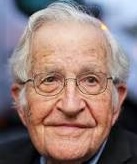
Noam Chomsky (born on December 7, 1928, in Philadelphia, Pennsylvania) is an American linguist, philosopher, cognitive scientist, historical essayist, social critic, and political activist. Sometimes called "the father of modern linguistics", Chomsky is also a major figure in analytic philosophy and one of the founders of the field of cognitive science. He is a Laureate Professor of Linguistics at the University of Arizona and an Institute Professor Emeritus at the Massachusetts Institute of Technology (MIT), and is the author of more than 150 books. He has written and lectured widely on linguistics, philosophy, intellectual history, contemporary issues, and particularly international affairs and U.S. foreign policy. Chomsky has been a writer for Z projects since their earliest inception, and is a tireless supporter of our operations.
ZNetwork is funded solely through the generosity of its readers.
Donate

