
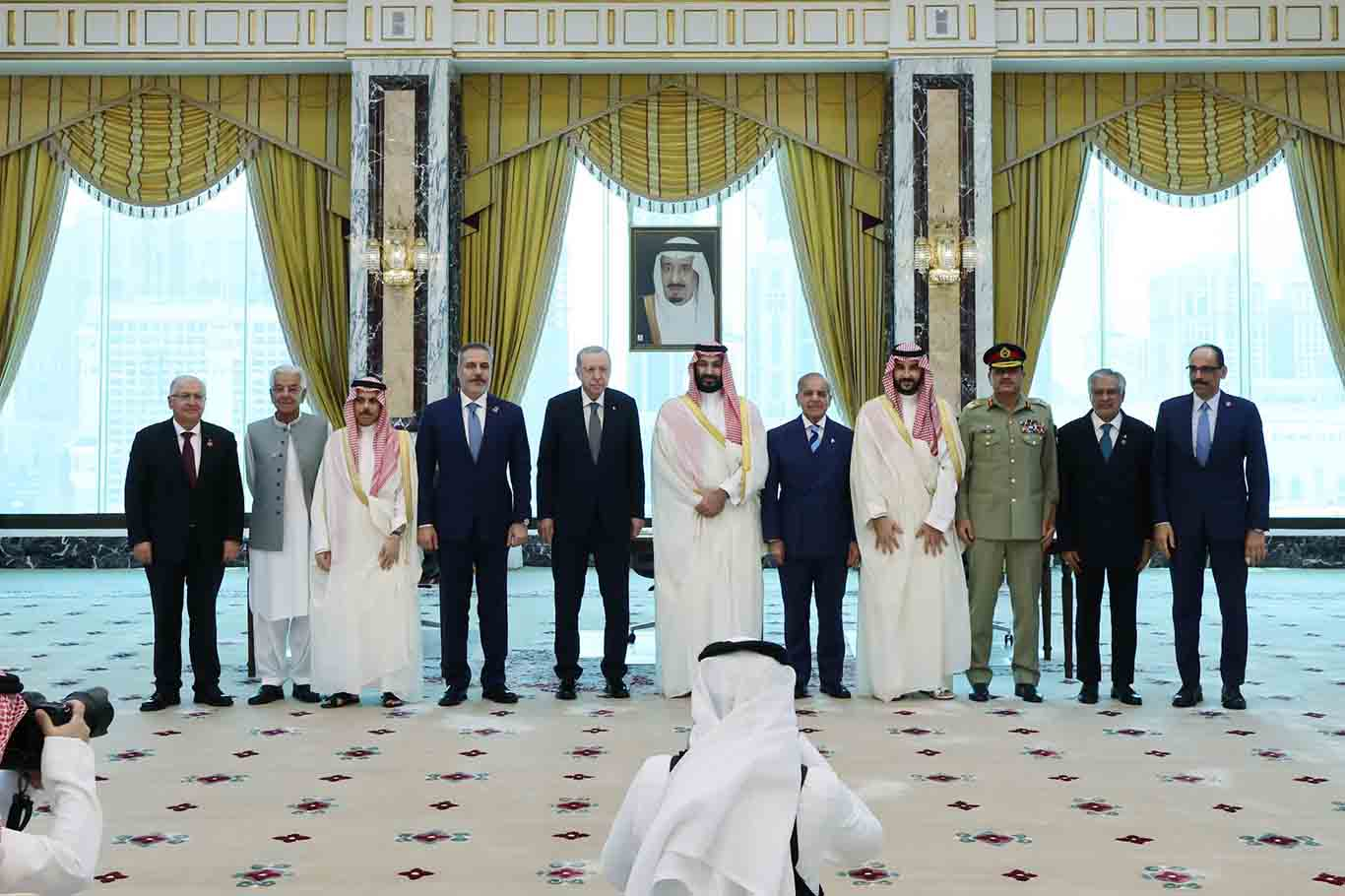
Read the terms of the Mecca Joint Defence Agreement signed at Al-Safa Palace, and the conventional knee-jerk instinct in security circles is to immediately tally warheads, assess military platforms, and calculate conventional balances of power. A trilateral security framework linking a nuclear-armed Pakistan, Saudi Arabia’s immense financial depth, and Turkey’s advanced defense-industrial base naturally sets off strategic alarms in Western capitals and regional choke points alike. Yet, focusing purely on force numbers misses the larger systemic forest for the trees. The defining feature of the August 7 pact is not simply who signed it, but who was conspicuously missing from the room when the ink dried.
Turkey remains a cornerstone NATO member with the alliance’s second-largest standing army. Saudi Arabia has operated as a foundational American security client since the historic meeting aboard the USS Quincy in 1945. Pakistan maintains the formal designation of a major non-NATO ally. That three primary pillars of Washington’s traditional security architecture spent months negotiating a collective-defense treaty entirely uninvited – and completely absent American oversight – marks a watershed moment in contemporary geopolitics. It signals a profound structural shift away from unipolar dependency toward autonomous regional hedging.
To understand why traditional American security partners felt compelled to draft an independent insurance policy, one need only examine the turbulent, high-stakes ledger of the past twelve months. The Israeli strike on Hamas figures in Doha in September 2025 pierced the sovereign soil of a host nation sheltering the largest United States air base in the region, leaving Washington conspicuously powerless to prevent or deter it. Months later, the opening salvos of Operation Epic Fury dismantled conventional deterrence across the Gulf, culminating in the death of Iran’s Supreme Leader and the subsequent, prolonged closure of the Strait of Hormuz.
With commercial and energy tankers repeatedly targeted in critical maritime chokepoints, the protective dividend Gulf states anticipated from decades of basing rights, intelligence-sharing agreements, and multi-billion-dollar arms contracts materialized far slower – and far less reliably – than advertised. When Washington’s political leadership demanded uncompromising surrender while attempting to dictate the internal political succession in Tehran, only to watch a hardened nationalist leadership consolidate power, it laid bare the dangerous limits of unilateral coercion. By late summer, internal military assessments were privately acknowledging the urgent necessity of an off-ramp. A superpower that initiates a conflict demanding total capitulation and concludes it hunting for an exit strategy inevitably teaches its partners a sobering lesson regarding the transactional volatility of its security commitments.
That hard-earned lesson is what ultimately crystallized in Mecca. Crucially, the pact’s enduring potency does not stem from it being a monolithic or offensive “Muslim NATO.” A rival alliance featuring an integrated command structure, unified joint commands, and standing offensive war plans would present Washington with a clear adversary to pressure, sanction, or contain. Instead, the agreement is far more subtle, calibrated, and resilient. It establishes a mutual defense baseline without demanding joint headquarters, shared planning cells, or immediate troop deployment obligations that could drag signatories into unintended theatres.
Turkey preserves its NATO commitments fully intact, and the signatories explicitly noted that the accord supersedes no prior bilateral arrangements. This is not a geopolitical blockade against Western influence or an anti-American front; it is an institutional hedge – a structural repricing of the American security guarantee that allows regional powers to diversify their strategic options without forcing an explicit diplomatic rupture with Washington. Clients purchasing insurance elsewhere are not declaring themselves enemies; they are rational customers who have simply noticed a second store.
When these tectonic shifts ripple across regional trade networks and global supply chains, their impact is immediate and physical. The lifeblood of Asian and European energy logistics – crude oil and liquefied natural gas – transits through the narrow, vulnerable channel of the Strait of Hormuz. When hostilities forced severe disruptions in the channel, tankers were thrust into navigating an active war zone to keep global refineries operational, proving that regional exposure is acutely physical, priced directly into every barrel forcing its way past contested chokepoints.
Furthermore, the Mecca Pact deals a severe, structural blow to rigid, unilateral transit corridors engineered to bypass key regional actors. Initiatives like the India-Middle East-Europe Economic Corridor (IMEC), unveiled with grand ambitions at the 2023 G20 summit, were explicitly designed to route commerce through the Gulf and Israel to Europe while pointedly bypassing both Turkey and Pakistan. President Erdoğan’s historic dismissal – insisting there was no viable corridor without Turkish participation – has been fully vindicated by time and conflict. With IMEC’s northern rail segments stalled by persistent regional instability and its maritime legs chained to a volatile Hormuz, Turkey has actively advanced logistics, digital infrastructure, and overland integration corridors directly with Saudi Arabia. The Mecca Pact effectively rehabilitates and institutionalizes the very states exclusion strategies sought to sideline.
What August 7 signifies is that transactional hedging has gone mainstream among Washington’s core security dependents. As Western leaders navigate domestic electoral reckonings against the backdrop of strategic overreach and resource constraints, the invisible bill is coming due globally. The wager underpinning decades of uncritical alignment – that the American strategic promise is the only serious guarantee on offer in a volatile region – has been fundamentally undermined. After Mecca, the American word is no longer an unchallenged monopoly; it is merely one option among several in an increasingly multi-aligned world order.
ZNetwork is funded solely through the generosity of its readers.
Donate

