
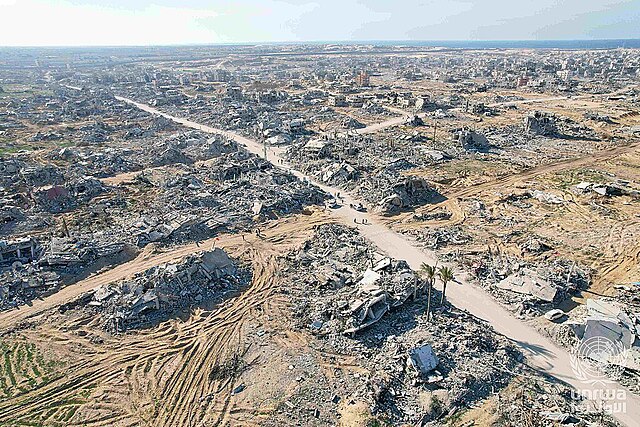
If Gaza’s reconstruction is mishandled, it will not only fail millions of Palestinians — it will accelerate the unravelling of the global order.
There are moments when a conflict refuses to remain a single story on a single map. Gaza has become one of those moments: not only a catalogue of human loss but a live test of whether the global order still believes in itself. The death toll — north of 70,000 according to Gaza health authorities — is a number that should shame every institution that claims to protect civilians and uphold the law.
Reconstruction is not a technical exercise; it is the political instrument that will demonstrate whether the international community can translate outrage into durable justice. Independent assessments put reconstruction needs at tens of billions — estimates clustering around US$50–70 billion, with immediate needs of roughly US$10–20 billion in the first years alone. Those figures are not abstract; they are the price of hospitals, schools, water systems, homes, livelihoods and, crucially, trust.
In that policy ledger, Indonesia’s recent signalling matters. A middle power with a long anti-colonial tradition and a record of UN peacekeeping, Indonesia has publicly trained and prepared up to 20,000 personnel for a stabilisation mission focused on health and infrastructure tasks. That offer is both a diplomatic message and a bargaining chip. If marshalled with legal clarity and moral precision, it could reshape how reconstruction is governed.
This is not an argument for reckless deployment. Warnings are warranted and must be heeded. Voices on the ground and in civil society argue that participation in a non-UN structure risks becoming an instrument that relieves an occupying power of responsibility and normalises foreign management of a dispossessed people’s life. Such cautions are legitimate and must shape any decision.
History offers a blunt lesson. After 2003, the Coalition Provisional Authority controlled roughly US$23 billion of Iraqi assets and channelled about US$7 billion into reconstruction projects — yet billions went unaccounted for, programs were poorly sequenced, and local institutions were sidelined, leaving corruption, wasted contracts and political fracturing in the wreckage of ‘rebuild’ plans. The Iraqi example shows how speed without legitimacy becomes theft by another name; good intentions cannot substitute for transparent mandates, accountable finances and local ownership.
Yet abstention from the table is not innocence. If Indonesia, Europe, or other middle powers decline to participate while a new architecture proceeds, the vacuum will be filled — and the occupants of that vacuum will set terms, finance modalities and legal arrangements that are likely to favour powerful patrons. The present design for a U.S.-backed “Board of Peace” — whose draft charter reportedly ties multi-year membership to a US$1 billion contribution — creates exactly the sort of club-logic that risks excluding voices and entrenching the very hierarchies that have eroded global credibility.
A different path exists: conditional engagement. Middle powers that value law, human rights and lasting stability can attach binding, public conditions to any operational role. The conditions should include a clear UN mandate or co-mandate, sequencing that guarantees an occupying power’s withdrawal before any disarmament of local armed actors, enforceable civilian protection rules of engagement, independent monitoring with investigatory powers linked to the ICC or other accountability mechanisms, and a short, legally binding sunset clause with parliamentary oversight.
These are not bureaucratic niceties; they are the architecture that converts goodwill into safeguards. RSIS and other regional analysts note the political currency that Indonesia’s offer already brings — currency that can be spent to buy legal guarantees rather than ideological cover.
Optimism about reconstruction must be tethered to realism about power. The reconstruction price tag — estimated by the World Bank and UN partners well into the tens of billions — implies that a coalition of donors, private investment and credible multilateral oversight will be necessary. The moment calls for creative finance that safeguards Palestinian ownership of recovery: trust funds with transparent governance, tiered rules for donor influence, and investment pledges conditioned on predefined human-rights benchmarks. A $1 billion cheque should not purchase a permanent seat at the expense of the Palestinian agency.
Palestinian ownership must be practical, not performative: it means Palestinian engineers and municipal councils leading project design and tendering; Palestinian ministries co-signing and controlling procurement decisions and budgets; and community councils setting neighbourhood priorities, with veto rights over demolition-oriented proposals. The World Bank and donor best practice stress participation, alignment with national plans and community-level accountability as the single best predictor of sustainable recovery.
The diplomatic prize is not prestige; it is legitimacy. Middle powers that insist upon UN anchoring and legal checks can blunt the worst impulses of ad-hoc governance. That insistence would also send a signal to millions in the Global South who rightly perceive a dangerous double standard: robust defence of sovereignty in some theatres and a negotiable application of the same norms in others. Think tanks from ODI to ECFR have warned that credibility is being eroded by inconsistency; rebuilding Gaza must therefore be undertaken in ways that restore, not hollow out, the rules-based order.
Practically, Indonesia’s contribution should prioritise the practical and the safe — hospitals, water, demining, engineering and medical logistics. Civil-military teams ought to be paired with independent humanitarian agencies and with Palestinian representatives in governance roles. Transparency must be relentless: public reporting, civil society access, and parliamentary scrutiny will be the best defence against the accusation of complicity. If the legal and moral conditions cannot be met, restraint becomes the only responsible posture.
There is an emotional dimension to policy that must not be surrendered to cynicism. Reconstruction gives an opportunity to reframe loss into purpose: training Palestinian engineers, rebuilding schools with curricula tied to civic restoration, rebuilding ports and markets that restore dignity and work. That form of reconstruction — locally led, internationally backed, legally anchored — can be a modest but real counterweight to the century of postponed justice that has passed through declarations and procedures without delivering freedom.
The arc from Balfour to Oslo to today is long and bitter; reconstruction governed by consent and law can tilt it, finally, toward repair.
If middle powers choose engagement with integrity, the result will be more than rebuilt infrastructure. The result could be a renewed confidence that international action can be both practical and principled. That is the quiet optimism worth taking into a devastated Gaza: the belief that law, money and muscle can be combined to restore life without selling out justice.
The choice is not between neutrality and partisanship — it is between building a durable peace rooted in law, or underwriting another generation’s grievance; the world must choose which history to bequeath.
Kurniawan Arif Maspul is a researcher and interdisciplinary writer focusing on Islamic diplomacy and Southeast Asian political thought. He holds an MEd in Advanced Teaching, an MBA and an MA in Islamic Studies and is currently pursuing a Master’s in Islamic Banking and Finance at Al-Madinah International University in Malaysia.
ZNetwork is funded solely through the generosity of its readers.
Donate