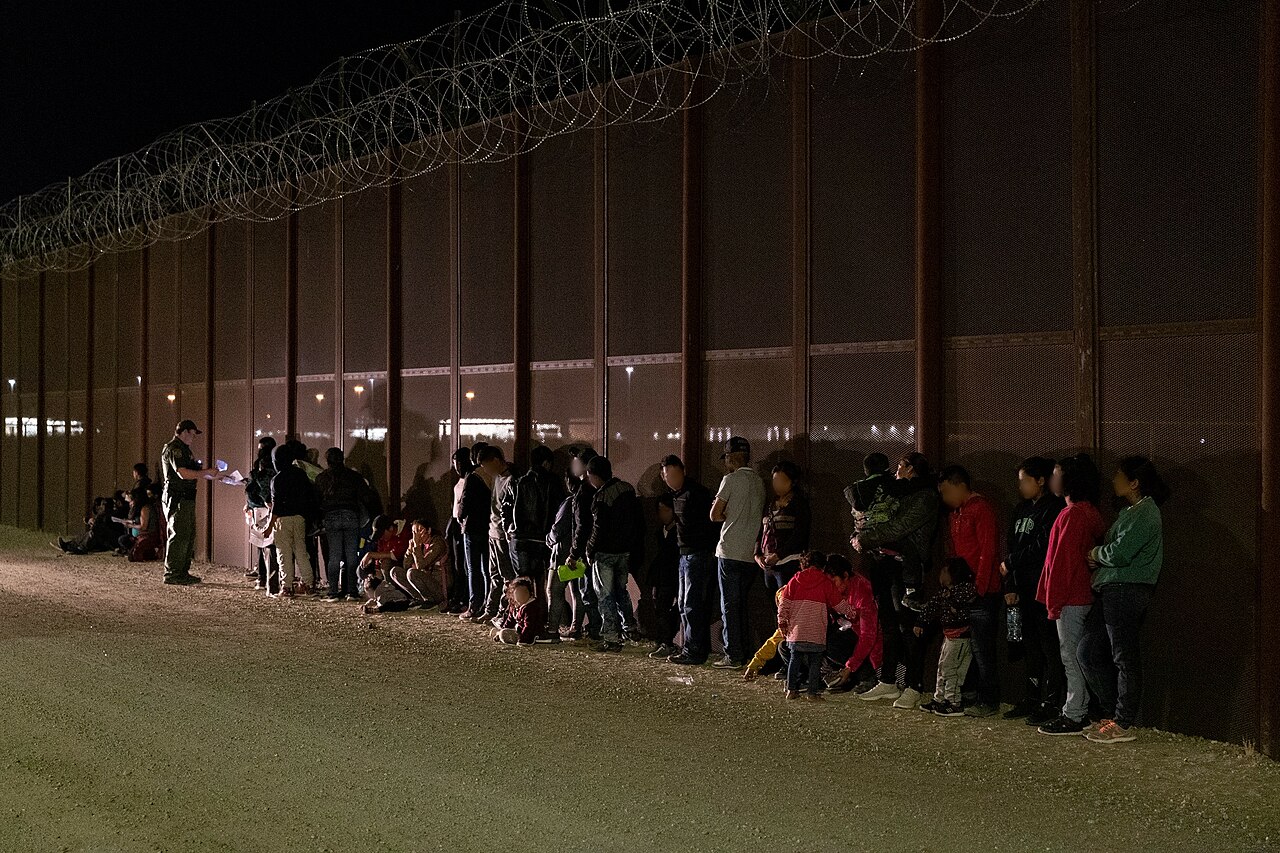
Immigration has been a touchstone of United States political debates for decades, and several cities claim to be at a “breaking point” as they struggle to absorb and support arrived migrants. But is there really a border crisis? And why are cities like New York unable to cope with the influx of migrants when their numbers are not unusual by historic standards? Have the Biden administration’s changes in asylum laws made a difference? Is there a “solution” to the migration “problem”? Avi Chomsky addresses these questions in an exclusive interview for Truthout.
Avi Chomsky is professor of history and coordinator of the Latin American studies program at Salem State University. She is the author of many books, including Is Science Enough? Forty Critical Questions About Climate Justice (2022); Central America’s Forgotten History: Revolution, Violence, and the Roots of Migration (2021); “They Take Our Jobs!”: And 20 Other Myths about Immigration (2007); and Undocumented: How Immigration Became Illegal (2014).
C.J. Polychroniou: The influx of migrants at the southern border has sparked renewed attention lately, and the immigration debate is raging once again. In fact, anti-immigrant rhetoric has escalated after Donald Trump said in a recent interview that undocumented people were “poisoning the blood of our country,” while a MAGA radio host even called for the shooting of charity workers helping migrants. First, is there an actual migration crisis at the U.S. southern border? Most people seem to think that the U.S. does have a border crisis, though there doesn’t seem to be a political consensus on how to deal with the rising flow of migrants. What’s your own take on this matter, and why is it that the number of international migrants keeps increasing over the years?
Avi Chomsky: I don’t actually agree that there is a “border crisis.” There are multiple crises, both inside the U.S. and outside, and sometimes they become most visible to the media and the U.S. public on the border — but the border is only one node of the crises.
The real crisis is what’s happening in countries like Haiti, Guatemala, Venezuela, and other places where long histories of colonial exploitation, inequality, and violence are exacerbated by neoliberal economic policies, militarization, new forms of extractivism and displacement, debt and climate change, and pushing people from their homes and into migration. Most people who leave their homes to undertake a dangerous journey in hopes of reaching the U.S. are not exactly voluntary migrants — they are forced out of their homes by desperation.
This article was originally published by Truthout; please consider supporting the original publication, and read the original version at the link above.
Aviva Chomsky is a prolific American historian, author, and activist, and has been active in Latin American solidarity and immigrants’ rights issues since the 1980s. She currently teaches at Salem State University in Massachusetts, where she is also the coordinator of the Latin American studies program. She previously was a research associate at Harvard University, where she specialized in Caribbean and Latin American history. Her book West Indian Workers and the United Fruit Company in Costa Rica 1870–1940 was awarded the 1997 Best Book Prize by the New England Council of Latin American Studies. She is also the author of many other books like Linked Labor Histories: New England, Colombia, and the Making of a Global Working Class. Her articles on immigration rights have appeared in The Nation, HuffPost and and TomDispatch.
C.J. Polychroniou is a political scientist/political economist, author, and journalist who has taught and worked in numerous universities and research centers in Europe and the United States. Currently, his main research interests are in U.S. politics and the political economy of the United States, European economic integration, globalization, climate change and environmental economics, and the deconstruction of neoliberalism’s politico-economic project. He has published scores of books and over one thousand articles which have appeared in a variety of journals, magazines, newspapers and popular news websites.
His latest books are Optimism Over Despair: Noam Chomsky On Capitalism, Empire, and Social Change (2017); Climate Crisis and the Global Green New Deal: The Political Economy of Saving the Planet (with Noam Chomsky and Robert Pollin as primary authors, 2020); The Precipice: Neoliberalism, the Pandemic, and the Urgent Need for Radical Change (an anthology of interviews with Noam Chomsky, 2021); and Economics and the Left: Interviews with Progressive Economists (2021).
ZNetwork is funded solely through the generosity of its readers.
The Wind Cries Freedom, the new book from Z co-founder Michael Albert, is a sweeping oral history of a future American revolution.
Through thirty interconnected chapters, it draws out the strategies, failures, turning points, and hard-won wisdom of a movement that called itself the Revolutionary Participatory Society. These are not the polished memoirs of politicians: they are the unfiltered accounts of people who organized in neighborhoods, hospitals, universities, stadiums, courthouses, and places of worship, and kept a shared vision alive through cynicism and exhaustion.
The result is speculative political fiction that reads like history: messy, human, and quietly hopeful in the way that only real experience and long thought can produce.
Get your copy and peruse more features on the book’s website below.
“Read it, argue with it, but don’t look away. The future it recalls is one we must still fight to deserve.”
Yanis Varoufakis
“The most unusual and intriguing combination of prophecy, manifesto, and movement building manual that I have ever encountered.”
Bill Fletcher Junior
“This work fills a huge gap in our social movement literature.”
Cynthia Peters
You've just read your article on Z this month.
DOES Z'S SURVIVAL MATTER?
You keep coming back for a reason: serious political analysis, movement reporting, and debate beyond the priorities of corporate media. Today, Z is in a precarious financial position. If Z is part of how you understand the world, help keep it going. The readers who give monthly are the reason this work survives between fundraisers.
Z is in a precarious financial position. If it’s part of how you understand the world, help keep it going.
Your reading count is stored only in your browser and is never sent to us.
Sound is muted by default. Tap 🔊 for the full experience
CRITICAL ACTION
Critical Action is a longtime friend of Z and a music and storytelling project grounded in liberation, solidarity, and resistance to authoritarian power. Through music, narrative, and multimedia, the project engages the same political realities and movement traditions that guide and motivate Z’s work.
If this project resonates with you, you can learn more about it and find ways to support the work using the link below.
Z is in the most precarious financial position in its history.
Z is a place to think beyond the limits of the present.
For decades, Z has brought together political analysis, movement reporting, debate, and visions of a different future from writers and activists around the world. That work is more than journalism. It is movement infrastructure: movements need places to develop ideas, test arguments, learn from experience, and imagine what comes next.
In the first two days of this fundraiser, 19 donors and 8 new monthly sustainers stepped up. Help us reach 1,000 donors who keep Z independent, for everyone.
For decades, Z has published the analysis, debate, and visions movements need, free of paywalls, ads, and billionaire owners. If that work should continue, Z needs your support now.