

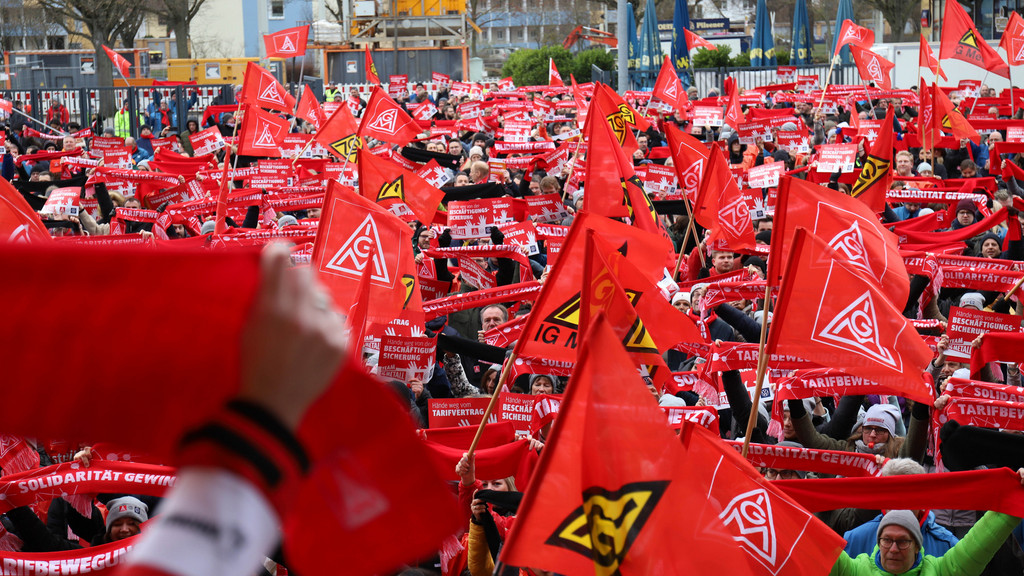
Perhaps the fact that workers go on strike is as old as capitalism itself. Wherever there is capitalism, there are workers – and wherever workers suffer under capitalism, there will be strikes – whether in Germany or elsewhere.
In 2024, Germany registered 286 official industrial disputes. (There were also unofficial work stoppages not counted in the official statistics.) This was just 26 fewer than in 2023, which saw a total of 312 collective bargaining conflicts.
Despite the slight decline, the frequency of conflicts remained high compared to historical averages. However, the volume of industrial action in 2024 was significantly lower than in the previous year: 946,000 “strike days won” (strike days are the holidays of workers) were counted as a result of industrial action.
Interestingly, the number of strike participants rose: 912,000 in 2024, compared to 857,000 in 2023.
A major reason for this was the large number of so-called warning strikes. In Germany’s labor relations, these strikes act as a signal to employers that workers and their union are prepared to fight. Often, this signal alone is enough to bring management to the bargaining table or even force concessions.
Germany saw waves of such strikes in, for example, the metal and electrical industries – both sectors covered by Germany’s model of “industrial unionism,” where one union represents an entire sector.
Within these industrial sectors, warning strikes dominated in 2024. Meanwhile, real and sustained work stoppages were generally shorter than those of the previous year.
The year 2025, however, began with rather spectacular strikes across Germany’s vast public service sector.
Due to Germany’s undemocratic system of labor law, strikes are still prohibited in large parts of the civil service. This means that in 2025, there will be no collective bargaining in many areas of Germany’s public service sector.
One such group excluded from striking is the Beamte – a kind of special state-soldier who receives a military-style Sold (not a wage) and is “bound to” the state, a feudalistic leftover from Prussia‘s administrative system.
Some undemocratic Prussian traditions survive in today’s Germany – mostly those favoring the ruling elite, Prussian or otherwise.
Strikes in 2024 were also shaped by trade unions trying to recover the massive real wage losses suffered during the recent crisis of high inflation – when energy prices soared in the wake of Russia’s war against Ukraine.
The long duration of collective agreements, coupled with wage suppression, meant workers had to wait a long time to even begin to recover from the dramatic rise in living costs.
In other words: wage bargaining is “not” an area where employers welcome their much-touted “flexibility.” Instead, they prefer to lock workers into long-term, suffocating agreements – and Germany’s hyper-law-abiding unions often go along.
For instance, wages in Germany’s construction industry weren’t due for renegotiation until 2024 – the last agreement having been signed in 2021. Flexibility, it seems, is only desirable when it benefits employers – not workers. Some of it is known as KAPOVAZ – working time flexibility according to managerial whims.
Still, conflict-oriented bargaining led to the first major strikes in Germany’s construction industry in two decades.
Strikes in 2024 were also marked by the aforementioned warning strikes in the metal and electrical industries – covering 3.9 million workers.
However, many disputes were not just about wage compensation. For instance, the fight at Volkswagen was triggered by management’s plan to close factories and cut jobs – offloading the consequences of mismanagement (e.g. falling behind in electric vehicle production) onto the workforce .
Such disputes increasingly reflect a forward-looking union strategy. Two major labor disputes from 2023 also carried over into 2024. Both involved working hours – for example, at Deutsche Bahn – alongside parallel conflicts in the retail sector that began in 2023 and spilled into the new year.
Meanwhile, Germany’s labor market in 2024 looked very different from previous years. Some sectors, like engineering and manufacturing, faced significant job cuts. Others, especially in services, were plagued by labor shortages.
Disputes weren’t only about higher wages – they were also about job security and improved working conditions.
Contrary to media narratives blaming “militant” unions, the reality is that in Germany, unions typically only influence the path of a conflict – not its cause. More often than not, it’s management that rejects reasonable offers, leaving workers with no choice but to strike.
In 2024, this was especially clear in the construction industry, where employers rejected the outcome of arbitration. A similar scenario unfolded in Germany’s public broadcasting sector.
In 2024, employers also increasingly turned to the courts to try to block industrial action – with mixed success. Alongside this came renewed calls to restrict a fundamental human right: the right to strike – something employers have been trying to curtail ever since capitalism’s birth in the 18th century.
Despite being enshrined in Germany’s Constitution and ILO conventions, the corporate-media-engineered campaign to restrict strike rights intensified in 2024.
The current strategy by employers seeks to legally complicate – or ideally prevent – strikes altogether. Once the Sunday speeches about “social partnership” end, employers tend to seek ways to undermine or destroy trade unions.
Despite all this, most strikes in 2024 happened outside of traditional, industry-wide bargaining frameworks. Instead, conflicts increasingly shifted to the enterprise or company level – a dangerous fragmentation of Germany’s labor relations model.
In response, unions tried to enforce industry-wide standards at the company level – pushing individual employers to accept broader agreements and industry benchmarks.
They also sought to establish agreements in previously non-unionized workplaces, countering a long-term decline in collective bargaining coverage that’s been visible since the mid-1990s.
These struggles were particularly drawn-out when companies refused to guarantee unionized conditions – so much for the “social partnership.”
It seems the principle of social partnership only exists for Sunday speeches. As long as unions believe in the ideology of partnership, German capitalism functions just fine.
For workers and unions, these disputes are a heavy burden – and success is not guaranteed.
For example, the bitter conflict at the East German scrap and recycling company SRW Metalfloat ended in failure in spring 2024 after 180 days of strike and a subsequent lockout.
But unlike SRW Metalfloat, many unions succeeded in winning new agreements. These smaller “house fights” – though limited in scope – helped stabilize the broader system.
Most of these strikes took place in small- to medium-sized enterprises and required considerable resources from unions.
Structurally, trade unions remain at a disadvantage under capitalism. This became particularly obvious in the case of Germany’s retail giants (read: monopolists), EDEKA and Rewe.
Both companies withdrew thousands of stores from collective agreements – using franchise systems to do so. It is managerial trickery vs. workers.
And like Amazon and Tesla, they refuse to recognize unions as legitimate bargaining partners.
Germany’s ver.di union has now been fighting for a collective agreement at Amazon for 12 years. Similarly, the push for a recognition agreement at Zalando remains stalled.
Strike actions in 2024 ranged widely. In some cases, a single strike led to a new agreement – as seen in southern Germany. That’s because German labor relations are organized not only by industry but also regionally.
Between 2014 and 2023, Germany averaged about 21 strike days per 1,000 workers – moderate by international standards.
Canada topped the list with 108 days (boosted by a major postal strike), followed by France (102), where massive strikes erupted against pension cuts.
In Finland, 107 strike days in 2023 followed protests against the right-wing government’s plan to restrict strikes and slash labor rights.
Cyprus saw 93 strike days due to a general strike over the inflation-linked cost of living allowance (COLA).
Spain, Norway, and the UK followed. Germany, the Netherlands, and the USA sat in the middle – around 20 days. Poland, Denmark, Ireland, and Portugal were slightly below that. Austria, Switzerland, Sweden, and Slovakia showed almost no strike activity.
However, international comparisons should be approached cautiously – data collection methods vary widely. For example, France’s stats exclude public administration. Spain excludes general strikes. The UK didn’t collect data in 2020–21. The U.S. only counts strikes involving over 1,000 workers.
In Germany, non-union strikes are rare. In Canada, by contrast, lockouts contribute significantly to strike data. Across Europe, the inflation crisis pushed many unions to strike in order to recoup lost wages. In many cases, strike action became the only way.
In early 2025, disputes in Germany were dominated by the service union ver.di. During collective bargaining for public service workers, there were widespread strikes with high participation.
In March 2024, tens of thousands joined strikes in the public sector. Other unions involved included the teachers’ union (GEW), the construction union (IG BAU), and the police union (GdP). On February 21, 2025, ver.di workers in six western states went on strike in public transport.
There were also strikes in municipal clinics, nursing homes, emergency services, and even nationwide airport strikes. After eight rounds of negotiations, an agreement was reached in April 2025.
Looking ahead to spring 2026, more strikes are likely. In December 2025, bargaining will begin for state workers in the Länder (federal states).
But disputes are not limited to the public sector. Deutsche Post AG faced strikes starting in January 2025. Eventually, a deal was struck – higher wages and more time off.
In June 2025, several thousand workers from private insurance firms also went on strike, achieving a quick agreement. At Deutsche Bahn, a deal was reached without a strike – as in previous years.
In February 2025, the food workers’ union NGG led 24-hour strikes at breweries. In July 2025, Lieferando drivers struck for 36 hours in Hamburg — still without a collective agreement.
In June, building materials workers in Baden-Württemberg struck after employers offered raises below the inflation rate – effectively demanding that workers get poorer.
Despite everything, strikes in Germany are alive and kicking. But not every strike is won. The SRW Metalfloat strike was the most painful defeat of 2025 – and it happened in Saxony, Germany’s most far-right state, where the neo-fascist AfD polls at 35%. By comparison, Hitler’s Nazi party got 41.3% in Saxony in July 1932.
One-third of voters in Saxony support neo-Nazism — no surprise in the birthplace of the NSU killers. This “Dunkeldeutschland” (dark Germany) remains a reactionary, anti-union, anti-Enlightenment region.
Meanwhile, Amazon has avoided union recognition for 12 years. We are not winning. Yet, despite Amazon – and despite the lingering East–West divide – trade unions made real gains in both western and eastern Germany in 2024 and 2025.
Still, many workers – especially Beamte – remain excluded from striking. Worse, general strikes are almost illegal in supposedly democratic and human rights respecting Germany.
Perhaps German capitalists and corporate elites have learned from 1918–19 and 1933 – a general strike might have prevented Hitler’s rise. Auschwitz might never have happened. Auschwitz was a Nazi death camp with trade unionists like Hermann Langbein as inmates.With the Neo-Nazi AfD on the rise, extending the right to strike – including political and general strikes – may be more urgent than ever. After all, very few want history to repeat itself.
ZNetwork is funded solely through the generosity of its readers.
Donate