
Creation of a Palestinian state next to Israel seemed feasible when President Bill Clinton hosted the signing of the Oslo accords at the White House in September 1993. The goal was reaffirmed in 2011 when 90 percent of the Senate co-sponsored a resolution supporting “a two-state solution to the Palestinian-Israeli conflict.”
But today, the two-state scenario is far-fetched to the point of delusion if not evasion.
For politicians, it has become a box to check. According to data from the American Jewish Congress, every Democrat and most Republicans on the Senate Foreign Relations Committee currently say they support “the two-state solution.”
Whatever the rhetoric, ending Israeli control over Palestinians in the territories occupied since 1967 is not on the table.
“Nobody who talks about a so-called ‘two-state solution’ talks about an end to settlements and colonization, and an end to the occupation,” Palestinian-American historian Rashid Khalidi said in an interview this year. “If you don’t have those as the preconditions, it’s not a state – it’s some reshuffling of a status quo of colonization and occupation.”
At best, only such reshuffling is on the horizon. The essence of colonization and occupation is baked into Israel’s Jewish nationalism that has hardened into systemic cruelty toward Palestinians undergoing genocide.
Yet the boilerplate refrain for a two-state solution has great political utility in the United States. For most politicians, it’s very handy for virtue signaling. The same holds true for pro-Israel pressure groups. Even AIPAC, while incapable of faulting the Israeli government for anything, blames Palestinians for refusing “to negotiate on the basis of the Trump peace framework – which envisions a two-state solution.”
Especially for politicians eager to have the deep-pocketed Israel lobby on their side at election time, saying “two-state solution” has become little more than a way of dodging key facts that exist on the ground. The Israeli military now controls 70 percent of Gaza after reducing it to rubble that has buried an unknown number of bodies. The 2.1 million Palestinians still alive in the enclave are confined to just 30 percent of its 141 square miles, under terrible living conditions.
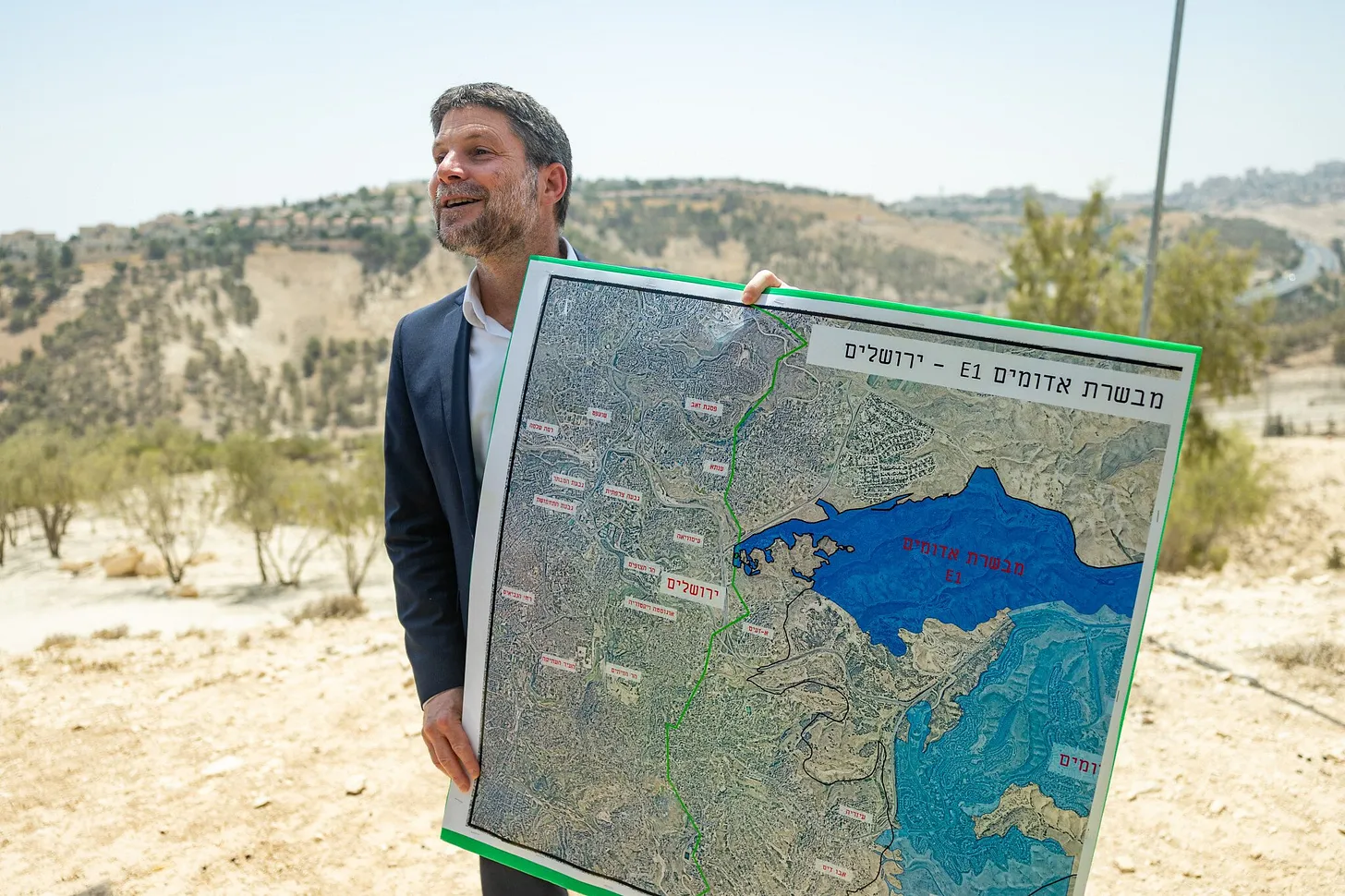
Meanwhile, the proliferation of settlements in the West Bank has pushed Palestinian people into smaller and smaller fragmented areas, by hundreds of checkpoints, while they face lawless violence from Israelis akin to the KKK’s terrorizing of blacks in the Jim Crow South. Several hundred settlements and outposts in the West Bank are now home to upward of 730,000 Israelis, with more arriving all the time.
Given such realities, advocates for a two-state solution have no credible answer to a basic question that is rarely asked: Where would the putative Palestinian state actually be located?
When Britain, Canada and Australia announced their formal recognition of a Palestinian state last fall, putting the number of nations doing so over 150, they were recognizing a phantom. “Israelis and Palestinians alike say the possibility of a two-state solution seems more remote than ever,” the New York Times reported at the time. “Israel’s military campaign in Gaza has devastated the enclave. Israeli settlements have become ever more entrenched in the West Bank.”
But in U.S. politics, the routine is to maintain the convenient fantasy of a two-state solution. Democratic presidential nominee Kamala Harris was simply offering up requisite platitudes during a CNN interview in August 2024 when she declared her commitment to “work toward a two-state solution, where Israel is secure and in equal measure the Palestinians have security and self-determination and dignity.”
David Mandel, a Sacramento chapter leader of Jewish Voice for Peace, told me: “In light of demographic and political realities, a ‘two-state solution’ has become a mostly empty mantra, frequently mouthed by politicians who did nothing to bring it about when it might have been a viable path to end violence and build toward something better.” He added: “It has also become a political refuge for many Americans, including a great many Jews, who are generally progressive and want to differentiate themselves from Benjamin Netanyahu and his ilk, but only performatively, without joining efforts to end real violations of Palestinian rights like occupation, ethnic cleansing, apartheid and genocide.”
A grim truth is that no one really knows what a genuine “solution” might be for the mega-tragedy that continues to unfold in Palestine. Unhelpful from Americans is the facile prescription of a two-state solution or, for that matter, any other supposed remedy. Claiming to know what’s best for Palestinians is built into a colonial mindset that has propelled intervention in the region for more than a hundred years.
The pivotal role for Americans is to end their government’s enabling of ethnic cleansing and genocide. The obvious step in that direction is to halt U.S. weapons shipments to Israel, but much more is involved. “I want to stop American aid,” Prime Minister Netanyahu said during a June 30 interview on Israeli television. “It’s like welfare. I don’t want it.” Earlier in the month, Netanyahu wrote about his plan to “draw down U.S. financial military assistance over the next decade” in a letter to Republican Representative Marlin Stutzman. “The time has now arrived for us to move from aid recipient to partner.”
Netanyahu touted what the congressman described as a “new framework of joint defense cooperation, co-development, coproduction and mutual investment in areas including advanced missile defense, artificial intelligence unmanned systems, cybersecurity and next generation military platforms.” That Israeli wish list is in line with Section 219 of the National Defense Authorization Act now pending in the House. “The provision would speed efforts to embed Israeli technologies into U.S. weapons systems in ways almost never codified into law, even for allies,” Human Rights Watch warns.
While Israel’s disrepute is now widespread among Americans, and more members of Congress are voting to cut off U.S. weapons shipments, current moves to integrate the U.S. and Israeli militaries are aiming to bypass public opinion and the political process. Increasingly, the pro-Israel mission in the United States is to circumvent democracy.
Is a two-state solution the best possibility for Palestine? That’s not for Americans to say. But there is a “two-state solution” that the United States could and should impose – on itself and Israel.
In this decade, the catastrophic U.S.-Israel alliance has enabled not only genocide and ethnic cleansing of Palestinians but also the ongoing wars of aggression on Iran and Lebanon. The alliance should not morph. It should end.
American refusal to support the genocidal state of Israel would be a “two-state solution.” And it might lead to solutions in Palestine.

Norman Solomon is the national director of RootsAction.org and executive director of the Institute for Public Accuracy. The paperback edition of his latest book, War Made Invisible: How America Hides the Human Toll of Its Military Machine, includes an afterword about the Gaza war.
ZNetwork is funded solely through the generosity of its readers.
Donate

