
This conversation took place before the deal.
Harry Lambert: So how are you feeling?
Yanis Varoufakis: I’m feeling on top of the world – I no longer have to live through this hectic timetable, which was absolutely inhuman, just unbelievable. I was on 2 hours sleep every day for five months. … I’m also relieved I don’t have to sustain any longer this incredible pressure to negotiate for a position I find difficult to defend, even if I managed to force the other side to acquiesce, if you know what I mean.
HL: What was it like? Did you like any aspect of it?
YV: Oh well a lot of it. But the inside information one gets… to have your worst fears confirmed … To have “the powers that be” speak to you directly, and it be as you feared – the situation was worse than you imagined! So that was fun, to have the front row seat.
HL: What are you referring to?
YV: The complete lack of any democratic scruples, on behalf of the supposed defenders of Europe’s democracy. The quite clear understanding on the other side that we are on the same page analytically – of course it will never come out at present. [And yet] To have very powerful figures look at you in the eye and say “You’re right in what you’re saying, but we’re going to crunch you anyway.”
HL: You’ve said creditors objected to you because “I try and talk economics in the Eurogroup, which nobody does.” What happened when you did?
YV: It’s not that it didn’t go down well – it’s that there was point blank refusal to engage in economic arguments. Point blank. … You put forward an argument that you’ve really worked on – to make sure it’s logically coherent – and you’re just faced with blank stares. It is as if you haven’t spoken. What you say is independent of what they say. You might as well have sung the Swedish national anthem – you’d have got the same reply. And that’s startling, for somebody who’s used to academic debate. … The other side always engages. Well there was no engagement at all. It was not even annoyance, it was as if one had not spoken.
HL: When you first arrived, in early February, this can’t have been a unified position?
YV: Well there were people who were sympathetic at a personal level – so, you know, behind closed doors, on an informal basis, especially from the IMF. [HL: “From the highest levels?” YV: “From the highest levels, from the highest levels.”] But then inside the Eurogroup, a few kind words and that’s it, back behind the parapet of the official version.
[But] Schäuble was consistent throughout. His view was “I’m not discussing the programme – this was accepted by the previous government and we can’t possibly allow an election to change anything. Because we have elections all the time, there are 19 of us, if every time there was an election and something changed, the contracts between us wouldn’t mean anything.”
So at that point I had to get up and say “Well perhaps we should simply not hold elections anymore for indebted countries”, and there was no answer. The only interpretation I can give [of their view] is “Yes, that would be a good idea, but it would be difficult to do. So you either sign on the dotted line or you are out.”
HL: And Merkel?
YV: You have to understand I never had anything to do with Merkel, finance ministers talk to finance ministers, prime ministers talk to Chancellors. From my understanding, she was very different. She tried to placate the Prime Minister [Tsipras] – she said “We’ll find a solution, don’t worry about it, I won’t let anything awful happen, just do your homework and work with the institutions, work with the Troika; there can be no dead end here.”
This is not what I heard from my counterpart – both from the head of the Eurogroup and Dr Schäuble, they were very clear. At some point it was put to me very unequivocally: “This is a horse and either you get on it or it is dead.”
HL: Right so when was that?
YV: From the beginning, from the very beginning. [They first met in early February.]
HL: So why hang around until the summer?
YV: Well one doesn’t have an alternative. Our government was elected with a mandate to negotiate. So our first mandate was to create the space and time to have a negotiation and reach another agreement. That was our mandate – our mandate was to negotiate, it was not to come to blows with our creditors. …
So that would be the first phase. The second phase was where they’d ask us what we intended to do on VAT. They would then reject our proposal but wouldn’t come up with a proposal of their own. And then, before we would get a chance to agree on VAT with them, they would shift to another issue, like privatisation. They would ask what we want to do about privatisation, we put something forward, they would reject it. Then they’d move onto another topic, like pensions, from there to product markets, from there to labour relations, from labour relations to all sorts of things right? So it was like a cat chasing its own tail.
We felt, the government felt, that we couldn’t discontinue the process. Look, my suggestion from the beginning was this: This is a country that has run aground, that ran aground a long time ago. … Surely we need to reform this country – we are in agreement on this. Because time is of the essence, and because during negotiations the central bank was squeezing liquidity [on Greek banks] in order pressurise us, in order to succumb, my constant proposal to the Troika was very simple: let us agree on three or four important reforms that we agree upon, like the tax system, like VAT, and let’s implement them immediately. And you relax the restrictions on liqiuidity from the ECB. You want a comprehensive agreement – let’s carry on negotiating – and in the meantime let us introduce these reforms in parliament by agreement between us and you.
And they said “No, no, no, this has to be a comprehensive review. Nothing will be implemented if you dare introduce any legislation. It will be considered unilateral action inimical to the process of reaching an agreement.” And then of course a few months later they would leak to the media that we had not reformed the country and that we were wasting time! And so… [chuckles] we were set up, in a sense, in an important sense.
So by the time the liquidity almost ran out completely, and we were in default, or quasi-default, to the IMF, they introduced their proposals, which were absolutely impossible… totally non-viable and toxic. So they delayed and then came up with the kind of proposal you present to another side when you don’t want an agreement.
HL: Did you try working together with the governments of other indebted countries?
YV: The answer is no, and the reason is very simple: from the very beginning those particular countries made it abundantly clear that they were the most energetic enemies of our government, from the very beginning. And the reason of course was their greatest nightmare was our success: were we to succeed in negotiating a better deal for Greece, that would of course obliterate them politically, they would have to answer to their own people why they didn’t negotiate like we were doing.
HL: And partnering with sympathetic parties, like Podemos?
YV: Not really. I mean we always had a good relationship with them, but there was nothing they could do – their voice could never penetrate the Eurogroup. And indeed the more they spoke out in our favour, which they did, the more inimical the Finance Minister representing that country became towards us.
HL: And George Osborne? What were your dealings like with him?
YV: Oh very good, very pleasant, excellent. But he is out of the loop, he is not part of the Eurogroup. When I spoke to him on a number of occasions you could see that was very sympathetic. And indeed if you look at the Telegraph, the greatest supporters of our cause have been the Tories! Because of their Eurosceptism, eh… it’s not just Euroscepticsm; it’s a Burkean view of the sovereignty of parliament – in our case it was very clear that our parliament was being treated like rubbish.
HL: What is the greatest problem with the general way the Eurogroup functions?
YV: [To exemplify…] There was a moment when the President of the Eurogroup decided to move against us and effectively shut us out, and made it known that Greece was essentially on its way out of the Eurozone. … There is a convention that communiqués must be unanimous, and the President can’t just convene a meeting of the Eurozone and exclude a member state. And he said, “Oh I’m sure I can do that.” So I asked for a legal opinion. It created a bit of a kerfuffle. For about 5-10 minutes the meeting stopped, clerks, officials were talking to one another, on their phone, and eventually some official, some legal expert addressed me, and said the following words, that “Well, the Eurogroup does not exist in law, there is no treaty which has convened this group.”
So what we have is a non-existent group that has the greatest power to determine the lives of Europeans. It’s not answerable to anyone, given it doesn’t exist in law; no minutes are kept; and it’s confidential. So no citizen ever knows what is said within. … These are decisions of almost life and death, and no member has to answer to anybody.
HL: And is that group controlled by German attitudes?
YV: Oh completely and utterly. Not attitudes – by the finance minister of Germany. It is all like a very well-tuned orchestra and he is the director. Everything happens in tune. There will be times when the orchestra is out of tune, but he convenes and puts it back in line.
HL: Is there no alternative power within the group, can the French counter that power?
YV: Only the French finance minister has made noises that were different from the German line, and those noises were very subtle. You could sense he had to use very judicious language, to be seen not to oppose. And in the final analysis, when Doc Schäuble responded and effectively determined the official line, the French FM in the end would always fold and accept.
HL: Let’s talk about your theoretical background, and your piece on Marx in 2013, when you said:
“A Greek or a Portuguese or an Italian exit from the Eurozone would soon lead to a fragmentation of European capitalism, yielding a seriously recessionary surplus region east of the Rhine and north of the Alps, while the rest of Europe is would be in the grip of vicious stagflation. Who do you think would benefit from this development? A progressive left, that will rise Phoenix-like from the ashes of Europe’s public institutions? Or the Golden Dawn Nazis, the assorted neofascists, the xenophobes and the spivs? I have absolutely no doubt as to which of the two will do best from a disintegration of the eurozone.”
…so would a Grexit inevitably help Golden Dawn, do you still think that?
YV: Well, look, I don’t believe in deterministic versions of history. Syriza now is a very dominant force. If we manage to get out of this mess united, and handle properly a Grexit … it would be possible to have an alternative. But I’m not sure we would manage it, because managing the collapse of a monetary union takes a great deal of expertise, and I’m not sure we have it here in Greece without the help of outsiders.
HL: You must have been thinking about a Grexit from day one…
YV: Yes, absolutely.
HL: …have preparations been made?
YV: The answer is yes and no. We had a small group, a ‘war cabinet’ within the ministry, of about five people that were doing this: so we worked out in theory, on paper, everything that had to be done [to prepare for/in the event of a Grexit]. But it’s one thing to do that at the level of 4-5 people, it’s quite another to prepare the country for it. To prepare the country an executive decision had to be taken, and that decision was never taken.
HL: And in the past week, was that a decision you felt you were leaning towards [preparing for Grexit]?
YV: My view was, we should be very careful not to activate it. I didn’t want this to become a self-fulfilling prophecy. I didn’t want this to be like Nietzsche’s famous dictum that if you stare into the abyss long enough, the abyss will stare back at you. But I also believed that at the moment the Eurogroup shut out banks down, we should energise this process.
HL: Right. So there were two options as far as I can see – an immediate Grexit, or printing IOUs and taking bank control of the Bank of Greece [potentially but not necessarily precipitating a Grexit]?
YV: Sure, sure. I never believed we should go straight to a new currency. My view was – and I put this to the government – that if they dared shut our banks down, which I considered to be an aggressive move of incredible potency, we should respond aggressively but without crossing the point of no return.
We should issue our own IOUs, or even at least announce that we’re going to issue our own euro-denominated liquidity; we should haircut the Greek 2012 bonds that the ECB held, or announce we were going to do it; and we should take control of the Bank of Greece. This was the triptych, the three things, which I thought we should respond with if the ECB shut down our banks.
… I was warning the Cabinet this was going to happen [the ECB shut our banks] for a month, in order to drag us into a humiliating agreement. When it happened – and many of my colleagues couldn’t believe it happened – my recommendation for responding “energetically”, let’s say, was voted down.
HL: And how close was it to happening?
YV: Well let me say that out of six people we were in a minority of two. … Once it didn’t happen I got my orders to close down the banks consensually with the ECB and the Bank of Greece, which I was against, but I did because I’m a team player, I believe in collective responsibility.
And then the referendum happened, and the referendum gave us an amazing boost, one that would have justified this type of energetic response [his plan] against the ECB, but then that very night the government decided that the will of the people, this resounding ‘No’, should not be what energised the energetic approach [his plan].
Instead it should lead to major concessions to the other side: the meeting of the council of political leaders, with our Prime Minister accepting the premise that whatever happens, whatever the other side does, we will never respond in any way that challenges them. And essentially that means folding. … You cease to negotiate.
HL: So you can’t hold out much hope now, that this deal will be much better than last week’s – if anything it will be worse?
YV: If anything it will be worse. I trust and hope that our government will insist on debt restructuring, but I can’t see how the German finance minister is ever going to sign up to this in the forthcoming Eurogroup meeting. If he does, it will be a miracle.
HL: Exactly – because, as you’ve explained, your leverage is gone at this point?
YV: I think so, I think so. Unless he [Schäuble] gets his marching orders from the Chancellor. That remains to be seen, whether she will step in to do that.
HL: To come back out again, could you possibly explain, in layman’s terms for our readers, your objections to Piketty’s “Capital”?
YV: Well let me say firstly, I feel embarrassed because Piketty has been extremely supportive of me and the government, and I have been horrible to him in my review of his book! I really appreciate his position over the last few months, and I’m going to say this to him when I meet him in September.
But my criticism of his book stands. His sentiment is correct. His abhorrence of inequality… [inaudible]. His analysis, however, undermines the argument, as far as I am concerned. Because in his book the neoclassical model of capitalism gives very little room for building the case he wants to build up, except by building upon the model a very specific set of parameters, which undermines his own case. In other words, if I was an opponent of his thesis that inequality is built into capitalism, I would be able to take apart his case by attacking his analysis.
HL: I don’t want to get too detailed, because this isn’t going to make the final cut…
YV: Yes…
HL: …but it’s about his metric of wealth?
YV: Yes, he uses a definition of capital which makes capital impossible to understand – so it’s a contradiction of terms. [Click here—link to add: http://yanisvaroufakis.
HL: Let’s come back to the crisis. I really understand very little of your relationship with Tsipras…
YV: I’ve known him since late 2010, because I was a prominent critic of the government at the time, even though I was close to it once upon a time. I was close to the Papandreou family – I still am in a way – but I became prominent … back then it was big news that a former adviser was saying “We’re pretending bankruptcy didn’t happen, we’re trying to cover it up with new unsustainable loans,” that kind of thing.
I made some waves back then, and Tsipras was a very young leader trying to understand what was going on, what the crisis was about, and how he should position himself.
HL: Was there a first meeting you remember?
YV: Oh yes. It was late 2010, we went to a cafeteria, there were three of us, and my recollection is that he wasn’t clear back then what his views were, on the drachma versus the euro, on the causes of the crises, and I had very, well shall I say, “set views” on what was going on. And a dialogue begun which unfolded over the years and one that… I believe that I helped shape his view of what should be done.
HL: So how does it feel now, after four-and-a-half years, to no longer be working by his side?
YV: Well I don’t feel that way, I feel that we’re very close. Our parting was extremely amicable. We’ve never had a bad problem between us, never, not to this day. And I’m extremely close to Euclid Tsakalotos [the new finance minister].
HL: And presumably you’re still speaking with them both this week?
YV: I haven’t spoken to the Prime Minister this week, in the past couple of days, but I speak to Euclid, yes, and I consider Euclid to be very close to be, and vice-versa, and I don’t envy him at all. [Chuckling.]
HL: Would you be shocked if Tsipras resigned?
YV: Nothing shocks me these days – our Eurozone is a very inhospitable place for decent people. It wouldn’t shock me either to stay on and accepts a very bad deal. Because I can understand he feels he has an obligation to the people that support him, support us, not to let this country become a failed state.
But I’m not going to betray my own view, that I honed back in 2010, that this country must stop extending and pretending, we must stop taking on new loans pretending that we’ve solved the problem, when we haven’t; when we have made our debt even less sustainable on condition of further austerity that even further shrinks the economy; and shifts the burden further onto the have nots, creating a humanitarian crisis. It’s something I’m not going to accept. I’m not going to be party to.
HL: Final question – will you stay close with anyone who you had to negotiate with?
YV: Um, I’m not sure. I’m not going to mention any names now just in case I destroy their careers! [Laughing.]
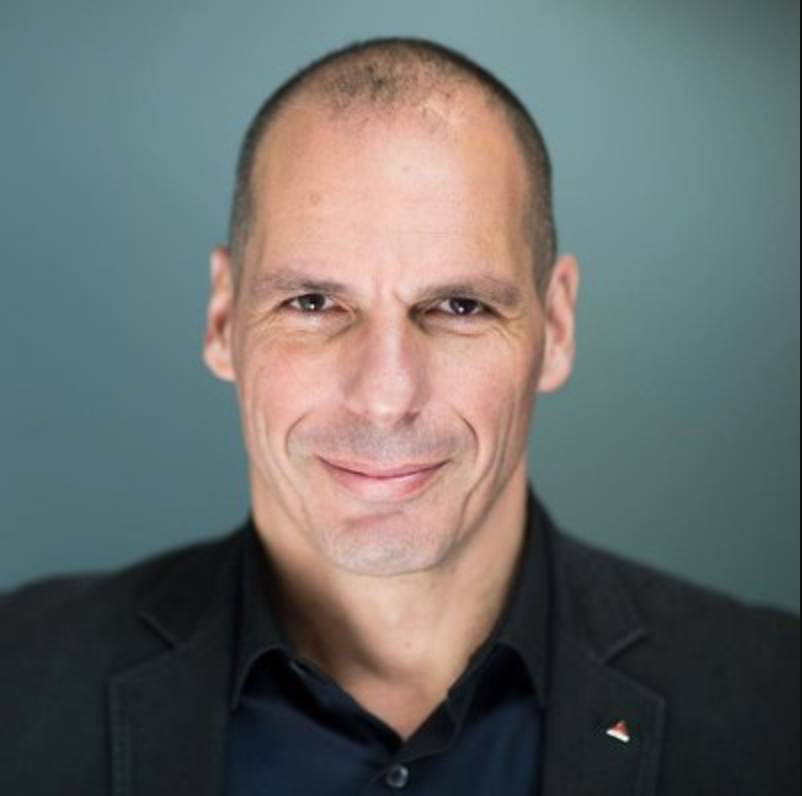
Yanis Varoufakis born 24 March 1961 is a Greek economist, politician, and co-founder of DiEM25. A former academic, he served as the Greek Minister of Finance from January to July 2015. Since 2019, he is again a Member of Greek Parliament and MeRA25 leader. He is the author of several books including, Another Now (2020). Varoufakis is also a professor of Economics – University of Athens, Honorary Professor of Political Economy – University of Sydney, Honoris Causa Professor of Law, Economics and Finance – University of Torino, and Distinguished Visiting Professor of Political Economy, Kings College, University of London.
ZNetwork is funded solely through the generosity of its readers.
Donate

