
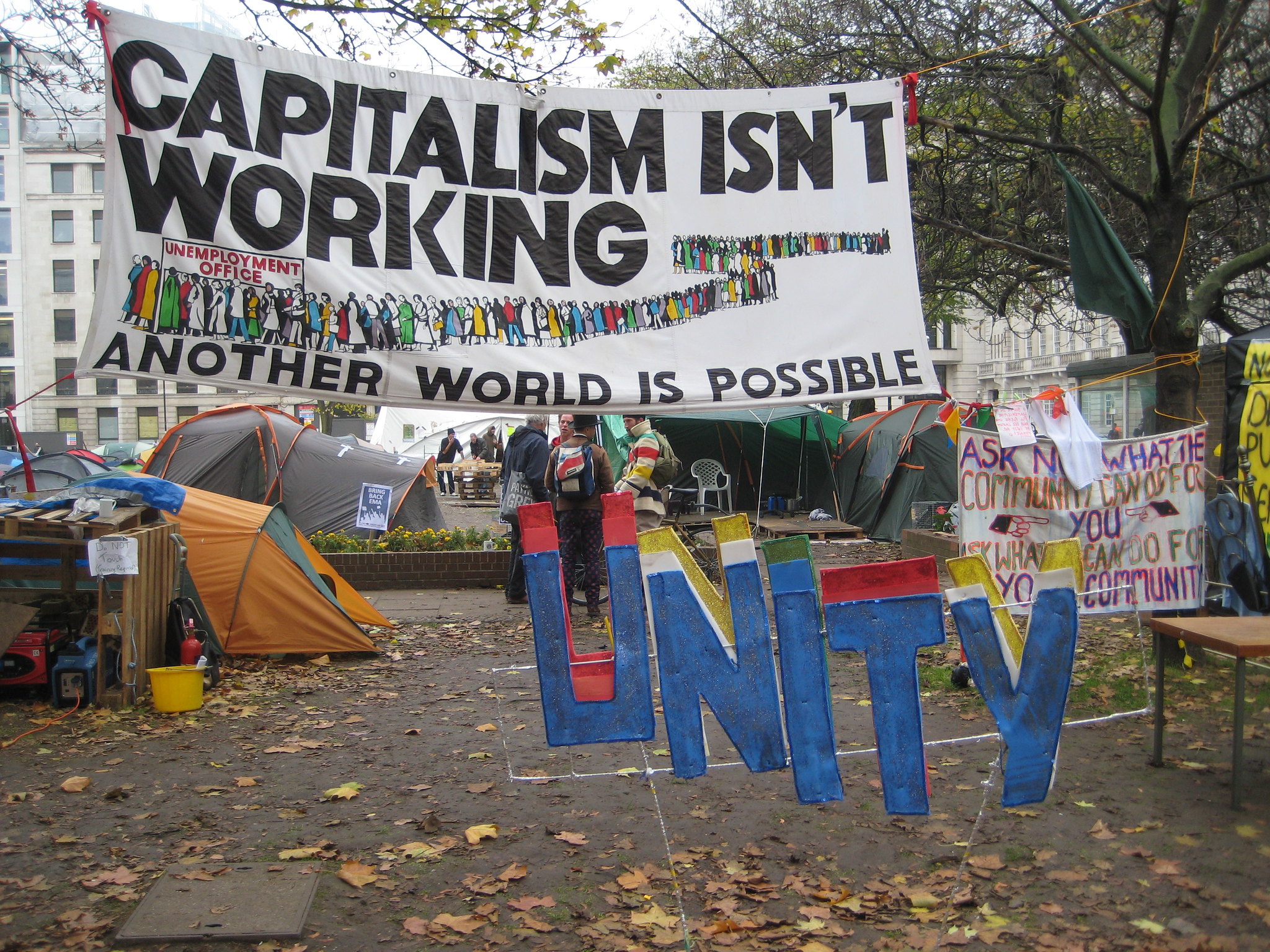
Capitalism is fast becoming so unpopular that the money-grubbing old autocrat in the White House wants to protect it by promising to investigate and prosecute anyone who speaks against it. Free speech be damned. But Milton Friedman said Capitalism and Freedom go together. So, we will use some of that fast-disappearing freedom to comment on the fading popularity of “free enterprise”. Capitalism’s legitimacy is sinking so quickly that even the right-wing Cato Institute recently complained that “Young Americans Like Socialism too Much.” This, of course, raises two questions: Just how unpopular is capitalism and, most importantly, why are people turning against it?
Capitalism has again become so openly exploitative that the old myths of the American Dream and Horatio Alger no longer obscure its cruel reality to more and more Americans. A recent Gallup poll, for example, revealed that only 54% of Americans hold a positive view of capitalism, down from 60% in 2021, and a mere 37% have a favorable attitude toward the corporate sector – the institutional form of capital. Compare this to 2012 when some 58% of Americans favored big business. While Republicans overwhelmingly support capitalism (75%), fewer Independents (51%) and Democrats (42%) view the class structures of capitalism as acceptable. Worse yet for the commanders of capital, 61% of Americans age 18-29 see socialism as a possible alternative. No wonder Socialist candidate Zohran Mamdani is winning big among New York City’s youngest voters. Why not? This is the generation that not only doesn’t expect to do as well as their parents. They really aren’t. College graduate underemployment and frustrated young house buying families suggest a nightmarish awakening from the American Dream. Given the realities of data and denial it’s no wonder that Trump and his right-wing allies are stepping up their war against critics of capital. Once people wake up there’s no telling what they will do. Like today’s youth, they might even take socialism seriously.
For those shocked at the drop in capitalism’s support, here’s a basic clue. Capitalist exploitation produces economic inequality. And inequality is not an abstraction: it inflicts real injury and harm to real human beings. It means the vast economic majority of working-class families in America can’t pay rent and food bills, or for clothes for their kids, much less the price of family health insurance, or something as extravagant as a night at the movies. According to The Economic Policy Institute, in 2023 the top 1% of all U.S. income earners, with an average income of just under $800,000, earn about 21% of all income. The top 0.1 % of earners average over $2.8 million. Contrast that to the $58,019 average income earned by the remaining 99%. The same trend holds true when it comes to wealth. Federal Reserve data for 2021 indicate that the top 1% own almost 31% of all wealth, and don’t they love to flaunt it. Think Jeff Bezos and his 400-foot yacht, or Donald Trump and his gold-plated toilet. We’re living in a new “gilded age” for the few and an un-gilded economic cage for the many. The bottom 50% possess next to no wealth at 2.6%. This inequality is not “natural”. It is a symptom of the social class hierarchy and dynamics of capitalism. Capitalism is about partly about surplus value extraction, i.e. paying workers less than the value of what they produce. But it’s also about meeting the financial expectations of financial asset owners. And God-forbid those expectations falter, watch out. As in 2008, the house of financial cards will fall again, and not on the bailed-out bankers, but on the working class. It is important to understand, and more and more people are beginning to, that capitalism is not only unjust and exploitative, it regularly falls apart, leaving in its wake an economic chaos the state cleans up at taxpayer expense. But then, as Thorstein Veblen once observed, what are the taxpayers for?
The dynamics of partnership between the corporate sector and the political state are a characteristic feature of the system and they reflected in the increasing wage and wealth gap. Consider, for instance, the all-out attack on organized labor waged by corporations with the assistance of government policies: A hostile legal system, outsourcing that contributed to the rise of globalism, and out-and-out union busting have crippled if not destroyed organized labor in the United States. During the 1950’s, union membership peaked at about 33%, today it is barely 10% overall, and only 6% in the private sector. And the number is dropping even more rapidly as Trump terminates the right of hundreds of thousands of federal workers to unionize. The only thing missing from earlier rounds of anti-labor policy are the thousands of injunctions used against strikes in the Gilded Age, but then today there aren’t enough striking workers to enjoin. Labor’s decline is part of a larger dynamic, including concentrated oligopolistic industries that set prices contributing to inflation; government’s toleration of relatively high unemployment levels that keep wages down by creating a reserve army of the unemployed, to use Marx’s term; and tax policies that favor the super-rich and pass costs onto workers by reducing the social safety net. Add to this the reckless behavior of finance capital fueled by greed and the unsustainable manipulation of low-income house buyers that led to the Great Recession, a recession that caused massive unemployment, wiped out the savings of millions of Americans, and stripped many of their homes. The massive public bailouts of the those responsible for the recession and the public funds that poured into the coffers of the super-rich – and some estimates of the bailout’s cost run north of $13 trillion – gave new life to the nascent Big Tech industry and their billionaire bosses who now flaunt their wealth amidst growing poverty.
Today the Trump administration has taken additional steps to remove the veil that obscures the realities of capitalism and the role the political state plays in promoting it. With a cabinet of billionaires hawking extremist pro-billionaire policies, it’s crystal clear that Karl Kautsky’s old dictum that “the capitalist class rules but does not govern” no longer holds. The billionaire capitalist class always used government to promote their own interests at the expense of the rest of us; now they’ve become the government and people don’t like it. The question is, what comes next? Now that the façade of capitalism is being exposed, will Americans turn to socialism as an alternative? Democratic socialists are gaining support across the nation, with several already in the House of Representatives. And New York City is poised to elect a socialist as mayor. Will Americans follow Trump down his authoritarian road, or will we turn to the model of the Scandinavian countries and build some democratic social control of capital?
ZNetwork is funded solely through the generosity of its readers.
Donate

