
Childhood is meant to be a journey of gradual awakenings; an accumulation of sunlit afternoons, scraped knees, carefree school days and the gradual safe unfurling of identity.
However, for a Palestinian child growing up in the Israeli killing fields of Gaza or the occupied West Bank there is no such protected sanctuary. In the West Bank, children are forced to navigate a labyrinth of state-engineered obstacles—concrete walls, checkpoints, barriers, surveillance, military raids and attacks by squatters (“settlers”). They mature in the shadow of the “separation” wall; concrete slabs that dictate whether they can visit family, play in open fields or reach needed medical care.
The sounds of military occupation that punctuate a child’s day are ominous. Waking up in the night to armed soldiers forcefully breaking into family homes, shouting indignities and commands, leaves a lasting fear and deep imprint on the minds of young children long after dawn.
In the concentration camp of Gaza, children simply hope for another day.
Generations have come of age treating the horizon itself as an unbearable limit.
Children under occupation absorb the anxieties of their parents long before they have the vocabulary to understand it. The trauma of seeing parents humiliated and abused by soldiers or seeing family homes demolished, leaves children with memories unaltered by time.
Under occupation, play gives way to hypervigilance. Children learn early to read soldiers, calculate safe routes to-and-from school and to live with daily fear and doubt.
Numerous international agencies, like the United Nations International Children’s Emergency Fund and mental health coalitions have documented high rates of psychological distress among Palestinian youth, manifesting as chronic anxiety, sleep disorders, bed wetting and deep feelings of helplessness. The trauma is not episodic. Because the occupation and violence are continuous, the emotional and physical wounds remain perpetually open.
Under occupation, school is not a safe harbor. In the West Bank, children experience school days—often interrupted—under severe duress. The perilous walk to school involves navigating unexploded ordnance, military checkpoints, “security” barriers and active threats from squatters and soldiers.
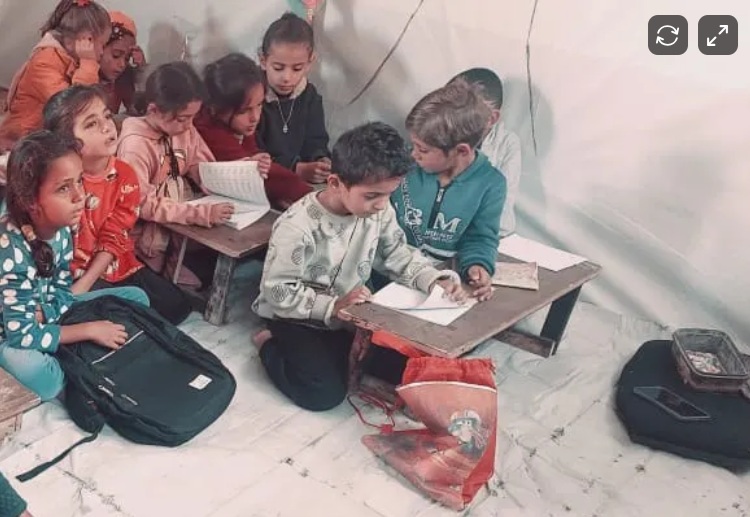
With over 95 percent of schools in Gaza damaged or destroyed, only a fraction —roughly one-third of the roughly 700,000 school-aged children—have access to limited, informal makeshift tent classrooms. The vast majority remain out of school. In spite of all obstacles, Palestinian children maintain a fierce commitment to education; one of the few tools of self-determination left in their hands.
Childhood in Palestine is defined by contradiction. Young lives, with infinite potential, are forced to navigate institutional and environmental barriers designed to destroy it. Growing up Palestinian in Palestine has meant that:
- For 80 years, the loud beat of war has drowned out the quiet promise of peace.
- For 80 years, generations have navigated an existence not of their making.
- For 80 years, generations have carried the weight of stateless dignity; where each simple childhood right becomes a radical act of defiance.
- For 80 years, generations have evolved into a stolen present; traversed into a future where normalcy is a fanciful dream and where they remain the keepers of an unwritten tomorrow.
- For 80 years, generations have learned from an early age that real life means facing death without evasion.
- For 80 years, generations have been imprisoned in a system designed to starve their genius and crush their spirit.
- For 80 years, the Zionist regime has failed to extinguish that spirit.
- For 80 years, the resilient spirit of Palestinian children has remained an indictment of a world that witnessed the catastrophe and did nothing.
Amid the crushing oppression, the essence of childhood stubbornly persists. Palestinians find ways to learn, play and to laugh; and most significantly, to cultivate an ardent solidarity with one another and their heritage.
This strong sense of unity was exhibited recently when 13-year-old, Saida Abdullah, and her classmates gathered for the start of a school day in a makeshift classroom in Gaza City. Standing before her classmates, she led them in this fearless refrain: “Long live a free and Arab Palestine,” and “Glory and eternity to our righteous martyrs.”
Each new generation of Palestinian children has had to shoulder the heavy burden of statelessness and survival. While they have done so bravely, the path toward ending the horrors demands a binding commitment by the international community to act. It demands a mandatory framework of comprehensive reparations, encompassing material compensation, institutional restitution, guaranteed rehabilitation and retribution for perpetrators.
Money can rebuild infrastructure, schools and medical facilities, but it can never reverse the engineered destruction of childhoods.
For a generation emotionally wounded by the loss of parents, limbs and the fundamental right to safety, true justice begins with the formal admission of guilt by the state and punishment imposed. Ultimately, in addition to atonement, meaningful restitution for the crimes of more than 80 years requires a secure and enforceable guarantee that Palestine will be returned to Palestinians. Only then, on their own land, will the lifelong healing and thriving in dignity begin.
ZNetwork is funded solely through the generosity of its readers.
Donate