
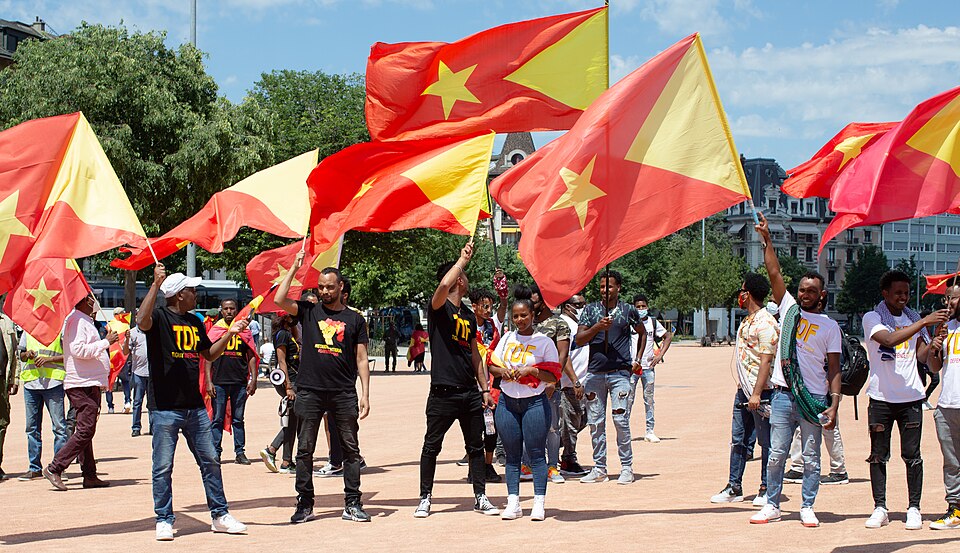
What is happening in Ethiopia is no longer adequately described as another round of the Tigray war. The fighting grew out of questions that Pretoria stopped but never resolved, and it is spreading geographically and politically. A new coalition known as Tsimdo has brought together forces that only recently fought one another, the war has moved into Afar and Amhara, Ethiopia’s principal air force base at Bishoftu has been struck, and Addis Ababa is increasingly accusing Eritrea, Sudan and Egypt of involvement. What remains an Ethiopian war could become a regional one.
I do not think the most useful way to understand this conflict is to keep a daily ledger of towns gained and lost. Towns can change hands repeatedly in a fluid war. The more important questions are where the fighting is spreading, what infrastructure can now be reached and whether the federal government can continue to rely on advantages it once considered secure.
The movement into Afar is therefore more significant than another announcement about possession of a town. Afar is part of the transport geography connecting landlocked Ethiopia to Djibouti and the outside world. According to the World Bank, more than 95 percent of Ethiopia’s import and export trade by volume passes through the wider Addis–Djibouti corridor. The railway itself runs farther south through the Dire Dawa and Dewele axis and has not been cut, but once fighting moves eastward and southeastward, Ethiopia has to think seriously about protecting the transport arteries on which its economy depends.
A further expansion of the war could bring the railway itself into the strategic geography of the conflict. For a landlocked country so overwhelmingly dependent on one external corridor, that possibility matters far more than a daily territorial scorecard. The issue is no longer simply where troops are standing on a particular morning, but whether the geography of the war is beginning to overlap with the infrastructure that keeps the Ethiopian economy connected to the outside world.
Bishoftu matters for another reason. I have no doubt that Harar Meda, Ethiopia’s principal air force base, was struck. Harar Meda is not an ordinary military installation. It is central to Ethiopian air power and has been associated with the country’s expanding use of drones. Open source investigations have previously identified Turkish, Chinese and Iranian drones at Harar Meda.
That makes the strike a psychological blow as much as a military one. Abiy Ahmed’s government has fought with an enormous advantage in air and drone power, and that advantage helped create the impression of a government able to strike its opponents almost anywhere while remaining protected far behind the battlefield. Bishoftu punctures that impression. It does not mean the government has suddenly lost its air force, but it does mean that the infrastructure from which its air power is projected is itself vulnerable. A government that feels it owns the air must now worry about protecting the ground beneath its aircraft.
The question is therefore no longer simply whether federal drones can reach Tigray, Amhara or Afar. It is whether Tsimdo can reach the bases from which those drones operate. Air defense, dispersal, fuel storage, intelligence penetration and protection of aircraft become part of the government’s calculations. For Tsimdo, the significance goes beyond whatever physical damage was inflicted. A force does not have to destroy an opponent’s air force to damage its aura of technological invulnerability. It only has to demonstrate reach.
Combined with the movement into Afar, Bishoftu changes the strategic question from who holds this town to what they can reach. That is a far more consequential way of thinking about the direction of the war because it brings both Ethiopia’s economic lifelines and the infrastructure behind its greatest military advantage into the same frame.
That is also the meaning of Tsimdo. The Tigrinya image is agricultural: two oxen yoked together and pulling in the same direction. What began as coordination among movements with very different histories is becoming something more substantial. These forces are no longer simply talking to one another. They are fighting together, suffering losses together and increasingly discussing what should follow the present government.
That deserves more attention than endless reminders that some of these actors were enemies in the past. Of course they were, and that is precisely what makes the development important. The seven group alliance announced on September 21 is not presenting itself simply as a battlefield arrangement. Its members are speaking about an inclusive transitional government and a political process after Abiy. Former adversaries are moving beyond tactical accommodation toward a common military and political framework.
People are also fighting and dying under this alliance, and that reality should not disappear behind abstract discussions about whether the organizations have identical political programs. Shared danger and shared sacrifice can create political relationships that conferences and communiqués alone cannot. The relevant question now is not whether these groups once distrusted one another. We know that they did. The question is what they are building together now.
That question also exposes the weakness of the international response to the Pretoria agreement. Pretoria was peace-making. It stopped a catastrophic war, and for that alone it mattered enormously. But peace-making is not the same thing as peace-building. A document can silence guns without resolving the conditions that produced the war, and that distinction has become central to understanding why Ethiopia is back here.
Even Washington understood that distinction at the beginning. When Antony Blinken met the signatories in March 2023, the State Department acknowledged that substantial work remained on disarmament, the interim administration, accountability and transitional justice. A year after Pretoria, Washington was still emphasizing truth telling, accountability, reparations, institutional reform and guarantees of non-recurrence. The United States itself said these questions remained central to sustainable peace.
Yet much of that peace-building never happened. Hundreds of thousands of displaced Tigrayans remained unable to return home. Western Tigray remained unresolved. Accountability for wartime atrocities remained extraordinarily weak. Political reintegration remained incomplete. Tigray was eventually excluded from the June 2026 election, while economic and administrative disputes between Mekelle and Addis Ababa persisted. As recently as April 2026, Human Rights Watch reported continuing persecution and displacement of Tigrayans in Western Tigray, describing people who remained unable to return almost four years after Pretoria and an unresolved territorial situation that continued to fuel tensions.
That is not successful peace-building. What happened instead was normalization of the federal government. In July 2024, the IMF approved a $3.4 billion program for Ethiopia, with roughly $1 billion immediately available. The World Bank later approved another $1 billion development policy operation.
The IMF and World Bank can say, reasonably, that these programs were designed to stabilize the Ethiopian economy rather than pass judgment on the war. But institutions do not operate outside politics merely because their mandates are economic. The effect was clear: the Ethiopian state was financially rehabilitated and internationally normalized while some of the most explosive political obligations of the peace remained unfulfilled.
This is where I find the behavior of the so-called international community difficult to stomach. It congratulated itself for peace-making and then largely walked away from peace-building. It knew that displacement remained unresolved, that questions of territory, accountability, reintegration and political participation remained open, and that Pretoria required continuing political work rather than ceremonial praise. Then the money began flowing again.
Now that the arrangement is coming apart, many of the same international actors have rediscovered urgency. The African Union again describes Pretoria as the cornerstone of peace and is calling for immediate restraint and renewed engagement. In Washington, Senate Democrats led by Jeanne Shaheen say the agreement is “unraveling” while criticizing both the federal government and Tigrayan forces.
This sudden barking at “both sides” comes very late. There are legitimate criticisms to make of Tigrayan authorities, including forced recruitment and other abuses, but formal symmetry conceals what happened between November 2022 and September 2026. Tigray did not emerge from Pretoria with power comparable to the Ethiopian state. It emerged devastated, displaced, economically weakened and politically marginalized, while the federal government regained international recognition, international finance and the normal privileges of sovereign power.
Calling on “both sides” now without examining how peace-building was neglected risks turning diplomatic neutrality into historical amnesia. Pretoria did not simply fail because two obstinate parties suddenly stopped obeying it. It was allowed to become a shell. The international community invested enormous political capital in getting signatures on a document but far less in creating the political conditions that would make a return to war unattractive or unnecessary.
The distinction between peace-making and peace-building is essential. Peace-making ends a battle. Peace-building addresses why people were fighting, how displaced populations return, how institutions regain legitimacy, how perpetrators are held accountable, how political participation is restored and how former enemies acquire confidence that disagreements can be settled without returning to arms. Ethiopia received the first and far too little of the second.
Now the landscape has changed again. Tigray is no longer politically isolated in the way it was in 2020. Amhara is in rebellion. Armed resistance continues in Oromia. Afar has become part of the battlefield. Former enemies are coordinating militarily and discussing a transitional government. That is what Tsimdo represents, and it is precisely what Addis Ababa’s increasing emphasis on foreign enemies obscures.
If the crisis is understood principally as domestic, the government confronts an uncomfortable question: why have Tigrayan, Amhara, Oromo, Afar and other actors come increasingly to identify the same federal center as their adversary? If Eritrea, Sudan and Egypt become the explanation, that question becomes easier to avoid. A legitimacy crisis can be reframed as foreign interference, and domestic rebellion can become a defense of Ethiopian sovereignty.
Eritrea is especially useful in this narrative. The worsening relationship between Addis Ababa and Asmara is increasingly discussed as though Eritrea suddenly intruded into an otherwise domestic Ethiopian problem. But the deterioration did not begin with Tsimdo. It followed years in which Abiy increasingly made sovereign Red Sea access and Assab part of Ethiopian political discourse.
The historical framing matters. Ethiopia did not wake up in 1993 and “lose” ports that had always belonged to it. Eritrea was federated with Ethiopia under a United Nations arrangement in 1952. Haile Selassie dismantled that arrangement and annexed Eritrea in 1962. Eritreans then fought a devastating thirty-year war for independence.
Eritrea regained sovereignty over Massawa, Assab and its Red Sea coastline. To describe that history as Ethiopia having “lost its ports” begins from the perspective of Ethiopian possession and quietly turns Eritrean self determination into Ethiopian territorial deprivation. Ethiopia has legitimate reasons to seek diversified commercial access to the sea, but economic need does not manufacture sovereign entitlement. Ports can be leased, corridors can be negotiated and commercial access can be diversified. Access is negotiable; sovereignty is not.
This is also where some academic commentary has become increasingly difficult for me to separate from the politics of the conflict itself. Clionadh Raleigh heads ACLED and is a scholar of political violence. I have heard her describe Eritrean independence as a mistake, and she has also described the TPLF through the language of “cancer.”
That word matters because Abiy himself used the language of “cancer” and “weeds” during the Tigray war. Amnesty International documented that rhetoric in an environment where hostility directed at the TPLF increasingly spilled over onto Tigrayans more broadly. “Cancer” and “weeds” belong to the same conceptual universe. The adversary is no longer simply a political opponent. It becomes something diseased or invasive within the body, something to be cut out or uprooted.
Rwanda should have taught us why that language matters. The comparison is not that Ethiopia is Rwanda or that every ugly metaphor leads automatically to genocide. The lesson is more basic. Before and during the Rwandan genocide, extremist propaganda collapsed the distinction between the RPF and Tutsis as a population and routinely described Tutsis as inyenzi, cockroaches. The United Nations has emphasized the devastating role dehumanizing language played in Rwanda.
What makes Raleigh’s language particularly disturbing to me is that she is a foreign academic. She is not an Ethiopian politician caught in the heat of domestic political combat. Her professional authority comes precisely from studying political violence, and one would expect that distance to produce greater caution, not an echo of the vocabulary being used by one side in the conflict.
There is an additional problem. We recognize a politician’s propaganda as propaganda. Academic language arrives wrapped in the authority of evidence, expertise and detachment. When the same language of contamination passes through that institutional authority, it can give political rhetoric a respectability it would otherwise lack. A foreign scholar of political violence should help us identify dangerous language, not reproduce it.
Kjetil Tronvoll goes farther. I have heard him argue that Ethiopia needs to bomb Massawa and other Eritrean infrastructure before Tsimdo becomes too strong. His logic is preventive: Ethiopia should act against Eritrea now rather than allow the emerging alliance to become more difficult for Addis Ababa to contain.
That is not detached analysis. It is advocacy for one sovereign state to attack another in order to influence a political and military struggle taking place principally inside Ethiopia. Massawa is an Eritrean city. Eritrean sovereignty is not conditional on whether an outside academic approves of Isaias Afwerki or Eritrea’s political system. One can condemn repression in Eritrea as strongly as one wishes without arriving at the conclusion that Ethiopia should bomb Massawa.
This is why I no longer think “bias” adequately describes what I am seeing. When Eritrean independence is treated as a mistake, the TPLF is spoken of as a cancer, and preventive bombing of Massawa is advocated before Tsimdo becomes stronger, hiding behind academia becomes difficult. The advocacy has become naked, and that matters because framing has consequences.
Once Eritrea is treated as though it is already responsible for Ethiopia’s domestic rebellion, an Ethiopian attack on Eritrean territory can be presented as retaliation rather than escalation. Years of Ethiopian rhetoric about Assab and sovereign Red Sea access disappear from the causal chain. The provocation disappears and the response becomes the beginning of the story.
Sudan is now entering the same external narrative. Ethiopia’s military leadership has accused Sudan, Eritrea and Egypt of supporting its opponents, while Sudan has rejected those accusations and made accusations of its own against Ethiopia. A domestic conflict is increasingly acquiring the diplomatic vocabulary of an interstate one.
The UAE adds another layer. On September 25, Abu Dhabi condemned the TPLF and the new armed alliance and declared support for Ethiopia’s sovereignty, unity and territorial integrity. What it may do beyond diplomatic support remains uncertain, but the UAE cannot be treated as an irrelevant observer given its extensive interests and involvement across the Horn and Red Sea.
Sudan is already at war. Egypt has its longstanding Nile dispute with Ethiopia. Eritrea regards Ethiopian rhetoric about Assab and sovereign Red Sea access as a threat to its sovereignty. Gulf powers have their own interests and alliances, so the ingredients for regionalization are already present.
There is also a larger international dimension. Eritrea sits on the African shore of a Red Sea system already under extraordinary pressure. Across the water, the Houthis have demonstrated an ability to disrupt maritime traffic through and around the Bab el-Mandab. The Bab el-Mandab is not simply a local waterway. It connects the Gulf of Aden and Indian Ocean to the Red Sea and Suez Canal, and insecurity there has already pushed commercial ships toward the much longer route around the Cape of Good Hope and brought foreign naval forces into the area.
That gives Eritrea’s coastline, and particularly the southern Red Sea around Assab, importance far beyond Eritrea itself. If Ethiopia’s internal war becomes a direct Ethiopia–Eritrea confrontation, another war would open on the African shore of a maritime system already under pressure from the Arabian shore. Such a conflict would intersect with the Houthi war, Gulf rivalries, European and American maritime interests and Asian trade routes. A political crisis that began inside Ethiopia could suddenly affect shipping, insurance, energy markets and the strategic calculations of governments thousands of miles away.
Regionalization does not require a dramatic moment when several states formally declare war. It develops through alliances, weapons, intelligence cooperation, transit routes, diplomatic breakdown and the gradual conclusion by neighboring governments that the outcome of another country’s civil conflict affects their own security.
That is why the direction of the present conflict concerns me more than daily territorial claims. The movement into Afar brings Ethiopia’s economic lifelines closer to the geography of war. Bishoftu demonstrates reach against the infrastructure behind the federal government’s greatest military advantage. Tsimdo is evolving from coordination into a political project that openly discusses a transitional government, while Addis Ababa is responding by increasingly externalizing the conflict.
Meanwhile the international community, having congratulated itself for ending the last war without building the peace required to prevent the next one, is again arriving with warnings, demands for restraint and carefully balanced criticism. That is not enough. The central question is not why former enemies in Tsimdo are cooperating. Their actions already answer that. They are fighting together, dying together and discussing a political transition together because opposition to the existing center has become stronger than the divisions that previously kept them apart.
The question is whether Ethiopia’s political order, and the international actors that helped preserve it after Pretoria, can recognize what has changed before the conflict expands beyond Ethiopia altogether. External enemies cannot explain why Tsimdo became possible, and repeated externalization can eventually produce the foreign war it invokes.
From Tsimdo to possible regional war is not inevitable. But the distance between the two is becoming dangerously short as Ethiopia’s unresolved internal crisis collides with the rivalries of the Horn and the already unstable strategic system of the Red Sea and Bab el-Mandab.
ZNetwork is funded solely through the generosity of its readers.
Donate