
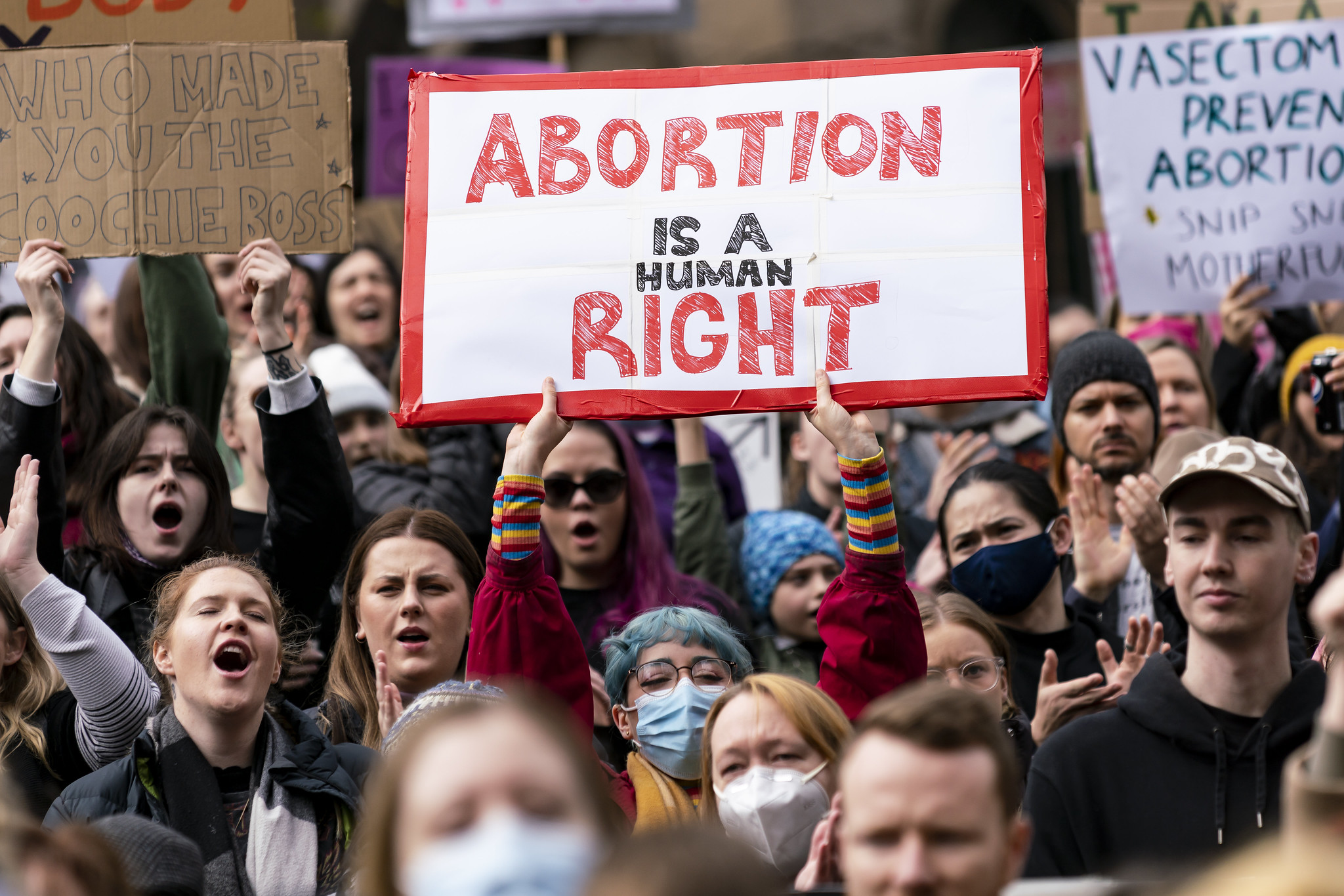
A federal judge has suggested that abortion rights may still be protected by the U.S. Constitution, in spite of the Supreme Court ruling last year that upended decades of precedent protecting the right to abortion.
The Court’s Dobbs v. Jackson Women’s Health Organization ruling last June overturned its 1973 Roe v. Wade ruling, which recognized the right to have an abortion in every state in the U.S., namely through provisions in the 14th Amendment of the constitution. In the Dobbs case, the conservative bloc majority of justices ruled that abortion rights weren’t actually covered under that amendment.
In an order issued on Monday, however, U.S. District Court Judge Colleen Kollar-Kotelly suggested that a different amendment could still require the Court to recognize abortion as a fundamental right.
Kollar-Kotelly, who serves on the U.S. District Court for the District of Columbia, is reviewing a case brought by anti-abortion activist Lauren Handy, who was sentenced last year for illegally trespassing at an abortion clinic and obstructing patients from accessing abortion services in late 2021. Handy is appealing that ruling, claiming it is now irrelevant due to the Supreme Court’s ruling that abortion isn’t protected by the 14th Amendment.
Though Handy has argued that the Court’s ruling states that the constitution, in its entirety, doesn’t recognize abortion as a federal right, Kollar-Kotelly’s order seems to reject that notion. While abortion is not a federally recognized right at the moment, it could be again, she wrote, noting that other provisions of the constitution could be interpreted as protecting the right.
“Of those provisions that might contain some right to access to such services, the Thirteenth Amendment has received substantial attention among scholars and, briefly, in one federal Court of Appeals decision,” Kollar-Kotelly wrote.
That amendment deals primarily with ending the practice of slavery, but also forbids “involuntary servitude.”
The full text of the amendment reads:
Neither slavery nor involuntary servitude, except as a punishment for crime whereof the party shall have been duly convicted, shall exist within the United States, or any place subject to their jurisdiction.
Koller-Kotelly’s order cites a scholarly article written by Northwestern University Law School professor Andrew Koppelman in 1990, which states that, “when women are compelled to carry and bear children, they are subjected to ‘involuntary servitude’ in violation” of the 13th Amendment.
At least one other appellate court has provided a precedent for using the 13th Amendment to block abortion restrictions. In 1995, the 10th Circuit Court of Appeals ruled against a judge that had fined an individual for getting an abortion, citing the 13th Amendment.
Kollar-Kotelly admitted in her order that Dobbs contains language stating that “the Constitution does not confer a right to abortion.” But she noted that the statement could have been “heuristic,” adding that the Court didn’t delve into abortion as it pertained to the constitution beyond the 14th Amendment.
“The ‘issue’ before the Court in Dobbs was not whether any provision of the Constitution provided a right to abortion,” the district judge wrote. “Rather, the question before the Court in Dobbs was whether the Fourteenth Amendment to the Constitution provided such a right. That is why neither the majority nor the dissent in Dobbs analyzed anything but the Fourteenth Amendment.”
Kollar-Kotelly ordered both Handy and prosecutors to submit legal briefs by mid-March detailing whether they believed the Supreme Court had indeed ruled that the constitution in its entirety couldn’t be interpreted to recognize abortion rights — and if they believed the Court had not ruled as such, to indicate which provisions, if any, could recognize such rights.
Kollar-Kotelly’s order comes just two weeks after the 50th anniversary of the Roe decision. Polling conducted by NPR and Ipsos from late January shows that the vast majority of Americans still disagree with the Supreme Court’s decision to upend that precedent.
According to the polling data, 60 percent of Americans believe Roe was correct while just two in five Americans say they back Dobbs. Sixty-two percent of respondents said the Dobbs decision was rooted in justices’ conservative politics, rather than a just interpretation of laws.
ZNetwork is funded solely through the generosity of its readers.
Donate

