
This is part I of a three-part series. [Part II] [Part III].
Why does representative democracy seem so broken that it is tempting to translate “Vox populi, vox dei,” (“Voice of the people, voice of god”) as “My god, how did we get into this mess?” One answer: most nominally democratic governments defy the will of their electorate.
In France, for instance, even after the exit of two prime ministers, and the President’s unpopularity ranging from 11% to the low twenties, the 2% wealth tax favored by around by 86% of the French electorate failed to pass, and the unpopular tax loophole that sets an extraordinarily low rate for investment income remains in place. In the United States, Trump joined Israel in starting a war against Iran that 56% of the US public opposes. In the UK Starmer proposed welfare cuts that included deeply unpopular reductions in disability payments. His “climbdown” preserved a still unpopular weakened version which 75% of voters in the UK oppose even though they now apply only to new recipients. Less than a third of Italy’s population has a favorable opinion of Meloni’s policies on employment, public security, environment, taxation and tax evasion, immigration, education, poverty and healthcare. In democratic nations worldwide slightly below two thirds of the population surveyed are dissatisfied with their democracy. 62% think their nation is on the wrong track.
Yes, there is much more to our crisis than the structure of government: global class structure, the current degree of economic inequality, gender, racial and ethnic oppression – and all the other oppressions that flow from them – including disability, and LGBTQA+. But that does not make institutional structure trivial. Institutions are the means by which oppression is carried out day to day. There is a limit to what direct violent coercion can achieve, and even that requires institutional structure. If the structure of government was not important, the right wing would not spend so much effort undermining it and reshaping it worldwide.
Many advocate expanding democracy as part of fixing this broken world. But can they win public support for such expansion when democracy remains nearly absent within government institutions that were already supposed to be democratic? Democracy advocates must explain this failure; cures depend on correct diagnosis.
Broken Promises
Put not your trust in princes. (Psalms 146:3)
One key: Politicians routinely break campaign promises. It is such a commonplace that only the stalest comedians bother to joke about it. In international surveys less than 37% of the those surveyed believed politicians keep their promises. In only two nations did 40% or more believe candidates’ pledges, and in none did as many as half the inhabitants trust campaign pledges.
Pushback against this knowledge takes the form of studies showing that politicians fulfill commitments, on average, 60% to 70% of the time. It takes a fair amount of chutzpah to paint that of level dishonesty as integrity. Would anyone consider a spouse or lover who broke one third of their promises a paragon of honesty?
But wait, there’s more! Additional studies compared voter ratings of issue priorities to broken promises. It turns out that politicians mostly break campaign pledges of highest importance to voters. Returning to the previous metaphor, the hypothetical spouse or lover will cheat on you and steal your money, while remembering birthdays and anniversaries, and seldom neglecting to take out the garbage.
In most democracies, voters are so used to broken promises that reforms aimed at curbing them may seem to come from another planet. But lack of accountability by politicians for their pledges, plays a large – even if secondary – role in our current worldwide descent into right-wing authoritarianism and fascism in a variety of ways. The equation of politicians and rulers with lying goes back to biblical times. If the knowledge that what politicians say is meaningless is part of unquestioned common sense, baked into the culture, then voting on the basis of vibes and appearances is a reasonable heuristic, a default that does not even require conscious choice. If all politicians lie, then why think about their promises? Why not treat politics under democracy similarly to politics under monarchy, aristocracy or dictatorship – weather that must be adapted to, but can’t be changed? That lack of attention favors demagogues. And when people try to pay attention to policy, broken promises disillusion voters with politics; they revert the attitude that is so deeply ingrained within most cultures. That disillusionment often leads to support for authoritarianism or to apathy and low voter turnout. Besides, if adaptation of a popular policy is thwarted long enough, people may decide it failed, even though it was never tried. “The grapes were sour.” Note that broken promises poison all sorts of democracies, duopolies like the United States, and multi-party democracies like Italy.
A few jurisdictions have instituted recall procedures, in an attempt to add accountability. Gather enough signatures on a recall petition and the government is required to hold a special election to determine whether the target is recalled or continues to serve in office. (In some cases, a judicial or administrative body must rule on stringent criteria before a recall can take place.) This process makes it too easy for groups with money and power to time signature gathering so that the recall election takes place when voter turnout will be at its lowest. That timing often allows the target to be recalled with fewer votes than originally elected them. However, the same process that is too easy for the rich and powerful is too burdensome for grass-roots movements. For organizations that are not wealthy, a successful recall effort drains resources and energy. Volunteer groups have occasionally won recall votes, but no grassroots organization or even coalition of grassroots organizations could afford to run frequent recalls. Thus, even including recalls, representative democracy includes no practical means to routinely hold representatives accountable between elections.
Lesser Evil Voting
Representative democracies also suffer the need for lesser evil voting. Lesser evil voting takes place either when nobody running represents a segment of voters on some issues important to them, or when every party whom they support on one issue takes a position they oppose on another. The latter can happen even in proportional representation systems, where parties win seats in rough proportion to the percentage of votes they receive. Unfortunately, most such systems have minimum percentages of votes a party must receive to win seats —thresholds. If the only party who holds a certain combination of views won’t make that threshold, a vote for them is a wasted vote, and may result in a voter’s most despised choice winning.
This problem is much worse in nations like that US where proportional representation is not used. Two candidates on the same side of the political spectrum, but far apart on where they stand within that sector may jointly win a majority of votes. But if voters are split between the two of them, then someone on the opposite side of the spectrum may get more votes than either of them do individually, and win the seat.
Think of a three-way race between the Kitten Party, the Cub Party and the Puppy Party, where the Kittens and the Cubs have much in common, but also serious differences. If, in one district electing one member, the Kittens win 39% of the vote, the Cubs 21%, and the Puppies 40%, the Puppies win the seat, even though the Cubs and Kittens combined won 60% of the electorate.
Gerrymandering and Rotten Boroughs
Beyond the lack of accountability and necessity of lesser evil voting that plague all existing representative democracies, two problems damage a significant minority of nations – gerrymandering and rotten boroughs.
Older electoral systems, like those the USA, France, Canada and the UK elect one member per district without considering votes cast in other districts. This can, and often does result in a minority of voters electing the majority of legislators.
To clarify: imagine a fantasy village with thirty people supporting the cute Kitty party and twenty voting the straight fluffy Puppy ticket; that’s fifty voters total, in five districts of ten people each. A fair election would result in three Kitty seats and two Puppy seats. Ah, but what if the Puppy Party drew the voting map?
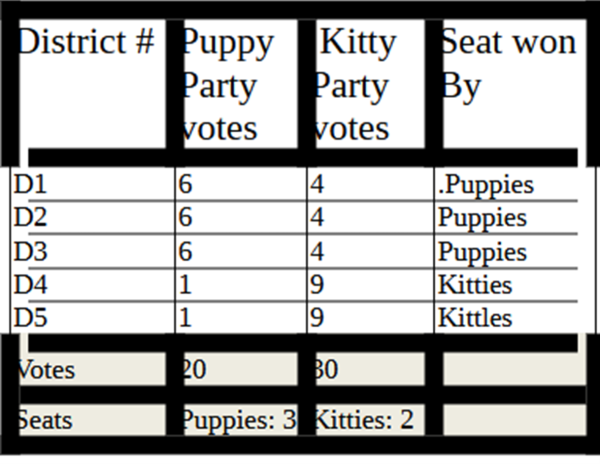
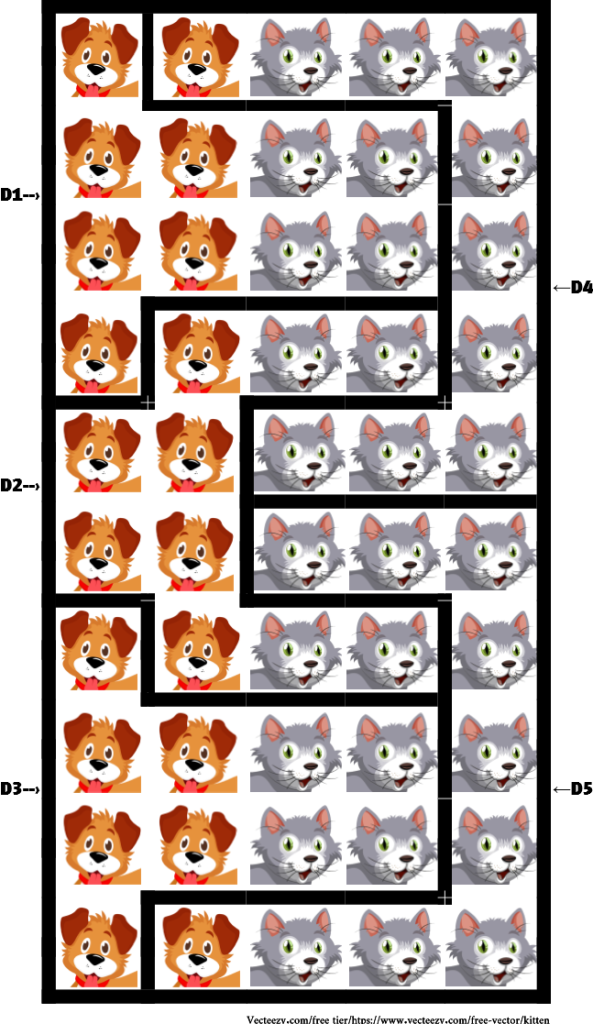
The more districts and voters, and the smaller the vote difference between parties, the easier gerrymandering is.
Real life examples: In 2012 Republicans won less than half of the popular vote, (and far fewer votes than the Democrats) for the House of Representatives of the USA, but won well over half the seats. Democrats and third parties won well over half the votes, but won significantly less than half the seats. (Third parties won around 4.5% of the popular vote and no seats.) In 2018 Wisconsin Republicans received 46 % of the vote for Assembly, but won nearly 64% of the seats. Note that, depending upon the form, PR either minimizes or eliminates gerrymandering.
A minority of democracies still include “Rotten Boroughs” which allow geographic areas with grossly unequal population sizes to elect the same number of legislators. For example, in the US, California has 67 times the population of Wyoming, but both elect two Senators to the upper house. Similarly, New South Wales in Australia has fifteen time the population of Tasmania, but both elect five Senators to Australia’s Senate. Brazil, Argentina, Mexico, Nigeria, and Switzerland use similar systems for their upper chambers.
Conclusion
Representative democracy throughout the world fails to represent the majority of voters. Legislatures fail to enact key policies the majority supports. Often, they fail to enact policies the majority believed they were voting for, because politicians routinely break promises. Voters frequently face dilemmas where they either vote for a lesser evil, or waste their vote on someone they support and see the candidate they most oppose take office. The problem is worse in older democracies that don’t use proportional representation to elect legislatures, but remains severe everywhere.
Part II in this series [“Control Failure”] will discuss alternatives to representative democracy, both those that have been tried, and common untested proposals – mostly but not exclusively participatory democracy. Part III, [“The Returnable Vote”], will discuss Delegatory Democracy, a form of representative democracy without the flaws discussed in parts I and II, which meets many of goals participatory democracy advocates seek.
Receipts:
| French President’s unpopularity from 11% Carl Meeus, 2025-Oct-30. “Sondage : Emmanuel Macron atteint son plus bas historique.” Le Figaro Magazine. |
| French President’s popularity increased to 23%Institut français D’opinion Publique, 2026-Jan-28.“Popularity ratings – Ifop Opinion Barometer – January 2026.” |
| 2% wealth tax favored by ~86% of French electorate Institut français d’opinion publique. 2025-Sep-19. “French support for various left-wing measures.” |
| 2% wealth tax failed to pass.Lee Thomas and Dominique Vidalon. 2025-Oct-31. “French lawmakers reject wealth tax on ultra-rich.” Reuters. |
| 56% of US public opposed Iran warMarist, 2026-Mar-06. “Majority of Americans Disapprove of U.S. Military Action in Iran.” |
| 75% of UK voters oppose PIP cuts, even in weakened formAmnesty International UK. 2025-Jun-30. “UK: Public sends clear message that ‘PIP cuts are cruel’ and unjust – new poll .” |
| Less than a third of Italy has a favorable opinion of most of Meloni’s policies.S. Galen. 2025-Nov-28. “Share of Italians who have a favorable opinion of Giorgia Meloni’s government in 2025, by policy area”. Statistica. |
| Worldwide slightly under two thirds of the population are dissatisfied with their democracyRichard Wike, Janell Fetterolf and Jonathan Schulman. 2026-Jun-30. “Dissatisfaction with democracy remains widespread in many nations.” Pew Research Center. |
| 62% think their nation is on the wrong track and the economy is bad.Teodros Gebrekal. 2025-Feb. “What Worries the World? February 2025”. Ipsos. |
| Global class inequalityGöran Therborn. 2011-Nov-11. “Global Inequality: The Return of Class.” Global Dialogue. |
| Class StructureInequality.org. 2026. “Facts: Global Inequality: Our world’s deepest pockets — ‘ultra-high net worth individuals — hold an astoundingly disproportionate share of global wealth.” Institute for Policy Studies. |
| Current Inequality “Richard Wike, Moria Fagan, Christine Huang, Laura Clancy and Jordan Lippert. 2025-Jan-09a. “Global perceptions of inequality and discrimination.” Pew Research Center. |
| Economic inequalityOECD. 2024-Jun-20. “Income and Wealth Inequalities” In “Society at a Glance 2024:OECD Social Indicators.” . |
| Gender (If progress continues at current rate, world will achieve gender equality in 123 years.)Kim Piaget and Yanjun Guo. 2025-May-05. “Progress despite uncertainty: Key findings from the Global Gender Gap Report 2025.” World Economic Forum. |
| Racial and ethnic discrimination“Richard Wike, Moria Fagan, Christine Huang, Laura Clancy and Jordan Lippert. 2025-Sep-01a. “Global perceptions of inequality and discrimination.” Pew Research Center. |
| DisabilityUnited Nations. 2024. “Disability and development report 2024: accelerating the realization of the Sustainable Development Goals by, for and with persons with disabilities.” pp 36-54 . |
| LGBTQ+European Union Agency for Fundamental Rights. 2024. LGBTIQ Equality at a Crossroads: Progress and Challenges. p20 |
| Internationally less than 37% of the world’s population believes politicians keep campaign pledgesInsa Bechert, Insa and Markus Quandt. 2010. “ISSP Data Report Attitudes towards the Role of Government.” International Social Survey Programme. P111, Figure 6.6. |
| Politicians fulfill pledges, on average, 60% to 70% of the time.R Thomson. R. T. Royed, E. Naurin, J. Artes, R. Costello, L. Ennser-Jedenastik, M. Ferguson, P. Kostadinova, C. Moury, and F. Petry. 2017-Jun-06. “The Fulfillment of Parties’ Election Pledges: A Comparative Study on the Impact of Power Sharing.” American Journal of Political Science (61:3: pp527–542), https://doi.org/10.1111/ajps.12313 |
| Politicians break promises of highest importance to votersJonathan Mellon, Christopher Prosser and Adam Feldman. 2021-Jul-15. “Which Promises Actually Matter? Election Pledge Centrality and Promissory Representation.” Public Studies(71:03) This mainly focuses on the 2017 UK election, but also surveys other three studies and finds similar results across 18 other elections.Another, later study found confirmation in results for a Canadian election. Yannick Dufresne, Alexandre Fortier-Chouinard, Camille Tremblay-Antoine and Adrien Cloutier. 2023-Sep-05. “Weighting Pledge Fulfilment: A Measure Based on Pledge Salience.” Presented at European Consortium For Political Research General Conference Charles University 4-8 September 2023. Prague. |
| Kitten and Dog cartoon sourceMG Designs on Vecteezy.com – free tier. htps://www.vecteezy.com/free-vector/kitten https://www.vecteezy.com/vector-art/4641950-little-cat-and-dog-isolated-on-white-background-cute-puppy-and-kitten |
| In 2012, Republicans won less than half the vote for the US House of RepresenativesHaas, Karen L. Feb-28-2013. “Statistics of the Presidential and Congressional election of November 6, 2012. COMPILED FROM OFFICIAL SOURCES BY KAREN L. HAAS CLERK OF THE HOUSE OF REPRESENTATIVES.” House of Representatives p.73.Republicans won well over half the seats: Ibid, P.74 |
| In 2018 Wisconsin Republicans received 46% of the vote for the Wisconsin Assembly but won nearly 64% of the seats.Kevin Drum. 2018-Dec. “Chart of the Day: Wisconsin Gerrymandering Was Awesome.” Mother Jones. |
| Lipow, Gar. 2024-Winter. “Participatory Democracy Minus Endless Meetings.” New Politics( XIX:4 whole number 76) |
Portions of this article were previously published by the author in New Politics, and are reused
with permission.
ZNetwork is funded solely through the generosity of its readers.
Donate
1 Comment
Portions of this article were previously published by the author in New Politics (https://newpol.org/issue_post/participatory-democracy-minus-endless-meetings/), and are reused with permission.