
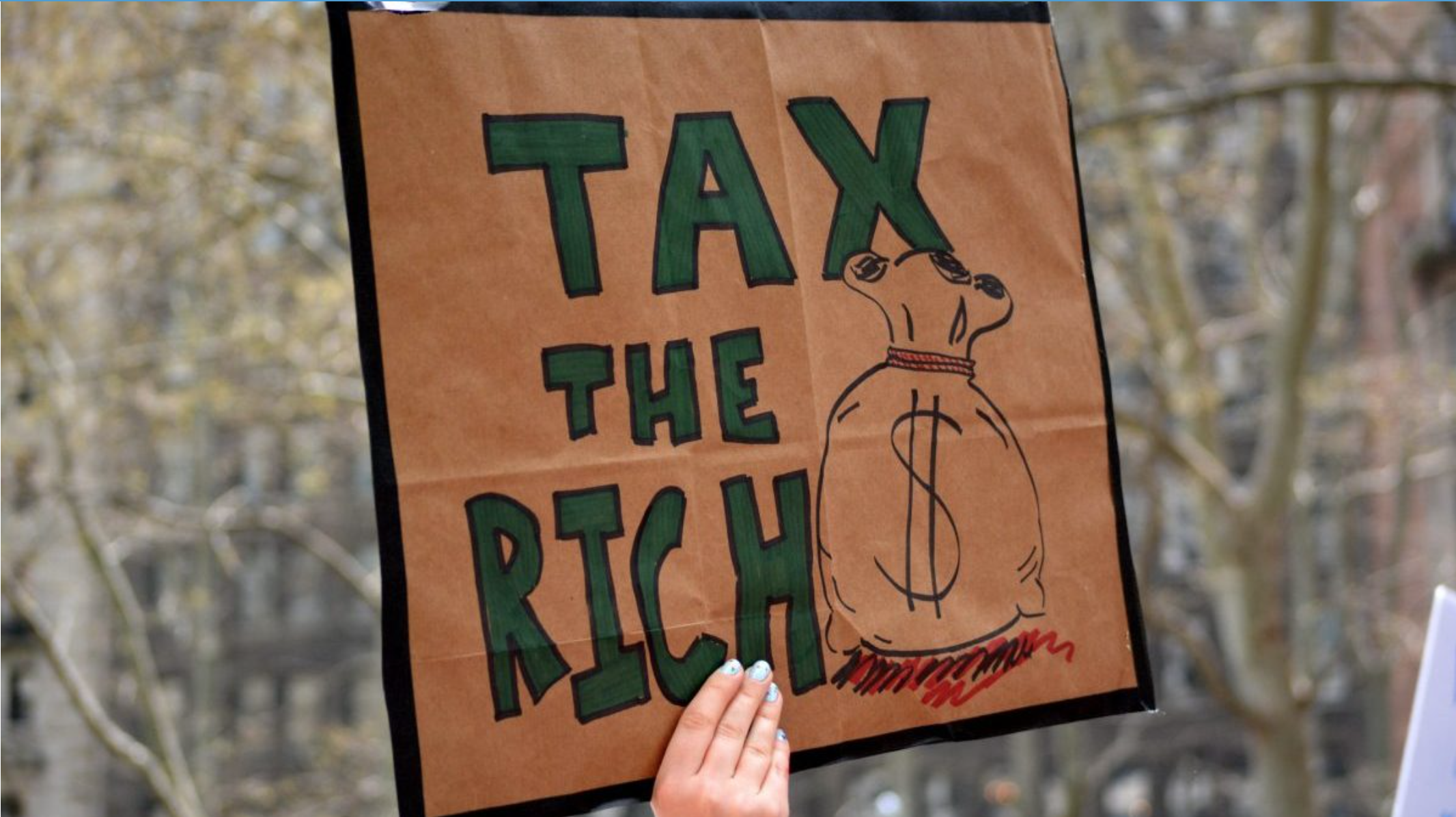
A good rule of thumb: centrist and center-left acceptance of reactionary framing produces terrible policy, especially on taxes. Recent example include Senator Richard Blumenthal and Mark Kelly’s Gas Prices Relief Act, Congress member Don Beyer and Senator Chris Van Hollen’s revenue neutral Working Americans’ Tax Cut, and Senator Corey Booker’s Keep Your Pay Act. They all aim at cutting taxes working class Americans pay, buying the right-wing pitch that taxes are the most evil thing on earth, well maybe other than trans people, and non-Afrikaner immigrants (including, apparently, nuns who work as registered nurses).
The smart play would aim, not at reducing taxes, but at using tax money to buy nice things for Americans like health care, and daycare, rather than wars, concentration camps, and coal plants. We need to bury the idea that taxes are evil and poisonous rather than a way for all of us together to get nicer things than we could buy on our own – bury it at a crossroads with a stake through its heart.
Even leftists and socialists may object: “but these tax cuts are progressive! They help the poor and the working and middle classes!” The idea that tax cuts can help workers more than using the money to provide public goods is what should be turned to dust by exposing it to sunlight.
“But its extra progressive to fund public goods with taxes on the rich, and cuts to the military, to ICE, and to brutal policing.” Well great. We should do that as much as we can! But past a certain point we can’t fund everything by taxing (or even expropriating) the rich – due to simple arithmetic.
One commonality of left politics, from social democrats, to full socialists is that everyone should have nice things – like first rate health care and a good education – not just a tiny elite minority. While what the rich gobble could pay for one or two new major nice things, that income could not pay for all the public goods a civilized government would provide.
US 2025 gross national income(GNI) was about 30.57 trillion dollars. The top 1% of income earners grabbed around 20.7% of this, about 6.33 trillion dollars.
A minimal social democracy would keep existing Social Security, veterans benefits and Indian Health, add Medicare for All, universal daycare, full free public college and university (including tuition, student fees, books & materials, dorm fees, and meal vouchers), along with at least existing k-12 funding. As part of ending poverty, it would guarantee jobs for anyone who wants one at(minimally) $20 per hour.
An extremely stingy guaranteed minimum income proposal made by economists at the New Politics institute would guarantee every adult, regardless of work status, $12,500 per year. Note that this is a top-up, not a UBI. That means it only provides what is needed over and above other sources to reach that number. (It also provides a small per child top-up, and phases out gradually.) These examples are far from a complete list.
Thus, a minimal and rather stingy social democracy, not even aiming at socialism and not including standard non-social-democratic government functions (which would still need to be paid for) would cost over 8.5 trillion, probably a great deal more.
| Budget Item | Trillions |
| Medicare for All | 3.40 |
| Existing VA (Health and other benefits) & Indian Health | 0.45 |
| Existing Social Security 2024 | 2.48 |
| Guaranteed Minimum Income (New School Proposal) | .88 |
| Job Guarantee $20/hour | 0.94 |
| Existing K-12 Public Education Spending | 0.98 |
| Free Full Ride Public College (Includes existing local, state, and federal Spending.) | 0.27 |
| Universal Childcare | 0.06 |
| Total Trillions | 8.58 |
Remember, the 6.33 trillion dollar figure is full expropriation. Taxation would generate less.
What about wealth and financial transaction taxes, rather than only income? The vast majority of wealth is in the form of direct and indirect ownership of the means of production. We won’t want to either tax or expropriate that money and then liquidate those assets for consumption. We want to go on producing things.
Yes, to anticipate the next objection, much of that production is waste – unneeded military and police equipment, positional goods, plus pure bubbles and various grifts. But we have plenty we need to do with any revenue from taxation or expropriation of wealth. We need about five million new housing units. We need massive rehabilitation of deteriorating units, and energy efficiency retrofits in existing buildings. We need to upgrade ventilation in existing buildings, and add UV in the human-safe spectrum to minimize the effects of current and future pandemics and epidemics. We need a massive buildout of carbon free electricity, of automated ultralight rail for cross-city and city-suburb transportation, of highspeed rail to displace some air traffic, and a massive upgrade of freight rail to displace trucking. We need massive improvements to water and water efficiency infrastructure. We need massive increases in city walkability and urban green spaces at the same time we upgrade urban density. Like the partial list of social democratic spending earlier, this is far from comprehensive.
So, even taxing (or expropriating) wealth as well as income, we are going to need some taxes that are not progressive. That does not mean there is not huge potential for taxing the rich. (And I am fine with expropriating them instead.) It is just that we can’t expect to somehow get everything for most of us for free, paid for only by the rich. Collective consumption does not mean “free.” It just means there is stuff we are better off paying for together than separately, public goods.
There are a bunch of reasons public goods are public. If you bought your own street lamp, then why would your neighbor put in one? (This is called the free rider problem.) Or think of the electric power grid. We only need one in any given geography. If there were two multi billion dollar electric grids running next to each other, that would be one hell of a waste of resources. But if there can be only one, there is no advantage to it being private, as there is no competition. (That is a “natural monopoly”. In the US, we mostly have private electric utilities; then we depend on regulation to keep them from taking advantage of their monopoly, which results in those private utility monopolies screwing us royally. You can also have natural oligopolies, where there is room for two or three players who then squeeze out anyone new who tries to enter – again no competition.) Or think of private health insurance vs. Medicare for all. With private insurance, transaction and administrations costs are overwhelming; everything is more expensive because dividing the market into tiny segments means we buy healthcare retail instead of wholesale. And no health care consumer knows as much about the healthcare system as doctors or insurers, so even if there is room for consumer to provider negotiation (there isn’t) consumers don’t have the information they need to negotiate. (The last is called information asymmetry.)
Absolutely we should raise the top marginal income tax rate to 70% or higher, tax capital gains at the same rate as ordinary income, institute the unitary tax so the rich could not avoid taxes by moving money around, close other loopholes, institute a wealth tax, and a financial transactions tax. (Or seize the means of production if you can get the support to do it.) But again, we cannot, in long run take more from the rich than they have. And wealth (as opposed to income), when taxed or expropriated should (as previously mentioned) be invested not liquidated.
That the rich can’t pay for everything we need is not an argument against having nice things. Because the rich are not paying for them now. We currently have a horrible broken medical system. And almost all of it is paid for by the working and middle classes through employer premiums, individual premiums, individual cost sharing of various kinds (deductibles, fixed copays, percentage copays), individual self-pay, and regressive state taxes. Only a tiny fraction of all medical costs are paid for out of general federal revenues. Social security is paid for regressively out of capped social security taxes. Public education is financed mostly by regressive state and local taxes, combined with student paid tuition and fees for higher education. Automobiles and trucks, the biggest item in transportation are paid for privately; the roads are paid for almost entirely regressively by gas, property, and sales taxes. (Businesses, which buy for these things too, pass costs on to consumers.) Insurance, vehicle fees, license fees, inspection fees are also paid for by individuals and businesses. Mass transit that is partially paid for by the rich in income and wealth taxes and partially paid for by regressive taxes would be a lot more progressive than automobiles whose funding is 100% regressive.
In short, we damn well should be able to get nice things paid for publicly when they are public goods, without worrying about whether the rich can pay 100% of the cost or not. Heck, if we have socialism, depending upon the form, either the rich will be a lot less rich than now, or there won’t be a wealthy class; everybody will be prosperous working class or whatever you want to call it.
The questions to answer on whether something should be provided publicly are: 1) is it a public good, or should it be paid for privately by those who want it? 2) is it worth the cost? 3) given that there is no such thing as an unlimited budget, is it high enough priority to do now?
It is a commonplace that social democracies pay for many of their social programs via regressive taxes like the Value Added Tax, and did so even when the rich paid high tax rates. But I seldom hear mentioned that even the old time state capitalist dictatorships (Like Mao’s China and Lenin and Stalin’s Soviet Union) did the same – via agricultural taxes, land taxes, excise taxes and (eventually) turnover taxes.
Next time you hear a proposal for a “progressive” tax cut, please try pushing back by advocating for more spending on public goods instead.
Receipts
Note that overall figures are low, but may seem high. They are low because often estimates are from older programs, and inflation adjustments don’t capture full cost increases, and demographic adjustments are simply not included. They may seem high though, because I don’t hesitate to include existing public costs. Whether a cost is incrementally new, or existing, it still has to be paid for.
Also please note that I’m not including many standard non-social-democratic features of government which still have to be paid for.
The “Gas Prices Relief Act” was a straight tax cut, without even a tax on the rich to make up for it.
“Blumenthal & Kelly Introduce Bill to Immediately Lower Gas Prices at the Pump” (2026-03-13). Blumenthal Senate Site. https://www.blumenthal.senate.gov/newsroom/press/release/blumenthal-and-kelly-introduce-bill-to-immediately-lower-gas-prices-at-the-pump
“The Working American’s Tax Cut” would have taxed millionaires to make the cut revenue neutral, but would was not intended to produce a net increase in tax collections, though it might have done so to a trivial extent.
S.4083 – 119th Congress (2025-2026): Working Americans’ Tax Cut Act. (2026, March 12). https://www.congress.gov/bill/119th-congress/senate-bill/4083
The “Keep Your Pay Act” was intended to be revenue neutral, paid for by taxes on the rich, though some models suggest it would be revenue negative. At any rate, like the two other tax cuts described, it does not significantly increase total taxes collected.
“Booker Announces Keep Your Pay Act” (2026,03,09). https://www.booker.senate.gov/news/press/booker-announces-keep-your-pay-act
“ICE releases Texas nun intercepted walking to church dressed in her habit” (2026-06-30). The Guardian. https://www.theguardian.com/us-news/2026/jun/30/ice-nun-detained-released-texas
US 2025 gross national income(GNI) in 2025 was 30.567 trillion dollars.
Federal Reserve Bank Of Saint Louis.
FRED – Gross National Income (A023RC1Q027SBEA) Adjust frequency to annual.
https://fred.stlouisfed.org/series/A023RC1Q027SBEA
The top 1% of income earners earned around 20.7% of this, which was around 6.33 trillion dollars.
Our World in Data – Share of the Richest 1% (Before Tax) 2024
https://ourworldindata.org/grapher/income-share-top-1-before-tax-wid
Medicare For All – 3.39 trillion dollars
First estimates back in 2018 suggested the annual cost would be around 2.93 trillion per year in 2019, a cost saving compared to expenditures at the time.
Pollin, Robert & Heinztz, James & Arno, Peter & Wicks-Lim, Jeanette & Michael Ash(2018-11). “Economic Analysis of Medicare for All.” Political Economy Research Center University of Massachusetts Amherst. https://peri.umass.edu/wp-content/uploads/2025/01/Medicare-For-All-12-5-18.pdf
Medical Inflation from 2019 to 2026 was 16.1%.
U.S. Bureau of Labor Statistics Databases, Tables & Calculators by Subject -Medical care in U.S. city average, all urban consumers, not seasonally adjusted. Accessed 2026-06-27. https://data.bls.gov/timeseries/CUUR0000SAM
Thus, multiplying 2.93 trillion by 1.16 gives 3.39 trillion
Veterans Administration Funding for 2026 Estimated at 445.49 million
Ahmed, Zarrin & Levine, Joanne (2026-06-05). “VA Budget Hits Record High Despite White House Setback.” Legis1. https://legis1.com/news/va-budget-fy2026-hits-record-high-despite-white
8.05 billion for Indian Health
“Congress Passes Minibus, Funding the Indian Health Service”(2025-01-26). National Indian Health Board. https://www.nihb.org/congress-passes-minibus-funding-the-indian-health-service/
Existing Social Security
1.6 trillion in 2025
“Social Security Administration Agency Financial Report Fiscal Year 2025.” Social Security Administration p9.
https://www.ssa.gov/finance/2025/Full%20FY%202025%20AFR.pdf#page=12
A guaranteed income proposal in the form of a negative income tax, had an estimated cost of 876 billion per year in 2021. It offered 12,500 per adult, and a smaller amount per child. I suspect these days, there might be support for a more generous guaranteed income proposal.
Zewde, Namomi & Strickland, Kyke & Capatosto, Kelly &
Glogower, Ari & Darrick Hamilton, Darrick (2021-05.) “A Guaranteed Income for the 21st Century.” The New School Institute on Race and Political Economy.” https://drive.google.com/file/d/1UDFPwUYu2Rf4RGgXuOTacmBj2Gt9paAV/view
A job guarantee would cost at least 940 billion per year
One proposal for for guaranteed jobs at 11 dollars per hour was estimated tocost around 543 billion in 2018. Adjusting for a wage of $20 per hour, that would result in 943 billion, without considering demographic differences between 2018 and today.
Paul, Mark & Darity, William & Darrick Hamilton (2018, 03, 09). “The Federal Job Guarantee – A Policy to Achieve Permanent Full Employment” Center on Budget and Policy Priorities’ Full Employment Project.
K-12 public spending on education was 981.57 billion in 2024.
Hanson, Melanie. “U.S. Public Education Spending Statistics”(2025-02-17). EducationData.org.
https://educationdata.org/public-education-spending-statistics
Full higher education (at public colleges and universities only) – tuition, student fees, books, materials, supplies, dorm fees, and meals is would cost around 272 billion. Note that much of this, perhaps more than two thirds, is existing public spending. The incremental cost is far lower.
Costs excluding books, materials and supplies 245.58 billion
Instruction 130.1 billion
Academic Suppor1 41.5 billion
Student Services: 28.25 billion
Institutional Support: 45.83 billion
Academic year 2023-2024 only
(Note that I am not including research, which is an important function universities. And I’m not including services and outreach to the broader community, which is also an important university function. I’m looking at the costs of instruction, student costs for learning (including indirect costs like university libraries), and costs of keeping students alive. Pretty much, this source includes all of these except books and materials.)
“Digest of Education Statistics Tables and Figures – Table 334.10 – Total expenditures of public degree-granting postsecondary institutions, by purpose and level of institution: Academic years 2009-10 through 2023-24.” National Center for Education Statistics.
https://nces.ed.gov/programs/digest/d25/tables/dt25_334.10.asp
Students report spending about 341 on average per year on books and supplies
“NACS Student Watch Report: Course Materials Spending Stable, High Satisfaction with Access Programs” (2025, 08, 20). National Association of College Students.
https://www.nacs.org/student-watch-report-course-materials-spending-stable
Number of students enrolled in public colleges and universities full time equivalent. 10.8 million
State Higher Education Finance (SHEF) Report – Enrollment and State Funding.
10.8 million enrolled x $341 costs and materials per student = 3.68 billion
Thus total is 249.26 billion
So a more generous public college program than the Sanders proposal, a true full ride would cost at least 249.26 billion, if we just paid for existing students. (Again, that includes existing public spending. The incremental difference is much smaller, probably far less than 100 billion per year.)
One of the most conservative estimate I have found is that a true free college proposal would increase enrollment in public higher education institutions by 9%-14% Probably a bit more because some part time students would become full time students if they got a full free ride.
Thus a 9% increase equals about 272 billion dollars.
Carnevale, Anthony P. & Sablan, Jenna R. & Gulish, Artem & Quinn, Michael C. & Gayle Cinquegrani(2020). “The Dollars and Sense of Free College.” Working paper at The Georgetown University Center on Education and the
Workforce McCourt School of Public Policy:p19. https://files.eric.ed.gov/fulltext/ED608985.pdf#page=23
Please note that an overall 9% increase in enrollment is very conservative. At least one peer reviewed article estimates an 85% increase in enrollment under a true free ride policy.
Maria Marta Ferreyra, Carlos Garriga, Juan David Martin-Ocampo, Angelica Maria Sanchez-Diaz(2024,09) “The limited impact of free college policies.” European Economic Review(168. 104800). https://www.sciencedirect.com/science/article/abs/pii/S0014292124001296
Universal Childcare – 6 billion
New Mexico’s universal childcare program currently cost 424 million per year. New Mexico is about about.64% of the US population. Extrapolating that to the entire US, New Mexico levels of child care would cost 42 billion per year. New Mexico, though, is a poor state with a low cost of living. At least 30% of children in the US live in high cost areas, so multiplying that by 1.3 gives a figure of 54.6 billon.
Andrew Perry(2025-10-29). “How New Mexico Will Pay for Universal Childcare.” Fiscal Policy Institute. https://fiscalpolicy.org/how-new-mexico-will-pay-for-–universal-childcare
High administrative and transaction costs in US health care
Himmelstein, David U. & Campbell, Terry & Woolhandler, Steffie(2020-01-07). Annals of Internal Medicine.
We pay more for pharmaceuticals than other rich nations.
Armstrong, David(2025-05-09). “Why Do Americans Pay More for Prescription Drugs?.” ProPublica. https://www.propublica.org/article/why-americans-pay-more-for-prescription-drugs
We pay more more medical equipment and devices.
Sanborn, Beth Jones(2018-10-05). “U.S. hospitals pay as much as 6 times more for medical devices than European counterparts, study shows.” Healthcare Finance. https://www.healthcarefinancenews.com/news/us-hospitals-pay-much-6-times-more-medical-devices-european-counterparts-study-shows
Higher physician costs than other rich nations
Laugesen, Miriam J & Glied, Sherry A. (2011,11). “Higher Fees Paid To US Physicians Drive Higher Spending For Physician Services Compared To Other Countries.” Health Affairs(30,9,pp 1647-1656). https://academiccommons.columbia.edu/doi/10.7916/D82V2T0Z/download
A second source that shows higher physician costs, especially, but not only for specialists.
Papanicolas, Irene & Woskie , Liana R. & Jha, Ashish K. (2018-03-13).“Health care spending in the United States and other high-income countries.” JAMA Clinical Review and Education (319,10,pp 1024-1039).
https://researchonline.lse.ac.uk/id/eprint/87362/2/jama_Papanicolas_2018_sc_180001_3_.pdf#page=5
ZNetwork is funded solely through the generosity of its readers.
Donate