
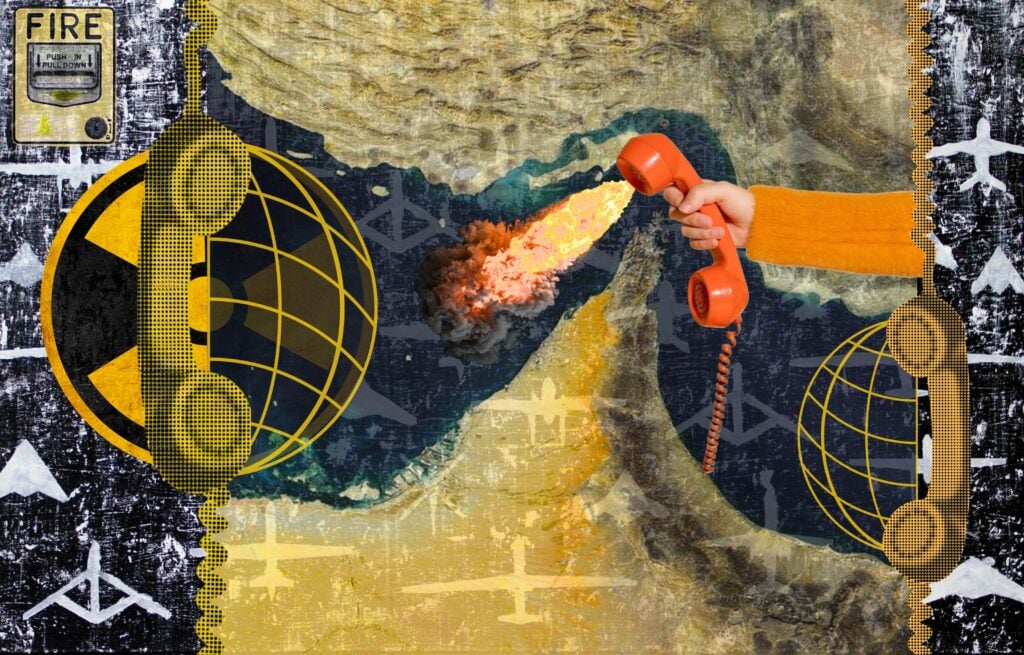
Deferring a Crisis: The Iran-US Ceasefire Cracks
Ceasefires in the Middle East seem especially susceptible to revision, alteration and contradiction. Missiles still get fired; airstrikes initiated. Destruction to infrastructure, and death, follows. Yet despite the misunderstandings, the sniping and the harrying, these odd understandings are often described by those funny political coves as “holding”. In the case of the ceasefire between Tehran and Washington, articulated with some fanfare with a Memorandum of Understanding, only the most piously delusional would claim it was holding in any way.
The June 18 MoU stipulates from the outset that the US, Iran and their allies “declare the immediate and permanent termination of military operations on all fronts, including Lebanon, and undertaken from now on not to initiate any war or any military of operation against each other, and to refrain from the threat or use of force against each other, and ensuring the territorial integrity and sovereignty of Lebanon.” The parties further understood that Iran would commit to a gradual reopening of the Strait of Hormuz to commercial shipping; the US would grant modest sanctions relief on Iranian crude, refined products and petrochemical products as well as lift its own naval blockade. Further talks would take place to reach a final agreement in 60 days.
The Lebanon side of the bargain has, from the outset, been a wretched shambles, with Israel continuing its operations with various shades of intensity against Hezbollah even as it seeks to occupy the south of the country. The Lebanese government has been increasingly confined to the status of humiliated water carrier. As for Tehran and Washington, the Strait of Hormuz has again become an area of rattling contentiousness. Despite being a mere 33 kilometres at its at its narrowest point, this humble body of water was, prior to the February 28 US-Israeli assault on Iran, responsible for the transiting of 20 to 21 million barrels of oil a day, making up somewhere between 20% to 21% of the total global consumption of petroleum liquids. Liquified natural gas to the proportion of 22% of global trade also took place through the strait.
Iran has continued to target vessels in the strait’s southern corridor, notably those transiting near the Omani coastline. Iran’s chief negotiator Mohammad Bagher Ghalibaf has declared in rather purplish terms that the Strait was a “divine gift from God granted us during this war and our greatest instrument of power”. Iran maintained sovereignty over Hormuz, though it would coordinate management matters with Oman and the Gulf states. Indeed, pursuant to Clause Five of the MoU, Iran and Oman had “already reached agreement on all legal and service-related matters.” It was only at the insistence of the Gulf states that transit fees would not be charged for 60 days.
On July 7, the United Kingdom Maritime Trade Operations centre noted three attacks on commercial shipping in the strait. While Tehran is suspected of being behind these, given that the tankers were not seemingly travelling through Iran’s approved transit route, it has so far not claimed responsibility for the actions.
These incidents took place even as representatives gathered in the disagreeable atmosphere of the North Atlantic Treaty Organization (NATO) summit just concluded in Ankara. US Central Command (CENTCOM) was swift in initiating strikes conducted “in response to Iranian attacks on three commercial vessels” transiting through the Strait. On July 8, another wave of attacks was announced by CENTCOM “to further degrade” Tehran’s “ability to threaten the freedom of navigation in the Strait of Hormuz. The United States is holding Iran accountable for recent unjustified aggression against commercial shipping and civilian crews navigating a vital international waterway.” Sanctions have also been reimposed on Iranian oil sales.
The response from Iran was not long in coming, keeping to the script written at the start of the war. The Islamic Revolutionary Guard Corps (RGC) promptly announced drone and missile strikes against the US Fifth Fleet headquarters in Bahrain and Ali Al Salem Air Base in Kuwait. Again, the Gulf states must be rueing their misplaced reliance on Washington’s security guarantee.
The NATO summit provided the appropriate backdrop of perverse dysfunction for US President Donald Trump, who managed to berate bruised allies even as various arms deals were made. In responding to a question about whether the ceasefire with Iran had ended, he claimed, as far as he was concerned, “it’s over.” He had no further appetite to “deal with them anymore, they’re scum.” They were “sick people, they’re led by sick people, and they’re vicious, violent people. And if they had a nuclear weapon, they’d use it.”
Groping for some rationalisation of these latest US attacks – some 80 sites struck across southern Iran – military pundits sense a shift towards crippling Tehran’s maritime denial capability, notably the country’s menacing use of fast attack craft, small submarines and armed speedboats. (CENTCOM insists that 60 small boats had been targeted.) But the occluding language of Washington’s military-industrial complex, one so inured to the propaganda of muscular might over subtle sense (when in doubt, resort to the favoured word “degrade”), remains blinded to the continued resilience of Iran’s war machine.
Even Trump, for all his raging petulance, can see that the diplomatic trail has not gone entirely cold, if only because he has no other sensible option. At the summit, he made grumbling mention of his chief negotiators, Steve Witkoff and Jared Kushner. “I don’t care, they can talk. But I think they’re wasting their time.” The Iranians were “a bunch of lying guys.” Given that negotiations, especially covering Iran’s nuclear program, have been placed in cold storage for the duration of the funeral obsequies for the late supreme leader Ayatollah Ali Khamenei, those lying guys will be waiting full of anticipation.
ZNetwork is funded solely through the generosity of its readers.
Donate

