
In January 1993 Michael Albert and Noam Chomsky recorded a series of conversations which were later distributed by Z Magazine. Here we present a transcription of some material from the 1993 tapes, essentially verbatim, in three parts. Some of the topical material is now historical, of course, but the rest is as timely as when first discussed. It is divided into three parts: Part I — Part II — Part III
I remember when I was organizing in the sixties and also since, thought it is harder to elicit when less seems to be at stake, I would frequently encounter a view lying behind people’s reticence to act or to become part of political movements. The view was basically that human nature is corrupt, egotistical, self-centered, anti-social and that as a result of that, society would always be haves and have-nots, oppressors and oppressed, hierarchical and so on. I’d often find that in organizing you could get agreement on the inhumanity of a particular system or the illegality or injustice of, say, the war or some set of policies, more recently, but that people would refrain from becoming active around it because of a sense of hopelessness having to do with this view of human nature. It may have been just an excuse, and it may be just a last line of defense against becoming active, but still, in order to deal with it you have to address the claim. So I’m wondering …
There is a sense in which the claim is certainly true. There certainly is something … human nature, that we all have. First of all, it is something we don’t know much about. Doubtless there is a rich and complex human nature, and doubtless it’s largely genetically determined, like everything else. But we don’t know what it is. However, there’s enough evidence from history and experience to show that it is certainly at least consistent with everything you mentioned.
Since we have had the phenomena, of course they can exist alongside human nature.
More than that. We know that human nature, and that includes our nature, yours and mine, can easily turn people into quite efficient torturers and mass murderers and slave drivers and so on. We know that. You don’t have to look very far. But what does that mean? Should we therefore not try to stop torture? If we see somebody beating a child to death, should we say, well, you know, that’s human nature? Which it is, in fact, an emergence of behavior based on the combination of human nature and certain pressures and circumstances. There are certainly conditions under which people will act like that. But to the extent that the statement it true, and there is such an extent, it’s just not relevant. Human nature also has the capacity to lead to selflessness and cooperation and sacrifice and support and solidarity and lots of other things, too.
Is there a sense in which one way of being is more consistent with human fulfillment and development and another way of being is somehow contrary to it? Where do values come from?
Where do values come from? That’s an interesting question. Any answer that we give is based on extremely little understanding, so nothing one says is very serious. But I don’t see how it can fail to be true, just from the conditions of moral judgment it seems to me that it must be true that moral values are basically rooted in our nature. The reason I say that is pretty elementary. Undoubtedly, the way in which we look at things and judge them and assess them and so on has a significant and notable cultural factor. But that aside, we are certainly capable, and everyone does, of making moral judgments and and assessments and evaluations in entirely new situations. We do it all the time. We’re constantly coming up with new situations. We may not consciously evaluate them, but we certainly are at least tacitly doing it. It’s the basis for our choice of action. So we’re constantly making all kinds of judgments, including moral judgments and esthetic judgments and all sorts of others about new things and new situations. Either it’s being done just randomly, like you pull something out of a hat, which certainly doesn’t seem to be true, either introspectively or by observation, or else we’re doing it on the basis of some moral system that we have in our mind somehow which gives answers, or at least partial answers, to a whole range of new situations. Nobody knows what that system is. We don’t understand it at all. But it seems to be rich and complex enough that it applies to indefinitely many new situations. How did it get there?
What characterizes a system like this?
Maybe it’s an axiomatic system. I’m sure this is false. You could imagine it’s like the axioms of number theory. It’s a bunch of principles from which you can deduce consequences, saying this action is preferable to that one. I’m not making that as a serious proposal, but that would be what such a system could look like. Or it could be like language.
Could you make a serious proposal?
A serious proposal I suspect is more like what we know about language. A lot is known: that there are basic fundamental principles that are invariant, sort of fixed in our nature. They hold for all languages. They provide the framework for language. They allow a certain limited degree of modification, and that modification comes from early experience. When the options of variation are fixed, you have a whole system functioning which allows us to do exactly what you and I are doing, namely to say new things, to understand new things, to interpret new expressions nobody has ever heard. Qualitatively speaking, that’s what the system of moral judgment looks like. So it’s conceivable that it has a similar kind of basis. But we have to find the answer. You can’t just guess. You could say the same about …
It can’t be simple. It can’t be “Thou shalt not kill,” obviously.
No. Because that’s not what we decide. We decide much more complex things. So what are they? We have good reason to believe that they’re there because we can in fact make relatively consistent judgments, understood and appreciated by others, sometimes with disagreement, in which case you can have moral discourse. And it’s under new conditions and facing new problems, and so on. Unless we’re angels, it got into the organism the same way other complex things did, namely, largely by a genetically determined framework which gets marginally modified through the course of probably early experience. That’s a moral system. How much variation can there be in such moral systems? Without understanding, we don’t know. How much variation can there be in languages? Without understanding we don’t know.
By variation, you mean from individual to individual?
Or from culture to culture, and so on. We can make a fair guess that it’s not much variation. The reason for that is quite elementary. The system appears to be complex and determinate, and there are only two factors that can enter into determining it. One is our fixed internal nature, and the other is experience. And we know that experience is very impoverished. It doesn’t give a lot of direction. Suppose somebody asks, Why do children undergo puberty at a certain age? Actually, nobody knows the answer to that, so we’re talking about a topic that’s unknown. But there are only two factors that can enter into it. One is something in pre-puberty experience that sets you to undergo puberty, some effect of the environment, say, peer pressure, or somebody told you it would be a good idea, or something like that. The other is, you’re just designed so that under certain conditions and at a certain level of maturation, hormones, this and that, you undergo puberty. Everybody assumes the second, without knowing anything. If somebody came along and said they think that it’s peer pressure that causes puberty because you see other people doing it and you want to be like them, without knowing anything you just laugh. The reason you laugh is very simple. The environment is not specific enough and rich enough to determine this highly specific change that takes place. That logic holds for just about everything in growth and development. That’s why people assume without knowledge that an embryo will become a chicken or a human depending on its nature, not depending on the nutrition that’s fed in, though its needs the nutrition. The nutrition doesn’t have enough information to cause those highly specific changes. And it looks as if things like moral judgment are of that character.
As are, you would say, rules of language, perhaps even concepts?
Yeah. For rules of language and for concepts, there’s a fair amount of understanding of the matter, especially rules of language. In fact, that’s the area of human intelligence where there’s most understanding. But almost everything has more or less the same logic. As I said, it’s not different from the logic of embryological development. In fact, it’s kind of similar to that. I think a reasonable judgment at this point would be that things like moral evaluation are similar. Actually contributing to this is the fact that you can have moral discourse. Take an issue on which people are really split. Take, say, slavery. If you look at the debate over slavery, to a certain extent it wasn’t just an intellectual debate, obviously. It was a struggle. But insofar as it was an intellectual debate, and it was, partially, there was a certain shared moral ground to it. And in fact the slave owner’s arguments are not so simple to answer. In fact some of them are valid and have a lot of implications, and they were taken seriously by American workers in the late nineteenth century.
You take better care of the slave if you own it than …
Exactly. You take better care of your car if you own it than if you rent it, so you take better care of your worker if you own it than if you rent it. So slavery is benevolent. And the free market is morally atrocious. Workers who organized into the Knights of Labor and other working-class organizations in the late nineteenth century, you look back at the literature and you see a strain running through that says, look, we fought to end slavery, not to impose it.
So somehow there are these moral principles or something that you understand that you have to appeal to even if what you’re doing is rather venal.
In fact, I think it’s extremely rare for even an SS guard or a torturer or whatever to say, I’m doing this because I like to be a son of a bitch. Everybody does bad things in their lives, and if you think back, it’s rare that you have said, I’m doing it because I feel like it.
You reinterpret the components of it so …
So it fits the moral values that you share with other people. I don’t want to suggest that moral values are uniform; if you look across cultures you do find some differences. But when you look at different languages you also appear to find in fact radical differences. You know they can’t be there. Because if the differences were really great, it would have been impossible to acquire any of the languages. So therefore they’ve got to be superficial, and the scientific question is, prove what must be true by the logic of the situation. I think the same things must be the case for moral judgment, too. Going back to your original point, we can’t reasonably doubt that moral values are rooted in our nature, I don’t think.
But if that’s true, I’ve always had to think about it in such a way that for me the image of a human being is a creature with certain kinds of needs and desires and potentials and capabilities and that the fulfillment of those is social, that the fulfillment of those doesn’t entail that one crush another, that one be on top of another, that one gain at another’s loss and so on. If that’s true, and if people have this shared set of values, then you have to explain why everything is as corrupt and hierarchical and war-laden as it is.
First of all, why not ask another question: how come there is so much sympathy and care and love and solidarity? That’s also true.
That’s the reverse. That’s the way I answer it all the time.
There’s no such thing as, Why is there so much of this and so much of that? There is what there is. What there is is doubtless conditioned by the opportunities and choices that are imposed and available in a particular social, cultural, and even physical setting.
Someone might say, just to clarify what all this means, to truck and barter is human.
Someone can say it, but there’s no reason to believe it.
Why isn’t there any reason to believe it? The person’s argument is, Look around. Trucking and bartering everywhere.
And you look at peasant societies and they lived for thousands of years without it. Take a look inside a family. Do people truck and barter over how much they’re going to eat for dinner? Certainly a family is a normal social structure. You can’t exist without it. And you don’t have trucking and bartering in it. If you look back at the history of trucking and bartering, say, look at the history of modern capitalism, here we know a lot about it. First of all, peasants had to be driven by force and violence into a labor system. They didn’t want it. Then there were major conscious efforts made to create wants. There’s a whole interesting literature about want creation. It happened over a long stretch in the evolution of capitalism, but you see it encapsulated briefly when slavery was terminated. It’s dramatic to look at those cases.
You see it all the time on TV.
Creating wants, yes. But I’m talking about conscious discussion of the need to do it. In the early 1830s there was a big slave revolt in Jamaica, which was one of the things that led the British to decide to give up slavery, that is, it was not paying any more. Within a couple of years they had to go from a slave economy to a so-called “free” economy. But they wanted it to remain exactly the same. They understood this. You take a look at the parliamentary debates. They’re very conscious that they’ve got to keep it the way it is. The masters become the owners. The slaves become the happy workers. We’ve got to somehow work it out.
Distribution of wealth and power, keep it. Slave relation, dump it.
Yes, they wanted everything to remain the same except not formal slavery, and the problem is, how do you do it? There’s a lot of open land in Jamaica. If you let the slaves go free, they’re just going to go out on the land and settle and be perfectly happy and they’re not going to work for the sugar plantations. How are we going to force them to work on the plantation? Two things were decided. This was the period when everybody was talking about how marvelous free trade is, the government’s not allowed to intervene and you can’t help people in the Irish famine a decade away and that sort of thing. But in Jamaica it was a little different. There they said, we’ll use government state force to close off the lands so people can’t go to the land. And since all these workers don’t really want a lot of things, they’re just going to satisfy their needs, which they can easily do in this tropical climate, we have to create wants. We have to create a set of wants so that they desire things which they now don’t desire. And the only way they’ll be able to achieve those desires is by working as wage labor in order to get them. There was conscious discussion and in fact extensive efforts made to do exactly what you see on TV: create wants so that people would be driven into a wage labor society which they don’t want themselves. That pattern is done over and over again through the history of capitalism. In fact, what the history of capitalism shows is that throughout people had to be driven into situations which are now claimed to be their nature. If the history shows anything, it’s that that’s not their nature.
But of course if you erase the history, erase the evidence, and look only at a snapshot of the present, it’s a consistent hypothesis that maybe it is natural. It becomes a compelling legitimation.
Sure. But again, by that argument, you could justify slavery. Take a snapshot of a slave society, and probably under most circumstances most of the slaves not only accept it but want it to stay that way. That’s the only way they can survive. They look to the master to protect them. They don’t want to give that up. Same about feudal societies. Same about absolutism. Probably the same about prisons, if you bother to look.
&nb
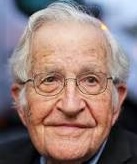
Noam Chomsky (born on December 7, 1928, in Philadelphia, Pennsylvania) is an American linguist, philosopher, cognitive scientist, historical essayist, social critic, and political activist. Sometimes called "the father of modern linguistics", Chomsky is also a major figure in analytic philosophy and one of the founders of the field of cognitive science. He is a Laureate Professor of Linguistics at the University of Arizona and an Institute Professor Emeritus at the Massachusetts Institute of Technology (MIT), and is the author of more than 150 books. He has written and lectured widely on linguistics, philosophy, intellectual history, contemporary issues, and particularly international affairs and U.S. foreign policy. Chomsky has been a writer for Z projects since their earliest inception, and is a tireless supporter of our operations.
ZNetwork is funded solely through the generosity of its readers.
Donate