
Source: Truthdig
Robert Scheer: Hi, this is Robert Scheer with another edition of “Scheer Intelligence.” And in this case–I always say the intelligence comes from my guests; in this case, I’m saying it with great respect and awe. My guest is Noam Chomsky. And actually, this is my first real encounter with this man. But I obviously, as many people throughout the world, know him through his writing.
And I’m a little bit intimidated, frankly. And I thought back to an earlier moment in my journalistic career, when I was the editor of Ramparts magazine, and The New York Times savagely attacked Bertrand Russell for his anti-war work, his concern about nuclear disarmament, and in particular for his opposition to the Vietnam War. And Russell had had a reputation as a strong critic of communism, and was rather well known for that. So it was particularly disturbing to the mass media that wanted to support this war. And The New York Times–now we talk a lot about fake news and real news–invented the fake news that Russell sort of had lost his rational capacity. And they actually engaged in character assassination, in an editorial and in reporting.
So I thought, well, I’m going to go to Wales–where he was living–and he was willing to be interviewed. And I went there, and I found an [incredibly]–frail, yes; he was then 94, turning 95. And this was–we published it in ’67, so I did it a month or two before. And Norman Rockwell, who was a great fan of Russell, was so offended by the character assassination, he volunteered his talent to do the cover of Ramparts, this wonderful drawing of Bertrand Russell. And I found this man–who was as lucid as you can be; frail physically, but very clear–and we did a marvelous interview.
Now, I have this [Laughs]–people have criticized Noam Chomsky, but they did it when he was a vigorous young man, and no more so now. But I do see the parallel between you and Russell. You know, great intellectuals who were willing, as you have been, to be also an activist, or play an active role, and so forth.
And I want to begin with an intellectual question. And that concerns a letter that Aldous Huxley wrote to Orwell on the occasion of the publication of 1984, and they were–this was a post-World War II publication, in the late forties, and [Huxley] had written Brave New World in 1931. And I hope everyone listening to this–
Noam Chomsky: Huxley had?
RS: Huxley had, yes. Sorry. And I hope everyone listening to this is, obviously, familiar with these books. One, Orwell’s, is very bleak–totalitarian, sadism and so forth of the totalitarian state; and Huxley presents a view that is also a reflection of the work that Noam Chomsky has written about the advertising society, the manipulative society, the consumer society. Manufacturing Consent, the drug effect of sports and consumerism, lulling people into acceptance. And in his letter to Orwell, and by an accident of history, Huxley had been, in 1917, Orwell’s French teacher at Eton, and knew him. And the publisher had sent it to Huxley thinking Huxley would just embrace it. And Huxley said some nice things, but he said: I think you missed the point; it won’t be so overt, because the ruling classes that want to hold on to their power will find that more subtle, manipulative means much more effective. That was Huxley’s rejoinder to Orwell.
Now, your own work has sort of talked about all of it. And when I look at the current situation in the United States now, it seems to me we have an amalgam of these two totalitarian, dystopian models emerging. We, in the words of Neil Postman, we amuse people to death, we distract them; in your writing, you’ve talked about those distractions. But we’re also a militarized state. We have punitive surveillance, and we use the espionage law. We have the boots on the ground; we have 800 bases.
So take it from there. Which–I think we can start with the assumption we have to be concerned about a dystopian future. Which model do you see emerging?
NC: Actually, I could add a third one. The first of this series of dystopian novels was Zamyatin, his book We, around 1920, Russian, gave a very vivid picture of a dystopian society that kind of amalgamates the kinds of pictures that Huxley and Orwell were developing. But we are very clearly moving to a tight surveillance society. There’s interesting work on this: Shoshana Zuboff, whose work you’ve probably seen, a Harvard professor, has a book called, I think, Surveillance Capitalism, which is about the techniques that are being developed to influence, control behavior, control people through the use of modern technology.
So as I’m sure you know, when you drive a car, the car is picking up a ton of information about you, going back to the auto maker to some central source, we don’t know exactly where. And so if you’re driving down the main street in Tucson, where we are now, and the information that’s been collected indicates that you like Chinese restaurants, then if you’ve got the right kind of gadgets in your car there’ll be an ad saying, you know, a half-mile from here there’s a Chinese restaurant you might like. And this is not just being used to flood you with information, but also to control you.
So, for example, the insurance companies are observing what you’re doing, if you’ve got your car wired up right. And if they see you go through a traffic light, they can send you an instant message saying you better be careful or you’re going to raise your insurance rates. They can even get to the point of locking your car, you know. But there’s a combination of sort of punishment and shaping, trying to direct you in certain directions. You see it every time you look something up on Google, you know; then you get a bunch of things saying you’d like this, or wanted to do this, and so on.
All of this goes, is moving on to controlling people at work. So by now, there’s the beginning–actually it began in Sweden, but it’s now expanded here–of placing chips in working people with an inducement. If you agree to have a chip inserted then you get, you know, free access to the coffee machine, and you can do all these interesting things, so people do it. But it also controls your actions. Like if you’re in an Amazon warehouse, they already have systems–which is backbreaking work–they’ve worked out the quickest routes between this spot and that spot.
And if you’re one of these people racing to try to keep up with a schedule, and you deviate from the route, you get a discredit immediately. You get an instant warning if you take off a little time to say hello to a friend, you get a warning. UPS is using it to control truck drivers. So if you back up when you shouldn’t have, you get a warning. If you stop for a cup of coffee when that wasn’t on your schedule, you get a warning. They’ve, in fact, they claim they’ve increased efficiency; these people internalize all this, and you race to keep to the commands, and they can claim they can now have more deliveries with fewer drivers, and so on.
This is being–the kind of model towards which society is moving is already illustrated to a substantial extent in China, where they have very heavy surveillance systems–cameras, you know, the devices that keep track of you, and so on. And you get a–they have what they call a credit system, social credit system. You get a certain number of points, and if you, say, jaywalk, violate a traffic rule, you lose points. If you help an old lady across the street, you gain points. Pretty soon all this gets internalized, and your life is dedicated to making sure you follow the rules that are established. This is going to expand enormously as we move to what’s called the internet of things. Meaning every device around you–your refrigerator, your toothbrush, and so on–is picking up information about what you’re doing, predicting what you’re going to do next, trying to control what you’re going to do next, advise what you do next. And in a way, Huxley was kind of right. People may not see it as intrusive; they just see it as that’s the way life is, the way the sun rises in the morning.
RS: Well, go further than that: they define freedom as consumer sovereignty. And they think of having choices about shoes to buy or the best bargain–that’s what Amazon specializes in–is a very shriveled notion of freedom. Because if you actually think of political freedom, or social activism, or being involved in the moral life of your community, then you will be a little wary of this information being out there. But I just want to make one point about this. What Edward Snowden revealed more than anyone else–and something I think you would be very familiar with, being at the sort of center of a lot of this technology at MIT for so many years–there’s a close connection between what the private sector can get and what the government has. And Snowden’s great revelation was that there’s no wall between Google and Amazon and the government. In fact, we now know Amazon is developing the cloud to keep all this information for the government, for the CIA, for the intelligence agencies.
So getting back to these dystopian models, we actually have the situation where people, in the manner of Huxley, give up their information because they’re taking the drug, consumerism, or whatever it is. But we also have the Orwellian image of Big Brother knowing everything, because we know the NSA and the CIA and every other agency has gotten all this information from Google. And so the question I want to put to you, is this the end of time for our species? And is this a reflection–and I know this is going to sound alarmist, but I reread your book, Hegemony or Survival, which was I think 2003. So by the standard of the internet, it was very early. And you mentioned there that the typical life of a species is 100,000 years. That’s one thing I got from it. And that we may be coming to the end of this disfavor, of however it happens. And secondly, it’s an open question whether being smart, as we define smart, is an important way of averting disaster and preventing the disintegration of the species.
And you leave it as an open question. The reason it’s a relevant question right at this moment is because we had the best and the brightest, as David Halberstam had described them, who gave us the Cold War and gave us Vietnam and gave us Iraq and everything else and, you know, gave away the money from Main Street to Wall Street, and all that. And now we have somebody who people like to think of as very crude, boorish, ill-mannered, which is Donald Trump. And we have Trumpwashing. Suddenly the smart, liberal people who created much of this mischief are now whitewashed, or Trumpwashed, by this buffoon. So I would like to ask you, first of all, are we in the end of times in that sense? And what is this battle, as I will define it, between Clintonism and Trumpism?
[omission 13:19 – 13:52]
NC: Well, you raise a lot of points. I should say there’s a kind of a subtle structure to the book that you mentioned, which may be too subtle for anyone to notice. It begins, the book begins with the discussion by the great biologist Ernst Mayr, who pointed out that–he did mention that the average life of a species–it’s been tens of billions of species–is about 100,000 years; that’s not far from us, we’re maybe 200,000 years. But the point he was making is that intelligence seems to be a kind of lethal mutation. If you look through the–what’s called biological success, what allows the species to survive and proliferate, turns out as you move up the scale of what we call intelligence, capacity to survive declines. So the species that are really very successful are beetles, for example, which have a fixed niche; they never change. Everything changes, the whole world changes, but they stick to their niche and keep reproducing and they’re fine. In fact Julian Huxley, Aldous’s brother, who was a great biologist, was asked once what biology had taught him about God. And he said what he had [been] taught was that God loves beetles. Because there’s a huge number of species that are all over the place, they do great. Another species that does fine is bacteria, the dumbest of all, but they mutate very quickly. So they adapt to whatever comes along.
As you move up to, say, mammals–say bigger mammals–their capacity to survive declines. What about when you get to humans? Well, you could argue that–and this is, let me just say at the very end of the same book, there’s a quote from Russell. Russell is asked, when will there be peace on earth? And he says, there will be peace on earth after all higher organisms have disappeared, and we’re back to the bacteria, and so on; then, there will be peace. That’s basically the structure. Now, if you think about it, we’ve been around for a couple hundred thousand years, we’re supposed to be the most intelligent species–we are now proving Mayr’s thesis. Not so much for the reasons you mentioned, which are bad enough, but we are racing to destroy the possibility of organized human life. And it’s a cooperation of those who call themselves the best and the brightest, and the Trumpian boors, and–all doing it. So I’m sure the CEOs of ExxonMobil and JPMorgan Chase know as much about global warming as we do. But they are–and they know, certainly, that continuing to do what they do–maximize the use of fossil fuels, pour money from the banks into development of fossil fuels–they know for certain that that’s going to destroy the possibilities of organized human life, not in the very distant future.
Go to the other end, Trump cares about nothing but himself. I don’t think there’s another idea in his mind, just me. What is he doing? Well, he’s following what’s good for me: keep his main constituency happy, the rich and the powerful, and somehow control the others. And one way to do it is by saying, let’s maximize the use of fossil fuels. Let’s use more coal, let’s use more energy, let’s be the greatest country in the world. We now are again the major producer of fossil–of oil, surpassing Saudi Arabia. It’s wonderful, let’s all cheer.
Does he know what’s going to happen? Well, even he knows. So he knows, for example, that sea levels are rising, it’s dangerous. In fact, he’s appealed to the government of Ireland to allow him to build a wall–you know, he loves walls–to protect his golf course in Ireland from rising sea levels. His administration came out with one of the most amazing documents in human history. The transportation administration came out with a long, I think, several hundred page environmental assessment study, which predicted that by the end of the century, temperatures will have risen seven degrees Fahrenheit. That’s what climate scientists describe as cataclysmic, about twice the level at which organized human society can survive. And they drew a conclusion from that. The conclusion is we should not put any more emissions controls on automobiles and trucks. Why? Sound argument. We’re going over the cliff anyway, so why not have fun?
So here you have the spectrum, all racing toward disaster, perfectly consciously, a great testimonial to human intelligence. And that’s only the beginning. There’s something else, which–at least this, some people are talking about–there’s another danger, at least as extreme, which is barely discussed. And that’s the greatly increasing threat of nuclear war. Greatly increasing. Not only the nuclear–the new nuclear strategy study, which is bad enough; Obama’s before it was also pretty awful. But also the dismantling of the entire arms control system which has kept us, more or less, barely alive. Anyone who looks at the history of the nuclear weapons period knows that it’s kind of a miracle that we’ve survived this long. Well, there was an arms control regime. One core part of it was the ABM Treaty, which George W. Bush dismantled. The second major part was the INF Treaty, negotiated by Reagan and Gorbachev, that reduced sharply the threat of nuclear war for 20 years. Trump has just abandoned it, and there’s barely a word about it.
And furthermore, immediately after abandoning it, the Pentagon carried out a test, obviously long-planned, of a missile that violates the treaty. Just pleading with the Russians and others, please make up, develop missiles to destroy us. The Open Skies treaty, initiated by Eisenhower–it was a different world then–that’s the next one on the chopping block, won’t do that. The New START treaty is next; the administration’s already said they’re not going to sign it. That ends the arms control regime; we are now free to create more and more destructive weapons to ensure that others do the same. If you read the announcements from Lockheed Martin and other arms control producers, they’re ecstatic, getting huge contracts to figure out ways to destroy us all and to make sure that others do it, too. Hardly a word said about this.
This is intelligence across the board, OK. So maybe Ernst Mayr is right, and human beings will demonstrate that [it’s] untrue that it’s better to be smart than stupid. We’re supposed to be smart; look at what we’re doing. That’s quite apart from the systems and surveillance and control that you’re talking about. These are the major issues in all of human history. There’s never been a moment in human history when we had to make a decision whether the species is going to survive in any recognizable form. And other species with it; we’re now destroying species at a rate that’s never been seen before. In fact we’re getting to the point, if you look at the temperature rise and the percentage of CO2 particles in the atmosphere, we’re going back to periods hundreds of thousands or even millions of years ago, when the sea level might have been 25 or 30 feet higher. What does that tell you about human life? What are we doing about it? Maximizing the effort, with the United States in the lead. Every other country in the world is trying to do at least something; the United States alone has pulled out of even the weak Paris agreement, and is now dedicated to maximizing these twin disasters. Other countries are bad enough, but we’re in the lead–the most powerful, richest country in history. This is something–there are no words to describe this.
RS: Well, this is exactly what caused Bertrand Russell to be considered controversial, and then smeared, when he pointed out the obvious: that the mutual assured destruction strategy of nuclear warfighting–in fact, he used the example not so much of the beetles, but of the survival of the cockroaches, another dumb species. That if you had this great policy that came out of very enlightened administrations, mutual assured destruction, all-out nuclear war and so forth, that it would be the cockroaches and the beetles that survived. And intelligence came into it as a way of more effectively rationalizing, or to use a word you’ve written a lot about, propagandize the public. It’s very skilled. So we argued, our best and brightest, for example, as–and it’s interesting, we’re doing this recording on a day when the Washington Post revealed that they had gotten through the Freedom of Information Act, basically, the Pentagon Papers of the Afghan war.
That this war has been a lie, just as the Vietnam War was a lie. We didn’t, we’re not doing it for any of the reasons that were shared with the public. That basically, you know, lives were squandered, and resources, for no purpose. And as we know, in Vietnam, the ignominious loss of the Vietnam War by the U.S.–they always said “you can’t just get out”–when we lost in the most ignominious defeat, communist China and communist Vietnam went to war, and it did not increase the security threat to the United States.
So the best and the brightest–and that’s why Halberstam used that title–used their intelligence to lie more effectively, to propagandize and so forth, and to tell the public stuff they knew was untrue. In fact the Secretary of State under Trump, who is now seen as a good guy, was the head of Exxon, Tillerson. And he could just–he wanted to be a more effective liar. It’s not that he was going to really do anything about global warming.
So my point, really, is this is distinction without a difference between so-called liberals and conservatives. I mean, you have the Democratic Party, now is basically a warmongering party. They want to be even tougher. Instead of saying–for instance, it was Ronald Reagan who was quite a warmonger, but nonetheless he made the agreement with Gorbachev. It was Ronald Reagan who said that at Reykjavík in Iceland: we can step back. You know, after calling them monsters–oh no, we can. We can do some of this. And in fact now, for all kinds of irrelevant reasons, we want to have a new Cold War with Russia, we want to have red-baiting without reds. It’s an exercise in madness. We’ve given up any idea of arms control. And ironically, Trump actually from time to time makes more sensible comments about getting along with some of these people.
And at the core of it is something you have written about effectively. It’s the notion–I don’t know if you use that word–of American innocence, American exceptionalism. And you know, this global warming started when, way back when you were writing and we were–they used to say 6% of the world’s population using 60% of its resources. And the waste that was built into the advertising society, and so forth. And it just–I think if I were to take your wisdom in a nutshell, it would be: beware of the people of power, and avarice, and wealth. Because the more intelligent they are, the better they’ll be at distorting reality and convincing us that what’s good for them is good for the world when it’s just the opposite.
NC: Well, you raise a great number of points. [Laughs] Be good to go after them point by point. But let’s start for a minute with the Pentagon Papers. The way the Pentagon Papers is interpreted, almost universally, is exactly the way you interpreted it. The Pentagon–I remember an article by Hannah Arendt in the New York Review, calling Washington “city of lies”–the Pentagon Papers showed they were lying to us. I don’t think that’s what the Pentagon Papers showed. The focus of discussion about the Pentagon Papers is almost entirely on the 1960s. If you look at The New York Times selection from it, it’s the 1960s. And yes, there was a lot of distortion and deceit, and self-deceit and so on in the sixties. But the Pentagon Papers go back to the 1940s. And if you look back at the early part–which I did writing about it at the time, in fact–you see a rational picture.
And in fact if you look at that picture, the idea that the U.S. failed in Vietnam becomes much muddier. Why did we get into Vietnam? Well, you look back around 1950. A major–in the late forties, the United States was kind of ambivalent about how to deal with the imperial systems. On the one hand, it wanted to support its allies–actually clients, by that time–Britain, France, Holland, and so on, which would have meant supporting their imperial systems. On the other hand, the United States was dedicated to what it called an open world in which U.S. multinationals, which were just developing at the time, would be free to exploit, to gain resources, to invest without any impediments. So no closed regions, all open regions, which we would expect to dominate. That meant opposing the imperial systems.
So there’s a quandary. And different decisions were made in different cases, by thinking about what the best way to do it was. When we got to Vietnam, this was right after what’s called the fall of China. The loss of China, a very interesting term; the assumption is we own it, we lost it. That was a huge event that led to McCarthyism and so on. At that point, U.S. policy toward Vietnam changed. Before that, it had been ambivalent. But the decision was made to support France in its effort to reconquer its former colony. And there was a reason. It’s the reason that underlies, that runs all through history. It’s ridiculed as the domino theory, but though it’s ridiculed, it’s never abandoned, because it’s correct. So therefore you go back to it, time after time.
The idea was put nicely by Henry Kissinger: when there’s a virus that spreads contagion–the virus is independent development, out of control of the United States. If that spreads contagion to others, we’re in trouble. Others will follow the same rule; the system of domination and control will erode. How do you deal with a virus that’s spreading contagion? Well, you kill the virus and inoculate the victims so they won’t be infected. That’s exactly what was done in Vietnam. Vietnam was smashed. It’s not going to be a model to anybody. Surrounding countries were inoculated by imposing vicious, brutal military dictatorships. No infection there; they’re going to be controlled.
And it worked. In fact, the telling point was Indonesia. They didn’t care much about Vietnam, but Indonesia they did care about; very rich in resources and so on. When Suharto took [power] in 1965, that was just killing hundreds of thousands of people, instituting a vicious regime of torture and murder, all described pretty accurately, with euphoria. It was a “gleam of light in Asia,” as the Times’ liberal correspondent James Reston described. You know, hope where there was none, and so on. Why? Because it ended the threat of contagion. In fact, in later years McGeorge Bundy, who was national security adviser for Kennedy and Johnson, he reflected that they probably should have ended the war in 1965, the Vietnam War. Because it had already been won. Vietnam was already smashed. The surrounding countries were now safe.
And what they were really worried about in 1950 was Japan. The Asia historian John Dower, famous Asia historian, called Japan the superdomino. They were concerned that if Indonesia and Burma and Thailand accommodated to move in a path of independence, Japan might join this system as its industrial commercial center, and they would be, the rest of Southeast, East Asia would be the surrounding resource area. What’s that? That’s what Japan tried to construct during World War II. That’s the new order in Asia. In 1950, U.S. planners were not ready to lose the Pacific War. This was disgraceful, but rational planning. And if you think about the consequences, it pretty much worked.
Now, you look at Afghanistan, the papers that came out this morning–notice what they’re focused on. Incompetence. Stupid decisions. We didn’t know what we were doing, and so on. You go back to, take Russia in the early 1980s. If we had internal documents from Russia in the early eighties, I’m sure we would find the generals, political analysts saying what we’re doing in Afghanistan is incompetent. We don’t know what we’re doing. It’s a mistake, we should do it differently, and so on. Is that the problem with the Russian invasion of Afghanistan? No. Is it the problem with the American destruction of Indochina, that there were lies and it was incompetent? No. All of this is deep-seated propaganda, internalized. We’re looking at the wrong thing, because that supports American innocence. If you say we were stupid, we made mistakes, and so on–well, we can still be the most idealistic, wonderful place in the world; anybody can make mistakes. If you look at the actual planning, and the reasoning–which was not silly, and in fact is duplicated over and over. The comment I quoted from Kissinger was about Allende. He said Chilean social democracy is a virus that might spread contagion. How is it dealt with? By installing the Pinochet dictatorship to kill it at its heart, to kill the virus. Installing brutal, vicious military dictatorships throughout the entire region. That’s pretty much duplicating the same reasoning.
And you can give case after case. And it goes back way before in the history of imperialism; you go back to King George the Third, time of the American Revolution. His concern was that this rise of republicanism in the British colonies could be a virus that would lead to a call for republicanism elsewhere, and the whole British Empire would erode. This is standard imperial history. We’re right in the middle of it. It’s not American exceptionalism. It’s American conformity to standard imperial history, along with the propaganda of innocence, exceptionalism, and so on. And interestingly, the best and the brightest are accepting the propaganda. That’s what they’re focusing on. Not the rational imperial planning; the implementation of it, which unfortunately is pretty successful. Many millions of people are paying for that. That’s what we should be thinking about.
RS: OK, you’re going to have to go, and we’re going to have to tie it up. But I want to get to what we were going to talk about at the beginning, the question of Israel. So I’m going to cut this short. I’m not disagreeing with anything you said. And by the way, the value of the Pentagon Papers was it showed we lied about the very reason for going in, and putting Diem in–
NC: They didn’t lie about it. If you look, about the early years, it’s described accurately. In the sixties, they were lying about it, that’s true. Because they were stuck and didn’t know what to do.
RS: OK, but when they had–I don’t want to go through the whole history, but when they had Tom Dooley and the Catholics fleeing, and they presented Vietnam as a totally Catholic–I mean, we can go through the tissue of lies. But I do want to make one point here, I don’t want to drop it, and I think it’s an interesting point. If we think, yes, imperialism is an outmoded model, or it’s a model that’s difficult to defend; it’s not the model that, say, Tim Cook of Apple would favor, or Sergey Brin of Google, or many of the people who have come out of MIT or Stanford or other places. They believe, actually, in a kind of virulent capitalism, including having dominance in particular industries and so forth.
And that model–just as communism turned out not to be nationalist, turned out to be highly–I mean, turned out to be highly nationalist, not internationalist. The Vietnamese really cared about Vietnam, and they had their own grievances with China; the Sino-Soviet Dispute was a reality going back to the 1920s. Tito was really the model we should have studied rather than, you know, some notion of communist imperialism, which is a fiction. And in fact, the communists turned out to prove Karl Marx right, which is capitalism was a stage that comes before socialism. It doesn’t replace socialism, and it ends the idiocy of rural life and builds big cities, et cetera, as he said in the manifesto.
So the real issue was, was the Cold War necessary? Could we have had American economic dominance and trade and so forth in a more truly open society, where they could do it with one form or another, and one degree or another of state involvement–and China is a perfect example. It’s now very a successful capitalist, state capitalist country, up to the point where it is now; Vietnam is following in that. And so all I’m saying is that they were irrational in trying to hold to an imperialist model at the very time when England and France knew it was not economically viable, and you have to abandon it. So, but leaving that–
NC: I don’t agree with that. England and France were trying to sustain their imperial model. And in fact, the imperial model that was developed was very successful. Suppose that the United States had really, in the forties and fifties, had allowed countries to go their own way. Suppose that they’d said, OK, Vietnam, you want to develop independently, out of our control–fine, go ahead and do it; you’ll be successful. Thailand followed, Burma followed, Indonesia followed; Japan joined in and became the center of this system. Would U.S. multinationals be able to dominate the world? Take a look at today’s world, OK.
There’s a kind of a–when we look at national power, what people look at typically is GDP, gross domestic product. And you look at U.S. share of GDP–it’s declined. It was maybe 40% in 1945, then maybe 25% by 1970, maybe 17% today. It looks like a decline. But take another measure. Take a look at the–here I’m quoting very interesting work by a young political economist, Ken Starrs. Suppose you look at the dominance of the economy by U.S.-based multinationals. It’s spectacular. U.S. multinationals control about 50% of the global economy, own–own 50% of it. In just about every area–manufacturing, retail–
RS: That’s my point. My point is it’s a more effective model than sending the troops–
NC: No, this is the imperial model, which succeeded. It prevented other countries from moving toward independent development, and therefore led to a situation in which U.S. multinationals dominate the world. If they had moved to independent development, we’d see exactly what we’re seeing with China today. It’s moving toward independent development; U.S. is trying to prevent it. The policies, shared bipartisan policies, are to try to prevent Chinese [independent] development. So if China, for example–you know, the mantra is “China’s stealing our jobs.” Is China stealing our jobs? They don’t have a gun to the head of Tim Cook, saying invest here. The U.S. multinationals are losing our jobs. But we don’t want China to develop as an economy.
That’s why the bipartisan programs are to prevent China from doing the things that make the economy successful–like industrial policy, to have a state industrial policy. We see that that’s successful; we want them to stop it. Kind of interesting, because that’s–economists and others, if they believe a word they’re saying, ought to be cheering. According to their theories, if the state intervenes in the economy, it’s going to harm the economy. But everyone knows the opposite is true. In fact, we ourselves have a massive state industrial policy. That’s why you have things like computers and the internet and so on, it’s mainly public funding. But we don’t want China to have that, because they’ll be successful, they’ll be out of our control; that we don’t want. That’s what the kind of concern was in the fifties. So I think the imperial model has been very successful. It’s led to a situation in which it’s primarily designed for the benefit of U.S. capital, which has succeeded beyond belief.
RS: Well, I think that’s absolutely true. The question is whether in this multinational world–and again, I need to get to these other points–but whether–and we’ll see; this is a real test with the whole argument about holding China back. Because for the individual companies, Apple makes a lot of money from China. China delivers a docile workforce; you know, it’s stable. And so the Chinese so-called communist model has turned out to be much better than if we had conquered China or returned Chiang Kai-shek to power, who controlled it.
NC: That’s right. But as soon as it’s beginning to get out of control, there’s a bipartisan agreement, backed by capital, to try to prevent their development. Now on a much smaller scale that happened in Vietnam, happened in Chile. It’s happened over and over again, even happened with Grenada if you want to look at it. And that’s a standard imperial model that goes back way before we picked it up. And overall, it’s been pretty successful. There were things that didn’t work out. But for the main drivers of American policy, which is concentrated capital, it’s been a pretty successful system.
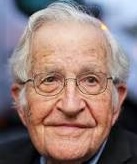
Noam Chomsky (born on December 7, 1928, in Philadelphia, Pennsylvania) is an American linguist, philosopher, cognitive scientist, historical essayist, social critic, and political activist. Sometimes called "the father of modern linguistics", Chomsky is also a major figure in analytic philosophy and one of the founders of the field of cognitive science. He is a Laureate Professor of Linguistics at the University of Arizona and an Institute Professor Emeritus at the Massachusetts Institute of Technology (MIT), and is the author of more than 150 books. He has written and lectured widely on linguistics, philosophy, intellectual history, contemporary issues, and particularly international affairs and U.S. foreign policy. Chomsky has been a writer for Z projects since their earliest inception, and is a tireless supporter of our operations.

ZNetwork is funded solely through the generosity of its readers.
Donate