
Australia has entered one of those rare diplomatic moments when grief at home collides with moral judgment abroad, and when a single invitation carries meanings far beyond the bounds of protocol. The decision to host Israeli President Isaac Herzog in the aftermath of the Bondi Beach Hanukkah massacre has become more than an act of condolence. It has evolved into a prism through which Australia’s values, alliances and international responsibilities are being examined with an unforgiving intensity.
The Bondi attack of December 2025 was a national trauma. Fifteen people were killed at a religious celebration on one of the country’s most iconic beaches, making it the deadliest mass shooting in modern Australian history. The response was immediate and muscular: a Royal Commission, tougher hate-speech laws, expanded gun controls and a rare early recall of parliament. Security agencies raised the national terror threat level to ‘probable’. Candlelight vigils filled streets from Sydney to Perth, while stories of courage – including that of a Muslim bystander who charged an armed attacker – briefly cut through the fear with a sense of shared humanity.
It was in this atmosphere that the Prime Minister extended an invitation to President Herzog, formally through the Governor-General, to visit Australia in early 2026. The rationale was simple and, on its face, uncontroversial: a head of state coming to honour victims of antisemitic terror and to stand with a grieving Jewish community. Mainstream Jewish organisations welcomed the gesture as a necessary signal that Australia would not waver in the face of hatred.
Yet the invitation landed in a radically different international context from earlier Israeli state visits. Since late 2023, Gaza has been subjected to a military campaign whose scale has few modern parallels. According to the UN Office of the High Commissioner for Human Rights, more than 35,000 Palestinians had been killed by mid-2025, with women and children forming the majority. Entire neighbourhoods were flattened; over 80 per cent of Gaza’s population was displaced. In September 2025, a UN Commission of Inquiry went further, concluding that Israel’s conduct met the legal criteria for genocide under the 1948 Convention. The report named senior Israeli leaders, including President Herzog, as having incited genocidal violence through public statements.
Those findings, while contested by Israel and its allies, carry significant moral and political weight. Australia is a signatory to the Genocide Convention, which imposes an obligation not only to punish genocide but to prevent it. Legal scholars have noted that a serving head of state enjoys immunity from arrest, and no international court has issued a warrant for Herzog. The issue, therefore, is not legality in the narrow sense, but legitimacy in the broader sense. Can a liberal democracy extend full ceremonial honours to a leader accused by the United Nations of incitement to genocide without diminishing its own commitment to international law?
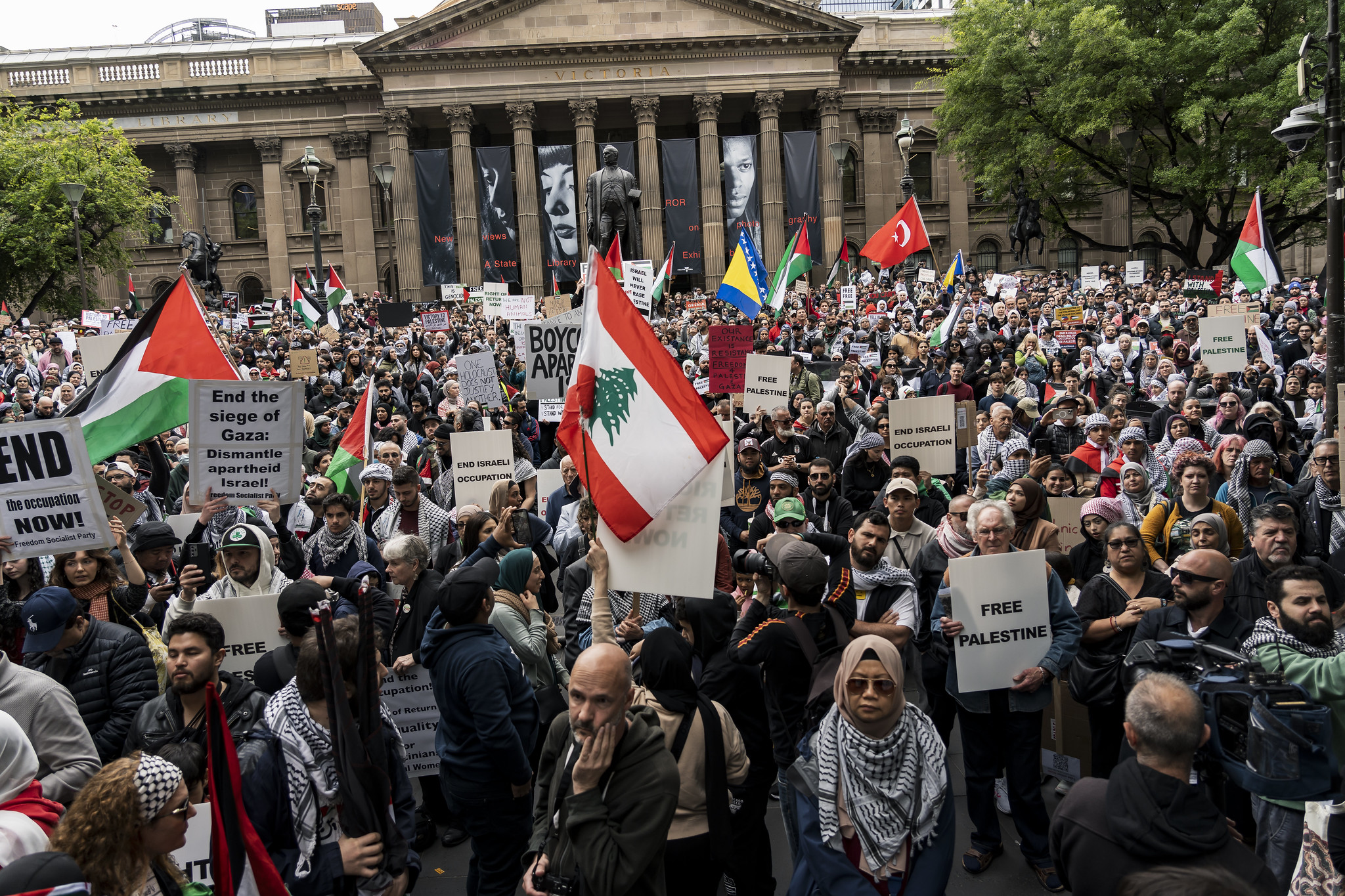
The domestic repercussions have been swift. Palestinian-Australian groups, joined by Indigenous activists and segments of the Jewish left, have announced nationwide protests timed with the visit. These mobilisations are unfolding against the backdrop of newly passed state and federal laws that sharply restrict protest activity and criminalise certain political slogans. Civil liberties organisations and the Australian Human Rights Commission have warned that these measures risk breaching obligations under the International Covenant on Civil and Political Rights, particularly the rights to peaceful assembly and political expression.
Greens Senator Mehreen Faruqi has defended her warning that ‘powerful forces’ — from the Murdoch press to hard-right parties and foreign leaders — are trying to weaponise the Bondi horror into political capital, a claim she reiterated in a press conference. Her remarks drew immediate condemnation from some Jewish community leaders, who argued the language risked echoing antisemitic tropes.
Here, the tension is acute. On one hand lies a legitimate duty to protect communities from hate-fuelled violence, especially after an atrocity like Bondi. On the other hand lies the democratic imperative to allow dissent, including dissent that is uncomfortable or confronting. History offers uncomfortable lessons about the consequences of conflating protest with extremism. Comparative research from think tanks such as Freedom House and the International Crisis Group shows that democracies responding to terrorism with sweeping speech restrictions often deepen polarisation rather than resolve it.
Foreign policy considerations add another layer. Israel remains an important security and intelligence partner for Australia, and solidarity after a terror attack aligns with alliance politics familiar to any student of realism. Yet Australia has also sought to position itself as a principled middle power, supportive of a rules-based international order. Recognition of Palestinian statehood at the United Nations in 2025 was framed in exactly those terms. The Herzog invitation now sits uneasily alongside that decision, suggesting a diplomacy pulled in opposite directions.
There are precedents. Democratic states have faced similar dilemmas when hosting leaders accused of grave abuses, from apartheid-era South Africa to more recent controversies involving Sudan and Myanmar. In many cases, protests outside the gates of official residences became part of the diplomatic landscape, signalling that state-to-state relations do not exhaust a nation’s moral voice. Australia’s challenge is whether it can accommodate such dissent without sliding into repression or endorsing it symbolically.
What makes this moment especially fraught is the intersection of multiple traumas. For Jewish Australians, Bondi reopened ancient wounds about vulnerability and belonging. For Palestinian Australians, Gaza represents an ongoing catastrophe, watched in real time through screens and personal loss. A policy response that recognises only one of these realities risks entrenching a hierarchy of grief. Scholars of conflict resolution have long argued that durable cohesion in plural societies depends on what they call competitive victimhood being replaced by inclusive recognition. That insight feels painfully relevant.
An alternative path remains possible. Diplomatic protocol need not preclude moral clarity. A state visit focused on condolence could be paired with an explicit reaffirmation of Australia’s commitment to international humanitarian law, including concern for civilian suffering in Gaza. Space could be protected for peaceful protest as a democratic safety valve rather than treated as a security threat. Symbolism matters in international relations, but so does context.
Solidarity with Palestinian Australians does not diminish Australia’s anti-antisemitism stance; rather, it enhances it by confirming that this country’s commitment to dignity, safety, and justice is independent of which lives are politically convenient to mourn.
Australia stands at a crossroads familiar to many middle powers in an era of protracted conflict and fragmented norms. The question is not whether solidarity with victims of terror is justified – it is. The question is whether such solidarity can coexist with an unflinching commitment to universal human rights and democratic freedoms. How this balance is struck will echo far beyond the tarmac and ceremonial guards, shaping perceptions of Australia’s moral compass in a world where those bearings are increasingly contested.
ZNetwork is funded solely through the generosity of its readers.
Donate
1 Comment
As a settler colonial country that also has committed genocide against its indigenous population, it’s not surprising Australia feels solidarity with Israel.