
This article is a transcription of a talk Chomsky gave to the students attending Z Media Institute in 2005. The three crises reviewed here are particularly relevant today, post-election, as neither of the three were addressed by the candidates (although they involve survival of the species) and there are no known plans to do something about them.
CHOMSKY: I’ve been asked to speak on imminent crises and earlier I asked for suggestions. I only got one: “Rapture.” So I’ll keep to that. It’s a good one, although I won’t talk about it in those terms.
There are actually three crises that I think are worth telling about, at very high priority. One is the Rapture, if you like. It has to do with the threat of nuclear war, which is very high—unimaginably high—certainly unacceptably so. And that assumption is very widely accepted among strategic analysts and others. In the U.S. strategic community, the official strategic analysts in the government regard the prospect of a dirty bomb as completely inevitable in the U.S. and the possibility of a real nuclear weapon as very high, which would mean apocalypse.
There was an article a couple of months ago by Robert McNamara called “Apocalypse Soon” in which he joined the general consensus among analysts that on the current course of policy—mostly U.S. policy which is driving it—a nuclear war is inevitable. McNamara and the former defense secretary William Perry, Graham Allison, an American political scientist and professor at the John F. Kennedy School of Government at Harvard, and many others give a subjective estimate that the probability of a nuclear terror attack within the next decade is 50 percent or higher. Subjective estimates don’t mean much, but it shows you what people are thinking—even in mainstream journals like the American Academy of Arts and Sciences, which is not given to hyperbole. Two leading strategic analysts a couple of months ago argued in some detail that the current policies of the Bush administration carry what they call “an appreciable risk of ultimate doom.”
So that’s one major crisis and how imminent it is anyone knows. It could be tomorrow. Everything’s in place for it. The second one is familiar and I won’t say that much about it—that’s the threat of environmental catastrophe, which is not imminent in the sense that it’s going to happen soon, but the decision as to whether to ensure that it does happen is soon. In fact, it might be right now.
So, for example, a couple of days ago a group of leading scientists from the National Academies of a number of counties and the National Academy of Sciences in the U.S., addressed a petition to the leaders of G8—the 8 industrial countries who were meeting in Scotland in a few months—urging them to take immediate steps to avert a threat, the details of which are unknown, but it could be catastrophic and it could be unavoidable if it’s allowed to drag on too long. Again, the U.S. is alone in refusing to take any steps. That’s the second imminent crisis.
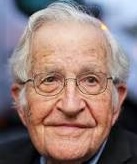
Noam Chomsky (born on December 7, 1928, in Philadelphia, Pennsylvania) is an American linguist, philosopher, cognitive scientist, historical essayist, social critic, and political activist. Sometimes called "the father of modern linguistics", Chomsky is also a major figure in analytic philosophy and one of the founders of the field of cognitive science. He is a Laureate Professor of Linguistics at the University of Arizona and an Institute Professor Emeritus at the Massachusetts Institute of Technology (MIT), and is the author of more than 150 books. He has written and lectured widely on linguistics, philosophy, intellectual history, contemporary issues, and particularly international affairs and U.S. foreign policy. Chomsky has been a writer for Z projects since their earliest inception, and is a tireless supporter of our operations.


