
These are exciting days in Washington, as the government directs its energies to the demanding task of containing Iran in what Washington Post correspondent Robin Wright, joining others, calls “Cold War II. During Cold War I, the task was to contain two awesome forces. The lesser and more moderate force was “an implacable enemy whose avowed objective is world domination by whatever means and at whatever cost.” Hence, “if the United States is to survive,” it will have to adopt a “repugnant philosophy” and reject “acceptable norms of human conduct” and the “long-standing American concepts of “fair play” that had been exhibited with such searing clarity in the conquest of the national territory, the Philippines, Haiti, and other beneficiaries of “the idealistic new world bent on ending inhumanity,” as the newspaper of record describes our noble mission.
The judgments about the nature of the super-Hitler and the necessary response are those of General Jimmy Doolittle, in a critical assessment of the CIA commissioned by President Eisenhower in 1954. They are quite consistent with those of Truman administration liberals, the “wise men” who were “present at the creation,” notoriously in NSC 68, but, in fact, quite consistently.
In the face of the Kremlin’s unbridled aggression in every corner of the world, it is perhaps understandable that the U.S. resisted in defense of human values with a savage display of torture, terror, subversion, and violence while doing “everything in its power to alter or abolish any regime not openly allied with America,” as Tim Weiner summarizes the doctrine of the Eisenhower administration in his recent history of the CIA. Just as the Truman liberals easily matched their successors in fevered rhetoric about the implacable enemy and its campaign to rule the world, so did John F. Kennedy, who bitterly condemned the “monolithic and ruthless conspiracy,” and dismissed the proposal of its leader (Khrushchev) for sharp mutual cuts in offensive weaponry, then reacted to his unilateral implementation of these proposals with a huge military build-up. The Kennedy brothers also quickly surpassed Eisenhower in violence and terror, as they “unleashed covert action with an unprecedented intensity” (Wiener), doubling Eisenhower’s annual record of major CIA covert operations, with horrendous consequences worldwide, even a close brush with terminal nuclear war.
But at least it was possible to deal with Russia, unlike the fiercer enemy, China. The more thoughtful scholars recognized that Russia was poised uneasily between civilization and barbarism. As Henry Kissinger later explained in his academic essays, only the West has undergone the Newtonian revolution and is therefore “deeply committed to the notion that the real world is external to the observer,” while the rest still believe “that the real world is almost completely internal to the observer,” the “basic division” that is “the deepest problem of the contemporary international order.” But Russia, unlike third word peasants who think that rain and sun are inside their heads, was perhaps coming to the realization that the world is not just a dream Kissinger felt.
Not so the still more savage and bloodthirsty enemy, China, which for liberal Democrat intellectuals at various times rampaged as a “a Slavic Manchukuo,” a blind puppet of its Kremlin master, or a monster utterly unconstrained as it pursued its crazed campaign to crush the world in its tentacles, or whatever else circumstances demanded.
The remarkable tale of doctrinal fanaticism from the 1940s to the 1970s, which makes contemporary rhetoric seem rather moderate, is reviewed by James Peck in his highly revealing study of the national security culture, Washington’s China.
In later years, there were attempts to mimic the valiant deeds of the defenders of virtue from the two villainous global conquerors and their loyal slaves—for example, when the Gipper strapped on his cowboy boots and declared a National Emergency because Nicaraguan hordes were only two days from Harlingen Texas, though, as he courageously informed the press, despite the tremendous odds, “I refuse to give up. I remember a man named Winston Churchill who said, ‘Never give in. Never, never, never.’ So we won’t.” With consequences that need not be reviewed. Even with the best of efforts, however, the attempts were never able to recapture the glorious days of Cold War I. But now those heights might be within reach, as another implacable enemy bent on world conquest has arisen, which we must contain before it destroys us all: Iran.
Perhaps it’s a lift to the spirits to be able to recover those heady Cold War days when at least there was a legitimate force to contain, however dubious the pretexts and disgraceful the means. But it is instructive to take a closer look at the contours of Cold War II as they are being designed by the former Kremlinologists now running U.S. foreign policy, such as Rice and Gates” (Wright).
“The task of containment is to establish a bulwark against Iran’s growing influence in the Middle East,” Mark Mazzetti and Helene Cooper explain in the New York Times (July 31). To contain Iran’s influence we must surround Iran with U.S. and NATO ground forces, along with massive naval deployments in the Persian Gulf and, of course, incomparable air power and weapons of mass destruction. And we must provide a huge flow of arms to what Condoleezza Rice calls “the forces of moderation and reform” in the region, the brutal tyrannies of Egypt and Saudi Arabia and, with particular munificence, Israel, by now virtually an adjunct of the militarized high-tech U.S. economy. All to contain Iran’s influence. A daunting challenge indeed.
And daunting it is. In Iraq, Iranian support is welcomed by much of the majority Shi’ite population. In an August visit to Teheran, Iraqi Prime Minister Nouri al-Maliki met with the supreme leader Ali Khamenei, President Ahmadinejad, and other senior officials, and thanked Tehran for its “positive and constructive” role in improving security in Iraq, eliciting a sharp reprimand from President Bush, who “declares Teheran a regional peril and asserts the Iraqi leader must understand,” to quote the headline of the Los Angeles Times report on al-Maliki’s intellectual deficiencies. A few days before, also greatly to Bush’s discomfiture, Afghan President Hamid Karzai, Washington’s favorite, described Iran as “a helper and a solution” in his country. Similar problems abound beyond Iran’s immediate neighbors. In Lebanon, according to polls, most Lebanese see Iranian-backed Hezbollah “as a legitimate force defending their country from Israel,” Wright reports. In Palestine, Iranian-backed Hamas won a free election, eliciting savage punishment of the Palestinian population by the U.S. and Israel for the crime of voting “the wrong way,” another episode in “democracy promotion.” But no matter. The aim of U.S. militancy and the arms flow to the moderates is to counter “what everyone in the region believes is a flexing of muscles by a more aggressive Iran,” “according to an unnamed senior U.S. government official”—“everyone” being the technical term used to refer to Washington and its more loyal clients. Iran’s aggression consists in its being welcomed by many within the region, and allegedly supporting resistance to the U.S. occupation of neighboring Iraq.
It’s likely, though little discussed, that a prime concern about Iran’s influence is to the East, where in mid-August, “Russia and China today host Iran’s President Mahmoud Ahmadinejad at a summit of a Central Asian security club designed to counter U.S. influence in the region,” the business press reports. The “security club” is the Shanghai Cooperation Organization (SCO), which has been slowly taking shape in recent years. Its membership includes not only the two giants Russia and China, but also the energy-rich Central Asian states Kyrgyzstan, Uzbekistan, Kazakhstan, and Tajikistan. Hamid Karzai of Afghanistan was a guest of honor at the August meeting. “In another unwelcome development for the Americans, Turkmenistan’s President Gurbanguly Berdymukham-medov also accepted an invitation to attend the summit,” another step in its improvement of relations with Russia, particularly in energy, reversing a long-standing policy of isolation from Russia. “Russia in May secured a deal to build a new pipeline to import more gas from Turkmenistan, bolstering its dominant hold on supplies to Europe and heading off a competing U.S.- backed plan that would bypass Russian territory.”
Along with Iran, there are three other official observer states: India, Pakistan, and Mongolia. Washington’s request for similar status was denied. In 2005, the SCO called for a timetable for termination of any U.S. military presence in Central Asia. The participants at the August meeting flew to the Urals to attend the first joint Russia-China military exercises on Russian soil. Association of Iran with the SCO extends its inroads into the Middle East, where China has been increasing trade and other relations with the jewel in the crown, Saudi Arabia.
There is an oppressed Shiite population in Saudi Arabia that is also susceptible to Iran’s influence—and happens to sit on most of Saudi’s oil. About 40 percent of Middle East oil is reported to be heading East, not West. As the flow Eastward increases, U.S. control declines over this lever of world domination, a “stupendous source of strategic power,” as the State Department described Saudi oil 60 years ago.
In Cold War I, the Kremlin had imposed an iron curtain and built the Berlin Wall to contain Western influence. In Cold War II, Wright reports, the former Kremlinologists framing policy are imposing a “green curtain” to bar Iranian influence. In short, government-media doctrine is that the Iranian threat is rather similar to the Western threat that the Kremlin sought to contain and the U.S. is eagerly taking on the Kremlin’s role in the thrilling new Cold War.
All of this is presented without noticeable concern. Nevertheless, the recognition that the U.S. government is modeling itself on Stalin and his successors in the new Cold War must be arousing at least some flickers of embarrassment. Perhaps that is how we can explain the ferocious Washington Post editorial announcing that Iran has escalated its aggressiveness to a Hot War: “the Revolutionary Guard, a radical state within Iran’s Islamic state, is waging war against the United States and trying to kill as many American soldiers as possible.” The U.S. must therefore “fight back,” the editors thunder, finding quite “puzzling…the murmurs of disapproval from European diplomats and others who say they favor using diplomacy and economic pressure, rather than military action, to rein in Iran,” even in the face of its outright aggression. The evidence that Iran is waging war against the U.S. is now conclusive. After all, it comes from an Administration that has never deceived the American people, even improving on the famous stellar honesty of its predecessors.
If the Charges Are True
Suppose that for once Washington’s charges happen to be true and Iran really is providing Shi’ite militias with roadside bombs that kill U.S. forces, perhaps even making use of some of the advanced weaponry lavishly provided to the Revolutionary Guard by Ronald Reagan in order to fund the illegal war against Nicaragua, under the pretext of arms for hostages (the number of hostages tripled during these endeavors).
If the charges are true, then Iran could properly be charged with a minuscule fraction of the iniquity of the Reagan administration, which provided Stinger missiles and other high-tech military aid to the “insurgents” seeking to disrupt Soviet efforts to bring stability and justice to Afghanistan, as they saw it. Perhaps Iran is even guilty of some of the crimes of the Roosevelt administration, which assisted terrorist partisans attacking peaceful and sovereign Vichy France in 1940-41, and had thus declared war on Germany even before Pearl Harbor.
One can pursue these questions. The CIA station chief in Pakistan in 1981, Howard Hart, reports that “I was the first chief of station ever sent abroad with this wonderful order: ‘Go kill Soviet soldiers.’ Imagine. I loved it. Of course the mission was not to liberate Afghanistan,” Tim Wiener writes in his history of the CIA, repeating the obvious. But “it was a noble goal,” he writes. Killing Russians, with no concern for the fate of Afghans, is a noble goal, but support for resistance to a U.S. invasion and occupation would be a vile act and declaration of war. Without irony, the Bush administration and the media charge that Iran is “meddling” in Iraq, otherwise presumably free from foreign interference. The evidence is partly technical. Do the serial numbers on the Improvised Explosive Devices really trace back to Iran? If so, does the leadership of Iran know about the IEDs, or only the Iranian Revolutionary Guard. Settling the debate, the White House plans to brand the Revolutionary Guard as a “specially designated global terrorist” force, an unprecedented action against a national military branch, authorizing Washington to undertake a wide range of punitive actions. Watching in disbelief, much of the world asks whether the U.S. military, invading and occupying Iran’s neighbors, might better merit this charge—or its Israeli client, about to receive a huge increase in military aid to commemorate 40 years of harsh occupation and illegal settlement, and its fifth invasion of Lebanon a year ago.
It is instructive that Washington’s propaganda framework is reflexively accepted, apparently without notice, in U.S. and other Western commentary and reporting, apart from the marginal fringe of what is called “the loony left.” What is considered “criticism” is skepticism as to whether all of Washington’s charges about Iranian aggression in Iraq are true. It might be an interesting research project to see how closely the propaganda of Russia, Nazi Germany, and other aggressors and occupiers matched the standards of today’s liberal press and commentators. The comparisons are, of course, unfair.
Unlike German and Russian occupiers, American forces are in Iraq by right, on the principle, too obvious even to enunciate—that the U.S. owns the world. Therefore, as a matter of elementary logic, the U.S. cannot invade and occupy another country. The U.S. can only defend and liberate others. No other category exists. Predecessors, including the most monstrous, have commonly sworn by the same principle, but again there is an obvious difference: they were wrong and we are right—QED.
An Important Study
Another comparison comes to mind, which is studiously ignored when we are sternly admonished of the ominous consequences that might follow withdrawal of U.S. troops from Iraq. The preferred analogy is Indochina, highlighted in a shameful speech by the president on August 22. That analogy can perhaps pass muster among those who have succeeded in effacing from their minds the record of U.S. actions in Indochina, including the destruction of much of Vietnam and the murderous bombing of Laos and Cambodia as the U.S. began its withdrawal from the wreckage of South Vietnam. In Cambodia, the bombing was in accord with Kissinger’s genocidal orders: “anything that flies on anything that moves”—actions that drove “an enraged populace into the arms of an insurgency [the Khmer Rouge] that had enjoyed relatively little support before the Kissinger-Nixon bombing was inaugurated,” as Cambodia specialists Owen Taylor and Ben Kiernan observe in a highly important study that passed virtually without notice, in which they reveal that the bombing was five times the incredible level reported earlier, greater than all allied bombing in World War II. Completely suppressing all relevant facts, it is then possible for the president and many commentators to present Khmer Rouge crimes as a justification for continuing to devastate Iraq .But although the grotesque Indochina analogy receives much attention, the obvious analogy is ignored: the Russian withdrawal from Afghanistan, which, as Soviet analysts predicted, led to shocking violence and destruction as the country was taken over by Reagan’s favorites, who amused themselves by such acts as throwing acid in the faces of women in Kabul they regarded as too liberated and who then virtually destroyed the city and much else, creating such havoc and terror that the population actually welcomed the Taliban. That analogy could indeed be invoked without utter absurdity by advocates of “staying the course,” but evidently it is best forgotten.
Under the heading “Secretary Rice’s Mideast mission: contain Iran,” the press reports Rice’s warning that Iran is “the single most important single-country challenge to…U.S. interests in the Middle East.” That is a reasonable judgment. Given the long-standing principle that Washington must do “everything in its power to alter or abolish any regime not openly allied with America,” Iran does pose a unique challenge, and it is natural that the task of containing Iranian influence should be a high priority.
As elsewhere, Bush administration rhetoric is relatively mild in this case. For the Kennedy administration, “Latin America was the most dangerous area in the world” when there was a threat that the progressive Cheddi Jagan might win a free election in British Guiana, overturned by CIA shenanigans that handed the country over to the thuggish racist Forbes Burnham. A few years earlier, Iraq was “the most dangerous place in the world” (CIA director Allen Dulles) after General Abdel Karim Qassim broke the Anglo-American condominium over Middle East oil, overthrowing the pro-U.S. monarchy, which had been heavily infiltrated by the CIA.
A primary concern was that Qassim might join Nasser, then the supreme Middle East devil, in using the incomparable energy resources of the Middle East for the domestic population. The issue for Washington was not so much access as control. At the time and for many years after, Washington was purposely exhausting domestic oil resources in the interests of “national security,” meaning security for the profits of Texas oil men, like the failed entrepreneur who now sits in the Oval Office. But as high-level planner George Kennan had explained well before, we cannot relax our guard when there is any interference with “protection of our resources” (which happen to be somewhere else). Unquestionably, Iran’s government merits harsh condemnation, though it has not engaged in worldwide terror, subversion, and aggression, following the U.S. mode—-which extends to today’s Iran as well, if ABC news is correct in reporting that the U.S. is supporting Pakistan-based Junullah, which is carrying out terrorist acts inside Iran. The sole act of aggression attributed to Iran is the conquest of two small islands in the Gulf—under Washington’s close ally the Shah. In addition to internal repression—heightened, as Iranian dissidents regularly protest, by U.S. militancy—the prospect that Iran might develop nuclear weapons also is deeply troubling. Though Iran has every right to develop nuclear energy, no one—including the majority of Iranians—wants it to have nuclear weapons. That would add to the threat of survival, posed much more seriously by its near neighbors Pakistan, India, and Israel, all nuclear armed with the blessing of the U.S., which most of the world regards as the leading threat to world peace.
Iran rejects U.S. control of the Middle East, challenging fundamental policy doctrine, but it hardly poses a military threat. On the contrary, it has been the victim of outside powers for years: in recent memory, when the U.S. and Britain overthrew its parliamentary government and installed a brutal tyrant in 1953, and when the U.S. supported Saddam Hussein’s murderous invasion, slaughtering hundreds of thousands of Iranians, many with chemical weapons, without the “international community” lifting a finger—something that Iranians do not forget as easily as the perpetrators. And then under severe sanctions as a punishment for disobedience.
Israel regards Iran as a threat. Israel seeks to dominate the region with no interference and Iran might be some slight counterbalance, while also supporting domestic forces that do not bend to Israel’s will. It may, however, be useful to bear in mind that Hamas has accepted the international consensus on a two-state settlement on the international border and Hezbollah, along with Iran, has made clear that it would accept any outcome approved by Palestinians, leaving the U.S. and Israel isolated in their traditional rejectionism. But Iran is hardly a military threat to Israel. And whatever threat there might be could be overcome if the U.S. would accept the view of the great majority of its own citizens and of Iranians and permit the Middle East to become a nuclear-weapons free zone, including Iran and Israel, and U.S. forces deployed there. One may also recall that UN Security Council Resolution 687 of April 3, 1991, to which Washington appeals when convenient, calls for “establishing in the Middle East a zone free from weapons of mass destruction and all missiles for their delivery.” It is widely recognized that use of military force in Iran would risk blowing up the entire region, with untold consequences beyond. We know from polls that in the surrounding countries, where the Iranian government is hardly popular —Turkey, Saudi Arabia, Pakistan—nevertheless large majorities prefer even a nuclear-armed Iran to any form of military action against it.
The rhetoric about Iran has escalated to the point where both political parties and practically the whole U.S. press accept it as legitimate and, in fact, honorable, that “all options are on the table,” to quote Hillary Clinton and everybody else, possibly even nuclear weapons. “All options on the table” means that Washington threatens war. The UN Charter outlaws “the threat or use of force.” The United States, which has chosen to become an outlaw state, disregards international laws and norms. We’re allowed to threaten anybody we want and attack anyone we choose.
Outlaw State
Washington’s feverish new Cold War “containment” policy has spread to Europe. Washington intends to install a “missile defense system” in the Czech Republic and Poland, marketed to Europe as a shield against Iranian missiles. Even if Iran had nuclear weapons and long-range missiles, the chances of its using them to attack Europe are perhaps on a par with the chances of Europe’s being hit by an asteroid, so perhaps Europe would do as well to invest in an asteroid defense system. Furthermore, if Iran were to indicate the slightest intention of aiming a missile at Europe or Israel, the country would be vaporized. Of course, Russian planners are gravely upset by the shield proposal. We can imagine how the U.S. would respond if a Russian anti-missile system were erected in Canada. The Russians have good reason to regard an anti-missile system as part of a first-strike weapon against them. It is generally understood that such a system could never block a first strike, but it could conceivably impede a retaliatory strike. On all sides, “missile defense” is therefore understood to be a first-strike weapon, eliminating a deterrent to attack. A small initial installation in Eastern Europe could easily be a base for later expansion. More obviously, the only military function of such a system with regard to Iran, the declared aim, would be to bar an Iranian deterrent to U.S. or Israel aggression.
Not surprisingly, in reaction to the “missile defense” plans, Russia has resorted to its own dangerous gestures, including the recent decision to renew long-range patrols by nuclear-capable bombers after a 15-year hiatus, in one recent case near the U.S. military base on Guam. These actions reflect Russia’s anger “over what it has called American and NATO aggressiveness, including plans for a missile-defense system in the Czech Republic and Poland, analysts said” (Andrew Kramer, NYT).
The shield ratchets the threat of war a few notches higher, in the Middle East and elsewhere, with incalculable consequences, and the potential for a terminal nuclear war. The immediate fear is that by accident or design, Washington’s war planners or their Israeli surrogate might decide to escalate their Cold War II into a hot one—in this case a real hot war.
Noam Chomsky is a linguist, philosopher, cognitive scientist, political commentator, social justice activist, and anarcho-syn- dicalist advocate. Chomsky has authored over 100 books was voted the “world’s top public intellectual” in a 2005 poll.
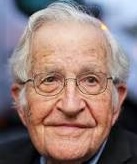
Noam Chomsky (born on December 7, 1928, in Philadelphia, Pennsylvania) is an American linguist, philosopher, cognitive scientist, historical essayist, social critic, and political activist. Sometimes called "the father of modern linguistics", Chomsky is also a major figure in analytic philosophy and one of the founders of the field of cognitive science. He is a Laureate Professor of Linguistics at the University of Arizona and an Institute Professor Emeritus at the Massachusetts Institute of Technology (MIT), and is the author of more than 150 books. He has written and lectured widely on linguistics, philosophy, intellectual history, contemporary issues, and particularly international affairs and U.S. foreign policy. Chomsky has been a writer for Z projects since their earliest inception, and is a tireless supporter of our operations.


