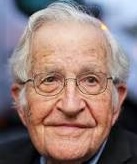
On this weekās episode of On Contact, Chris Hedges travels to Cambridge, Massachusetts for a conversation with Americaās most important intellectual, Professor Noam Chomsky. In Part I of their conversation, Chomsky discusses the adverse effects of neoliberalism on the working class, as addressed in his book, āRequiem for the American Dream: The 10 Principles of Concentration of Wealth & Powerā.
Noam Chomsky (born on December 7, 1928, in Philadelphia, Pennsylvania) is an American linguist, philosopher, cognitive scientist, historical essayist, social critic, and political activist. Sometimes called "the father of modern linguistics", Chomsky is also a major figure in analytic philosophy and one of the founders of the field of cognitive science. He is a Laureate Professor of Linguistics at the University of Arizona and an Institute Professor Emeritus at the Massachusetts Institute of Technology (MIT), and is the author of more than 150 books. He has written and lectured widely on linguistics, philosophy, intellectual history, contemporary issues, and particularly international affairs and U.S. foreign policy.
Chomsky has been a writer for Z projects since their earliest inception, and is a tireless supporter of our operations.
Chris Hedges worked for nearly two decades as a foreign correspondent for The New York Times, National Public Radio and other news organizations in Latin America, the Middle East and the Balkans. He was part of the team of reporters at The New York Times who won a Pulitzer Prize for their coverage of global terrorism. Hedges is a fellow at the Nation Institute and the author of numerous books, including War is a Force That Gives Us Meaning.
ZNetwork is funded solely through the generosity of its readers.
The Wind Cries Freedom, the new book from Z co-founder Michael Albert, is a sweeping oral history of a future American revolution.
Through thirty interconnected chapters, it draws out the strategies, failures, turning points, and hard-won wisdom of a movement that called itself the Revolutionary Participatory Society. These are not the polished memoirs of politicians: they are the unfiltered accounts of people who organized in neighborhoods, hospitals, universities, stadiums, courthouses, and places of worship, and kept a shared vision alive through cynicism and exhaustion.
The result is speculative political fiction that reads like history: messy, human, and quietly hopeful in the way that only real experience and long thought can produce.
Get your copy and peruse more features on the book’s website below.
“Read it, argue with it, but don’t look away. The future it recalls is one we must still fight to deserve.”
Yanis Varoufakis
“The most unusual and intriguing combination of prophecy, manifesto, and movement building manual that I have ever encountered.”
Bill Fletcher Junior
“This work fills a huge gap in our social movement literature.”
Cynthia Peters
This is your article this month.
We’re glad you keep coming back. If Z’s work has informed, challenged, or inspired you, that’s no accident: there are no paywalls, no ads, and no billionaire owners here, and there never will be. Independent media survives because readers choose to support it.
Billionaires fund their own media. We fund ours. Help us reach 1,000 sustaining donors:
Your reading count is stored only in your browser and is never sent to us.
Sound is muted by default.Ā Tap š for the full experience
CRITICAL ACTION
Critical Action is a longtime friend of Z and a music and storytelling project grounded in liberation, solidarity, and resistance to authoritarian power. Through music, narrative, and multimedia, the project engages the same political realities and movement traditions that guide and motivate Zās work.
If this project resonates with you, you can learn more about it and find ways to support the work using the link below.
Independent media is not disappearing because the ideas are weak.
It is disappearing because platforms reward speed, outrage, and algorithmic visibility over thoughtful analysis.
More than 100,000 people read Z every month, free of paywalls, ads, and billionaire owners. It takes fewer than 1 in 100 of them to fund all of it: 1,000 donors who keep Z independent, for everyone, and build what comes next.