

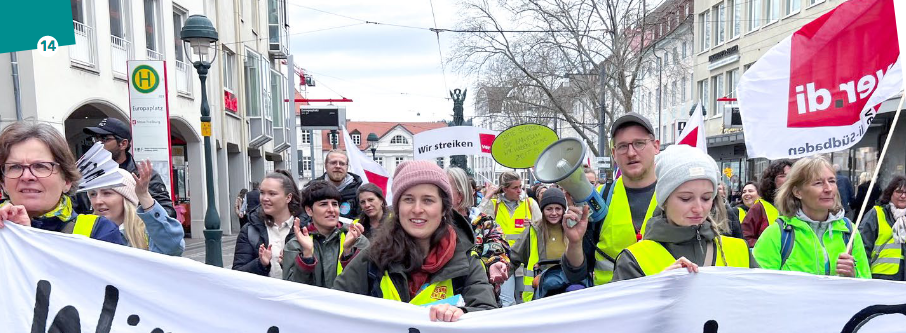
Perhaps ever since the dawn of capitalism, when the first workers were – literally – whipped into factory work and converted from life on a farm with a natural day and night rhythm and adjusted to the factory clock on the wall of a Satanic Mill, workers have known that working hours have a huge impact on life as a whole.
A day has 24 hours, a week has seven days and five working days – for most. As a recent survey of almost 10,000 workers by Germany’s almost two-million-member service workers’ trade union Ver.di shows, the five-day work week does not exist, for example, in care work. Yet, for them and for other workers, working time remains very important for private life and recreation.
Beyond that, the length of working time, the location of work, and the reliability of working hour schedules often depend on whether work takes place under a private (corporate, i.e. for profit) or public provider. If, for example, public or corporate management – both increasingly behaving as if they were one and the same – extend working hours, there is less time spent elsewhere. Economists call this a zero-sum game. Put simply, time spent at work is not time spent with, for example, one’s family – and vice versa.
Very unfortunately for capitalism, workers still need periods of rest. Economists call this “reproduction.” One of the more dubious economists – Robert Malthus – even discussed the conditions under which workers would reproduce themselves as a class – needed as a usable commodity in 18th-century factories and workhouses.
For the necessary reproduction to occur, this includes – among other things – time for rest, sleep, housework, food, and for “private” life (Malthus’ procreation). In times of an ageing society, this increasingly includes responsibility for the care of others – the elderly, the incapacitated, etc. – and unpaid work.
Management can and does make workers work overtime and change working hours and schedules, and this has an impact on health, social life, private interests, families, and care work. Germans know this as KAPOVAZ, which roughly translates into capacity-oriented variable working time.
In this form of working time, hours are scheduled by management – unilaterally – so that they match the amount of work – also scheduled unilaterally. Work time assignments are exclusively determined by management. As a result, workers are severely restricted in terms of predictability of their time.
Yet, flexible regulation of working hours can also have a positive effect, but this only occurs if the general conditions are right – a fair distribution of paid work must be enshrined in collective bargaining agreements. Such positive effects could even extends to filling the 600,000 positions that are currently open in Germany’s public sector.
Meanwhile, management like to claim that some schedules are difficult to plan even though planning is their job. This, more often than not, is the well-crafted managerial reality “for” or perhaps “against” female workers. This, in turn, impacts the care of children as well as the care of loved ones. Next to limiting the caprices of management, an overall reduction of working hours can ensure time for care work. On the downside, this can also mean workers earn less money and experience reduced career opportunities. This will, inevitably, increase the risk of old-age poverty – particularly for female workers.
Still, the realities of working time are often incompatible with “work-life” compatibilities and health – particularly in Germany’s service and care industries. To maintain and promote humane working conditions, needs-based working hours can enable a good balance between employment and personal life. Germany’s Working Time Act provides some protective measures in this regard.
Currently, the German union index on “Good Work” shows that almost all workers want working hours that are compatible with their lives. Unsurprisingly, 95% of workers in Germany wish to be able to finish work before 6 pm and 72% would like working hours of less than eight hours.
The basis for good compatibility between employment and personal life is that work supports the mental as well as physical health of workers. In other words, work must be designed in such a way that there is no harm to health and that health is preserved in the long term.
In total, more than a third (36.9%) of workers in Germany’s service sector work on a part-time basis. The part-time rate for women stands at 53.3% – much higher than for men: 16.4%.
Almost half of all workers have reduced working hours – among other reasons – in order to have time for childcare (49.3%) and for private life (49.4%). For 41.7% of part-time workers, workloads would be too high if longer hours were required.
Yet, work stress remains a widespread phenomenon for workers in Germany’s service sector. 24.6% say they “regularly” experience stress at work, while 29.2% say they often do so. 32% say they rarely experience stress at work, while 14.2% say “never.”
As one might expect, a whopping 71.2% of all service sector workers in Germany say that irregular working hours make it hard for them to participate in social activities and private life. It gets worse.
On average, half (51.8%) of all workers in Germany’s service sector believe that the current level of work intensification – often without restrictions on managerial decisions – makes it impossible to work until retirement age. Two out of five employees – a staggering 41.5% – say they will not last that long.
However, such assessments vary greatly depending on the kind of service work performed. Forecasts in Germany’s retail sector are particularly alarming. More than half of all workers (54%) do not believe they will be able to work until retirement. It looks similarly negative in Germany’s social services (49.7%) and the health sector (49%).
Worse, almost two-thirds (62.5%) of all workers in Germany’s service sector go to work even though they feel sick. In addition, 71.5% say they work through their lunch breaks or shorten them.
The picture is similarly bleak regarding the infamous “work-life balance” – something that is talked about a lot but seemingly hard to find. German data support this assumption: 47.3% of workers in Germany’s service sector say they experience a positive work-life balance only “rarely” and 18.7% say never.
In other words, for roughly two-thirds of workers, work-life balance rarely or never exists. Yet 15.3% say they do have a positive work-life balance, with 18.7% saying they sometimes experience it. In short, the famous work-life balance exists for about one-third of all service sector workers, while for two-thirds it rarely or never does.
What does not help is that 60.9% of all workers in Germany’s service sector say they experience work pressure and pressure to work faster – imposed by management. On the statement, “I am too exhausted after work to take care of private and family duties,” 57.9% of workers in social services agreed; 55.3% in retail; and 54.5% in health.
Paradoxically, and perhaps as a result of Germany’s labour relations system, 53.5% of all workers in Germany’s service sector report that they have provisions in their collective bargaining agreements to improve conditions, such as better working time arrangements. But at the shop floor – in hospitals, care homes, day-care and aged-care centres, etc. – these provisions are often not used.
In other words, Germany’s labour relations system has negotiated collective bargaining agreements that allow for improvements in working time. Yet at shop-floor level – where works councils need to implement and oversee these provisions – these arrangements are not enforced with the necessary determination. In other words, there is room for improvement.
Overall, however, such working time arrangements in Germany’s service sector are challenged by management at the shop-floor level. As a consequence, it remains difficult to achieve good compatibility between managerial demands and a positive work-life balance. This creates health risks.
The Ver.di data also show an unequal distribution of unpaid care work. This, in turn, leads to a high proportion of women working part-time. More than half of women working part-time do so because of childcare, and almost a fifth because of the care of relatives.
Meanwhile, work stress remains widespread in Germany’s service sector. Many workers report being highly affected by management’s quest to “rush things” and by constant time pressure.
In addition, three-quarters of workers who work shifts – in the evening or on weekends – say this makes it more difficult to participate in social life. As a consequence, there are rather pessimistic expectations about the ability to work until retirement. Healthcare workers are particularly affected. In Germany’s social services and retail sectors, every second person does not expect to stay in the job until retirement.
Some workers are even forced to endanger their health in order to maintain employment. They do so by going to work even when sick or by waiving much-needed breaks. Only one third of all workers in Germany’s service sector have never gone to work sick. Just 29% do not have to make compromises regarding breaks. There are significant conflicts over time in Germany’s service sector.
More than half of all workers in Germany’s social services, retail, and healthcare sectors are often too exhausted after work to attend to family and private matters, such as caring for others.
Meanwhile, positive working time arrangements do contribute to occupational safety. In other words, even when workers have the ability to be flexible at the start and end of their daily working time, this may not help much if they are rushed, face unlimited time demands from management, and – worse – are pressured to work while sick in order to meet ever-increasing performance expectations.
Therefore, there is a need for clearly defined protective limits on maximum daily working hours as well as guaranteed breaks and recovery times. This is why mandatory recording of working time is important. Attention must be paid to human element in the organisation of work. Finally, strong works councils are needed at the ground level so that protective regulations for workers can be enforced and require – authoritarian, macho-, despotic– or otherwise – management to adhere to these regulations and collective bargaining agreements.
ZNetwork is funded solely through the generosity of its readers.
Donate