

Coca-Cola Deutschland [Germany] has an almost 100-year-long history. It was first bottled in 1929 by the Vertriebsgesellschaft für Naturgetränke [Natural Drinks Company] – even though, apart from water and sugar, not much is natural in Coca-Cola.
In the first year, a whopping 5,840 crates of Coke were sold, and by 1939, 50 factories were in operation in Germany, selling 4.5 million crates of Coke.
To challenge the stratospheric rise of Coke, Karl Flach introduced a German version called Afri Cola on June 26, 1931, with headquarters in Cologne.
In the 1930s, Flach ran an advertising campaign against the market leader Coca-Cola, using Germany’s widespread anti-Semitic attitudes in Hitler’s Reich.
From a U.S. factory tour, Flach took bottle caps stamped with the word “kosher” in Hebrew script – merely indicating that Coke was kosher.
Yet, Flach presented them in Nazi Germany as proof that Coca-Cola was a Jewish company. It was factual nonsense but effective propaganda.
In the Coke vs. Afri Cola advertising war, it worked: Coke’s market share declined, and even the Nazi Party headquarters hastily cancelled their Coke orders. The damage to Coke was severe.
Meanwhile, Flach’s propaganda and anti-Semitic rumors that Coke had Jewish owners continued to circulate for years in Nazi Germany, where propaganda masterminds fueled conspiracy fantasies.
Meanwhile, Coke’s German boss, Max Keith, maintained a good relationship with the Nazi regime. However, the Nazis – unsuccessfully – demanded the removal of a Jewish member from Coca-Cola’s supervisory board.
Yet, nothing captures Coke’s history in Germany – its ties to Nazism and post-war developments – better than Billy Wilder’s utmost exquisite 1961 English-language – “James Cagney” – film Eins, zwei, drei.
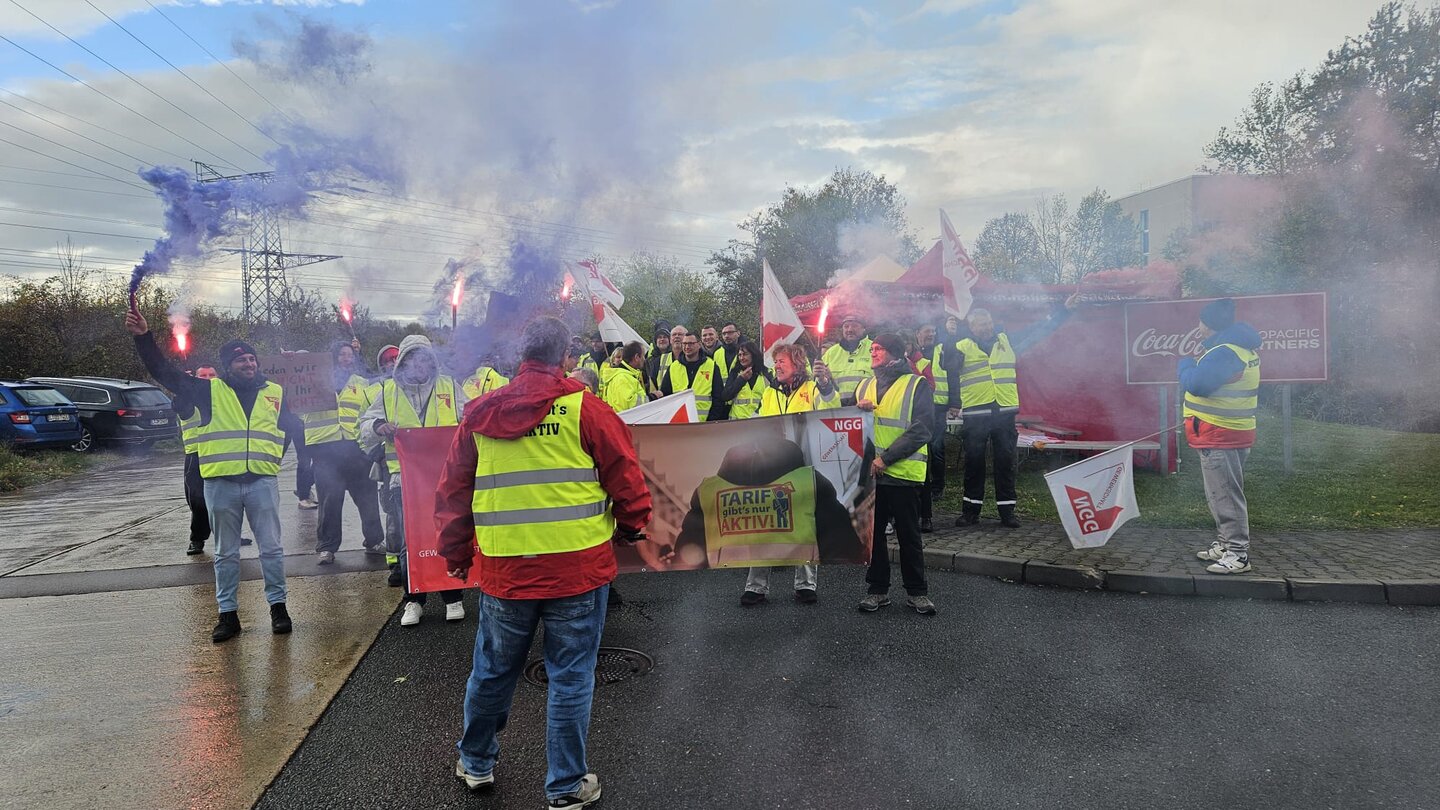
Fast forward to today’s Berlin, where Coke workers in Germany have gone on strike. Workers want to bottle the “brown gold” – water, sugar, and great marketing that leads to handsome corporate profits – for a fair wage.
In October 2025, workers and their trade union, NGG, began strike action at Coca-Cola’s production site in the East German town of Genshagen, just outside Berlin.
According to Coca-Cola’s management, there had already been a wage increase in 2025. However, there is considerable “displeasure” among Coke workers at the site. Unsurprisingly, the conflict centers on wages – a livelihood for workers but a mere business expense for management (read: to be reduced).
The resistance from management forced workers and their union, the NGG (food industry and hospitality), to call a one-day mini-strike to make it clear that workers would not accept the company’s offer in collective bargaining negotiations.
In the nationwide negotiations, the NGG is demanding a wage increase of €150 ($175) per month, plus an additional 5% increase for 2025 – most workers in Germany are paid monthly. The allowance for apprentices should increase by €120 ($140) per year of apprenticeship. The new agreement would apply retroactively from September 1, 2025, for one year.
The noted “displeasure” of the workforce stems from Coca-Cola’s rather offensive salary downgrades for its workers. Worse, Coca-Cola’s management does not envisage any wage increase for 2025 and only wants to offer a meager 1.5% in 2026.
While workers and the NGG call this a blunt provocation, no wage increase effectively means a 2.5% loss, as Germany’s “official” inflation stands at 2.5%. With no raise, workers cannot even keep up with the cost of living – they go backwards.
In other words, Coke’s management wants workers to have less money. And this is aside from the fact that any wage increase should be based on three elements:
- Inflation – to maintain purchasing power;
- Productivity – since productivity gains are only possible through workers’ labor, they should share in the benefits;
- Robin Hood principle – taking from the rich to give to the poor. With inequality and a CEO-to-worker pay gap of 632:1 (the so-called “CEO Pay Machine”), perhaps it’s high time to reverse this ever-growing divide.
For workers, it was particularly reprehensible that compensation for trainees – already earning meager wages – should not increase. Not surprisingly, workers in Genshagen, as elsewhere in the country, are finally demanding appreciation and fair pay.
A Coca-Cola manager, unsurprisingly, disagreed, claiming that wages had already increased by 3.5% or €170 ($197) since March 2025. The union, however, argues that its wage demand is economically viable – and indeed, Coca-Cola is making plenty of money [solide Gewinne].
According to Germany’s foremost business daily, Handelsblatt (October 2025 business data), Coca-Cola’s net profit rose sharply by 17% to €244 million ($260 million). Management is confident it will increase sales by 7% for the full year and achieve an operating return on sales of just over 29.5%.
Coca-Cola Deutschland has 13 factories and 6,500 workers. Yet despite these strong results, management prefers to talk about a “challenging economic situation” – while sales and profits continue to climb.
The increase in profits is only possible because fewer and fewer workers are doing more and more, with stagnating wages and rising costs. To boost profits further, the company announced last year that it would cut 500 jobs in Germany.
Five locations – including Berlin-Hohenschönhausen – were to be closed to “position the company more cost-effectively in a persistently competitive market environment,” as management put it.
In other words, Coke Germany is not outsourcing – production remains in Germany. Rather, it’s automation that drives job cuts. Coca-Cola fills up to 60,000 bottles per hour, with 95% of machinery sourced domestically. It’s a production boom alongside job losses: fewer people, more output – the capitalist wonderland.
At Genshagen, about 180 people work surrounded by machines, filling large PET bottles. For the strike, around 100 workers turned out – the entire early and late shifts – including employees from production, administration, drivers, and trainees.
This was only the beginning; further strikes are planned in Berlin. By the end of October 2025, Coca-Cola locations across Germany were on strike. On November 10, the union and Coca-Cola will resume collective bargaining in Hamburg. Meanwhile, the union plans further strikes at the German headquarters in Berlin-Friedrichshain.
Union officials remain confident, saying: “If Coca-Cola does not move in negotiations, workers will extend the strike until a fair and decent offer is on the table.”
Meanwhile, in East Germany, striking workers stopped the entire morning shift – nothing was running at the plant that day. According to management, 80 employees participated across both the early and late shifts.
In short, no Coke was produced during the strike, and several deliveries were postponed. With their action, workers showed they would not accept management’s previous (non-)offer in wage talks.
Coca-Cola is not planning any wage increase in 2025 – only a measly 1.5% next year. Management emphasizes that wages have already increased by a total of €670 ($780) per month since 2023, including a 3.5% raise in early 2025.
While denying any increase and forcing workers to fall further behind, management still claims that in “recent successful years, we have recognized our workforce’s achievements with high salary qualifications.” They add that they “bear these higher wage costs permanently” – in other words, wages are treated merely as costs to be minimized.
Despite this deceptive corporate language, workers saw the planned wage stagnation [reduction] rather differently. It led to strikes at several sites in Germany to increase pressure in the Berlin-Brandenburg region – still trailing West Germany in pay levels.
Coca-Cola workers have already gone on strike at several other sites: Bremen, Hildesheim, Lüneburg, Mölln, and near Stuttgart. There are 24 Coca-Cola locations in Germany, including 13 production plants and around 6,500 employees.
At Bad Neuenahr, 250 Coca-Cola workers shut down the plant in a 24-hour strike that began with the night shift on Sunday. The action took place amid the ongoing wage dispute.
With strong participation, the production sites in Halle and Weimar were also shut down – all shifts joined, and production and bottling stopped completely.
Coca-Cola’s “zero increase” offer was met with zero acceptance among workers. The strong strike support will surely make management think twice. If management remains stubborn, workers will escalate.
A nationwide strike wave is sweeping through Coca-Cola. In East Germany, the Genshagen site in Brandenburg has already seen action. With the next bargaining round scheduled for November 10, 2025 – and management determined to make workers fall further behind – more strikes are likely to follow this winter at Coca-Cola Germany.
ZNetwork is funded solely through the generosity of its readers.
Donate