

Recently, the staunchly anti-communist supporter of neoliberalism, ex-BlackRock hedge fund manager and now Germany’s chancellor, Friedrich Merz, told Germans to work more – that is what Germany needs. But rather than being aligned with most Germans, conservative Merz seems to be off the mark.
Meanwhile, the hard-working businessman Merz — who last took the rubbish out on 12 March 1997 — is calling on what Max Weber described as the Protestant Work Ethic, or more simply: “work makes life sweet,”as the petty-bourgeois saying goes.
“Work until you drop” – that’s probably what neoliberal politicians think but never say. A good example is the almost permanently right-wing populist boss of Bavaria, Markus Söder, who believes “it makes sense to work longer” – work until you drop, once again. It is claimed to be an interesting symbiosis between capital and conservatism.
Shortly afterwards, Söder cranked it up by calling for an extra hour of work per week, claiming that overtime is a solution to Germany’s economic problems.
At the same time, the conservative CDU’s neoliberal wing wants to restrict the right to part-time work, arguing that if you can work more, you should work more.
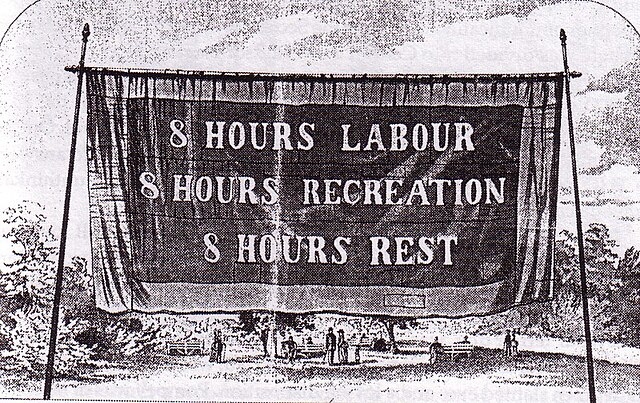
Meanwhile, the facts are these: Germany’s Working Time Act already provides for a maximum weekly working time of 48 hours over six days. However, the current coalition government of the social-democratic SPD and the conservative CDU wants to abolish the eight-hour day in favour of a maximum weekly working time.
According to Germany’s statistical office, the average weekly working time in 2024 was 34.3 hours, while recent surveys on work in Germany show that full-time work remains the most popular form of employment. In other words, Marx is still right: workers need to sell their labour power. Millionaires like Friedrich Merz do not — they are chancellor because they want power.
Surveys also show that a large majority of workers reject a weekly working time of up to 48 hours. A recent survey by Germany’s Internationale Hochschule (IU) found that 73.5 percent stated that a 48-hour week would have a “negative” or “very negative” impact on their lives.
Among the reasons cited were too little time for family and friends, sports or hobbies, as well as health concerns of a physical or psychological nature. At the same time, the IU survey showed that full-time work best fits people’s life situations.
This is followed by a four-day week with 32 hours at full pay (33.9 percent). A classic part-time model with less than 35 hours per week was preferred by 18.5 percent.
The most common working model in the survey was 35 – 40 hours per week (44.7 percent), followed by a four-day week with 32 hours (32 percent), and part-time work under 35 hours (18.5 percent).
The findings show that what the population wants and thinks is decoupled from the wishes of German capital and conservatives. It is hardly surprising how far the basic mood of the population diverges from business interests and conservative politics.
In other words, there is strong rejection of a 48-hour week and broad support for the eight-hour day or less. Simply saying that people have to work more is ultimately short-sighted.
Many people think it’s acceptable to work 40 hours. At the same time, they say: “that’s all you can do, because you can’t reconcile longer working hours with your life.”
In addition, as long as there is no comprehensive childcare and the care crisis – aged care, nursing, and so on — remains unresolved, many things simply do not work.
On the upside, there are many good reasons to reduce long working hours. In the much-discussed shortage of skilled workers, labour is entering what some have called a “golden age.” Companies are desperately searching for qualified personnel, and some are increasingly willing to let workers dictate conditions — including working time.
Unfortunately for the advocates of longer hours, there is much that speaks against increasing working time. Reducing working hours could represent an important step towards a more humane world of work. After all, paid work – under capitalism, under an abusive boss, or both — is not a pleasant experience for many.
Beyond this, collective bargaining gives workers the option to choose between higher earnings and more time off. The majority choose time. This is shown by a new study from the Economic and Social Science Institute (WSI).
Workers in companies with stressful working environments or little room to reconcile work and family life are particularly likely to opt for this – in plain terms: get out as early as possible.
More time can be better than more money. This is how the majority of workers see it. Collective agreements that allow a choice between more free time and higher wages reflect this reality.
According to a joint study by the University of Bielefeld (IAB) and the WSI in 2022, significantly more than half of all workers opted for more time instead of additional money.
In concrete terms, 59 percent chose exclusively more time, 6 percent a combination of time and money, and only 35 percent opted exclusively for more money.
Unsurprisingly, women – especially those with children under the age of 14 – were far more likely to reduce working hours. A predictable 79 percent of this group did so.
Interestingly, the motivations hardly differ by gender. For both women and men, “more time for the family” ranked second. The most common reason was “more time for hobbies, friends and myself.”
Whether workers opt for more free time is also closely linked to corporate culture. Where full-time work is the rigid norm, only 54 percent take advantage of the option to reduce working hours in exchange for lower pay.
The fear of wage and career disadvantages due to shorter working hours is particularly strong where traditional ideas of “standard” working time prevail.
Overall, more time off matters more to many workers than higher wages. This highlights how great the need for time relief really is. The currently discussed deregulation [better: pro-business re-regulation] – driven by corporate Germany and conservative politics – directly contradicts workers’ needs.
In a 2025 survey, almost three-quarters of workers feared negative consequences for their health, work-life balance and everyday organisation if working days of more than ten hours were introduced — as planned by the capital-conservative push for deregulation. Women were even more likely than men to expect negative effects.
In other words, Germany urgently needs social progress on working time. By contrast, the planned sharp increase in working hours is not only an attack on the eight-hour day but would also make it harder for women to work at all. Put plainly: two old men – Merz and Söder – are set to make women’s lives harder.
Contrary to these attacks, many full-time workers want shorter hours. More free time may not boost the much-celebrated GDP, but it is invaluable for people. What good is it if your gravestone reads: “He worked long hours but never saw his daughter grow up,” or “She contributed to GDP but didn’t know who her son really was”?
Despite workers’ wishes, conservative (Merz) and reactionary (Söder) politicians — supported by neoliberal economists, the willing executioners of capitalism — demand longer working hours. They do so in stark contrast to people’s needs.
Merz argues that people must work more to preserve the “prosperity of this country” — code for protecting corporate profits. That workers want the opposite is shown by a SOEP survey from Germany’s Institute for Employment Research, which found that prosperity for workers means having sufficient time beyond employment and self-determination over working hours.
It remains essential that people can spend time together – on weekends, for example – and that work is not intensified to the point where life outside of work is written off due to exhaustion.
Most workers want more time beyond the job. Given increasing work intensity, a general reduction in working hours – towards a healthy full-time of 30 hours per week– is appropriate.
GDP is used – and abused – as a central metric in a so-called debate where corporate media, conservatives and lobbyists disguised as “economic experts” play ping-pong with one another. GDP is based on the neoliberal hallucination of eternal growth and says nothing about who actually benefits — namely, that the rich keep getting richer.
Since reunification in 1990, Germany’s GDP has risen sharply, despite recent dips. The political priority of the neoliberal-business-conservative bloc remains growth — not climate protection.
For the profit-maximisers of neoliberal capitalism, this is why more work is demanded. Growth benefits the rich disproportionately. As Warren Buffett famously admitted:
There’s class warfare, all right,
but it’s my class, the rich class,
that’s making war — and we’re winning.
Ideologically, rising GDP is equated with prosperity. But GDP says nothing about wealth distribution or “time prosperity” (what German unions call Zeitwohlstand) – self-determined time beyond paid labour.
Meanwhile, productivity stagnates and health insurance data document the harmful effects of work. This is sidelined. Instead, corporate media amplify claims from neoliberal businessmen and conservative politicians that Germans are working too little. This is media capitalism at work.
There is no clear measure of what “too little” even means. The debate has long ceased to be about meeting human needs — housing, food, culture, leisure — and has become solely about making more money from money.
According to neoliberal ideology , there is never enough. Even when people are well supplied and leisure increases, capitalism demands more growth.
If studies don’t support political goals, facts are freely invented. Corporate media eagerly spread narratives that discredit any opposition — especially opposition to capitalism. Communist parties have been finished off, social-democratic parties are next on the list.
Prosperity, we are told, requires greed. The message is always TINA – there is no alternative – even in the midst of climate collapse.
Meanwhile, 61 percent of workers fear burnout. Being unemployed is awful, but working too much – or under the wrong conditions – is also destructive. Worse still: many workers remain poor despite full-time work – the precariat.
More than 800,000 workers earn wages too low to live on. For millions, the bitter reality remains: from dishwasher to dishwasher.
It is no secret that the neoliberal growth mantra of higher, faster, more leads not to shared prosperity but to over-exploitation of people and planet. Instead of being strapped to this wheel of illusion, workers need two things:
- A fundamentally different economy for planet Earth.
- New concepts of work and prosperity beyond neoliberal constraints.
The reasons to abandon growth fetishism are many — personally and socially. The next time corporate captains crack the whip and tell us to row, the answer should be simple: row yourself. In other words, some row the boat while others sit on the upper deck. See: metropolis.
Given the choice, workers overwhelmingly prefer more time over more money. Collective agreements must guarantee that choice.
This also suggests that trade unions can – and should – continue reducing working hours without wage losses. It is imperative to resist the planned erosion of leisure time pushed by corporate Germany and its conservative political enforcers – the willing executioners of neoliberal capitalism.
ZNetwork is funded solely through the generosity of its readers.
Donate