
Canada is burning and First Nations and Indigenous communities in the north are on the front line.
It has made the air unbreathable across vast portions of North America.
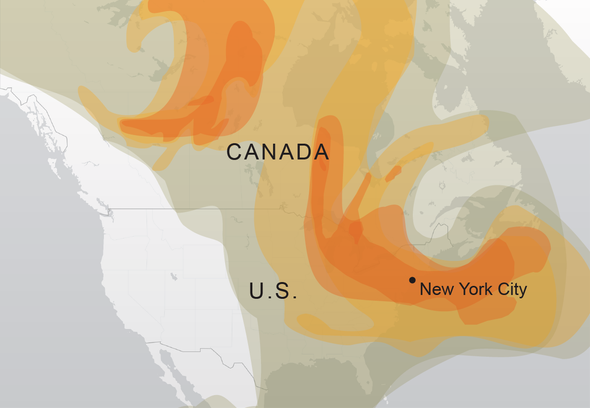
The unprecedented environmental disaster has turned skies in the biggest cities on the U.S. east coast eerily blood orange and is causing unhealthy air to affect millions of people. Prime Minister Justin Trudeau and President Joe Biden are having emergency phone calls and firefighters from all over the world are flying to Canada to fight the climate crisis war that has arrived at every door.
Professional baseball games and other events have been forced to postpone up and down the east coast, and some flights have been delayed as health officials warn people to be cautious going outdoors. Warnings also included shortening time outside for pets.
In Washington, bluer skies can be seen Friday. An improvement in air quality compared to Wednesday and Thursday, but a haze still sits over the mid-Atlantic.
In Canada, Blake Desjarlais, Metis Nation, a member of Parliament, gave an impassioned speech in the Canadian House of Commons about how Indigenous peoples have been living with the growing threat of fire for as long as he can remember. The young first time Parliament member who came to Ottawa as a self-described “climate champion” recalled the raging wildfire that drove him and his family from their homes as a child in 2003.
“It brought down forests, it brought down power lines, it stopped roads, it stopped services. We were stranded. I was alone and I was scared. Me, my mom, my dad, my sister, alone cut off by all roads. Trees fall on either side of us. We thought surely this would be it,” the 29-year-old member of the Fishing Lake Metis Settlement shared during an emergency debate in the evening of June 5. “My dad, my mom prayed. My dad did what he could. His father had built a barn and he looked after that barn. Inside that barn, our saddles, handmade, passed on from generation to generation. From horse whisperers in my family to some of the best rodeo clowns our province has to offer. That history burned to ash, my father reduced to tears.”
Trudeau held a press conference on Wednesday with all ministers who lead the government’s response to the national emergency, including ministers of National Defense, Emergency Preparedness and Indigenous Services. An unusually dry and warm period in Canada has sparked a threatening wildfire season. Some fear it’s only getting started. More than 400 blazes burned Thursday, with nearly half in the Quebec area, according to the Associated Press.
“Unfortunately, over the past years, we’ve seen extreme weather events increase in their intensity and their impact on Canadians as well as on their cost to families to provinces and to the federal budget,” said Trudeau. “We have, over the past years, seen atmospheric rivers in (British Columbia) causing devastating floods. We’ve seen a hurricane Fiona hit harder than hurricanes in recent memory last year, and this year, the worst wildfire season we’ve ever had right across the country.”
Indigenous communities were the first to feel the impacts.
“There are 17 First Nations that are currently affected by wildfire events and there are 13 First Nations that are evacuated. More than 6,500 people remain evacuated,” said Minister of Indigenous Services Canada Patty Hadju. “Some communities are evacuating as a result of the incredible health risks to people that are already vulnerable and living with a number of health conditions. Chiefs like Chief (Billy-Jo) Tuccaro of Mikisew First Nations spoke about critical infrastructure that they’re losing, including hunting cabins on the land, critical to communities livelihood and self determination in terms of food security.”
Indigenous Services is the federal ministry that is responsible for action on the ground and in the communities, Indigenous Relations is the ministry responsible for negotiation and Treaty Relations.
“Chief (April) Martel K’atl’odeeche First Nation toured her devastated community with critical infrastructure, housing, administrative offices that have been lost and had to break the news to the families that were evacuated that everything that they loved was gone overnight,” said Minister Hadju. “We’ve seen chiefs and councils and Indigenous first responders rolling up their sleeves and working diligently to try to protect communities. And of course, with the first priority being to protect the lives and make sure people are moved to safety.”
When a First Nation community on-reserve is evacuated, all costs related to a wildfire response are covered through the Emergency Management Assistance Program, according to Indigenous Services Canada. This can include accommodations, transportation, food, and security protection costs, as well as mental health and wellness support. Measures that support First Nations members to safely remain in place during an emergency event are also eligible under the program. After a wildfire, it covers recovery-related expenses including repair or replacement of homes, roads, and other infrastructure. As the wildfires are still active, Indigenous Services Canada continues to support communities affected and is in daily contact with leadership to discuss the day-to-day plans and supports required, as well as the long-term actions needed to support the communities that have had a loss of infrastructure.
“We know that First Nations continue to be on the frontline of climate change. Communities are not only devastated from the effects of wildfires in their own communities, but also many are surrounded by forests that provide the economy that many members work in,” stated Minister Hajdu. “We’ll be with communities as they begin that hard work of assessing what it will take to rebuild in the cases of communities that have damaged infrastructure, we’ll be there to support communities as they help their members in extraordinarily difficult evacuation situations.”
Dejarlais visited the East Prairie Metis Settlement just north of the city of Edmonton, Alberta, and near his home community of Fishing Lake after they returned to their burned out home. He met with leadership and community members including a residential school survivor whose memories of that experience were brought up during the evacuation.
“She said the fear she had in her heart to not know what she was going back to triggered her. And she wept. And she found that although there was nothing left of her home, that there was so much left of her community,” said Desjarlais. “Her strength and what she provided to the leadership, kindness to the children, to the mothers, to those who are truly in pain. She offered them smiles and she offered them condolences and she offered them love even though hers and herself had lost so much.”
Emergency Preparedness Minister Bill Blair noted the international support to this national crisis with international impact. “We’re still working with our international partners. We’ve had conversations going on with our American colleagues in particular, but also right across the country to make sure that we have those assets and resources when and wherever we need them,” said the Minister. “We also learn from these events and if there is an opportunity to be more agile, more adept, more responsive to the needs of communities right across Canada, we’re gonna find ways to do it.”
The updates below are as of June 7, 2023 at 17:00 EDT unless otherwise noted.
Alberta
Mikisew Cree First Nation is preparing a repatriation plan for evacuees however remains fully evacuated at this time. Overall in Alberta there remains over 3,100 evacuees from the following communities: Little Red River Cree Nation, Dene Tha’ First Nation, Mikisew Cree First Nation and Athabasca Chipewyan First Nation.
Saskatchewan
As there is no fire threat to communities, Buffalo River Dene Nation and English River First Nation began repatriation of vulnerable community members on June 6.
Ontario
Respective chiefs from Taykwa Tagamou Nation and Mattagami First Nation requested at least an additional 12 hours on June 6 to monitor wildfire activities before deciding further actions.
Québec
Nearly 3,500 members from six First Nations communities are currently evacuated: Lac Simon, Kitcisakik, Barrière Lake, Oujé-Bougoumou, Opitciwan et Waswanipi.
The 1,500 evacuees from Uashat mak Mani-Utenam were able to leave Pessamit to return to the community. About 750 evacuees from the Lac Simon Anishnabe Nation returned home on June 5, but 150 vulnerable people remain evacuated.
Oujé-Bougoumou Cree Nation carried out the complete evacuation of the approximately 1,000 members of the community. The city of Saguenay has opened an emergency shelter in the arena and at the Cégep de Chicoutimi. 433 people are registered as of June 7.
On June 6, the Atikamekw of Opitciwan decided to evacuate its vulnerable population due to the presence of thick smoke. The evacuees are housed in Roberval, at the hotel. Other people joined on June 7 and were welcomed into the emergency accommodation center set up by the community of Mashteuiatsh.
Waswanapi evacuated part of its population on June 7. Vulnerable people were directed to hotels in Quebec City as well as to an emergency accommodation center at the Center de expositions de Québec. For more details on coordinating the evacuation and accommodation of members of Waswanipi, please contact the coordination office set up by the community for this purpose.
British Columbia, Manitoba, Nova Scotia and Northwest Territories
For British Columbia, Manitoba and Nova Scotia, there are no updates to report as the situation remains stable for First Nations communities.
For the Northwest Territories – the Kátł’odeeche First Nation remains fully evacuated.
ZNetwork is funded solely through the generosity of its readers.
Donate