
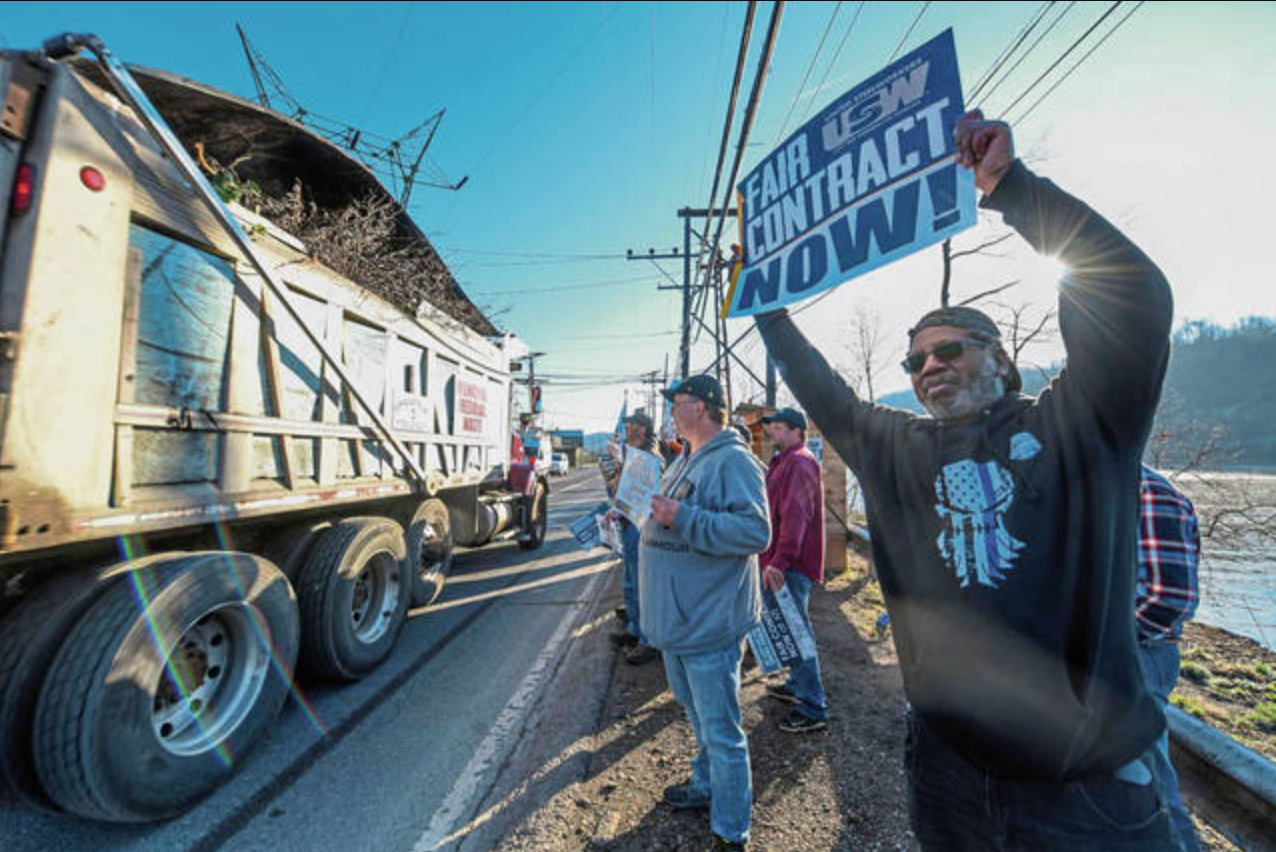
Terry Stickles supported the successful union drive at JSW Steel in Mingo Junction, Ohio, in 2025, then went to the bargaining table eager to hammer out his first contract with the company and set a course for the future.
His coworkers, also new members of the United Steelworkers (USW), felt the same urgency. But JSW chose to play around instead, offering few meeting dates to union negotiators, taking hours to review even basic contract proposals, and cutting bargaining sessions short for no good reason.
“It’s almost like kids’ games,” Terry, an Army veteran and millwright, explained of a bargaining process that continues to drag on because of the company’s stonewalling.
This kind of dithering is how spoiled-brat executives retaliate against hardworking people for exercising their labor rights. It’s why it takes workers, on average, almost 500 days to negotiate their first contract after joining a union.
Negotiations over health care coverage, workplace safety, and related issues are no place for juvenile antics—and that’s exactly why Democrats and Republicans in the U.S. House joined forces recently to pass the Faster Labor Contracts Act.
The legislation, now before the Senate, promises to fix a broken system that allows employers to flout labor law and run roughshod over workers’ rights.
It would require companies to begin negotiations within 10 days of workers’ vote to form a union and require mediation if the two sides prove unable to reach a contract within three months. If mediation also fails to bring consensus, a panel of arbitrators would step in and set the terms of the first contract.
The legislation forces a company’s negotiators to roll up their sleeves and get down to business. That makes perfect sense to working people. It’s what we do every day.
“Show up,” Terry said, referring to JSW’s negotiators. “Let’s do our job. Let’s get this over with.”
Sadly, many executives view empowered workers as a threat.
It bruises their inflated egos to think that the people who actually produce the company’s wealth want a seat at the table, and so they pull every trick imaginable to thwart workers from banding together in the first place. Like many others, the USW members at JSW faced a nasty anti-union campaign in the run-up to voting for the union.
When workers unionize in spite of all the threats and harassment, their bosses double down on obstructionism and slow-walk the bargaining process. They’d rather pay their labor lawyers to twiddle their thumbs—and let their HR consultants run up huge tabs doing nothing—than come to the table in good faith and wrap up a fair contract with the workers who deliver day after day.
This isn’t an occasional occurrence. It’s become the corporate business model, with research showing that the average fight for a first contract is actually taking longer as the years go by.
The stalling takes various forms.
For example, the company sometimes rebuffs union efforts to schedule negotiating sessions. Or it agrees to meetings and then cancels them, often at the last minute. Or the company negotiators arrive late and leave early, deliberately leaving little time to get anything done.
On other days, the company representatives throw a tantrum and walk out. Or they say they can’t discuss a certain issue because they failed to bring the right person with them. Or they take a union proposal and disappear into a caucus for hours at a stretch, just to waste time, as often happens at JSW.
You get the picture.
It’s all calculated to demoralize workers and punish them for unionizing. Corporations also hope that frustrated workers will turn on each other, undermining the solidarity that’s the heart of collective power.
This is more than petty. It’s harmful, holding up progress on issues truly important to workers and employers alike.
“We want safety,” Terry said of his coworkers, who make steel for wind turbines. “We want a voice on safety.”
Terry and the rest of the negotiating team provide regular updates to their colleagues, keeping everyone up to date and focused on the fight.
They’ll prevail. But passing the Faster Labor Contracts Act will put teeth in our labor laws, force employers to respect the bargaining process, and spare millions of other workers the chicanery that Terry and his coworkers face.
This article was produced by the Independent Media Institute.
ZNetwork is funded solely through the generosity of its readers.
Donate

