
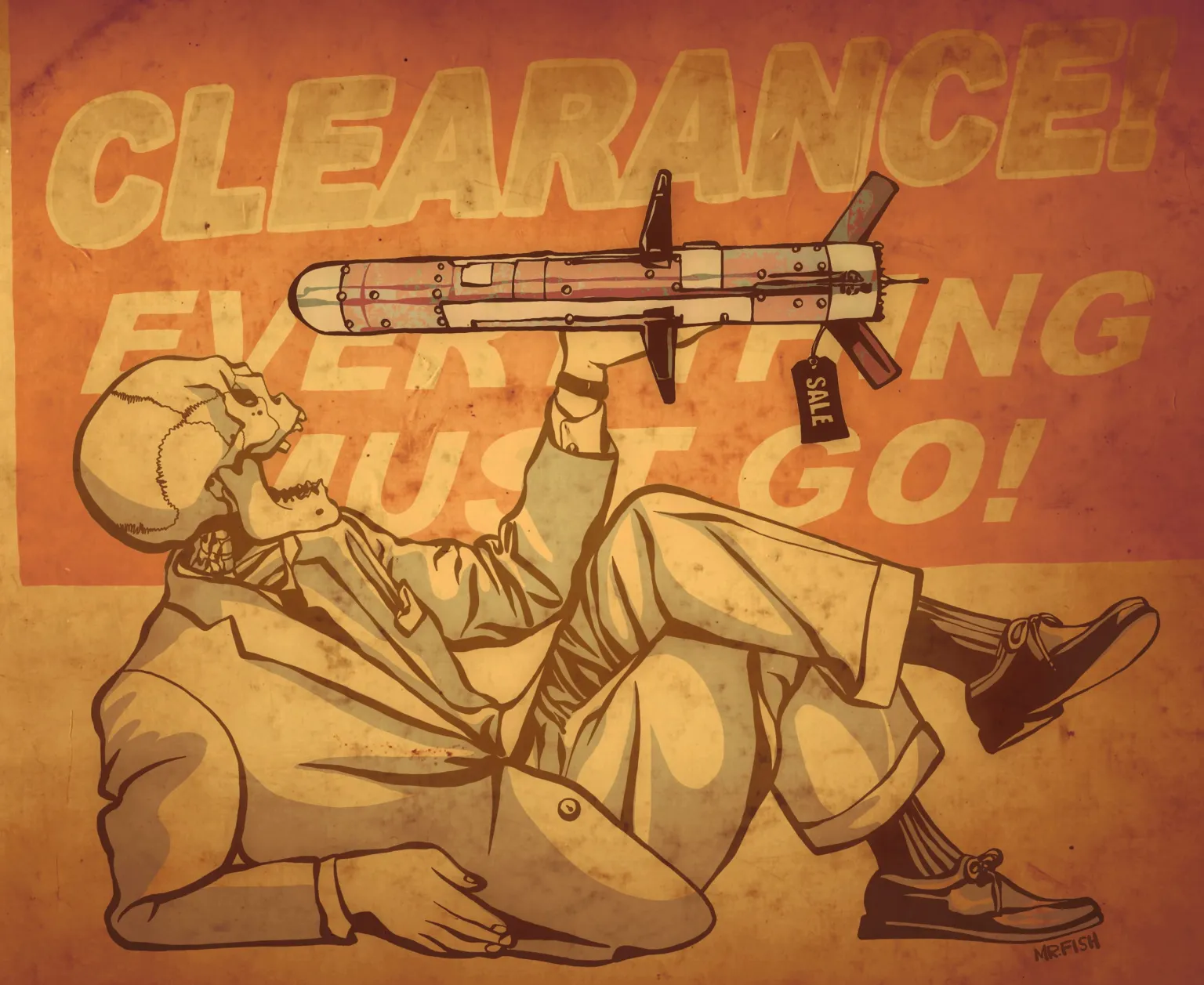
NATO support for the war in Ukraine, designed to degrade the Russian military and drive Vladimir Putin from power, is not going according to plan. The new sophisticated military hardware won’t help.
Empires in terminal decline leap from one military fiasco to the next. The war in Ukraine, another bungled attempt to reassert U.S. global hegemony, fits this pattern. The danger is that the more dire things look, the more the U.S. will escalate the conflict, potentially provoking open confrontation with Russia. If Russia carries out retaliatory attacks on supply and training bases in neighboring NATO countries, or uses tactical nuclear weapons, NATO will almost certainly respond by attacking Russian forces. We will have ignited World War III, which could result in a nuclear holocaust.
U.S. military support for Ukraine began with the basics — ammunition and assault weapons. The Biden administration, however, soon crossed several self-imposed red lines to provide a tidal wave of lethal war machinery: Stinger anti-aircraft systems; Javelin anti-armor systems; M777 towed Howitzers; 122mm GRAD rockets; M142 multiple rocket launchers, or HIMARS; Tube-Launched, Optically-Tracked, Wire-Guided (TOW) missiles; Patriot air defense batteries; National Advanced Surface-to-Air Missile Systems (NASAMS); M113 Armored Personnel Carriers; and now 31 M1 Abrams, as part of a new $400 million package. These tanks will be supplemented by 14 German Leopard 2A6 tanks, 14 British Challenger 2 tanks, as well as tanks from other NATO members, including Poland. Next on the list are armor-piercing depleted uranium (DU) ammunition and F-15 and F-16 fighter jets.
Since Russia invaded on February 24, 2022, Congress has approved more than $113 billion in aid to Ukraine and allied nations supporting the war in Ukraine. Three-fifths of this aid, $67 billion, has been allocated for military expenditures. There are 28 countries transferring weapons to Ukraine. All of them, with the exception of Australia, Canada and the U.S., are in Europe.
The rapid upgrade of sophisticated military hardware and aid provided to Ukraine is not a good sign for the NATO alliance. It takes many months, if not years, of training to operate and coordinate these weapons systems. Tank battles — I was in the last major tank battle outside Kuwait City during the first Gulf war as a reporter — are highly choreographed and complex operations. Armor must work in close concert with air power, warships, infantry and artillery batteries. It will be many, many months, if not years, before Ukrainian forces receive adequate training to operate this equipment and coordinate the diverse components of a modern battlefield. Indeed, the U.S. never succeeded in training the Iraqi and Afghan armies in combined arms maneuver warfare, despite two decades of occupation.
I was with Marine Corps units in February 1991 that pushed Iraqi forces out of the Saudi Arabian town of Khafji. Supplied with superior military equipment, the Saudi soldiers that held Khafji offered ineffectual resistance. As we entered the city, we saw Saudi troops in commandeered fire trucks, hightailing it south to escape the fighting. All the fancy military hardware, which the Saudis had purchased from the U.S., proved worthless because they did not know how to use it.
NATO military commanders understand that the infusion of these weapons systems into the war will not alter what is, at best, a stalemate, defined largely by artillery duels over hundreds of miles of front lines. The purchase of these weapons systems — one M1 Abrams tank costs $10 million when training and sustainment are included — increases the profits of the arms manufacturers. The use of these weapons in Ukraine allows them to be tested in battlefield conditions, making the war a laboratory for weapons manufacturers such as Lockheed Martin. All this is useful to NATO and to the arms industry. But it is not very useful to Ukraine.
The other problem with advanced weapons systems such as the M1 Abrams, which have 1,500-horsepower turbine engines that run on jet fuel, is that they are temperamental and require highly skilled and near constant maintenance. They are not forgiving to those operating them who make mistakes; indeed, mistakes can be lethal. The most optimistic scenario for deploying M1-Abrams tanks in Ukraine is six to eight months, more likely longer. If Russia launches a major offensive in the spring, as expected, the M1 Abrams will not be part of the Ukrainian arsenal. Even when they do arrive, they will not significantly alter the balance of power, especially if the Russians are able to turn the tanks, manned by inexperienced crews, into charred hulks.
So why all this infusion of high-tech weaponry? We can sum it up in one word: panic.
Having declared a de facto war on Russia and openly calling for the removal of Vladimir Putin, the neoconservative pimps of war watch with dread as Ukraine is being pummeled by a relentless Russian war of attrition. Ukraine has suffered nearly 18,000 civilian casualties (6,919 killed and 11,075 injured). It has also seen around 8 percent of its total housing destroyed or damaged and 50 percent of its energy infrastructure directly impacted with frequent power cuts. Ukraine requires at least $3 billion a month in outside support to keep its economy afloat, the International Monetary Fund’s managing director recently said. Nearly 14 million Ukrainians have been displaced — 8 million in Europe and 6 million internally — and up to 18 million people, or 40 percent of Ukraine’s population, will soon require humanitarian assistance. Ukraine’s economy contracted by 35 percent in 2022, and 60 percent of Ukrainians are now poised to live on less than $5.5 a day, according to World Bank estimates. Nine million Ukrainians are without electricity and water in sub-zero temperatures, the Ukrainian president says. According to estimates from the U.S. Joint Chiefs of Staff, 100,000 Ukrainian and 100,000 Russian soldiers have been killed in the war as of last November.
“My feeling is we are at a crucial moment in the conflict when the momentum could shift in favor of Russia if we don’t act decisively and quickly,” former U.S. Senator Rob Portman was quoted as saying at the World Economic Forum in a post by The Atlantic Council. “A surge is needed.”
Turning logic on its head, the shills for war argue that “the greatest nuclear threat we face is a Russian victory.” The cavalier attitude to a potential nuclear confrontation with Russia by the cheerleaders for the war in Ukraine is very, very frightening, especially given the fiascos they oversaw for twenty years in the Middle East.
The near hysterical calls to support Ukraine as a bulwark of liberty and democracy by the mandarins in Washington are a response to the palpable rot and decline of the U.S. empire. America’s global authority has been decimated by well-publicized war crimes, torture, economic decline, social disintegration — including the assault on the capital on January 6, the botched response to the pandemic, declining life expectancies and the plague of mass shootings — and a series of military debacles from Vietnam to Afghanistan. The coups, political assassinations, election fraud, black propaganda, blackmail, kidnapping, brutal counter-insurgency campaigns, U.S. sanctioned massacres, torture in global black sites, proxy wars and military interventions carried out by the United States around the globe since the end of World War II have never resulted in the establishment of a democratic government. Instead, these interventions have led to over 20 million killed and spawned a global revulsion for U.S. imperialism.
In desperation, the empire pumps ever greater sums into its war machine. The most recent $1.7 trillion spending bill included $847 billion for the military; the total is boosted to $858 billion when factoring in accounts that don’t fall under the Armed Services committees’ jurisdiction, such as the Department of Energy, which oversees nuclear weapons maintenance and the infrastructure that develops them. In 2021, when the U.S. had a military budget of $801 billion, it constituted nearly 40 percent of all global military expenditures, more than the next nine countries, including Russia and China, spent on their militaries combined.
As Edward Gibbon observed about the Roman Empire’s own fatal lust for endless war: “[T]he decline of Rome was the natural and inevitable effect of immoderate greatness. Prosperity ripened the principle of decay; the cause of the destruction multiplied with the extent of conquest; and, as soon as time or accident had removed the artificial supports, the stupendous fabric yielded to the pressure of its own weight. The story of the ruin is simple and obvious; and instead of inquiring why the Roman Empire was destroyed, we should rather be surprised that it had subsisted for so long.”
A state of permanent war creates complex bureaucracies, sustained by compliant politicians, journalists, scientists, technocrats and academics, who obsequiously serve the war machine. This militarism needs mortal enemies — the latest are Russia and China — even when those demonized have no intention or capability, as was the case with Iraq, of harming the U.S. We are hostage to these incestuous institutional structures.
Earlier this month, the House and Senate Armed Services Committees, for example, appointed eight commissioners to review Biden’s National Defense Strategy (NDS) to “examine the assumptions, objectives, defense investments, force posture and structure, operational concepts, and military risks of the NDS.” The commission, as Eli Clifton writes at the Quincy Institute for Responsible Statecraft, is “largely comprised of individuals with financial ties to the weapons industry and U.S. government contractors, raising questions about whether the commission will take a critical eye to contractors who receive $400 billion of the $858 billion FY2023 defense budget.” The chair of the commission, Clifton notes, is former Rep. Jane Harman (D-CA), who “sits on the board of Iridium Communications, a satellite communications firm that was awarded a seven-year $738.5 million contract with the Department of Defense in 2019.”
Reports about Russian interference in the elections and Russia bots manipulating public opinion — which Matt Taibbi’s recent reporting on the “Twitter Files” exposes as an elaborate piece of black propaganda — was uncritically amplified by the press. It seduced Democrats and their liberal supporters into seeing Russia as a mortal enemy. The near universal support for a prolonged war with Ukraine would not be possible without this con.
America’s two ruling parties depend on campaign funds from the war industry and are pressured by weapons manufacturers in their state or districts, who employ constituents, to pass gargantuan military budgets. Politicians are acutely aware that to challenge the permanent war economy is to be attacked as unpatriotic and is usually an act of political suicide.
“The soul that is enslaved to war cries out for deliverance,” writes Simone Weil in her essay “The Iliad or the Poem of Force”, “but deliverance itself appears to it an extreme and tragic aspect, the aspect of destruction.”
Historians refer to the quixotic attempt by empires in decline to regain a lost hegemony through military adventurism as “micro-militarism.” During the Peloponnesian War (431–404 B.C.) the Athenians invaded Sicily, losing 200 ships and thousands of soldiers. The defeat ignited a series of successful revolts throughout the Athenian empire. The Roman Empire, which at its height lasted for two centuries, became captive to its one military man army that, similar to the U.S. war industry, was a state within a state. Rome’s once mighty legions in the late stage of empire suffered defeat after defeat while extracting ever more resources from a crumbling and impoverished state. In the end, the elite Praetorian Guard auctioned off the emperorship to the highest bidder. The British Empire, already decimated by the suicidal military folly of World War I, breathed its last gasp in 1956 when it attacked Egypt in a dispute over the nationalization of the Suez Canal. Britain withdrew in humiliation and became an appendage of the United States. A decade-long war in Afghanistan sealed the fate of a decrepit Soviet Union.
“While rising empires are often judicious, even rational in their application of armed force for conquest and control of overseas dominions, fading empires are inclined to ill-considered displays of power, dreaming of bold military masterstrokes that would somehow recoup lost prestige and power,” historian Alfred W. McCoy writes in his book, “In the Shadows of the American Century: The Rise and Decline of US Global Power.” “Often irrational even from an imperial point of view, these micro-military operations can yield hemorrhaging expenditures or humiliating defeats that only accelerate the process already under way.”
The plan to reshape Europe and the global balance of power by degrading Russia is turning out to resemble the failed plan to reshape the Middle East. It is fueling a global food crisis and devastating Europe with near double-digit inflation. It is exposing the impotency, once again, of the United States, and the bankruptcy of its ruling oligarchs. As a counterweight to the United States, nations such as China, Russia, India, Brazil and Iran are severing themselves from the tyranny of the dollar as the world’s reserve currency, a move that will trigger economic and social catastrophe in the United States. Washington is giving Ukraine ever more sophisticated weapons systems and billions upon billions in aid in a futile bid to save Ukraine but, more importantly, to save itself.

Chris Hedges worked for nearly two decades as a foreign correspondent for The New York Times, National Public Radio and other news organizations in Latin America, the Middle East and the Balkans. He was part of the team of reporters at The New York Times who won a Pulitzer Prize for their coverage of global terrorism. Hedges is a fellow at the Nation Institute and the author of numerous books, including War is a Force That Gives Us Meaning.
ZNetwork is funded solely through the generosity of its readers.
Donate