
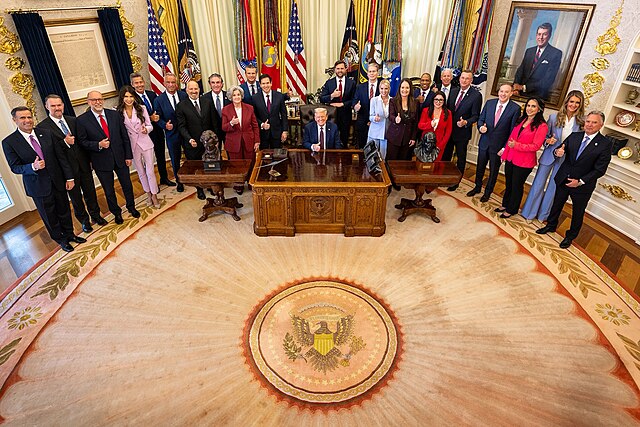
During Trump’s first term it became something of a meme to compare Trump’s inner circle to the collection of grotesque villains portrayed in Batman movies and cartoons. The Trump administration had seemingly been culled directly from Gotham City. In this 2017 warmup to fascism, Trump still had “Sloppy” Steve Bannon, moving chess pieces, Alex Jones’ spouting unhinged conspiracies, and the narcoleptic Ben Carson as secretary of housing, but the appointment of such misshapen ghouls as RFK Jr., Kristi Noem, Tom Holman, Pete Hegseth and Stephen Miller to positions invested with latent sadism had yet to be imagined.
One of the overlooked paradoxes of fascism juxtaposes the oddly broken collection of miscreants coalescing at the centers of power with the targeting of disabled people. This peculiarity rather mirrors the historical propensity of fascism to cleave persecuted groups into victims and collaborators. Thus Nazi Brownshirts, operating within an overarching masculinist narrative, featured an array of “homosexual” leaders at the vanguard of street violence (at least prior to the “Night of the Long Knives”). Ghetto roundups for the death camp transports were conducted significantly by the “Jewish police” and “racially inferior” Slavs were conscripted to carry out the gruesome task of Nazi genocide. Obviously, persecuted collaborators had a rational survival motive to assist their tormentors, but the scope and ferocity of such collaboration speaks to darker, more subliminal forces. The Jewish police in the Nazi ghetto system exhibited cruelty that went well beyond the mere motive of survival:
“In the summer of 1942, German authorities began an operation to deport hundreds of thousands of Warsaw’s Jews to killing centers in occupied Poland. Jewish police officers helped bring the ghetto’s inhabitants to collection points, from which most were sent to be murdered by gas at Treblinka. Diaries and testimonies describe the ruthless tactics of the policemen—they used sticks and axes to ensure delivery of their required quota of “heads.” Many officers ignored exemption papers and took bribes. Those who exceeded their quotas often “sold” their captives to less successful comrades.”
Eugenic movements feature a leadership core dominated by “imposters” whose fanaticism parallels that of anxiously collaborating victims. This oddity may not be at all conscious – fascism is driven by unacknowledged insecurities. Thus, the Nazi leadership hardly displayed the outward veneer of eugenic elites – we have the alleged missing testicle and micro-penis of the amphetamine scarfing Fuhrer, the chinless profile of Heinrich Himmler, the club-footed Joseph Goebbels, the gnomish figure of Julius Streicher and the obese figure of drug addled Herman Goering – a target of physical mockery at the pinnacle of eugenic passion. We will probably never have access to the inner torment of those who precariously masquerade as talisman of the master race. Does Stephen Miller, wielding his oversized bald head, tethered to the nerdish body of a petite Jewish man, ever consider how vulnerably hypocritical his homicidal bigotry might appear? Fascism requires oceans of subconscious motivation.
We seldom consider fascism’s weirdness, improbable irony, counterintuitive and fragmented collection of things that do not fit together. The mass psychology of fascism normalizes absurdity, and the capacity for resistance falls apart when we lose sight of fascism’s grotesque, mutant and dreamlike character. Why is ICE disproportionately comprised of Hispanic recruits? How do the historically scapegoated Jews (in the narrative association with Israel) become transformed into key players in the US propensity to support genocide? We lose agency when we fail to recognize that fascism occupies something of a parallel dimension in which cause and effect no longer transpire in accustomed ways. Fascism may be partly driven by self-interested criminality, but it would never gather momentum without the collective force of millions of adherents goaded by subconscious worries. We inhabit a darker world than we are willing to admit.
Robert Reich, in a recently posted YouTube video, states matter-of-factly that, “Donald Trump shows signs of dementia.” The observation that Trump displays mental decline has been stated, more or less by every reasonable political writer, and, in our easily accessed social media history of news-clips, we have a huge backlog of Trump’s malapropisms, his lapsing into confused, guttural, groping for words and his defaulting into pure incoherence. These rhetorical quirks compete with the clearer facets of Trump’s narrative style – a systematic, self-indulgent patter of bigotry and racism animated by a strikingly mendacious series of blurted, nonsensical assertions. We are told about migrant invasions, radical communist Democrat Parties, Haitian dog and cat barbecues, and fentanyl carrying caravans. Trump’s rhetoric drives a movement of genocidal intent with its crowning aspiration to violently remove nearly a 6th of US residents using masked, militarized ICE agents. How does dementia factor in? Would a more mentally solid replica of Trump better serve the public interest?
Almost all of the media fare alleging Trump’s dementia (from centrist Democratic Party affiliated pundits and those significantly associated with leftist positions) manifest the same unwarranted assumption – if the public understands that Trump suffers from Alzheimer’s, they will demand his removal from office via the 25th amendment. This basic, rational assumption misses the irrational core of fascism – a system of mass psychology founded, according to Wilhelm Reich (analyzing Nazism), on the subconscious projection of German middle class authoritarian family structure upon the fascist leader. Thus, in (Wilhelm) Reich’s view, the German masses had little motivation to parse fine details of policy, class identity and self- interest when such reasoned considerations were opposed by emotional devotion to “the motherland” and the authoritarian leader that symbolized the dominant family structure of German culture. In Wilhelm Reich’s words:
“Nationalist feeling is the direct continuation of family attachment and, like the latter, is based on the unconscious, deeply anchored mother fixation. This cannot be explained biologically. For this mother fixation itself is a social product.”
Trump’s alleged dementia might be thought of as encouraging the sort of response Dorothy Parker allegedly quipped upon learning of Calvin Coolidge’s death – “how did they know?” Trump has long been subjected to formal and informal diagnostic schemes – he has been labeled as being “a malignant narcissist,” as having “anti-social personality disorder,” and more colloquially, as being a grifter, thug, asshole, imbecile, predator, murderer and pedophile. If all the assertions that many of us have made about Trump have had no success in convincing the public to take action, why should a diagnosis of dementia move the needle of public response? And how do we know (borrowing Dorothy Parker’s wit) that Trump’s bizarre utterances reflect dementia and not some other weird quirk?
Trump is clearly not so demented that he has forgotten his racist, homophobic, militaristic, masculinist enthusiasm. Trump’s enormous collection of cognitive and psychological afflictions bely an intuitive ability to access the darkest corners of our national uncertainty. He has, as if by accident (for Trump, unlike Hitler, has almost no ability to align his perverse character with a coherent strategy) become the pied piper of broken men. His insanity is our national essence.
JW van Prooijen’s piece, “Psychological benefits of believing in conspiracy theories,” offers a more updated take on irrational thinking than that of Wilhelm Reich, arguing that outlandish ideas provide both entertainment and a sense of personal identity to alienated people:
“Research supports the notion that people experience conspiracy beliefs as entertaining. Conspiracy beliefs are associated with dispositional aversion to boredom, and with the more general trait sensation-seeking, reflecting people’s desire for intense sensations and experiences. Sensation-seeking also predicts a range of phenomena closely related with conspiracy beliefs, including radicalization and participation in violent extremist groups, and supernatural beliefs. Moreover, conspiracy beliefs are associated with not only negative but also positive emotions.”
van Prooijen does not link conspiracy thinking to gender, but research clearly indicates that men are significantly more prone to bizarre explanations than women are. We recognize that the MAGA movement has deep roots in the “manosphere,” and the masculinist passions that have always driven Trump’s political career might, in fact, be energized in direct proportion to Trump’s degree of unhinged bile. The crazier he becomes, the more he satisfies the cravings of his followers. In that sense, Trump’s dementia may be the “cherry on top” – the unwitting factor that makes the orange buffoon absolutely irresistible. One is reminded of comedian, Jim Jeffries’ comment before the 2016 election – “I’m voting for Trump to see just how crazy shit gets.”
So how should one explain Trump’s dementia? It certainly misses the moment to appeal to the rational understanding that dementia ought to be an unequivocal disqualifier. Clearly, history proves otherwise in the cases of Ronald Reagan and Joe Biden, but Robert Reich’s video loses something far more shocking than Trump’s dementia. The truly horrifying realization ought to be that Trump’s dementia, like his malignant narcissism, sexual assaults, war mongering, environmental destruction and murderous campaign against immigrants doesn’t alter his blessed trajectory. Trump satisfies, demented or not, the intrapsychic longings of tens of millions of people, and the profit motives of corporate America.
For Trump’s entire presidential career, his opponents have pursued the mirage of pre-fascist normalcy – through the Access Hollywood Tapes, the Mueller Investigation, the Zelenskyy phone call, the fake elector scandal, the recorded phone call to Brad Raffensperger demanding electoral manipulation, two impeachment trials, the Epstein Files scandal, the Jean Carrol court ruling and an ongoing background din of claims that Trump is mentally ill, demented and cognitively limited. The media, including those on the left, have been agonizingly unable to appreciate that objective reality has little meaning in a fascist system.
The public cannot mobilize and fight back if they believe that people need to simply be informed of Trump’s medical condition. We live in a time of unprecedented absurdity, and garden variety rational discourse provides no relief. The media simply can’t stop its perseverative spree of scandal mongering to report on the people’s efforts to organize numbers for civil disobedience against a rapidly consolidating fascist juggernaut – the only story that really matters.
ZNetwork is funded solely through the generosity of its readers.
Donate