
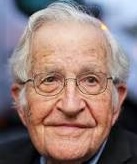
On Monday, over 2,000 people packed into Riverside Church in Manhattan to celebrate the 20th anniversary of Democracy Now! It was an historic occasion in part because it marked the first time Noam Chomsky and Harry Belafonte appeared on stage together in conversation. The two have been longtime champions of social justice. Chomsky is a world-renowned political dissident, linguist and author who gained fame in the 1960s for his critique of the Vietnam War and U.S. imperialism. He is institute professor emeritus at Massachusetts Institute of Technology, where he has taught for more than 50 years. Harry Belafonte is a longtime civil rights activist who was an immensely popular singer and actor. He was one of Martin Luther King’s closest confidants and helped organize the March on Washington in 1963.
AMY GOODMAN: On Monday, over 2,300 people packed into the historic Riverside Church in New York City to celebrate the 20th anniversary of Democracy Now! It was a momentous occasion, in part because it marked the first time Noam Chomsky and Harry Belafonte appeared on stage together in conversation. The two have been longtime champions of social justice. Noam Chomsky is a world-renowned political dissident, linguist, author, who gained fame in the ’60s for his critique of the Vietnam War and U.S. imperialism. He’s institute professor emeritus at the Massachusetts Institute of Technology, where he’s taught for more than half a century. Harry Belafonte is a longtime civil rights activist, immensely popular singer and actor. He was one of Martin Luther King’s closest confidants and helped organize the March on Washington in 1963. Democracy Now!’s Juan González and I sat down with Noam Chomsky and Harry Belafonte on Monday at Riverside Church.
AMY GOODMAN: Now, I just want to start off by saying you have just witnessed an historic moment. Is this the first time, Harry and Noam, that you have met?
HARRY BELAFONTE: It’s not the first time we’ve met, but it’s the first time we’ve shared a platform together.
AMY GOODMAN: Ah.
HARRY BELAFONTE: And it’s a bit overwhelming, a little intimidating, to sit with so much knowledge and sensitivity. Anyway, it’s nice to be with all of you.
AMY GOODMAN: So, we have this opportunity to talk with the two of you at this critical juncture in U.S. history and the world. Harry, back in ’40, before you went off to war, you were banned from the Copacabana as an African American. You come back, and you’re headlining there as one of the world’s great entertainers and musicians. You marched in Selma with Dr. King and were one of his closest confidants. Noam, you marched against the Vietnam War. You thought you’d be spending years, maybe decades, in jail, even as you were rising in your academic career at MIT, willing to give up everything. You two giants of many movements, your thoughts today in the age of Donald Trump?
NOAM CHOMSKY: I defer to you. You’re much more eloquent.
HARRY BELAFONTE: I must admit that I had far more commitment to the belief that in the final analysis, no matter how extreme things might be in America, that eventually our citizens would rise up and righteously stop the enemy at the gate, if not in fact put them in retreat. And each time certain events took place, we met the horror and the terror of not only what I referenced before—to some, I noticed when I mentioned the Fourth Reich, wasn’t quite sure what I was talking about. Just for clarity, as you know, the last great global torment was the Nazi era. It was called the Third Reich. And I thought that we had thoroughly cleansed ourself of that encounter and that we would be much more resilient. But I think, to a degree, we do reveal some resilience, but the real test has not yet come, until the inaugural transference has taken place.
And what concerns me is that, beyond the mischief of Trump and all those in his Cabinet and the people that he’s appointed into roles of leadership, I had never quite understood that we had another severe, unattended enemy in our midst. And that was our species’ commitment or weakness in the face of absolute greed. And I think we have failed to come to certain solid conclusions, because we have been so contaminated with possessions and power that we have forgotten that we have destroyed our children, or set the tone for that. I would welcome Professor Chomsky’s point of view, and I hope he says something that will make me dance out of here.
NOAM CHOMSKY: Well, I should say that I was somewhat immunized to the Trump Electoral College victory—of course, not popular victory, as you know—by the fact that my wife was the only person I knew who, even before the Republican primaries, predicted that Trump was going to win, just looking at the country so much from the outside. She’s from Brazil and felt that somehow she had her finger on the pulse of a large part of the country and was confident that this was going to happen. So I wasn’t all that surprised. Or I think it’s extremely dangerous, in many ways, like the ones I mentioned and others that you’re quite familiar with.
On the other hand, there’s plenty of opportunities. We should bear in mind that the country has become much more civilized in the past 50 or 60 years. A meeting like this could not have been conceivable in 1960, 1970. The kinds of commitment and engagement that you and many others like you are committed to is something quite new. And there have been many advances and achievements: women’s rights, civil rights generally, rights of gays, opposition to aggressions way—environmental concerns didn’t even exist at that time. There’s been tremendous progress. That means that struggles today start from a much higher plane than they did not many years ago. At the time when Harry was marching in Selma, it was a much harsher world than it is today. The reason is that plenty of people did commit themselves to constant, dedicated struggle, and there were plenty of achievements.
And that goes back in American history. No need to review it, but the earlier period is one of total horror. I mean, after all, the country was founded on two incredible crimes, unbelievable crimes: one, virtual extermination of the indigenous population—it’s kind of a migrant crisis of the kind we don’t think about today—and a form of slavery, which was the most vicious in history and is in fact the basis for a large part of the wealth and economic development of the United States, England, France and others. That’s history. When Donald Trump talks about making the country great again, for many people, it wasn’t that great. Quite the opposite.
But the point is, there has been plenty of progress, because people, facing much harsher conditions than we do, didn’t give up. That’s an important lesson. Furthermore, even the election itself suggests major opportunities. For one thing, as you know, the Democrats actually had a considerable majority of the vote. And if you look at the younger voters, the people who will shape the future, they were overwhelmingly anti-Trump and even more overwhelmingly pro-Sanders. That’s an—and we should also bear in mind what a remarkable phenomenon the Sanders campaign was. I mean, there’s—here’s somebody unknown, came from nowhere; practically no one in the country knew who he was. He was using words like “socialism,” which used to be a real curse word. No corporate support, no media support, no support from the wealthy—everything that has always been crucial to winning elections. Mostly we have bought elections. Had none of it and practically took over one of the two major parties—and could have taken it over if it hadn’t been for shenanigans we know about. That’s—and it was primarily driven by young people. All of these are very hopeful signs. I mean, there are plenty of things that can be done. There are opportunities that can be grasped, and no time to run through them, but there are plenty of them. And it’s really very much in our hands and, among the younger of you, in your hands to carry us forward in this long path, long, arduous path towards trying to create a civilized society and a decent world.
AMY GOODMAN: MIT professor and political dissident Noam Chomsky and world-renowned entertainer and activist Harry Belafonte, speaking at Riverside Church on Monday at Democracy Now!‘s 20th anniversary celebration. We’ll return to their historic conversation, the first time they’re on a public panel together, talking about Trump, Ku Klux Klan and much more, in a minute.
[break]
AMY GOODMAN: Tom Morello performing “Flesh Shapes the Day” at Democracy Now!‘s 20th anniversary celebration Monday at Riverside Church. It was a packed house, over 2,300 people. This is Democracy Now!, democracynow.org. I’m Amy Goodman. We return now to this historic conversation between MIT professor, world-renowned political dissident Noam Chomsky and Harry Belafonte, known around the world as an entertainer and an activist. They had never appeared on stage together in conversation before. Juan González and I interviewed them together.
JUAN GONZÁLEZ: I’d like to ask both of you—there’s been a lot of discussion in recent weeks about the role of workers, of the working class, in this election, of Trump’s supposed appeal to white workers. And, Harry, you know that the civil rights movement, as it was—as it was growing and developing, needed and was fueled, as well, by progressive unions, like 1199 and the auto workers and others, that gave it strength and organization and resources. I’m wondering how you’re looking at this issue, because, Noam, as you mentioned all the young people, the problem is that the young people, the so-called creative classes, are increasingly concentrating in the big cities. They’re in Seattle, and they’re in Chicago, and they’re in New York. And then the issue then is what happens in rest of country. You know, back in the ’60s and ’70s, we used to say you’ve got to go back out and organize, organize in the communities from which you came from. How do you see this whole analysis of the, quote, “loss” of working class to sort of progressive politics that we’re hearing in the commercial and the corporate press?
NOAM CHOMSKY: Well, take a look again at the last few elections. Many of the Trump voters among the white working class voted for Obama. They were deluded by the slogans of the campaign. You may recall that the 2008 campaign was based on the slogan “hope and change.” Well, many people voted, rightly, for hope and change. The working class has suffered, not disastrously, but severely, from the neoliberal policies of the past generation, pretty much from 1979. So if you look, say—just take the 2007, the peak of what economists were calling the economic miracle, right before the crash. 2007, American workers had real wages, lower, considerably lower, than in 1979, before these policies were instituted. They lost.
Listen to Alan Greenspan, who, during the height of the euphoria over the economy, was called Saint Alan, you know, the greatest economist of all time. He testified to Congress explaining the basis for the success of the economy that he was running. He said it was based on growing worker insecurity—growing worker insecurity, meaning if workers are beaten down enough and intimidated enough, and if their organizations, their unions, are sufficiently destroyed that they can’t ask for higher wages and for decent benefits, then it’s good for the economy, creates a healthy economy, by some measure. We know the measure.
Well, all of this has happened, and the working class has suffered from it. They had a real need for hope and change. Well, they didn’t get hope, and they didn’t get change. I don’t usually agree with Sarah Palin, but I think she nailed it when she asked at one point, “Where’s all this hopey-changey business?” Well, you know, there wasn’t any. So, no hope, no change. Already—it showed very quickly in midterm and future elections.
This election, a con man came along and is offering hope and change, and they’re voting for it. Suppose that people like you, the people who formed the Sanders movement, would present an authentic, constructive program for real hope and change. It would win these people back. I think many of the Trump voters—many of the Trump voters could have voted for Sanders, if there had been the right—the right kind of activism and organization. And those are possibilities. It’s been done in the past under much harsher circumstances. Organizing white working people in Indiana is a lot easier than what the Freedom Riders tried to do in the South 60 years ago. Much easier. Takes work, but it can be done.
And my feeling is that a core part of a progressive program is to rebuild the organized structure of the labor movement, which throughout modern history has been in the forefront of progressive change. And that’s not impossible either. It’s been beaten down pretty severely in past generation, but it’s been worse before. If you go back to the 1920s, a period which is not unlike today in many ways, the Gilded Age, you know, the labor movement was virtually destroyed. Woodrow Wilson’s red scare practically wiped it out. There had been a militant, activist labor movement. There was almost nothing left of it in the 1920s. By the 1930s, it revived. A militant labor action, organization of the CIO, overcame racist conflicts, laid the basis for the New Deal programs, which were highly beneficial. To the extent that they remain, they remain beneficial. That can happen again. No reason why it can’t.
AMY GOODMAN: Well, in a moment, Patti Smith is going to be coming out on the stage to share her talents. But I wanted to wrap up with Harry. You know, Democracy Now! originally came out of Pacifica Radio, which was five stations—WBAI in New York, among them, and KPFT in Houston. And KPFT is the only radio station in the country whose transmitter was blown up. It was a few weeks after it went on the air in 1970, blown up by Ku Klux Klan. And when they got back on their feet and rebuilt, the Klan blew it up again, strapped 15 times the dynamite to the base of the transmitter. And it took months to get back on the air after that. And I can’t remember if it was the grand dragon or the exalted cyclops, because I often confuse their titles, but he said it was his proudest act, because he understood how dangerous Pacifica—how dangerous independent media is, for people to speak for themselves.
That’s a story of history, though. Who would have thought in 2016 we’d be talking about the Ku Klux Klan today? When president—when Donald Trump was asked whether he would disavow David Duke’s support, you know, he hesitated. He said he’d have to find out more from David Duke or the Klan, which—you know, exactly who it was who was supporting him—maybe the only time he hesitated before he spoke. You know, what was it? Which Klan chapter, he wanted to know, in the United States it was, to make a decision. But what about this? What about Donald Trump, the Ku Klux Klan and the messages that he is constantly putting out to lure more voters and support?
HARRY BELAFONTE: I believe that Trump, in bringing a new energy to the realization of the vastness of the reach of the Ku Klux Klan, is not something that has been out of our basic purview of thought. The Ku Klux Klan, for some of us, is a constant—has a constant existence. It isn’t until it touches certain aspects of white America that white America all of the sudden wakes up to the fact that there is something called the Klan and that it does its mischief.
What causes me to have great thought is something that’s most unique to my experience. And as I said earlier tonight, at the doorstep of being 90 years of age, I had thought I had seen it all and done it all, only to find out that, at 89, I knew nothing. But the most peculiar thing to me has been the absence of a black presence in the middle of this resistance, not just the skirmishes that we’ve seen in Ferguson and Black Lives Matter—and I think those protests and those voices being raised are extremely important. But we blew this thing a long time ago. When they started the purge against communism in this country and against the voice of those who saw hope in a design for socialist theory and for the sharing of wealth and for the equality of humankind, when we abandoned our vigil—our vision and vigils on that topic, I think we sold out ourselves.
A group of young black students in Harlem, just a few days ago, asked me what, at this point in my life, was I looking for. And I said, “What I’ve always been looking for: Where resides the rebel heart?” Without the rebellious heart, without people who understand that there’s no sacrifice we can make that is too great to retrieve that which we’ve lost, we will forever be distracted with possessions and trinkets and title. And I think one of the big things that happened was that when black people began to be anointed by the trinkets of this capitalist society and began to become big-time players and began to become heads of corporations, they became players in the game of our own demise.
And although I believe that Professor Chomsky’s evaluation is valid and a basis for great thought, I am looking at the victories that we’re having, like the one we’ve just received a few days ago, our Native American brothers. The fact that our Native American brothers and sisters stopped the engine for a moment is really a call for us to be reminded that the engine can be stopped. And therein I find solace. Therein I find the capacity to really do things and create things that will make a difference to where it appears we appear to be headed. I think people have to be more adventurous. The heart has to find greater space for rebellion.
So, we pay a penalty for such thought, because I was just recently reminded of Schwerner, Goodman and Chaney. They sit particularly close to my own feelings and thoughts, because I was one of the voices that was raised in recruiting those young students to participate in our rebellion.
AMY GOODMAN: David Goodman, Andrew’s brother, is here today.
HARRY BELAFONTE: I’m sure of it. He’s always at the right places.
But I think that there are those kinds of extremes that will be experienced in the struggle, but the real nobility of our existence is: Are we prepared to pay that price? And I think once the opposition understands that we are quite prepared to die for what we believe in, that death for a cause does not just sit with ISIS, but sits with people, workers, people who are genuinely prepared to push against the theft of our nation and the distortion of our Constitution, and that, for many of us, no price is too great for that charge—and we have great history to call upon. I mentioned a few before, but we’ve still got a few left.
And I want to just take this opportunity, because I know we’re winding down, to just say to you, Amy, and to you, Juan, that I’ve been through much in this country. I came back from the Second World War. And while the world rejoiced in the fact that Hitler had been met and defeated, there were some of us who were touched by the fact that instead of sitting at the table of feast at that great victory, we were worried about our lives, because the response from many in America was the murder of many black servicemen that came back. And we were considered to be dangerous, because we had learned the capacity to handle weaponry, we had faced death on the battlefield. And when we came back, we had an expectation, as the victors. We came back knowing that, yes, we might have fought to end Hitler, but we also fought for our right to vote in America, that in the pursuit of such rights came the civil rights movement. Well, that can happen again. We just have to get out our old coats, dust them off, stop screwing around and just chasing the good times, and get down to business. There’s some ass kicking out here to be done. And we should do it.
AMY GOODMAN: Thank you. Thank you very much.
AMY GOODMAN: World-renowned entertainer and activist Harry Belafonte and MIT professor, linguist, political dissident Noam Chomsky, speaking at Riverside Church Monday at Democracy Now!’s 20th anniversary celebration. We began 20 years ago on nine Pacifica and community radio stations. Today we broadcast on over 1,400 public television and radio stations around the world.
A very special happy birthday to Noam Chomsky. Today is his 88th birthday. Harry Belafonte will turn 90 on March 1st. You can watch the full event of our celebration with Harry Belafonte, Noam Chomsky, Danny Glover, Patti Smith, Tom Morello, Denny DeVito and more, Michael Stipe, as well, in a surprise appearance, at democracynow.org.
ZNetwork is funded solely through the generosity of its readers.
Donate
1 Comment
This was a very inspiring, uplifting, hopeful, and visionary interview with Noam Chomsky and Harry Belafonte. We shall reach
“The Promised Land” through their leadership, wisdom, insight, and guidance that shine like a white orchid. Happy Birthday Noam!!!!