
The world is running out of time to kick our fossil fuel addiction and stave off the most destructive effects of climate change. To keep global warming below 2 degrees Celsius, climate scientist Kevin Anderson calculates that we need to cut emissions by 8 percent every year, starting now — which means replacing oil and gas with clean electricity, fast.
But electrification poses its own problems, chiefly that batteries powerful and plentiful enough to run everything from cars to homes to industry require vast quantities of critical minerals like graphite and cobalt. And at present and projected rates, we won’t be able to mine these critical minerals fast enough.
Consider an optimistic scenario in which we need 85 Terawatt-hours (TWh) of battery storage (compared with 140 TWh or more by some estimates) to electrify the global economy. Bloomberg predicts we will only have 7.3 TWh of battery capacity in 2035 — less than 10 percent of what we’d need in this scenario. This pathway is too slow to limit the temperature rise to 2 degrees Celsius.
In the face of these concerns, advocates for electrification typically point to emerging ways to source the materials we need, as well as new battery technologies that use more abundant materials. Innovations in sodium batteries, for example, prompted a group of researchers in 2025 to declare that all battery supply shortages are “resolved.” But even in that paper, researchers predicted we will only have 27 percent of the batteries we’d need to decarbonize the global economy in 2035.
I asked Princeton University energy professor Jesse Jenkins about the discrepancy between the amount of batteries we’d need and the amount we’ll have, in light of a 2 degrees Celsius timeline. “If you’re asking if what we’re doing on climate is inadequate,” Jenkins responded, “the answer is yes.” In that case, it’s necessary to step back and ask: Is electrification a viable way to phase out fossil fuels while limiting temperature rise? And if not, what are we supposed to do?
We have countless technological and socioeconomic options before us for transitioning off of fossil fuels: electrifying everything, nuclear power, advanced geothermal. Two rules of thumb can help us figure out how to decarbonize in the fastest, cheapest, and most resilient manner. First, the best energy is the energy we don’t need. And second, the next best energy is the one closest to home. Since buildings and cars account for 52 percent of global carbon emissions, we can start there.
The good news is that there are plenty of ways to decarbonize these systems without material bottlenecks — ways that are faster, cheaper, and more resilient than electrification and compatible with reducing emissions by 8 percent per year. And we can advocate for them with the same fervor that we’ve advocated for electrification.
Buildings Beyond Electricity
The first and best way to lower emissions, cut energy bills, and build resilience is to make it so our buildings don’t need so much energy to stay warm or cool. Harold Orr, acclaimed energy engineer and inventor of the blower door test, believes the most high-impact work begins with simply fixing the air leaks in our homes — that is, preventing heated or cooled air from slipping through the gaps — and reducing the amount of heating and cooling our buildings need in the first place.
Prudence Ferreira, a building science expert, echoed this sentiment, telling Jacobin, “We can get almost everything we need from insulation and ERVs.” ERVs are short for “energy recovery ventilators,” a device that brings fresh air into buildings without losing temperatures inside — unlike opening a window. A Canadian engineer named Anthony Douglas calculated that in colder climates, installing ERVs delivers ten times the return on investment of an equivalent solar installation.
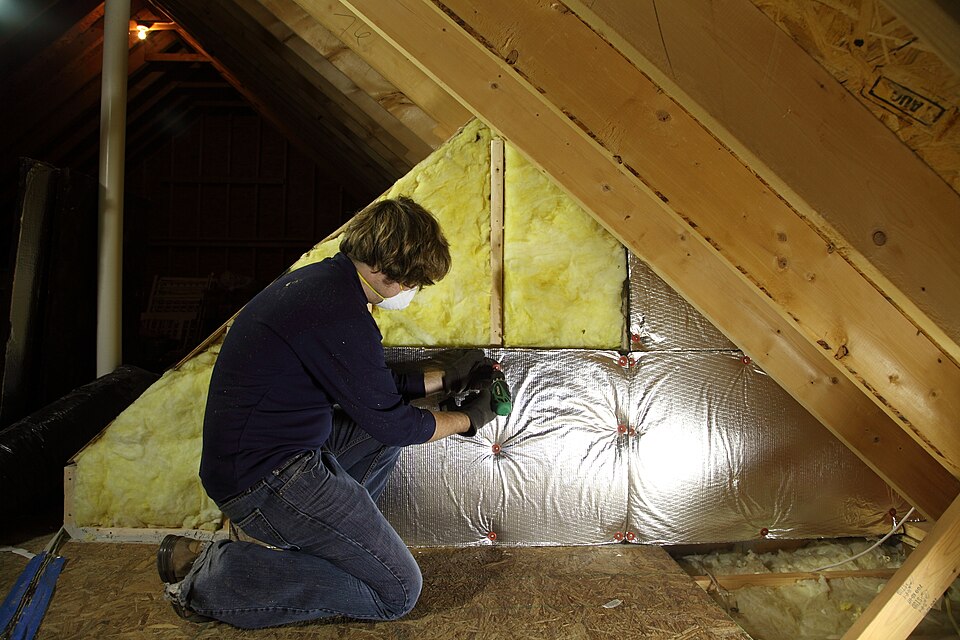
New window-unit ERVs are relatively low cost and take just minutes to install, making them accessible and affordable for homes and apartment units everywhere. Fixing air leaks, insulating roofs and basements, and installing ERVs are a way to significantly lower home emissions and energy bills without any electricity or critical minerals — by simply eliminating energy needs at the source.
When it comes to the energy we do need, we can get that at the source as well. President Jimmy Carter put solar panels on the White House back in 1978. But these panels didn’t generate electricity — they made heat. The panels heated water behind glass and distributed it to kitchens and buildings around the White House complex, a technology known as solar thermal. With 70 percent of our home energy use for heating and hot water, solar thermal is a critical technology, and it’s already in use worldwide.
Solar water heaters used to be commonplace in America, only falling out of favor around 2010 as solar electric panels started getting significantly cheaper. But more recently, as utilities have begun facing higher costs due to increased electrification, and as states like California have ended net metering incentives, we’ve seen a renewed demand for solar heat that doesn’t depend on grid power or battery storage. Since 2009, every new home in Hawaii has been built with a solar water heater, eliminating pollution and reducing grid strain while ensuring the availability of hot water during outages.
Living Energy Farm, a sustainable technology research center in central Virginia, has heated multiple off-grid buildings with solar thermal — without electricity or gas — for over ten years. “There’s a lot of solar collection going on here, but the bulk of it is not actually creating electricity,” explained Debbie Piesen, cofounder of Living Energy Farm, in a presentation. “It’s storing solar energy as heat.”
Arctica Solar, a California-based company, makes solar thermal products that enable you to harvest heat from your exterior walls. Originally designed to heat camps in Antarctica, Arctica’s “solar air heaters” simply draw cold air into a glass panel, use the sun’s heat to warm it, and send the heated air back into living spaces. Five of these panels, costing a total of $6,000, can provide 30,000 BTUs of heat per hour — almost the average amount of heat used by an American home. These solar thermal systems don’t depend on electricity, fuel, or hardly any moving parts. That means they take heat off your energy bill permanently, and ensure it’s always there.
In 2021, a winter storm swept across Texas, leaving 4.5 million homes and buildings without power and causing up to seven hundred deaths in the freezing temperatures. Solar thermal energy can prevent those disasters. One homeowner who installed Arctica’s panels in Billings, Montana, reported that when outside temperatures were 3 degrees Fahrenheit with eight inches of snow, Arctica’s panels kept indoor temperatures at 61 degrees Fahrenheit — higher than the average indoor temperature for Montana in that time of year.
Big picture, solar thermal has a number of benefits over electric-based heating. Solutions like Arctica’s solar air heaters are easy for general contractors to install. Perhaps more importantly, solar thermal is simple to produce. Unlike electric panels, which rely on complex circuitry and manufacturing, solar thermal primarily relies on glass and heat. Many people even make solar thermal panels themselves at home with off-the-shelf parts.
In terms of global decarbonization and transitions away from fossil fuels, solar thermal can be manufactured by any country, regardless of technological capacity. Many countries are already using it for heating and hot water needs. EU energy policy officer Jamie Kern reported seeing solar water heaters throughout Morocco — even connected to temporary structures such as tents.
Scott Sklar, director of the George Washington Solar Institute at The George Washington University, believes America should scale up solar thermal again as well. “This solar thermal panel added $5.40 to my renovation mortgage per month and saved me back then $20 per month,” Sklar said, on a tour of his net-zero home in the suburbs of Washington, DC “It’s absolutely cost-effective.”
As for our remaining electrical needs, we can meet them at lower cost and with materials right from home, too. Unlike typical rooftop solar installations, plug-in solar panels — rapidly rising in popularity — don’t feed power into the grid (which requires batteries to store that electricity) or into home batteries. Instead, they send power directly into your home’s circuits. Your appliances draw power from plug-in panels when the sun is shining and fall back to the grid when sunlight at your home isn’t enough. This simple solution is the cheapest, fastest, and most resilient way to get electricity to our homes — especially with more outages ahead due to extreme weather, rising power demand, and the advent of data centers.
New Cool Technologies
The most difficult question for decarbonizing our buildings is: How do we stay cool? Air conditioning isn’t sufficient. In 2024, widespread power outages hit the Mediterranean during a summer heatwave, due to all of the homes running AC units in the extreme heat. The outage left residents even more vulnerable in hotter temperatures. This is a preview of what’s to come across all our regions as temperatures rise — and it illustrates why low-power cooling, independent of the electric grid, is so important.
Insulation and ERVs cool buildings at the source. Other low-power technologies — from white curtains and window overhangs, to whole-house fans and solar attic vent fans that flush out hot air, to green spaces and trees that provide shade and evaporative cooling as they “sweat” — all help cool buildings as well, with minimal electricity required.
Beyond this baseline, how we cool buildings in a resilient, emissions-free way remains an open question. The American Geophysical Union headquarters in Washington, DC, a global leader in zero-energy design, offers one solution: overhead radiant cooling panels that use chilled water above the panels to draw heat from the air below.
Andrew Lowenstein, who has worked on radiant cooling panels with advanced teams at Princeton and the University of Pennsylvania, views “liquid desiccation” as another approach. This technology dehumidifies the air, which reduces the energy air conditioners need to expend for cooling.
Another solution, from Peng Wang at Sun Yat-sen University in China, is called NESCOD, or No Electricity and Sustainable Cooling on Demand. NESCOD utilizes a chemical solution dissolved in water to pull heat from the surrounding air. The cycle is recharged by adding solar thermal heat to the solution, rather than electricity, making it well-suited for hot temperatures, with no electricity or batteries required.
Still, more work is needed to make these cooling approaches accessible for everyday homes and buildings so we can begin to decarbonize this sector with the materials on hand today.
Fewer Cars, Better Cities
The last sector constrained by critical-mineral challenges is transportation — specifically, our cars. Car-dependent transportation makes up 26 percent of greenhouse gas emissions. But the cheapest, fastest, and most sustainable and resilient way to decarbonize cars isn’t just making all of them electric. It’s ensuring that we need far fewer cars in the first place.
Washington State representatives voted 94-2 earlier this year to allow all homes to offer shops, services, and businesses. After a state senator chose not to schedule the widely popular bill for a Senate vote, Washington municipalities began advancing neighborhood retail laws directly. This will make Washington neighborhoods more walkable, with everything from groceries to childcare to cafés and repair clinics potentially available within residential areas.
In addition to lowering emissions, these laws will support affordability. One of the highest costs for local businesses is fixed commercial rental leases. The new laws emerging in Washington — following the example of Nashville, Buffalo, and communities around the world — will allow people to operate shops and services from their homes without paying additional rent and to pass those savings on to customers.
From insulation to new heating and cooling technology to shops and services in our neighborhoods, these are the fastest, most sustainable, and most cost-effective ways to decarbonize our homes and buildings. The sectors these approaches target — buildings and transportation — account for more than half of global emissions, and they don’t require us to wait for new technologies or production to ramp up.
All of these interventions are based on technologies we have available today, and we can scale them up without the critical minerals, deep-sea mining, or delays that we and future generations cannot afford.
This work has been made possible by the support of the Puffin Foundation.
ZNetwork is funded solely through the generosity of its readers.
Donate